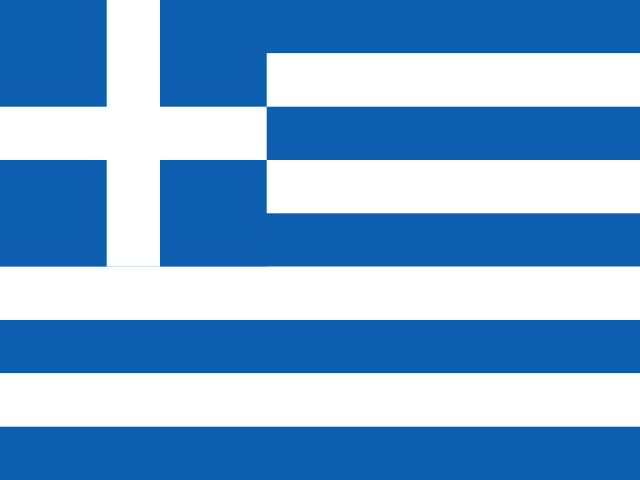
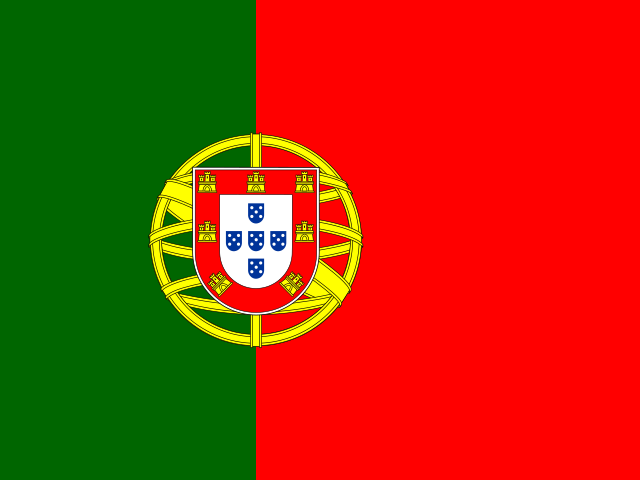
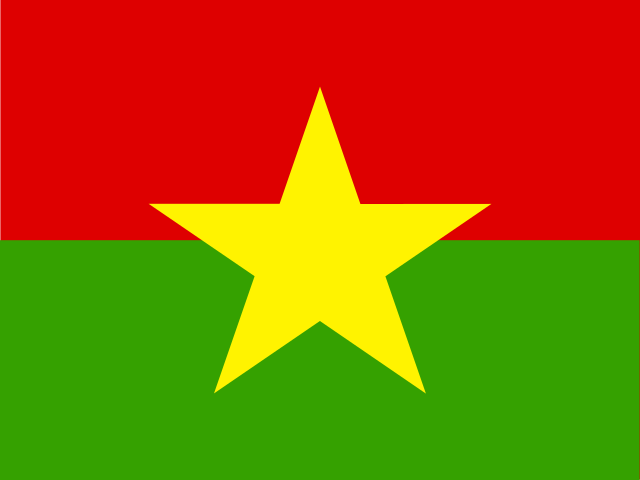
 Burkina Faso
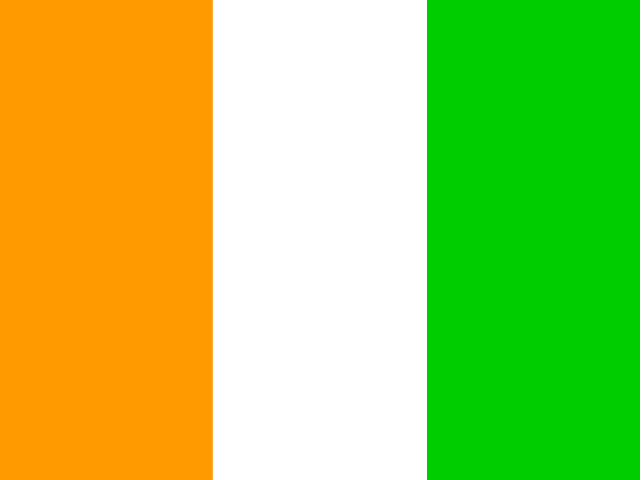 Ivory Coast
 Togo
TogoPortuguese sailors reach the Gold Coast
Portuguese ships reached this coast in 1471 and found people trading gold, which the Akan states inland had long sold northwards across the Sahara. Europeans soon called the land the Gold Coast.
A free large-print PDF. Choose what goes in: facts, map, history, dishes and recipes, phrases, fun facts, a quiz with or without answers. Made for clubs, care homes, libraries and family afternoons.
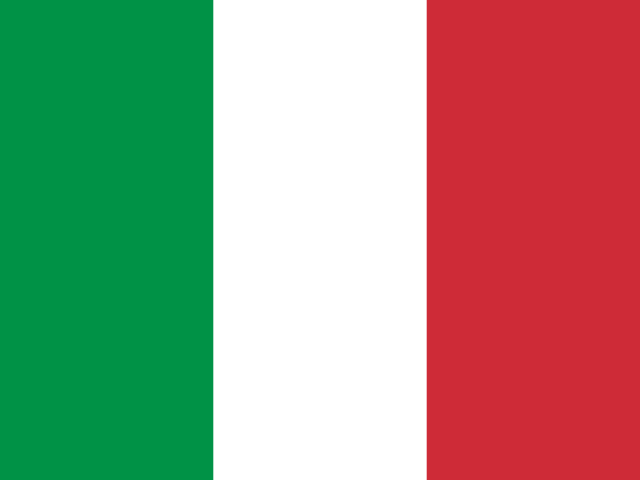
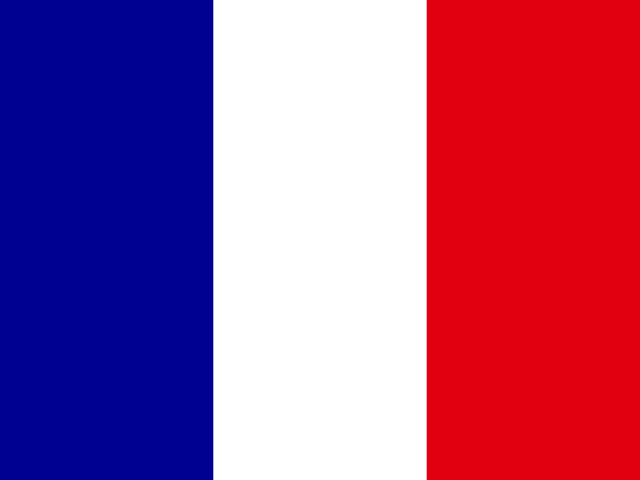
Ghana lies in West Africa on the Gulf of Guinea, a few degrees north of the equator, between Ivory Coast, Burkina Faso and Togo. Low coastal plains with sandy beaches and fishing villages rise to forested hills in the centre and dry savanna in the north. The Volta River and its tributaries drain most of the country into Lake Volta, the huge reservoir behind the Akosombo Dam, and the Prime Meridian passes through the port city of Tema, near Accra.
Powerful kingdoms grew here long before Europeans arrived: Bonoman in the forest, Dagbon in the north and later the Asante Empire, ruled from Kumasi. Portuguese ships came in 1471 looking for gold, and Europeans named the land the Gold Coast. Over the next four centuries more than 30 forts and castles were built along the shore, first for the gold trade and then for the Atlantic slave trade. Britain made the coast a colony in 1874. On 6 March 1957, led by Kwame Nkrumah, the Gold Coast became independent as Ghana, one of the first countries in sub-Saharan Africa to win independence from colonial rule, and took its name from the ancient Ghana Empire.
Today Ghana is a democracy of about 35 million people (2025 estimate). The Akan are the largest group, followed by the Mole-Dagbani, Ewe and Ga-Dangme peoples. English is the official language, but most Ghanaians also speak Twi or another local language. Most people are Christian and almost a fifth are Muslim. Ghana is one of the world's biggest cocoa growers and a large producer of gold, and it is known for kente cloth, highlife music, its footballers and a warm welcome, summed up in one word: akwaaba.
The kingdoms of Bonoman and Dagbon grew up in the forest and the savanna centuries ago, and in 1701 the Asante formed a union that became one of the strongest states in West Africa. From 1471 Portuguese, then Dutch, English, Danish, Swedish and German traders built forts along the coast, first for gold and then for the Atlantic slave trade. Britain took control in the 19th century after long wars with the Asante. In 1957 the Gold Coast became independent Ghana, and after years of coups it has been a stable multiparty democracy since 1992.
Portuguese ships reached this coast in 1471 and found people trading gold, which the Akan states inland had long sold northwards across the Sahara. Europeans soon called the land the Gold Coast.
Sent by King John II of Portugal, Diogo de Azambuja began the castle of São Jorge da Mina at Elmina in 1482. It was the first European trading post on the Gulf of Guinea and is the oldest European building still standing in sub-Saharan Africa.
The Dutch West India Company seized Elmina Castle from the Portuguese in 1637 and took the rest of the Portuguese Gold Coast in 1642. English, Danish, Swedish and German traders followed, and more than 30 forts and castles rose along the shore, trading first in gold and then in enslaved people.
Osei Tutu and his priest Okomfo Anokye led a union of Asante states against their overlord, Denkyira, and defeated it at the Battle of Feyiase in 1701. Kumasi became the capital and Osei Tutu the first Asantehene. Legend says the Golden Stool came down from the sky to seal the union.
Worried by Asante attacks, Fante chiefs on the coast signed the Bond of 1844, which let British officials try serious crimes such as murder and robbery. More than a century later, Ghana's independence day was set on its 113th anniversary.
The Dutch sold their forts to Britain in 1872. After a British army took and burned Kumasi in the war of 1873 to 1874, Britain proclaimed the Gold Coast Colony on 24 July 1874. Accra became the capital in 1877.
In 1900 the British governor demanded to sit on the Golden Stool, the sacred symbol of the Asante nation. Yaa Asantewaa, the Queen Mother of Ejisu, led an uprising. The British won and made Asante part of the colony in 1902, but the stool itself was never handed over.
On 28 February 1948 police fired on a peaceful march of former soldiers who had fought for Britain in the Second World War and were asking for their promised pensions. Three were killed, and days of riots followed. The shooting became a turning point on the road to independence.
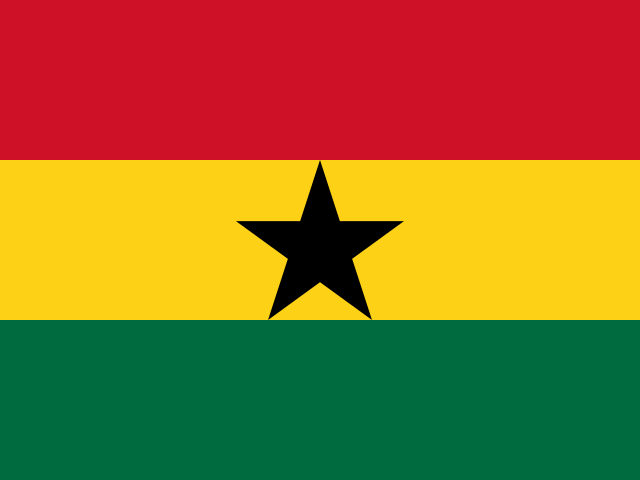
At midnight on 6 March 1957 the Gold Coast, Ashanti, the Northern Territories and British Togoland became one independent country named Ghana, with Kwame Nkrumah as prime minister. The new red, gold and green flag carried a black star.
On 1 July 1960 Ghana became a republic with Kwame Nkrumah as its first president. The day is still marked as Republic Day.
The dam across the Volta River at Akosombo was completed in 1965 to power an aluminium smelter and the country. Its reservoir, Lake Volta, flooded 740 villages, and about 78,000 people had to move to new towns.
On 24 February 1966, while Nkrumah was abroad on a visit to China, the army took power. Military and civilian governments then alternated for more than 25 years.
On 28 April 1992 voters approved a new constitution in a referendum, bringing back multiparty elections. The Fourth Republic began on 7 January 1993, and since then presidents have been elected for four-year terms, with a limit of two terms.
Kofi Annan, born in Kumasi in 1938, became Secretary-General of the United Nations in 1997, the first to be chosen from the UN's own staff. He served until 2006 and shared the Nobel Peace Prize with the UN in 2001.
Ghana invited people of African descent around the world to visit in 2019, 400 years after the first enslaved Africans landed in the English colony of Virginia in 1619. Many visitors came to the castles of Cape Coast and Elmina.
A Ghanaian meal is built around a filling starch, such as fufu, banku, kenkey, rice or boiled yam, served with a soup or stew and some fish or meat. Soups are the main course, not a starter. Tomatoes, hot peppers and onions are the base of most sauces, so jollof, soups and stews are often red or orange. The south eats more cassava and plantain, while the drier north grows millet, sorghum and maize. Breakfast is often porridge with bean fritters or bread, and street food, from kelewele to waakye, is sold everywhere.
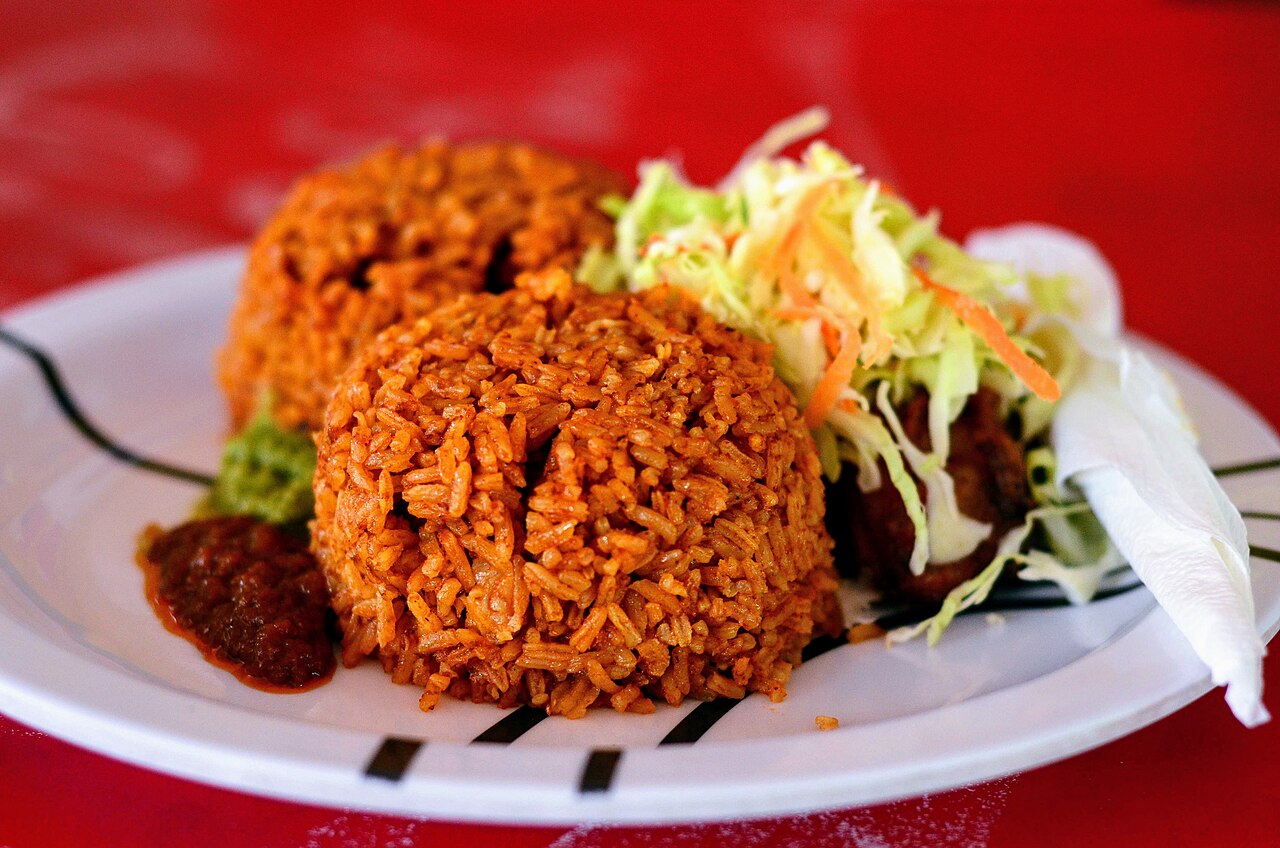
Rice cooked in a rich sauce of tomatoes, peppers, onions, ginger and garlic until every grain turns orange-red. Ghanaian cooks often use fragrant jasmine rice. It is served at parties and family gatherings with chicken, goat or beef, fried plantain, salad and a spoonful of shito.
Ghana and Nigeria each say they make the best jollof, a friendly contest known as the 'Jollof wars'. World Jollof Day has been celebrated on 22 August since 2015.
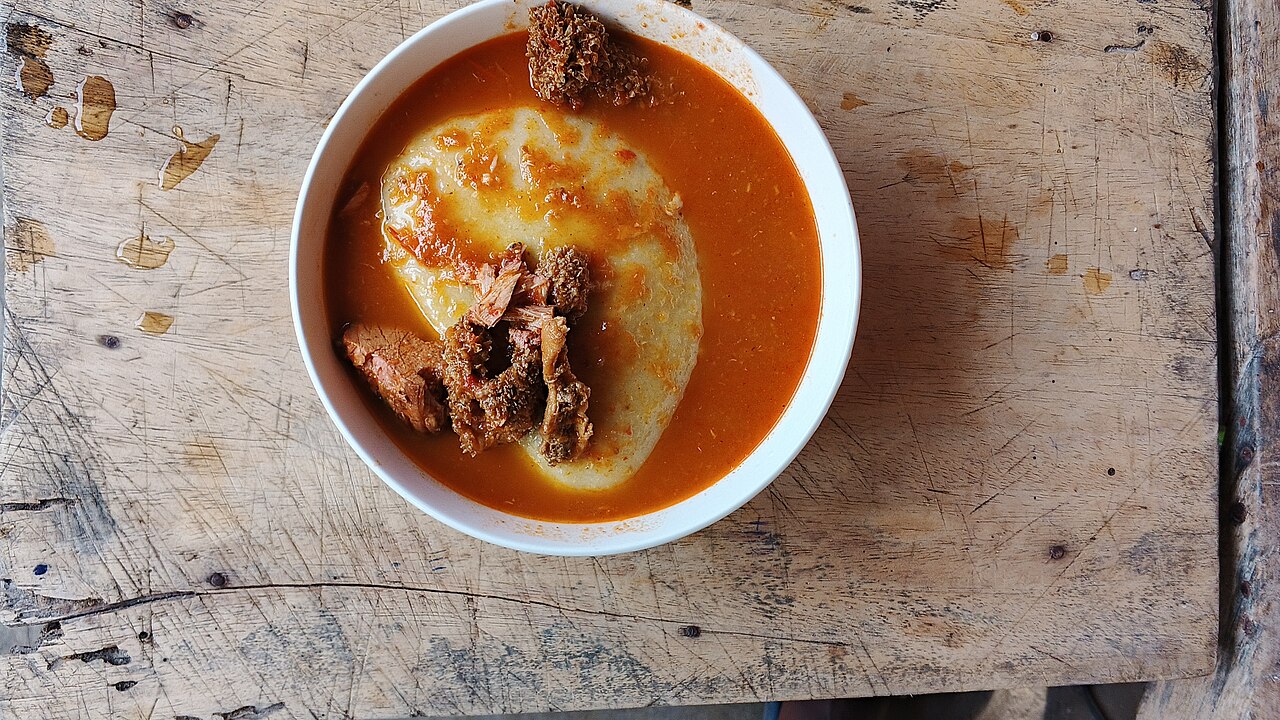
Boiled cassava pounded with green plantain, or sometimes cocoyam or yam, into a soft, smooth, stretchy dough. It is pounded in a wooden mortar with a long pestle, and between blows the dough is turned by hand. Fufu is served in a bowl of soup, such as light soup, palm nut soup or groundnut soup, and eaten with the fingers.
The word fufu comes from Twi, and it is now used for similar pounded foods from Sierra Leone to Angola. Many families today use a fufu machine instead of pounding by hand.
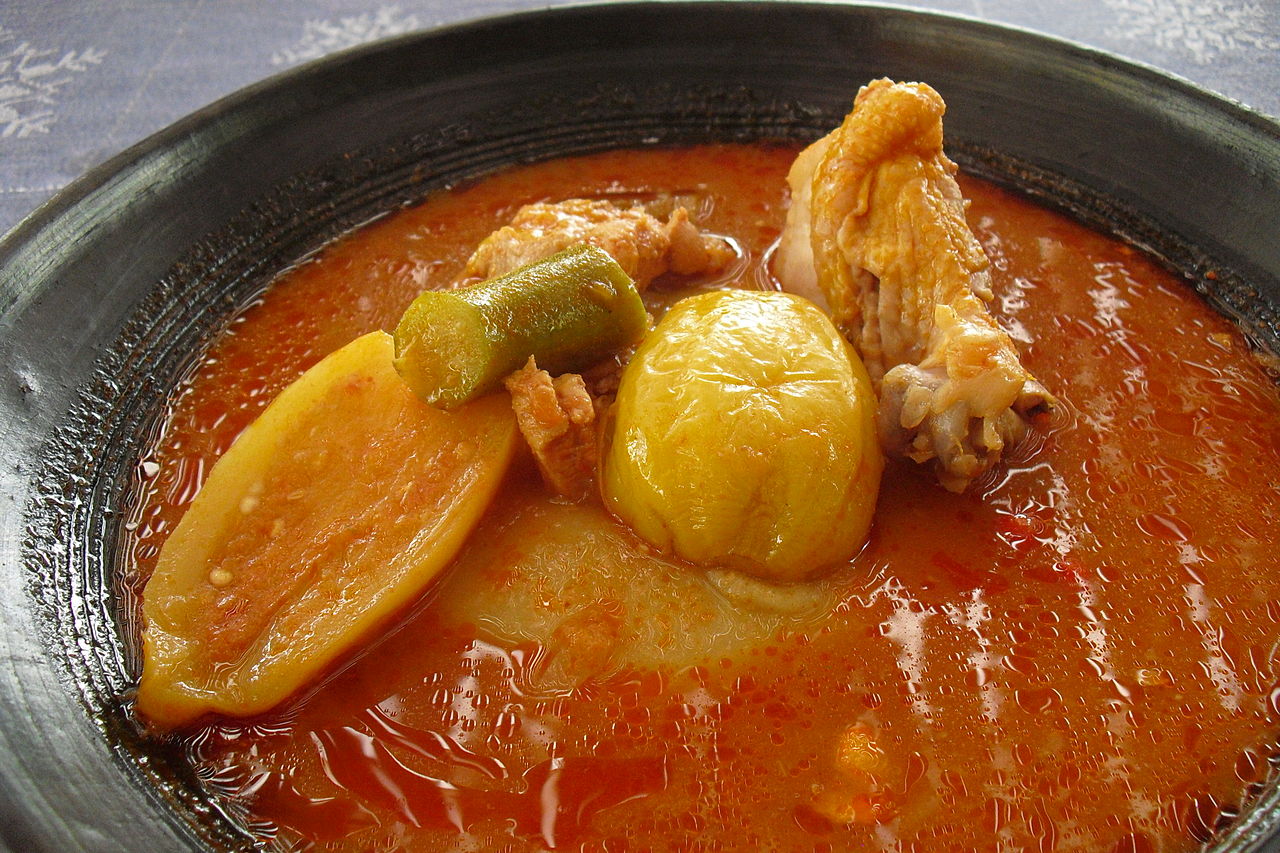
A thin, spicy soup of tomatoes, onions, hot pepper, ginger and garden eggs (small African aubergines), cooked with goat, chicken or fish. It is called 'light' because the broth is thin. It is most often eaten with fufu, banku or rice balls.
It began as a tomato and seafood soup made for fishermen on the coast near Accra, and only later became a meat soup too.
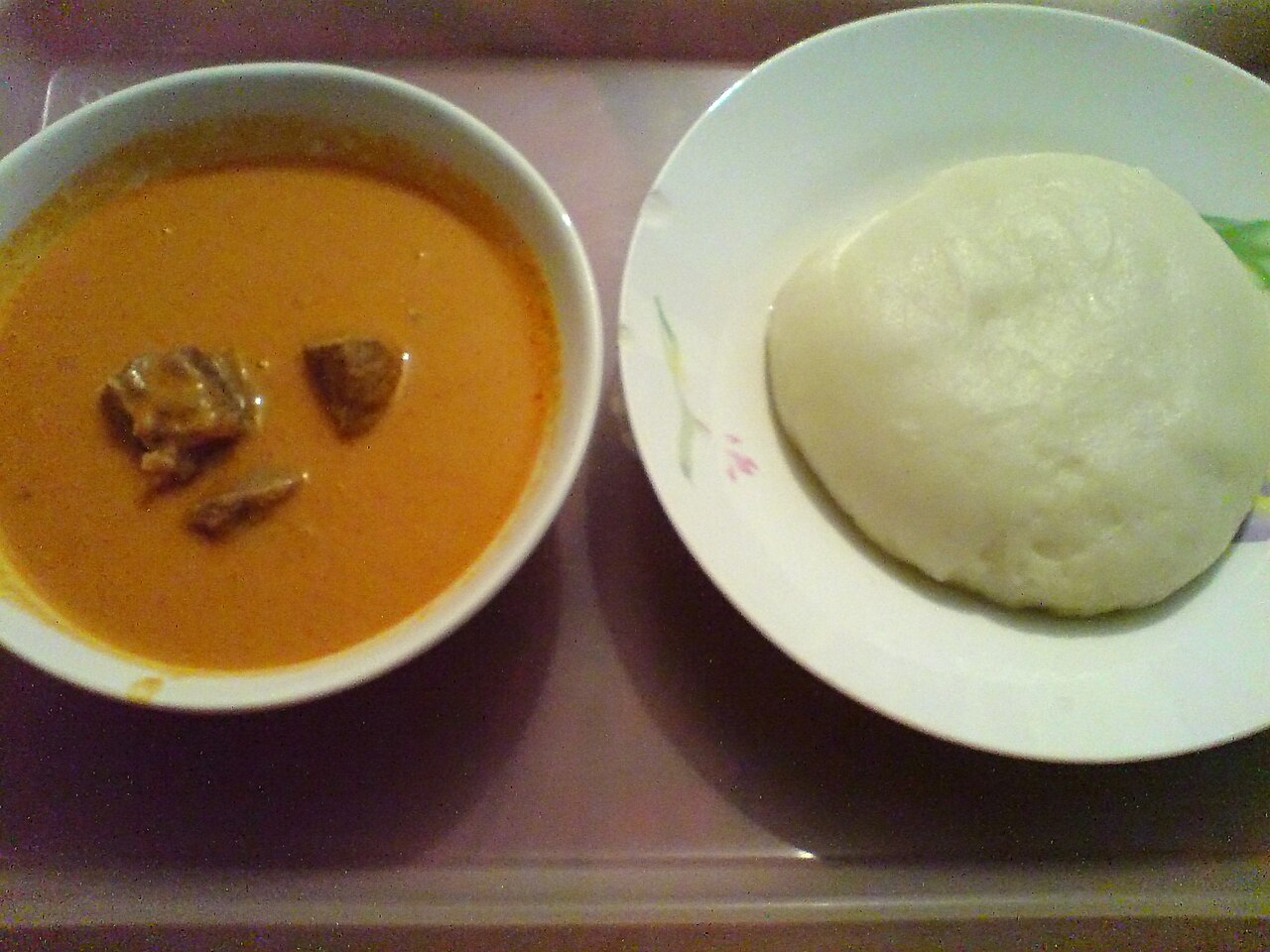
A creamy, spicy soup made with ground peanuts, tomatoes and pepper, usually with chicken or goat. It is eaten with fufu, rice balls (omo tuo) or banku.
In Twi it is called nkatenkwan; nkwan means 'soup', and the word ends many soup names, such as abenkwan for palm nut soup.
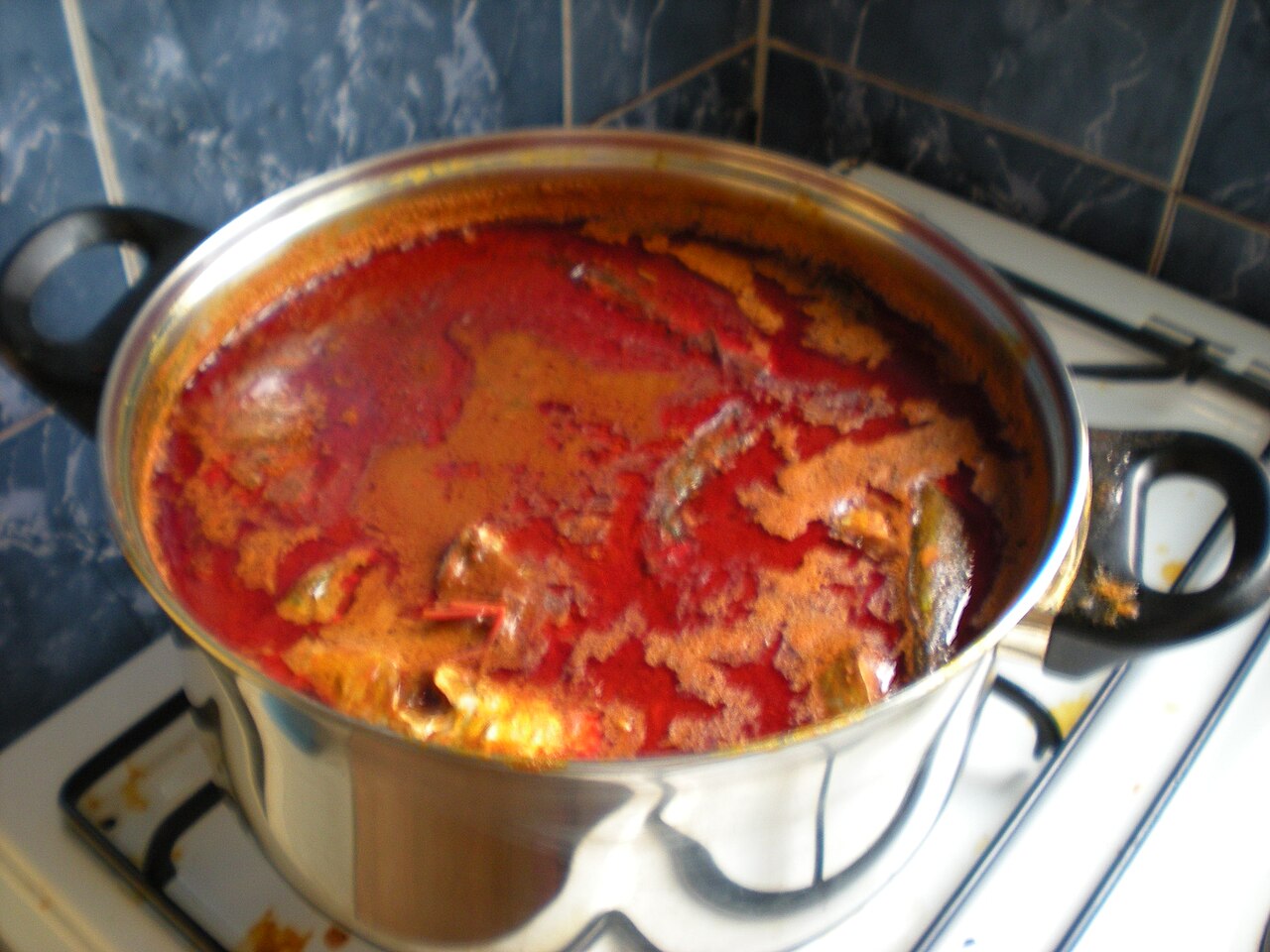
A rich orange-red soup made from the pulp of boiled palm fruits, cooked with meat, smoked fish, crab or snails, tomatoes, onions and pepper. It is served with fufu or rice balls.
Palm nut soups are eaten from Sierra Leone to Congo; in Nigeria a similar soup is called banga.
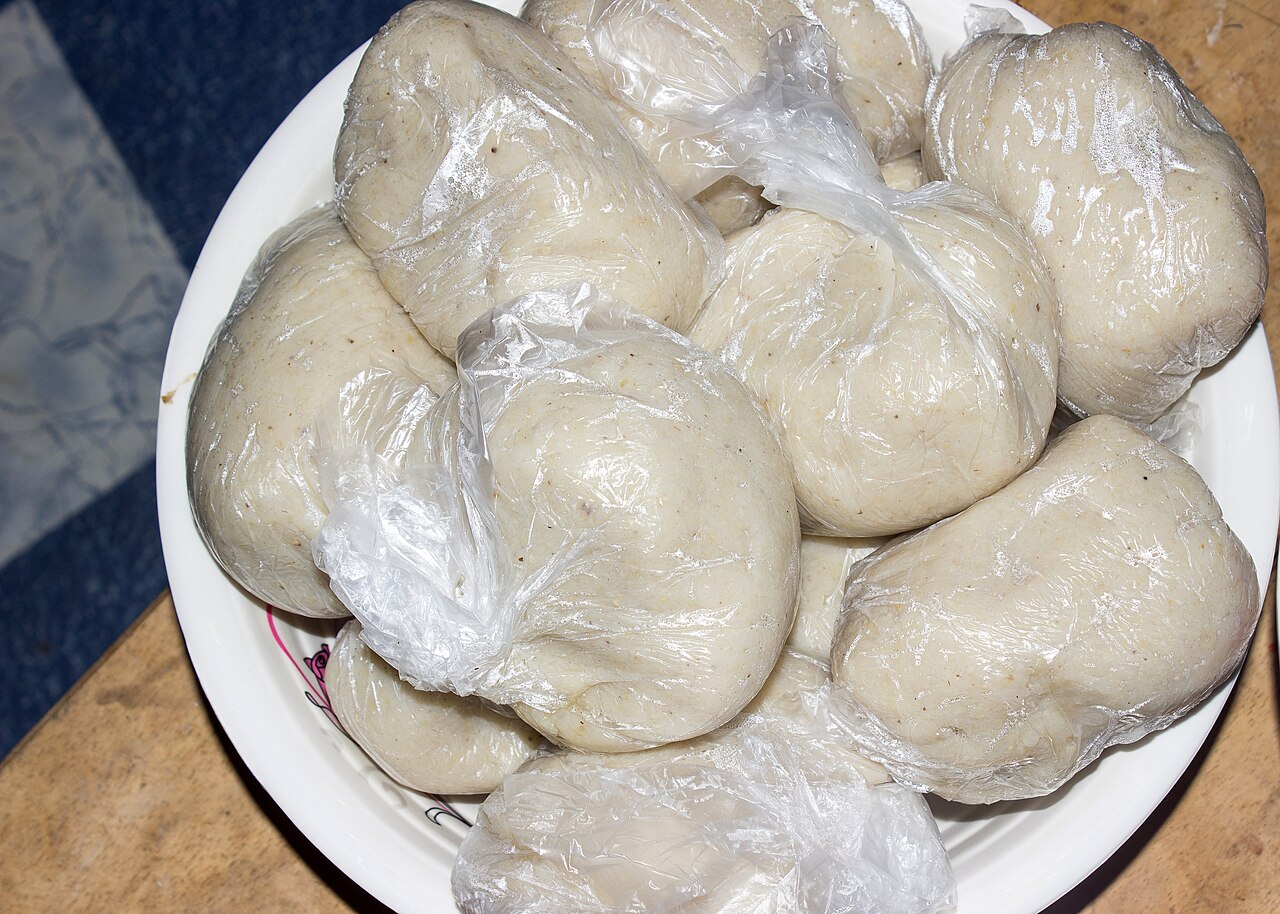
A mixture of fermented corn dough and cassava dough, cooked and stirred hard in a pot until it becomes a smooth, slightly sour ball. Banku with grilled tilapia and a fresh hot pepper sauce is a classic pairing served in many restaurants. It is also eaten with okra soup or light soup.
The name comes from the Dangme words 'ba mi ku', meaning food kept in leaves, because banku was once stored wrapped in leaves.
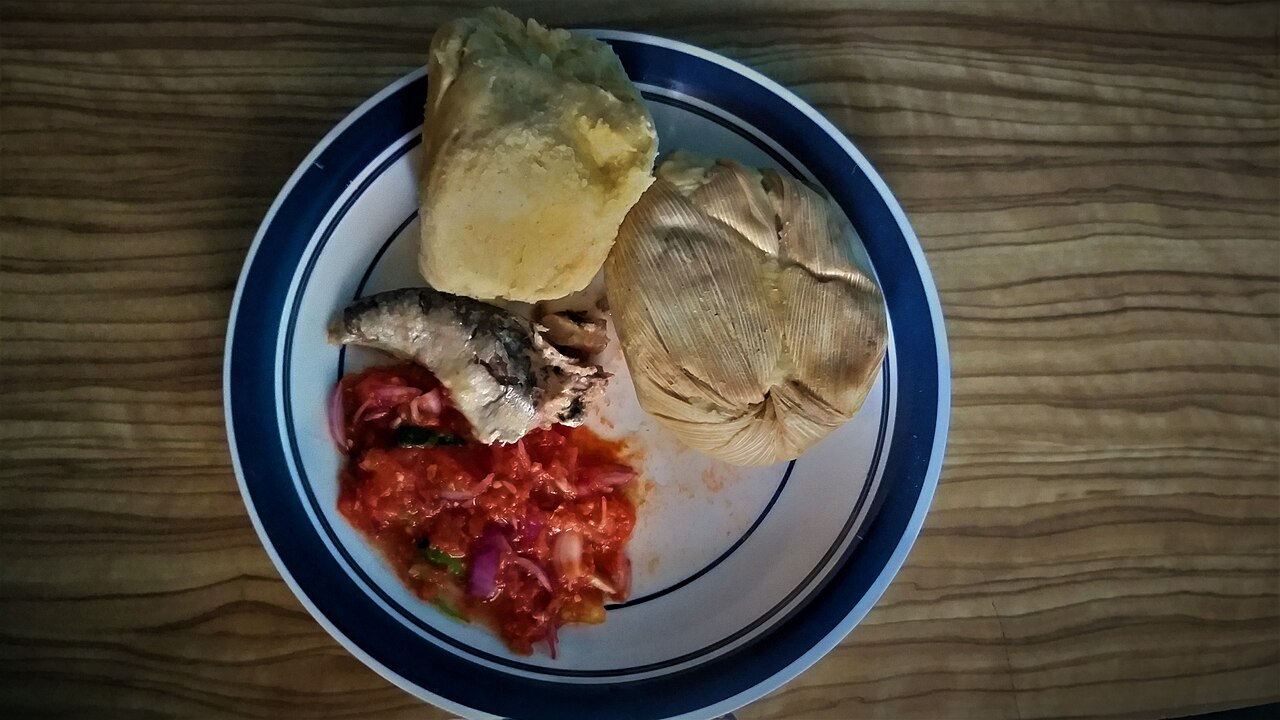
Maize soaked, ground and left to ferment for several days, then partly cooked, wrapped and boiled into firm, tangy dumplings. Ga kenkey is wrapped in maize husks, while Fante kenkey is wrapped in plantain leaves. It is eaten with fried fish, a raw pepper sauce and shito.
In Jamaica a sweet dumpling wrapped in banana leaf is called duckunoo, one of several Caribbean names that echo the Akan word dokono.
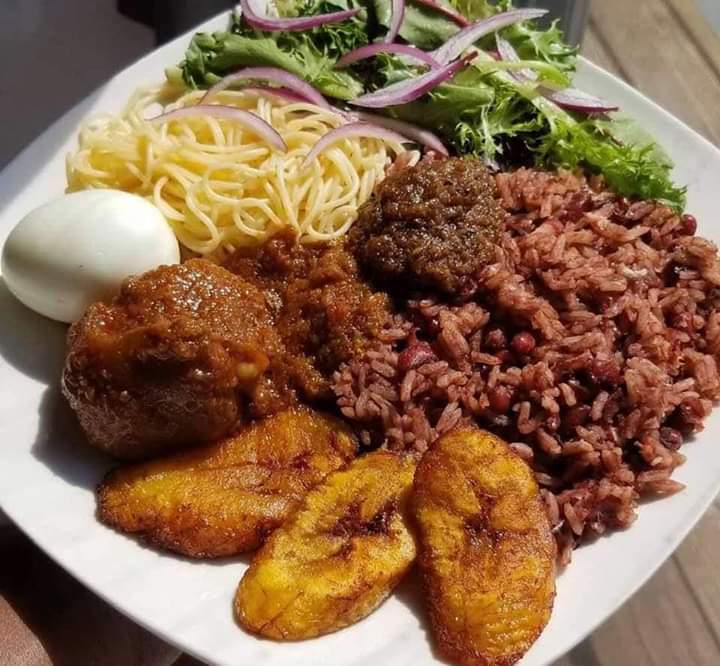
Rice and beans, usually black-eyed peas, cooked together with dried sorghum leaves, which give the dish its reddish-brown colour and are taken out before serving. It is a favourite breakfast or lunch, sold at roadside stalls wrapped in a leaf, with gari, shito, boiled eggs, fried plantain and even spaghetti, which Ghanaians call talia.
The name comes from Dagbani, a language of northern Ghana, where it means a kind of bean.
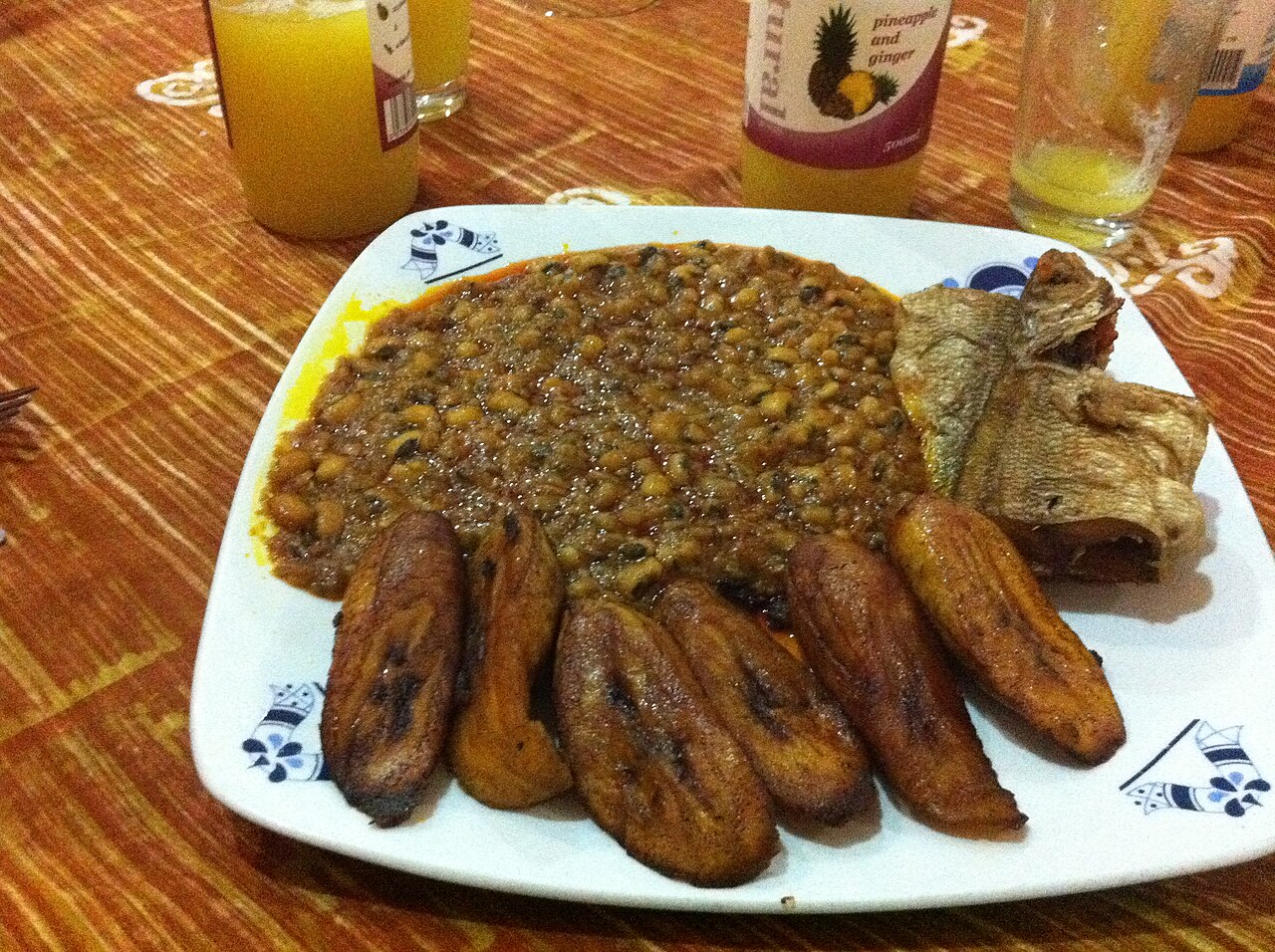
A stew of black-eyed beans cooked in red palm oil with onions, tomatoes and pepper, often with tinned mackerel or sardines, and served with fried ripe plantain. The name comes from the red of the palm oil and the orange of the plantain. It can easily be made without fish.
Many people sprinkle gari, dry grains of roasted cassava, over the beans for crunch.
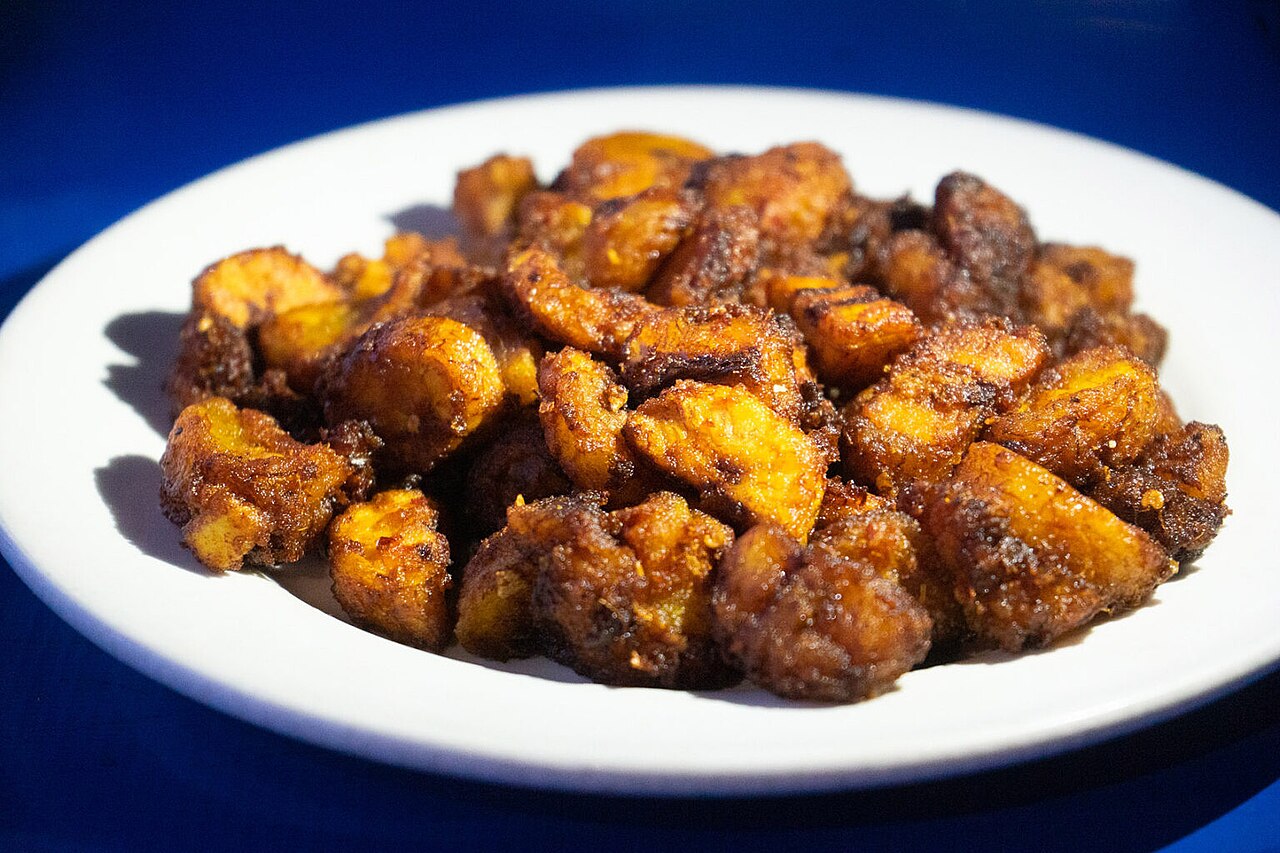
Cubes of ripe plantain tossed with ginger, hot pepper and salt, then fried until the edges caramelise. In Accra it is sold in the evening by street vendors, often with a handful of roasted peanuts, and it is also eaten as a side dish with red red.
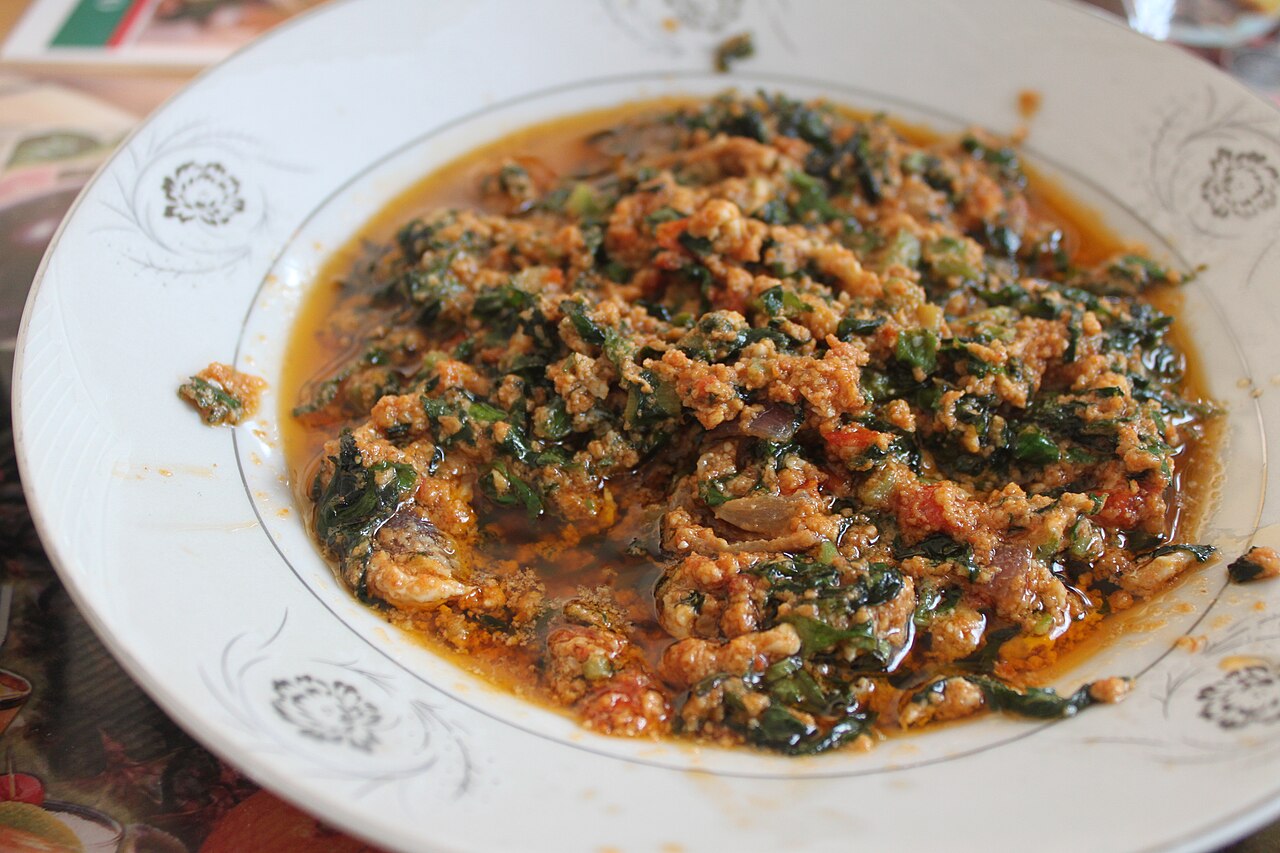
A green stew of chopped cocoyam leaves cooked in palm oil with onions, pepper and smoked fish, often thickened with ground egusi (agushi) seeds. It is eaten with ampesi: boiled yam, plantain or cocoyam.
Across West Africa similar leaf stews are called palaver sauce. 'Palaver' comes from the Portuguese word for 'word' or 'talk'.
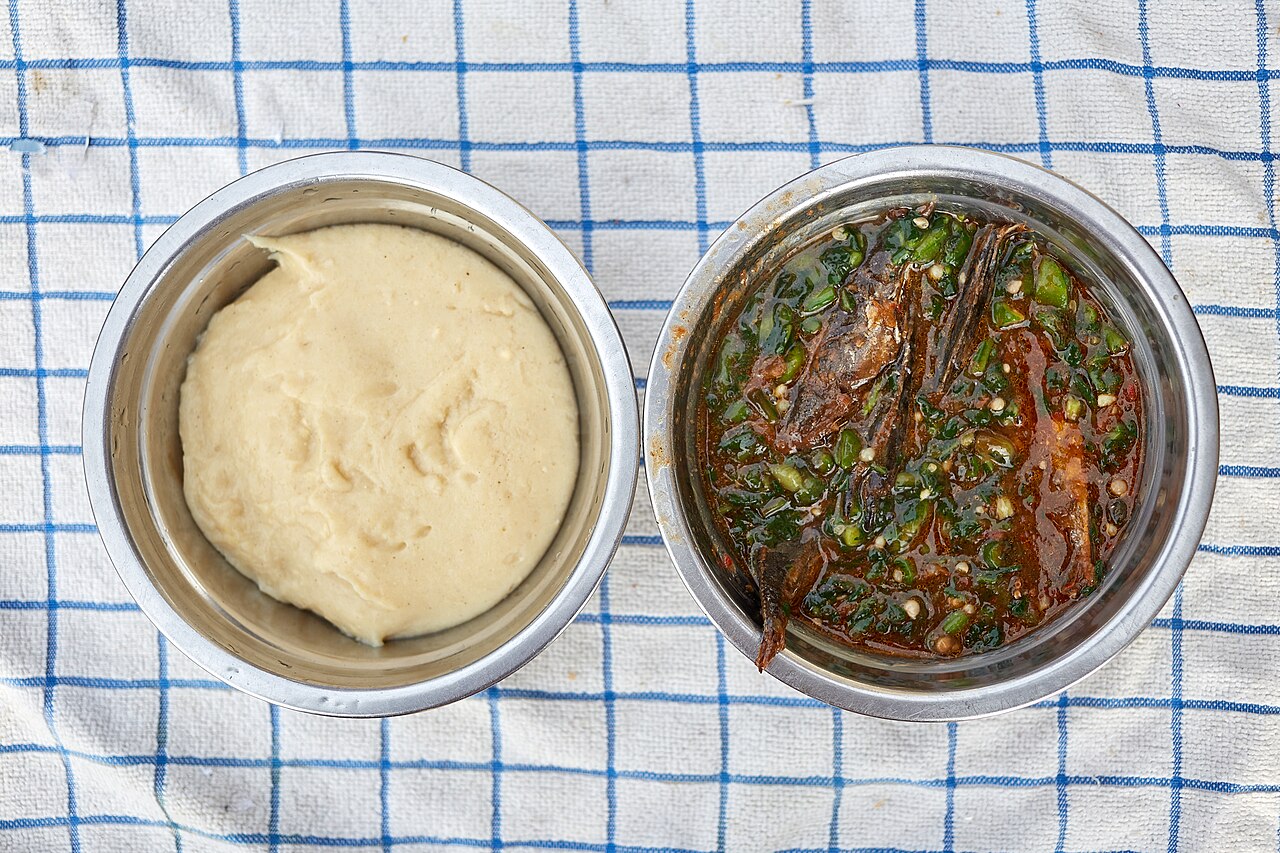
A smooth, firm porridge of maize flour, or millet or sorghum flour, cooked in water and served in soft mounds. It is the everyday staple of the north, eaten with a green leaf soup called ayoyo or with okra soup and meat or fish.
The 'tuo' in its name comes from tuwo, the Hausa word for this kind of stiff porridge.
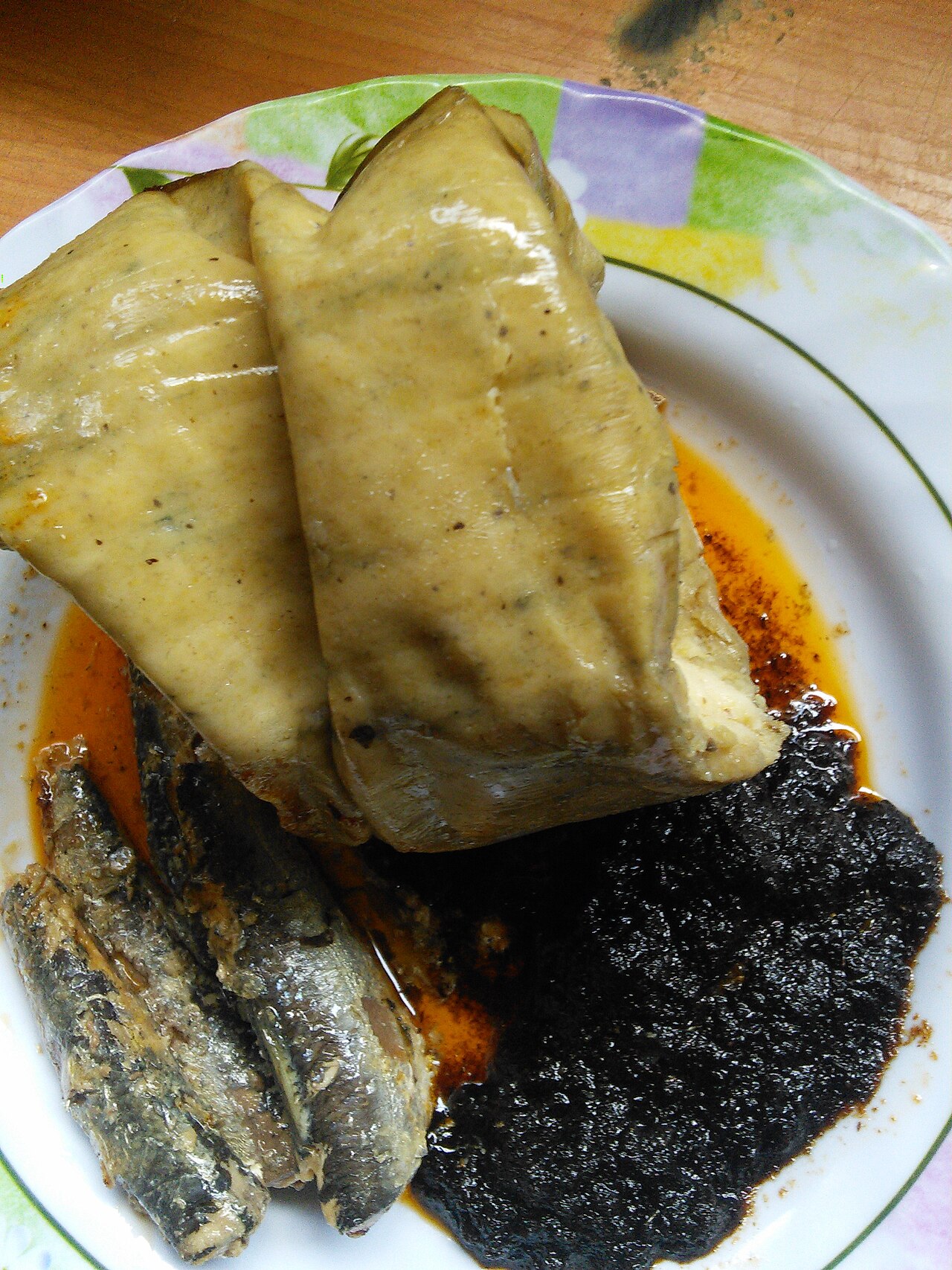
A dark, hot pepper sauce of dried fish, dried shrimp, ginger, garlic and chilli, slowly fried in oil for about an hour. Recipes differ from village to village, and it is found everywhere. It goes with kenkey, waakye, rice, jollof and even bread.
The name means 'pepper' in the Ga language; its full name, shitor din, means 'black pepper'.
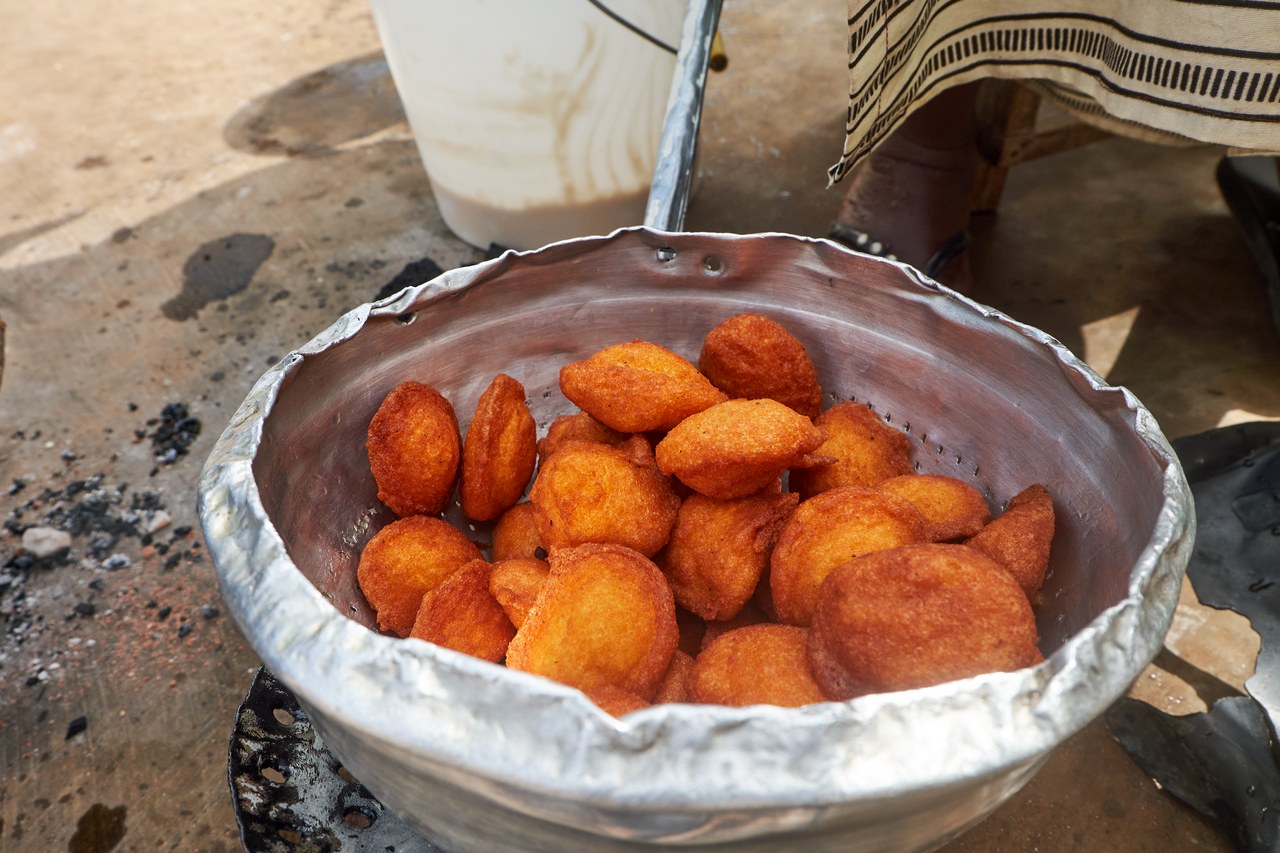
Small, crisp fritters of ground black-eyed peas with onion and hot pepper, fried in oil. They are a favourite breakfast with a bowl of Hausa koko, a spiced millet porridge, or tucked into a piece of bread.
The same kind of fritter is called akara in Nigeria and acarajé in Brazil.
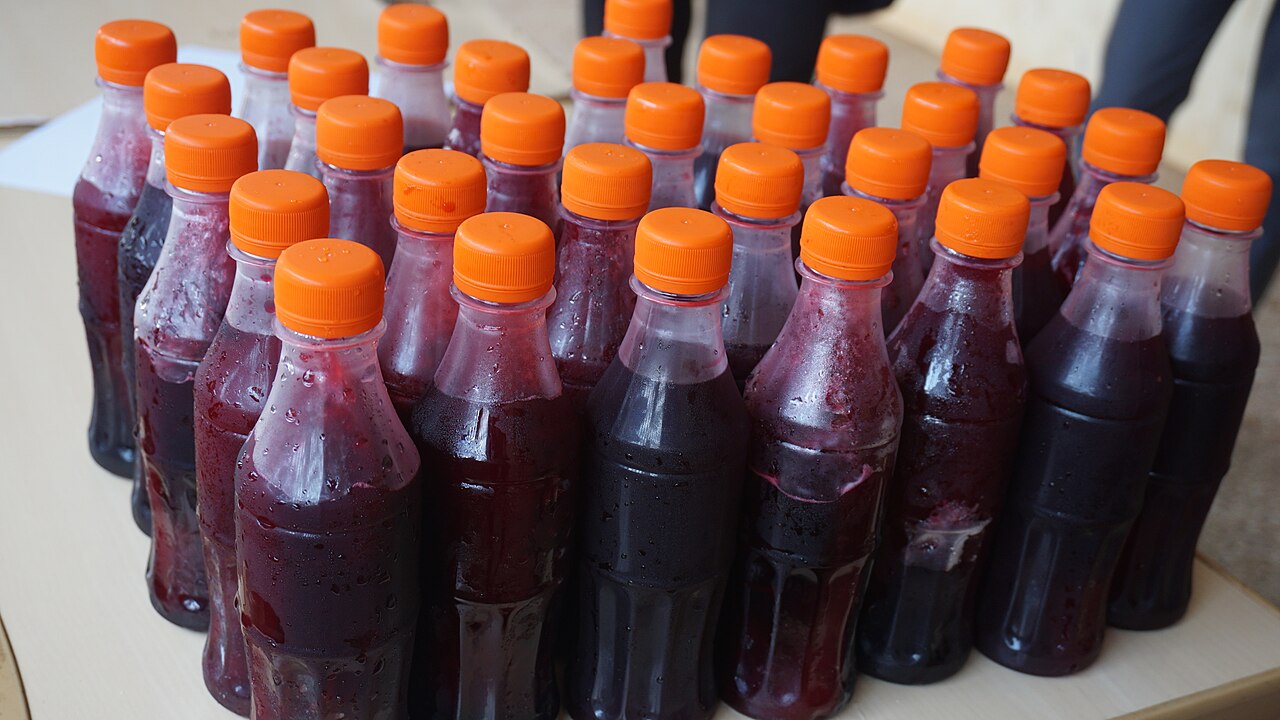
A deep red drink made by boiling dried hibiscus flowers with ginger and cloves, then sweetening and chilling it. It tastes a little like cranberry juice and is usually served cold.
The same drink is called bissap in Senegal and Burkina Faso and zobo in Nigeria.
Most Ghanaians live in the south: around Accra and the port of Tema, in the forest belt around Kumasi, and in the old towns along the coast. Tamale is the great city of the north. Each of Ghana's 16 regions has its own capital, and several of them, from Cape Coast to Ho, were once capitals of colonial territories.
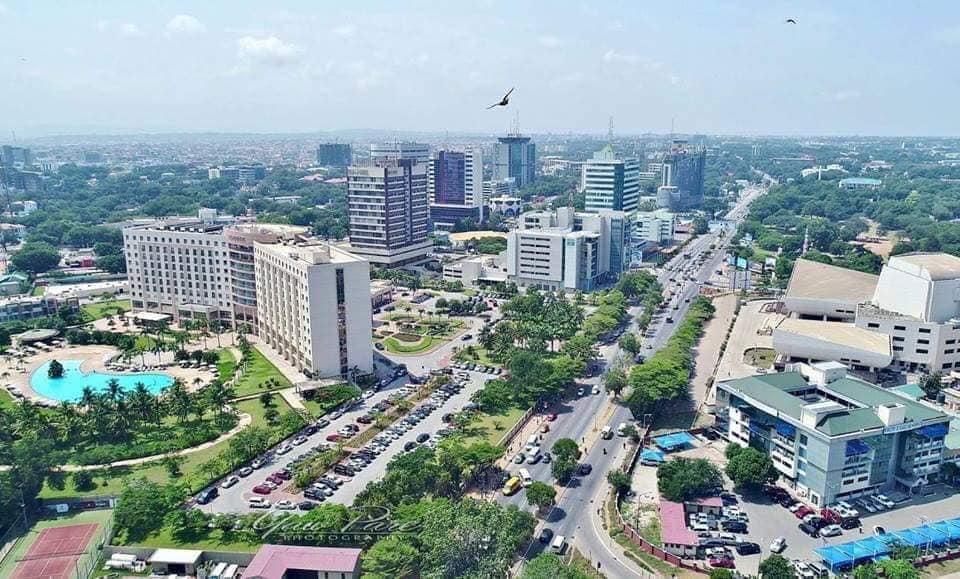
The capital and largest city. It grew from three towns built around a British, a Dutch and a Danish fort, and it has been the capital since 1877. More than 5 million people lived in the Greater Accra Region at the 2021 census, making it the country's centre of government and business.
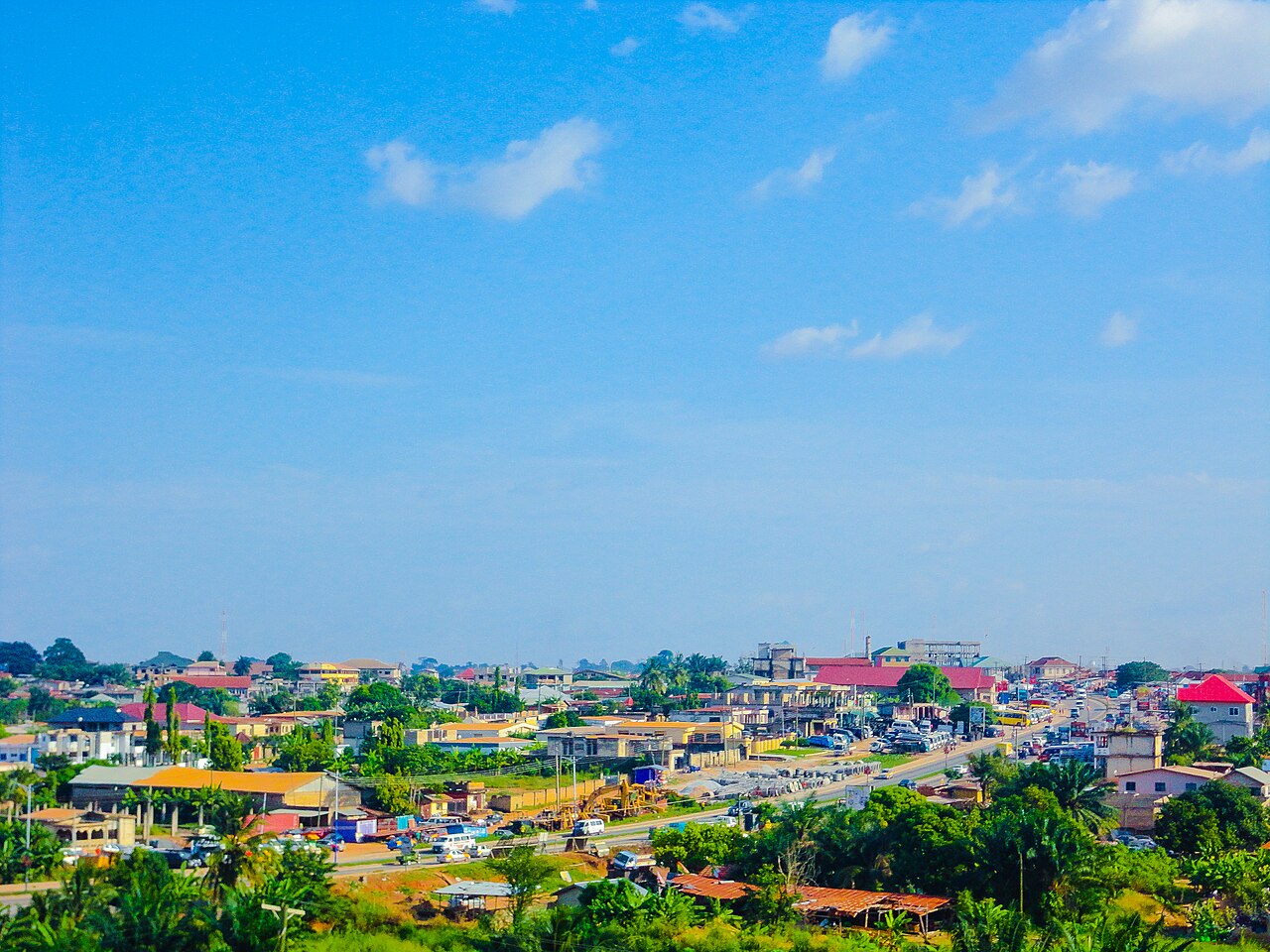
Ghana's second largest city, founded in the late 1600s as the capital of the Asante kingdom. The Asantehene, the king of the Asante, still lives here, and the city is the heart of Asante culture. It is called the Garden City and is a great trading centre.
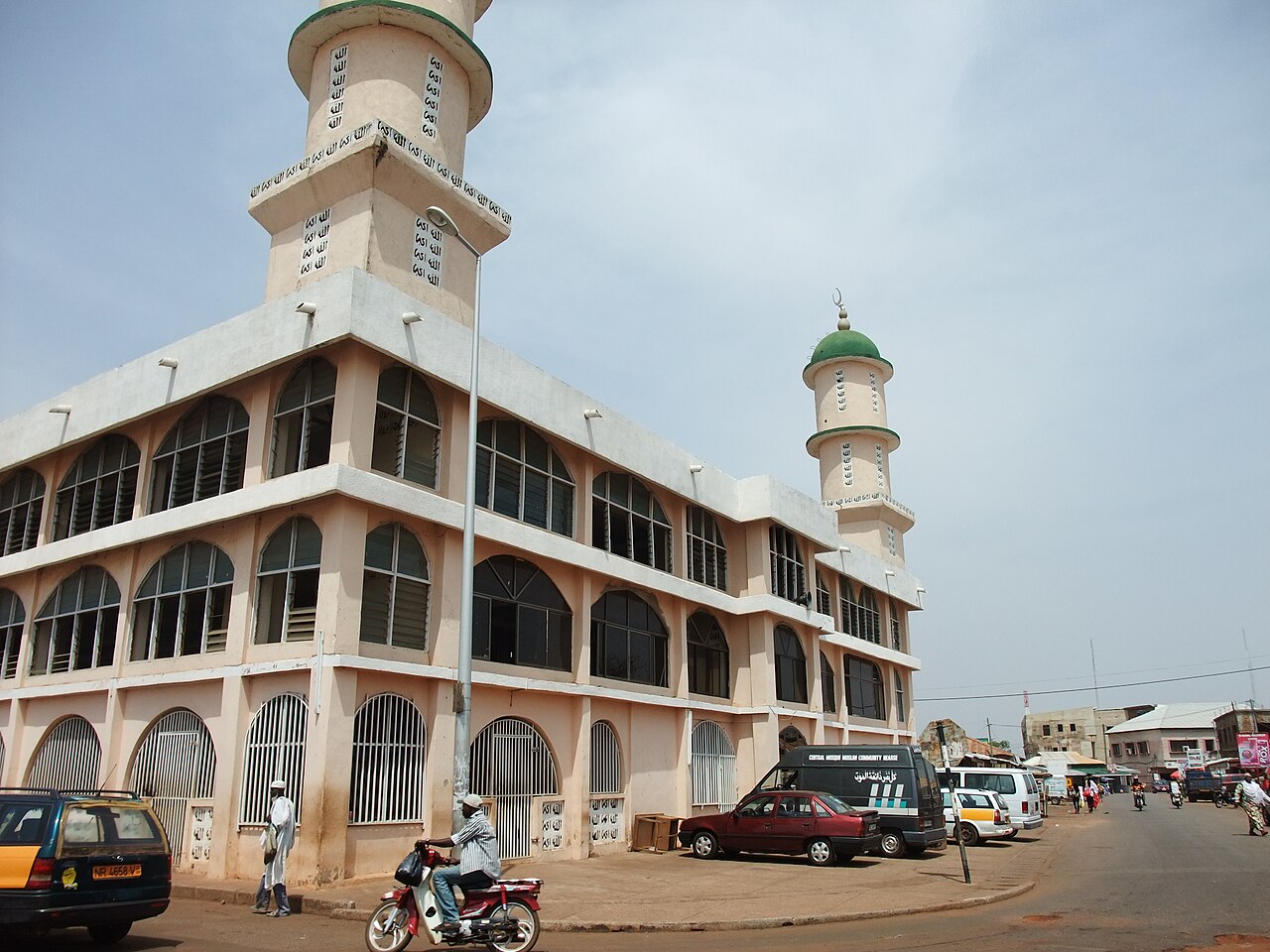
Ghana's third largest city and the capital of the Northern Region since 1960. It grew from small villages of the kingdom of Dagbon after the British set up offices here in 1907, and it is one of the fastest growing cities in West Africa.
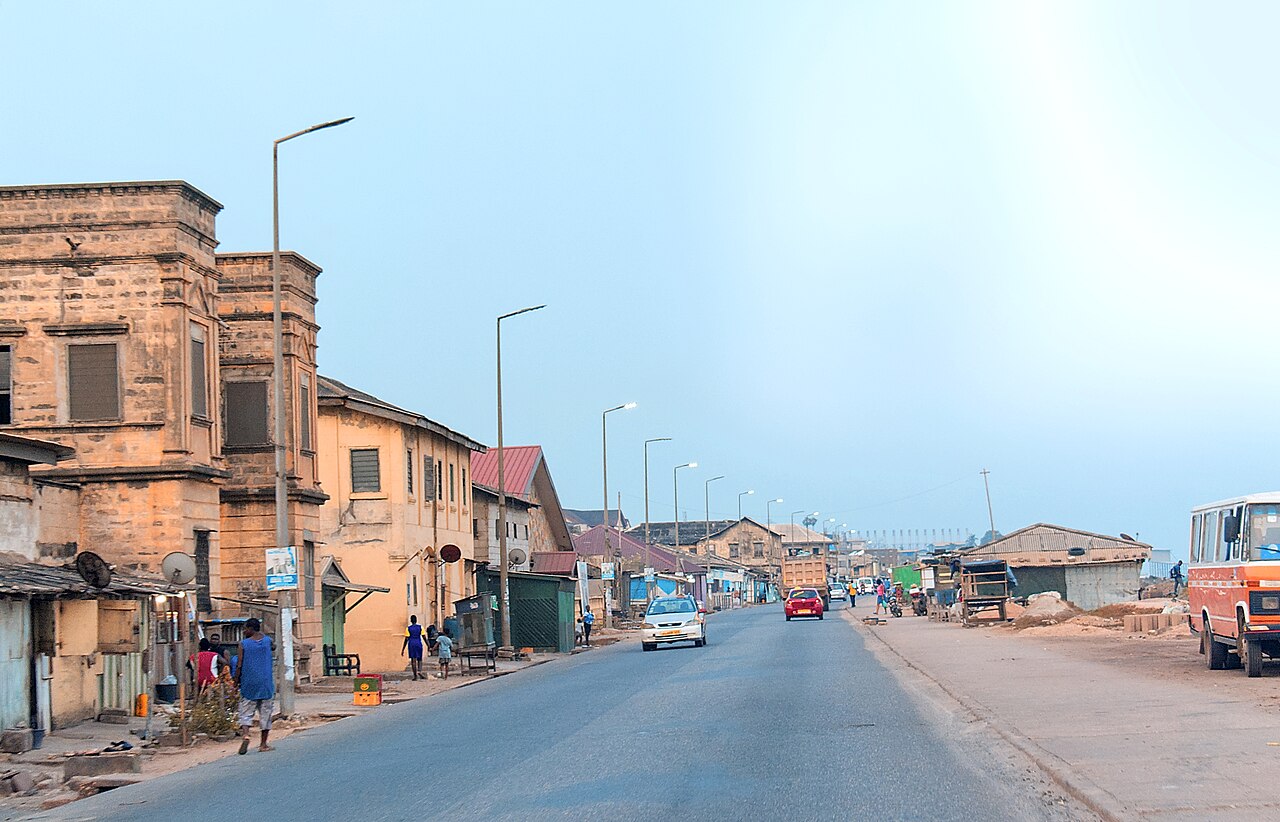
Twin cities joined in 1946 and the capital of the Western Region. Both grew from old Dutch and English forts. The railway came to Sekondi in 1903 and a deep-water harbour opened at Takoradi in 1928. Since oil was found offshore, it has been called the Oil City.
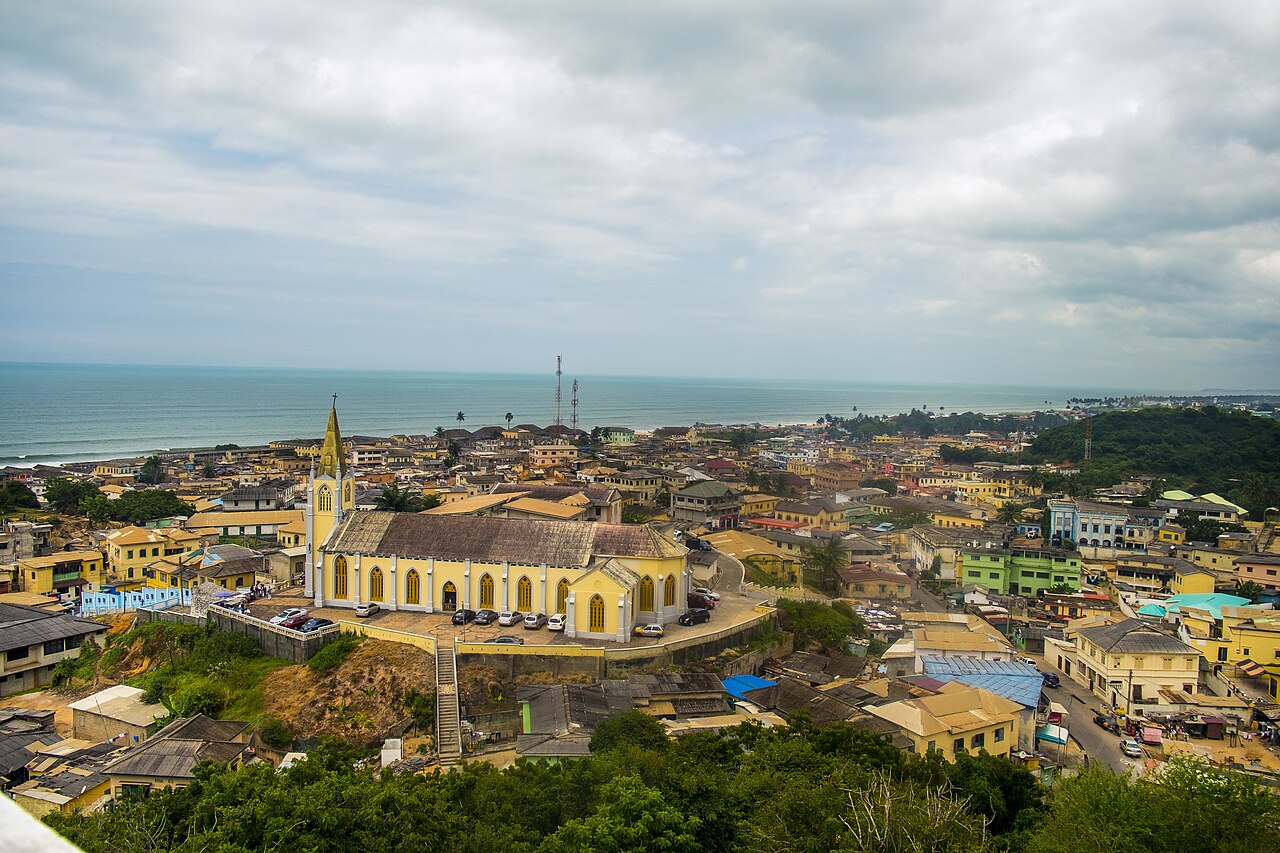
The capital of the Gold Coast from 1821 until 1877 and today the capital of the Central Region. Its local name is Oguaa, meaning 'market'. The Portuguese called it Cabo Corso, 'short cape', which became Cape Coast in English. It is known for its schools and its university.
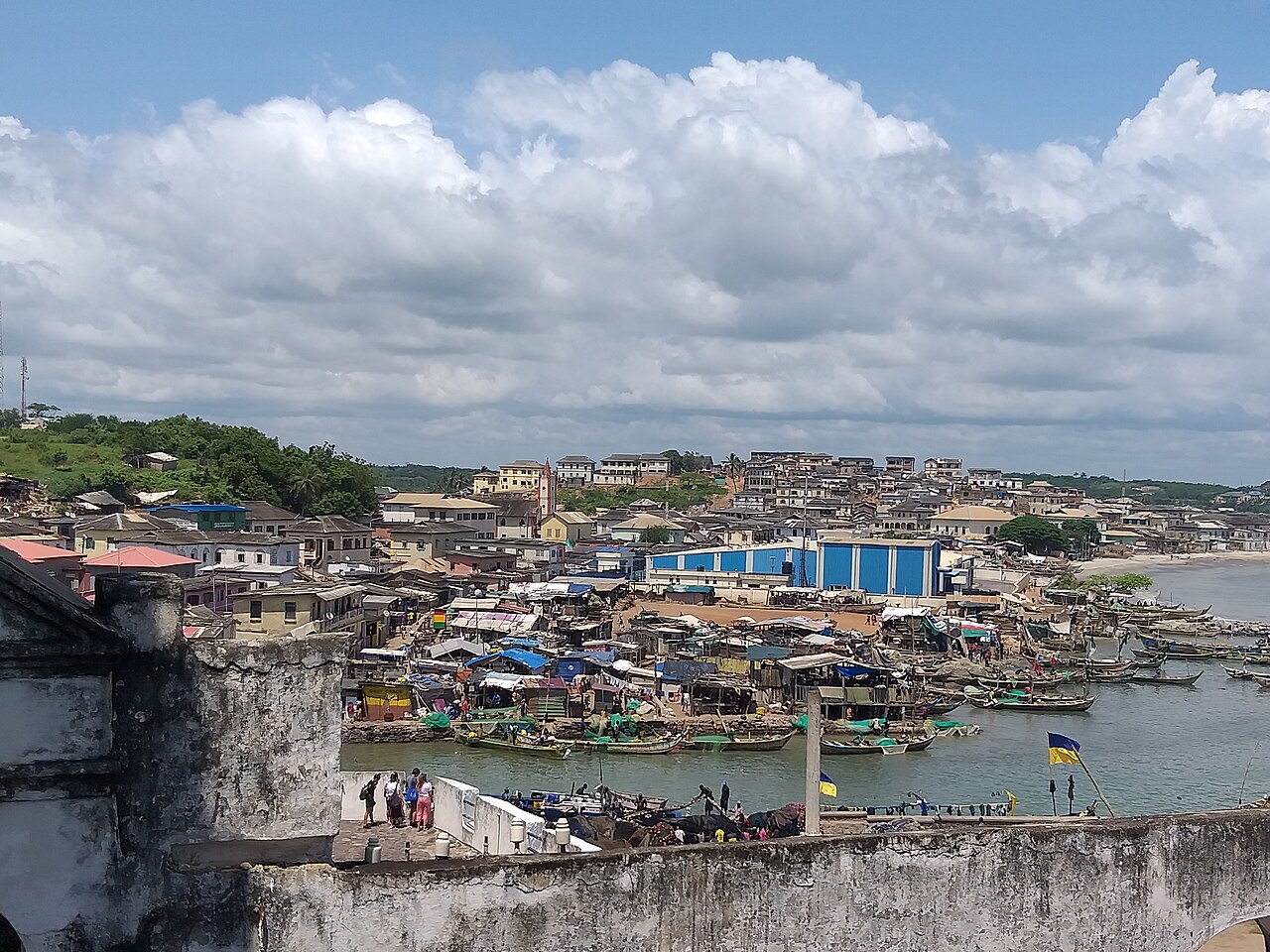
A fishing town on a bay about 12 km west of Cape Coast. Its old name was Anomansah, and the Fante call it Edina. It grew around the castle the Portuguese began in 1482, and today it lives from fishing, salt-making and tourism.
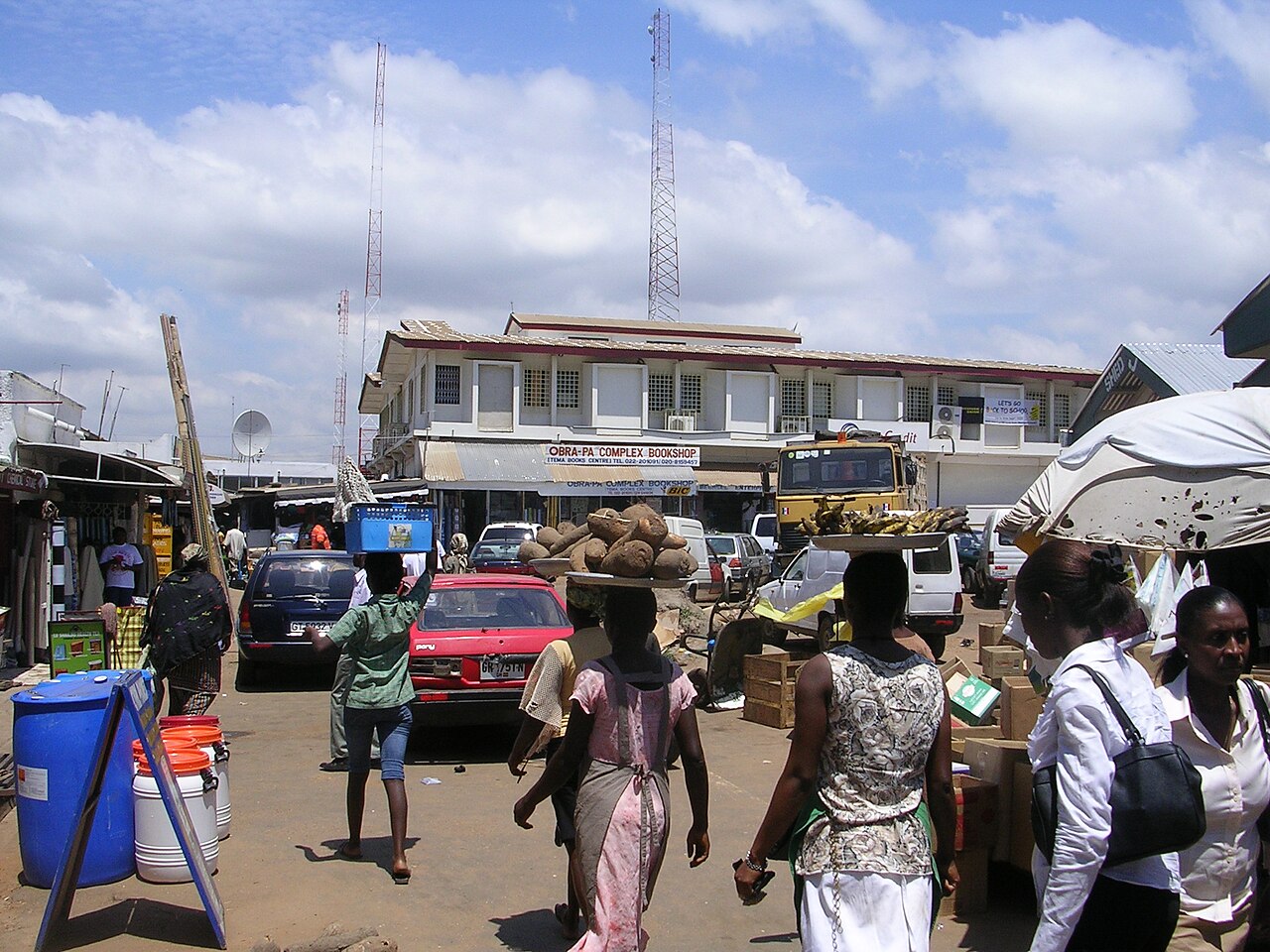
A planned port city about 25 km east of Accra, built after independence on the site of a small fishing village. Its harbour opened in 1962 and is Ghana's largest seaport. Neighbourhoods are simply numbered, from Community 1 upwards.
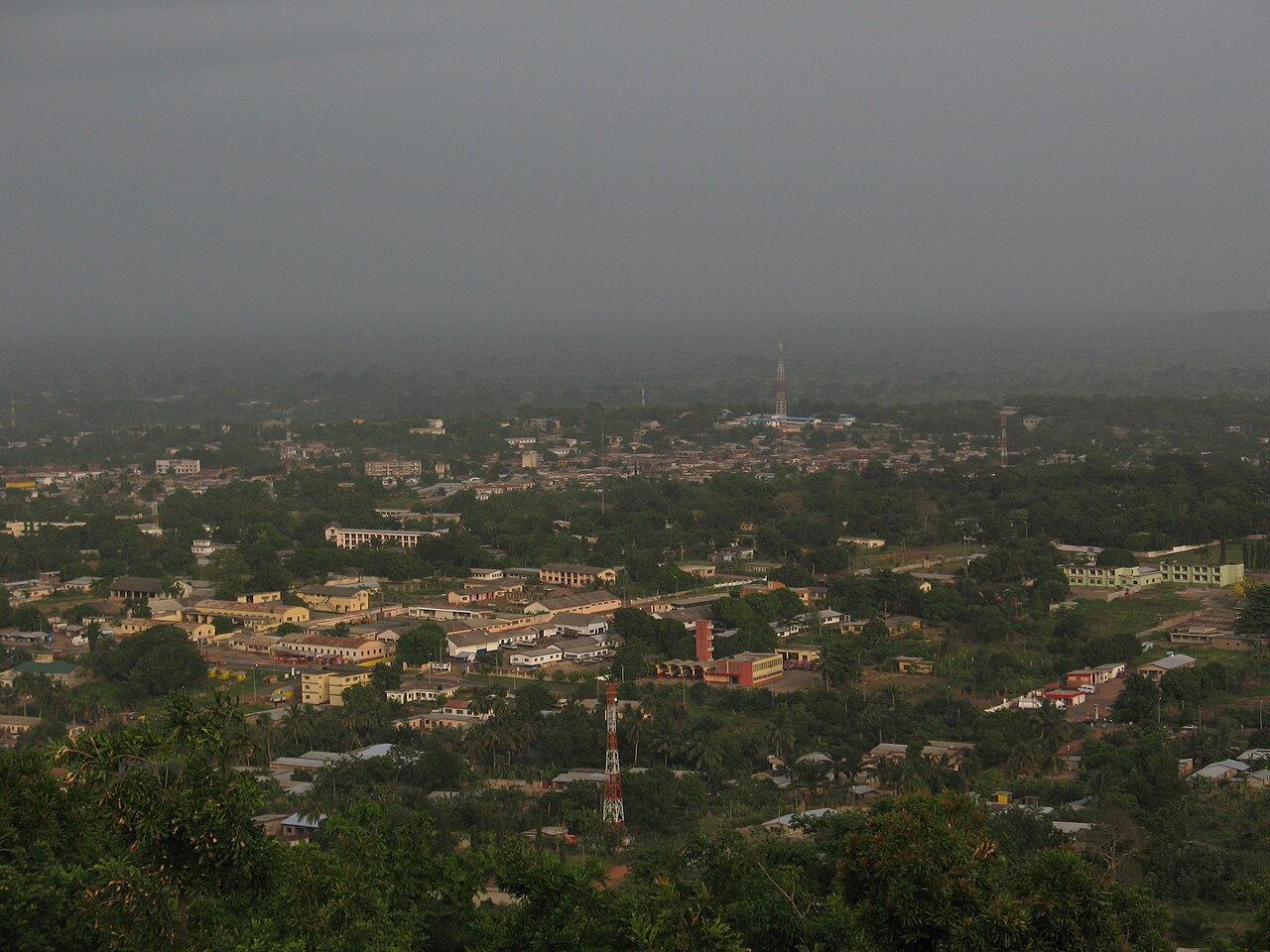
The capital of the Volta Region, set between green hills. It was part of German Togoland until the First World War, then the capital of British Togoland, which joined Ghana at independence. Most people here are Ewe.
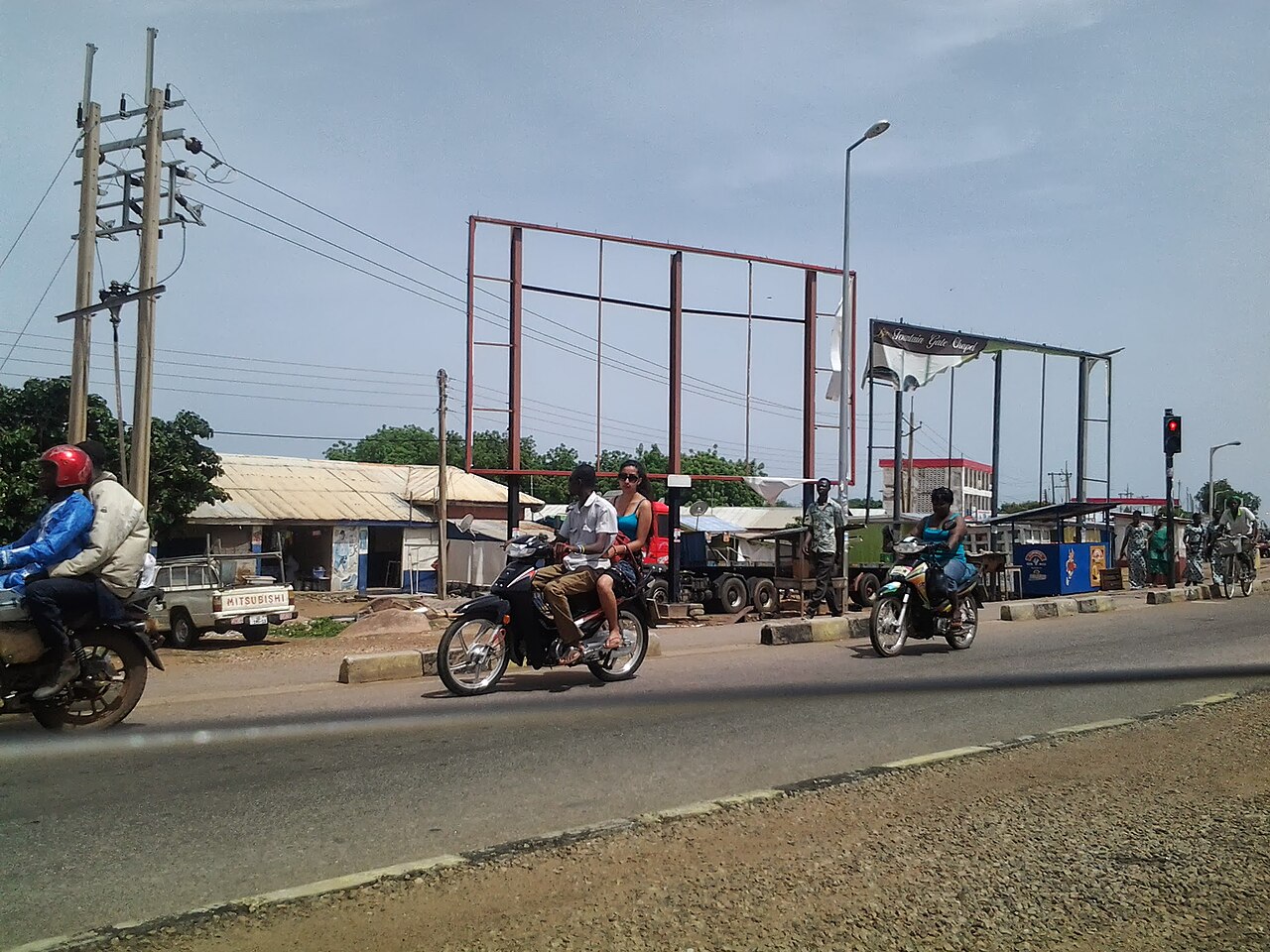
A market town in the far north, often simply called Bolga, and the capital of the Upper East Region. It lies near an old trans-Saharan trade route and is the craft centre of the region.
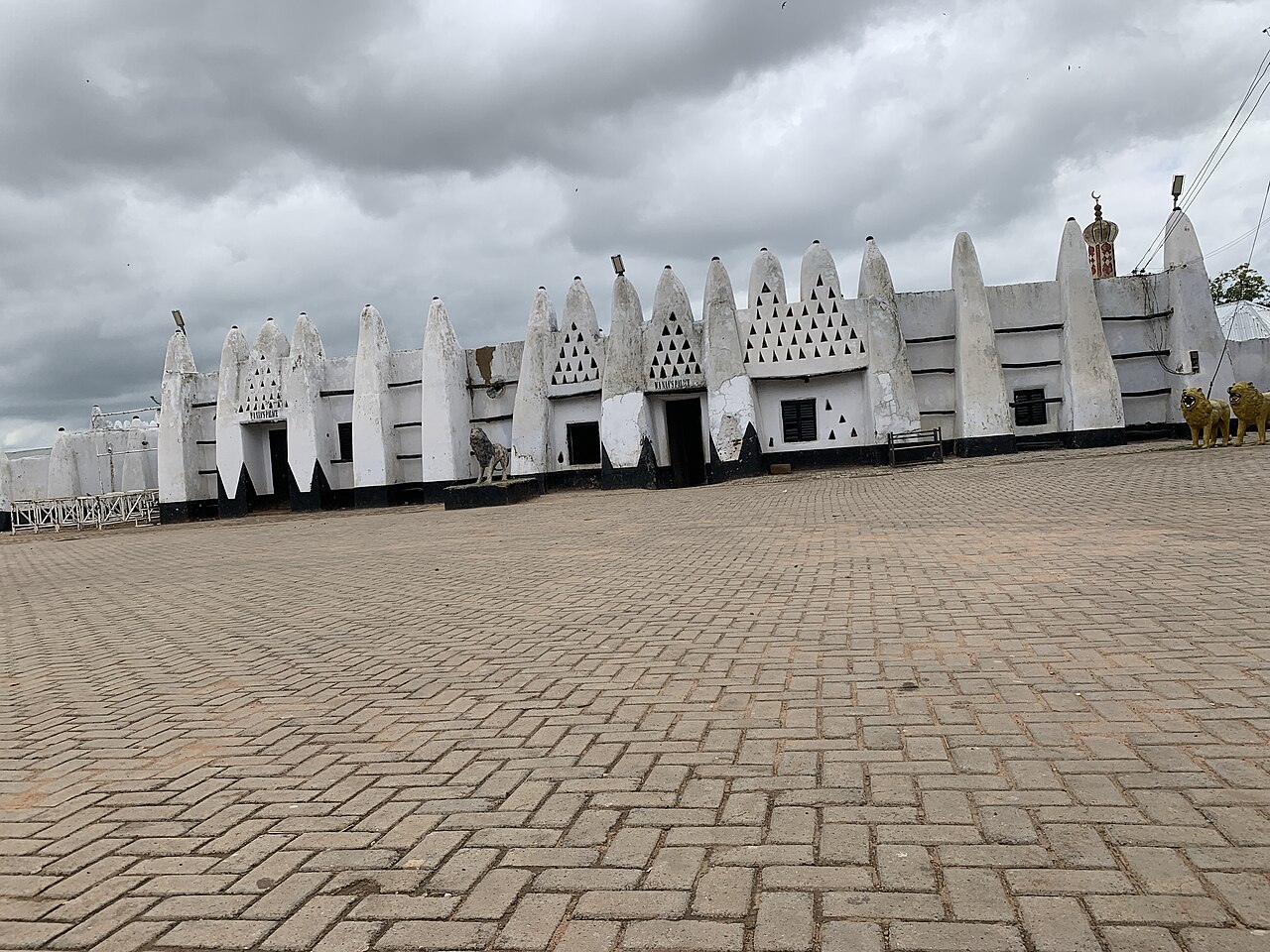
The capital of the Upper West Region and a trading town for the far northwest. Its name comes from the Dagbani for 'we came to watch a dance'. Most of its people are Muslim, and many families still farm maize, millet, yams and groundnuts.
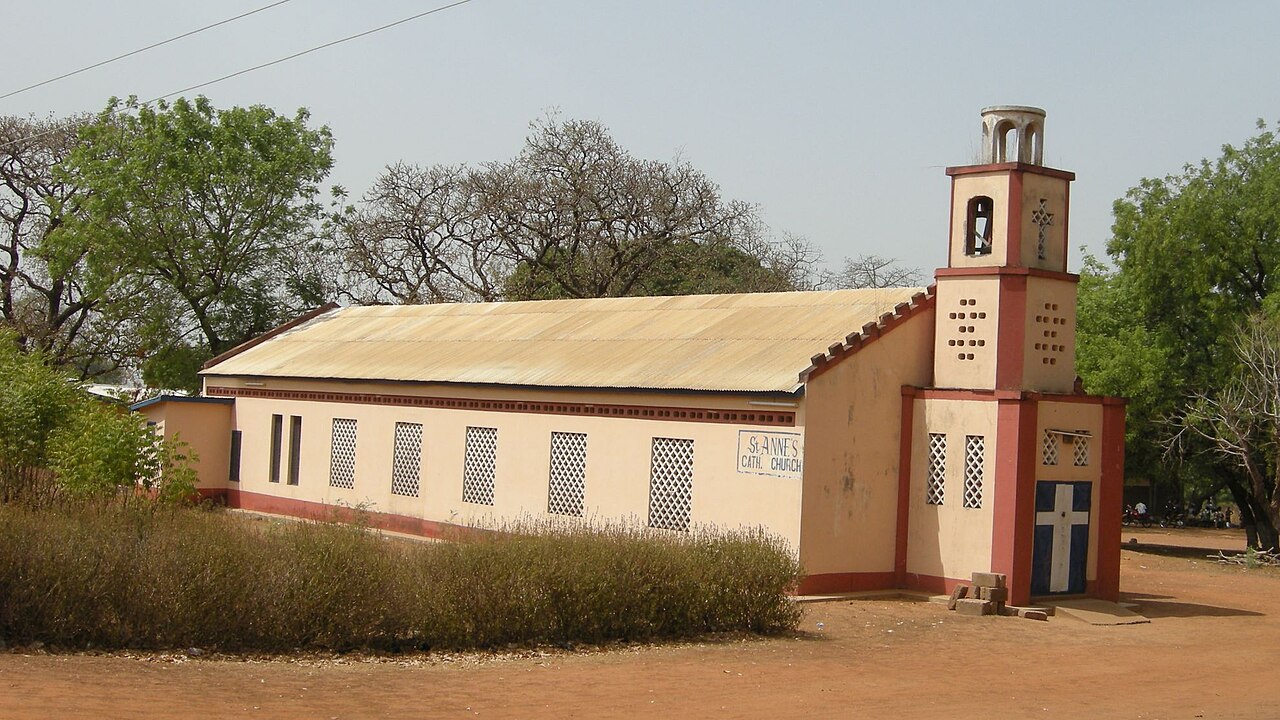
A small town that became the capital of the new Savannah Region in 2019. It is home to the paramount chief of the Gonja kingdom and is the main town near Mole National Park, about 24 km away.
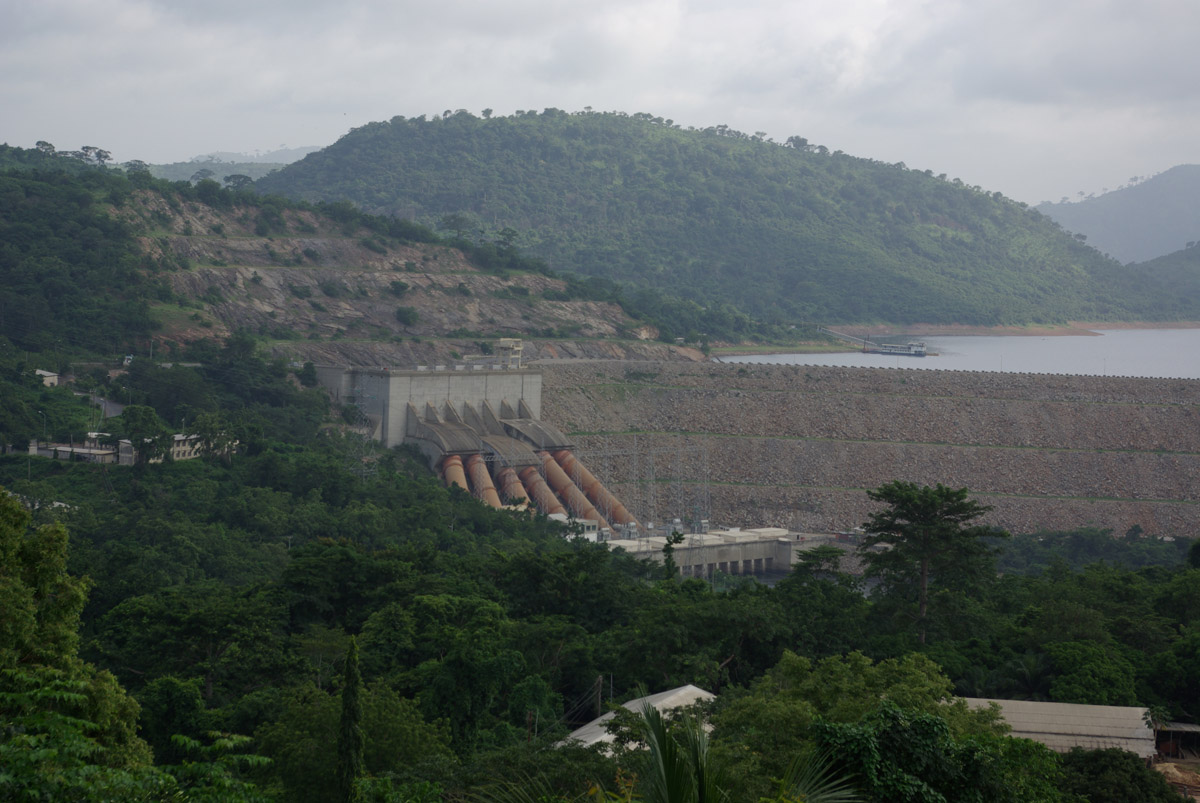
A small town in the hills of the Volta gorge, built next to the great dam. Just downstream, the Adomi Bridge crosses the Volta at Atimpoku.
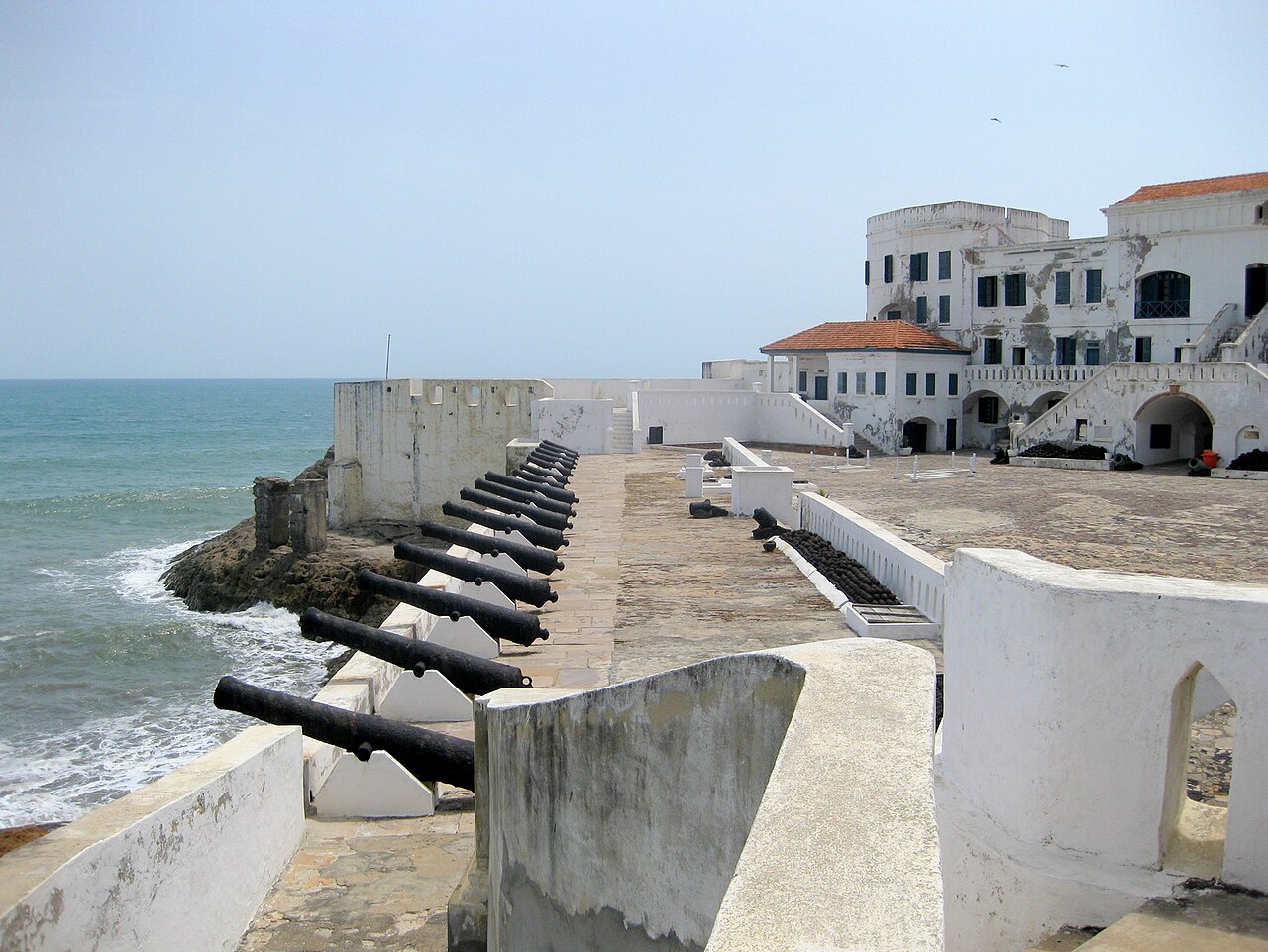
A large white fort on the rocks above the sea, begun as a Swedish timber fort in the 1650s and later the British headquarters on the coast. Enslaved Africans were held in its underground dungeons, as many as a thousand at a time, before being shipped across the Atlantic; the last gate they passed is remembered as the 'gate of no return'. Today it is a museum and a place of remembrance, part of a UNESCO World Heritage Site with Ghana's other forts and castles.
UNESCO World Heritage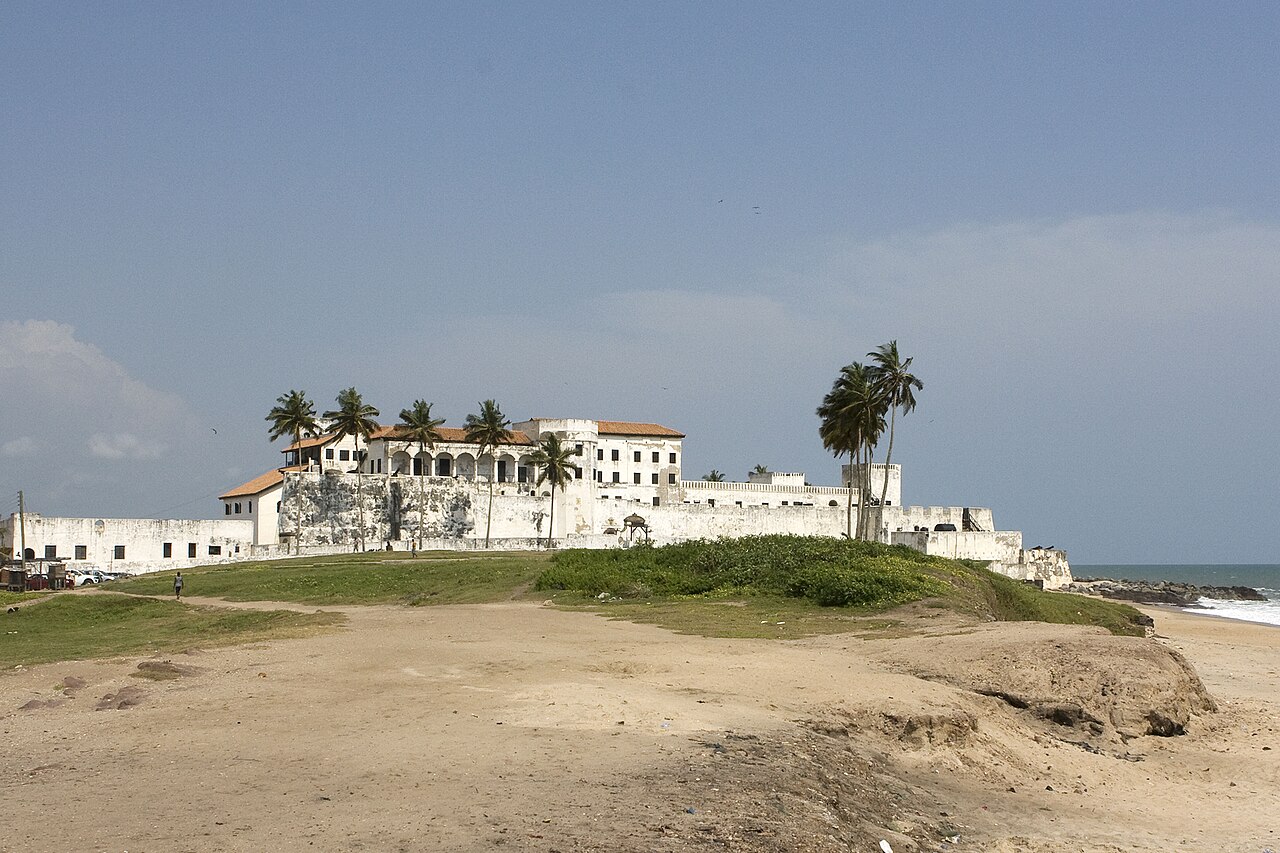
Begun by the Portuguese in 1482 as São Jorge da Mina, it is the oldest European building still standing in sub-Saharan Africa. It was built for the gold trade and later became one of the main stops of the Atlantic slave trade. The Dutch held it from 1637 until 1872. Guided tours lead through its courtyards and dungeons. It is part of a UNESCO World Heritage Site.
UNESCO World Heritage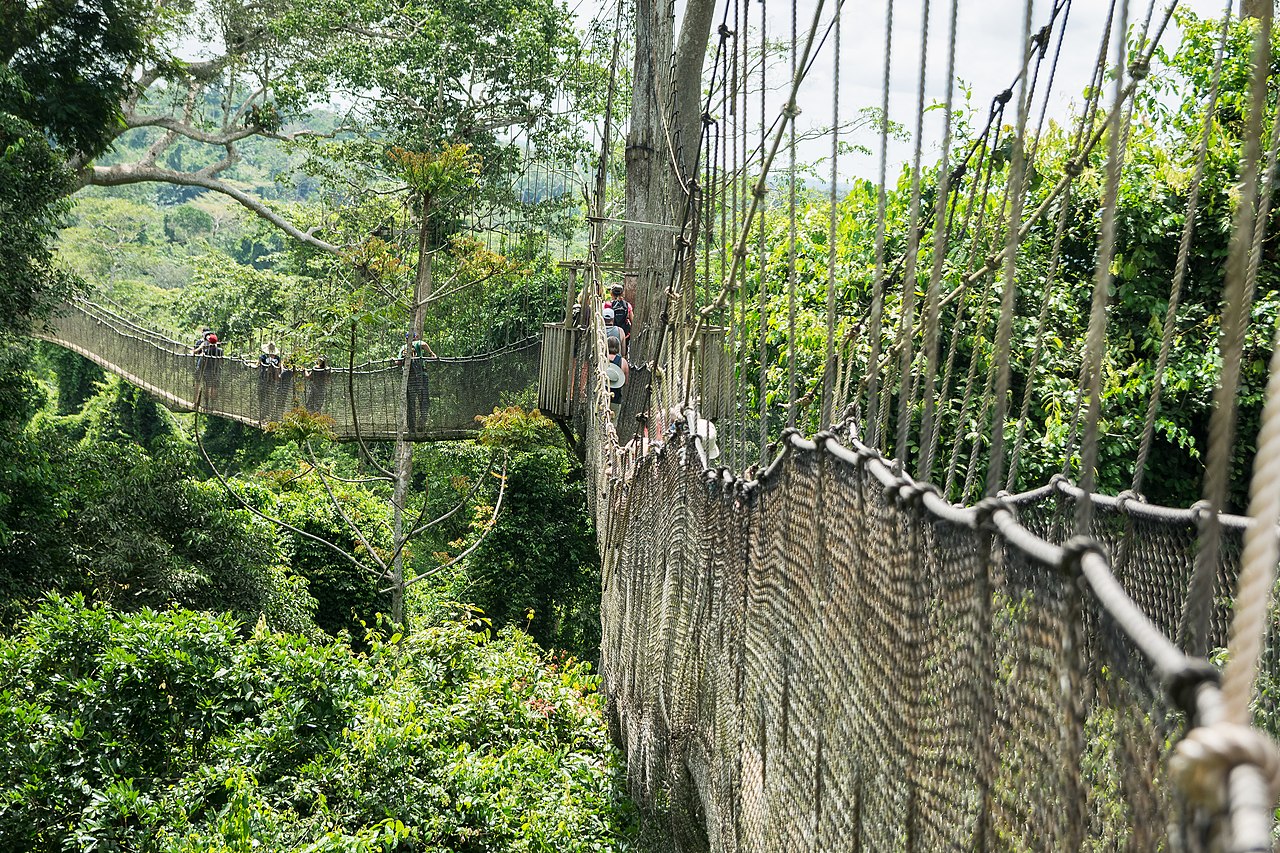
A protected rainforest north of Cape Coast, where a chain of seven swaying rope bridges hangs about 40 m above the forest floor, linking the tops of giant trees. The forest is home to forest elephants, Diana monkeys and more than 260 kinds of birds, though most visitors see birds rather than big animals.
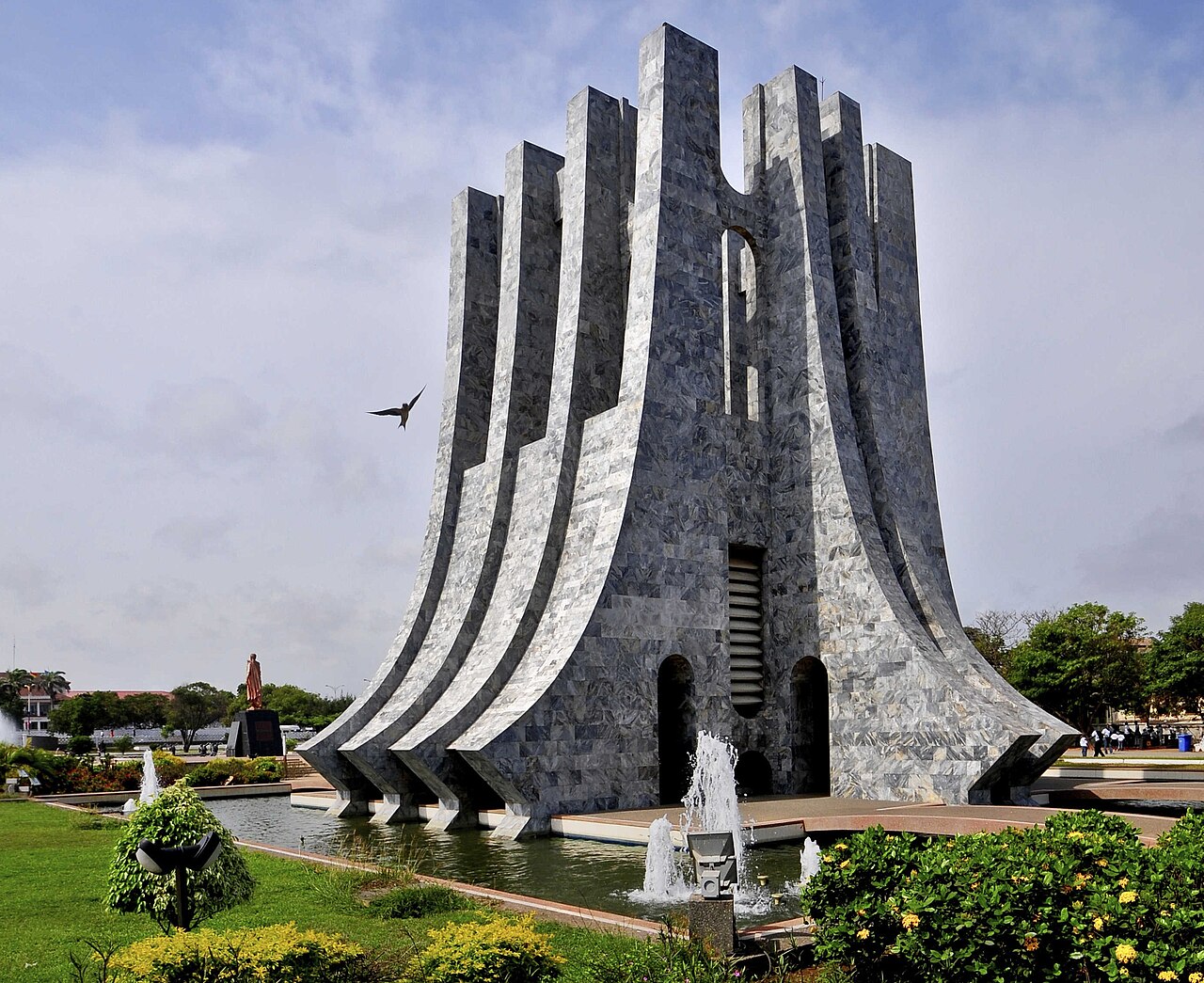
A park and marble mausoleum in central Accra, on the old polo ground where Kwame Nkrumah declared Ghana's independence in 1957. Nkrumah and his wife Fathia are buried here, and a museum tells the story of his life. The mausoleum's shape recalls an upturned sword, an Akan symbol of peace. Independence Square with its arch is a short walk away.
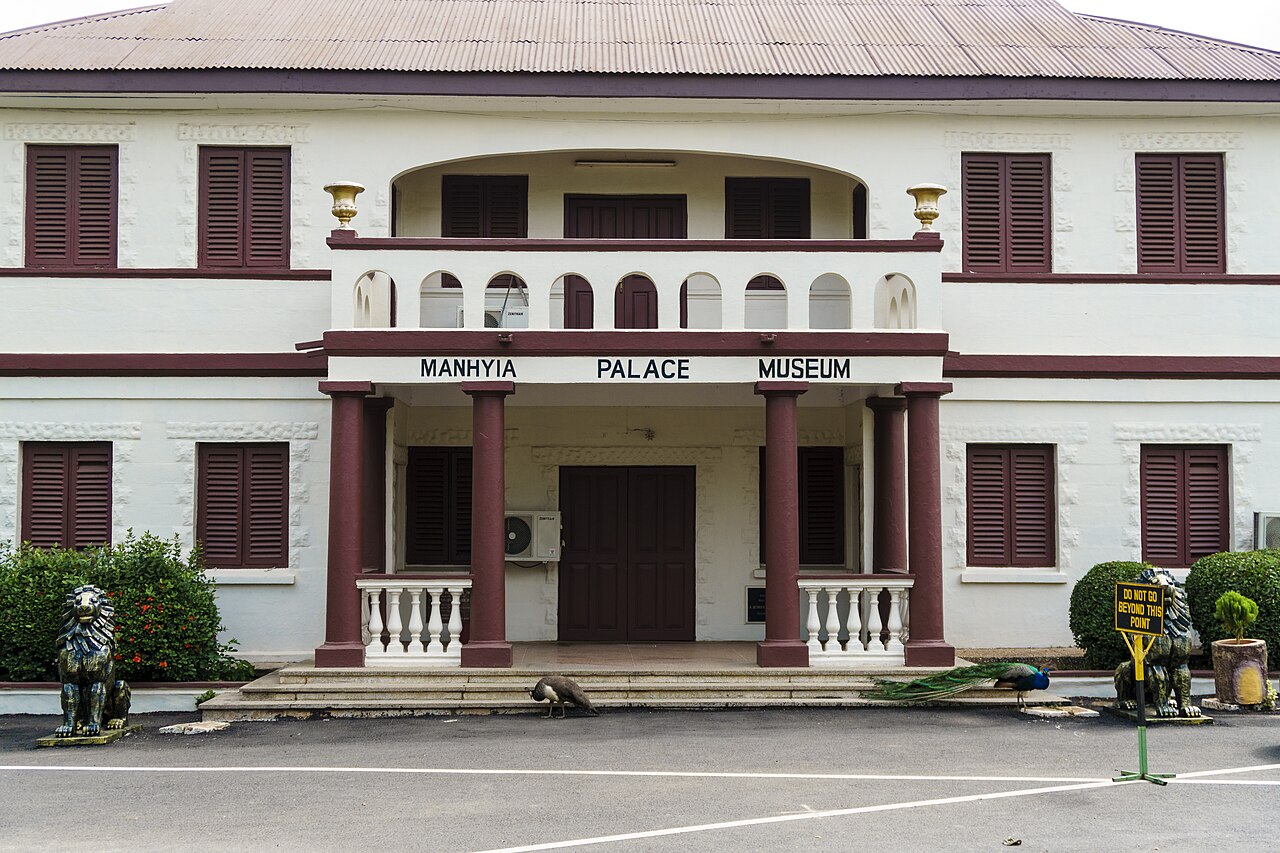
The former palace of the Asante kings in Kumasi, built in 1925 for King Prempeh I when he returned from exile, and a museum since 1995. It shows royal furniture, a bronze head of King Prempeh II and life-size wax figures of Asante kings and queens. The present Asantehene lives in a newer palace close by.
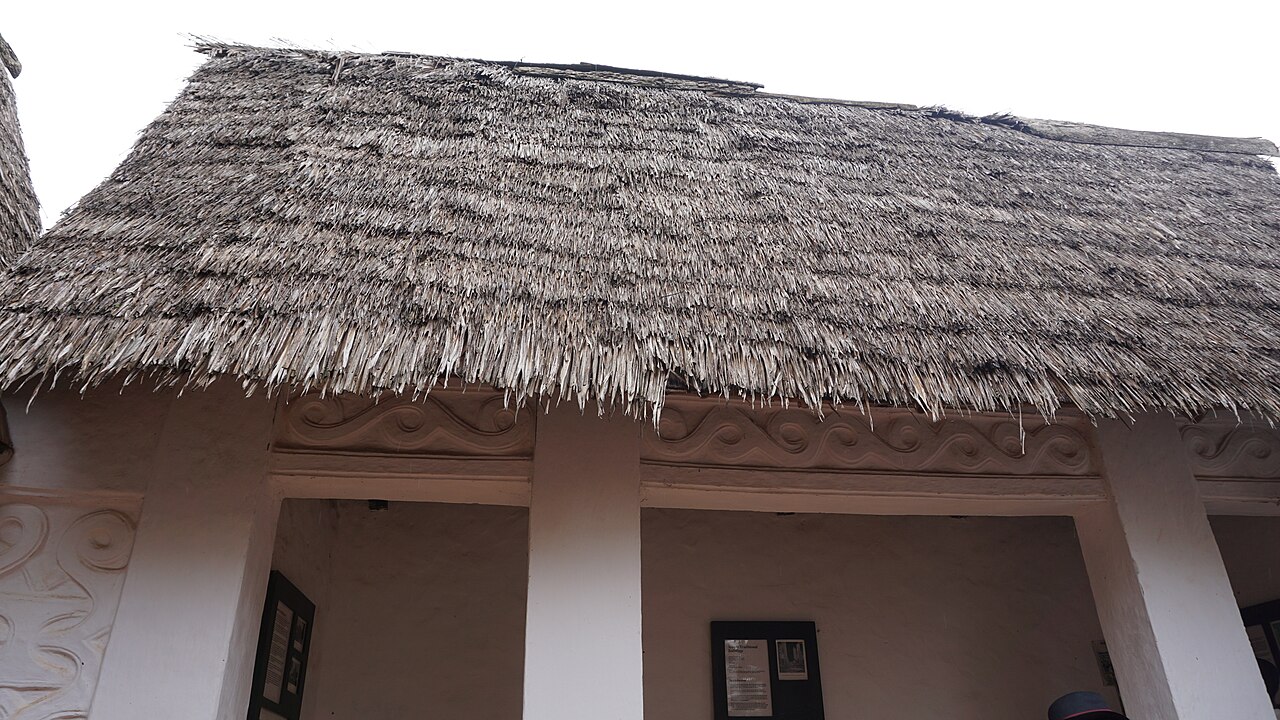
One of the ten Asante Traditional Buildings, a UNESCO World Heritage Site since 1980. These shrines of timber, bamboo and mud are the last buildings left from the time of the Asante Empire, their walls decorated with raised spirals, animals and Adinkra symbols. The shrine at Besease stands near Ejisu, east of Kumasi.
UNESCO World Heritage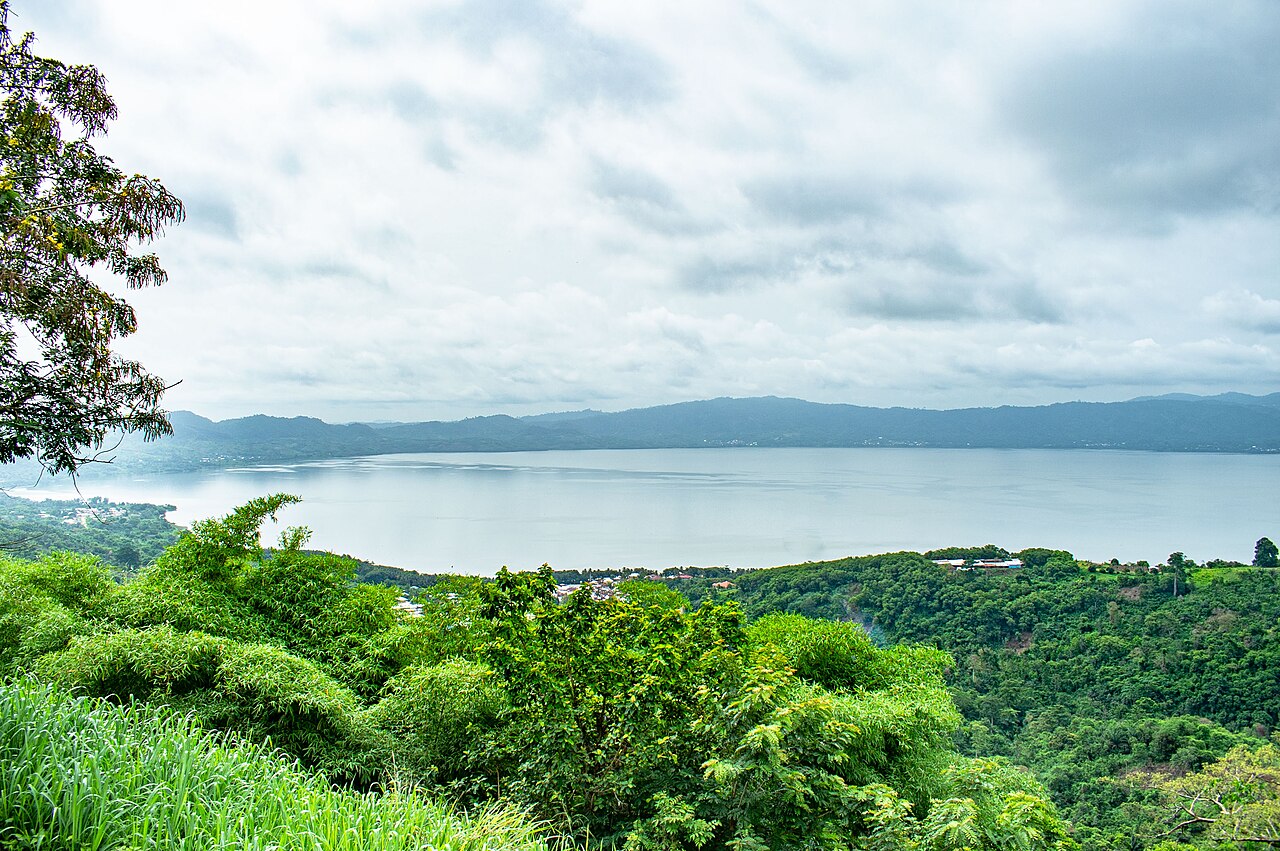
A round lake about 8 km across, filling a crater made by a meteorite that struck about 1.07 million years ago. It is Ghana's only natural lake, about 30 km southeast of Kumasi. The Asante consider it sacred, and tradition allows fishing on the lake only from simple wooden planks.
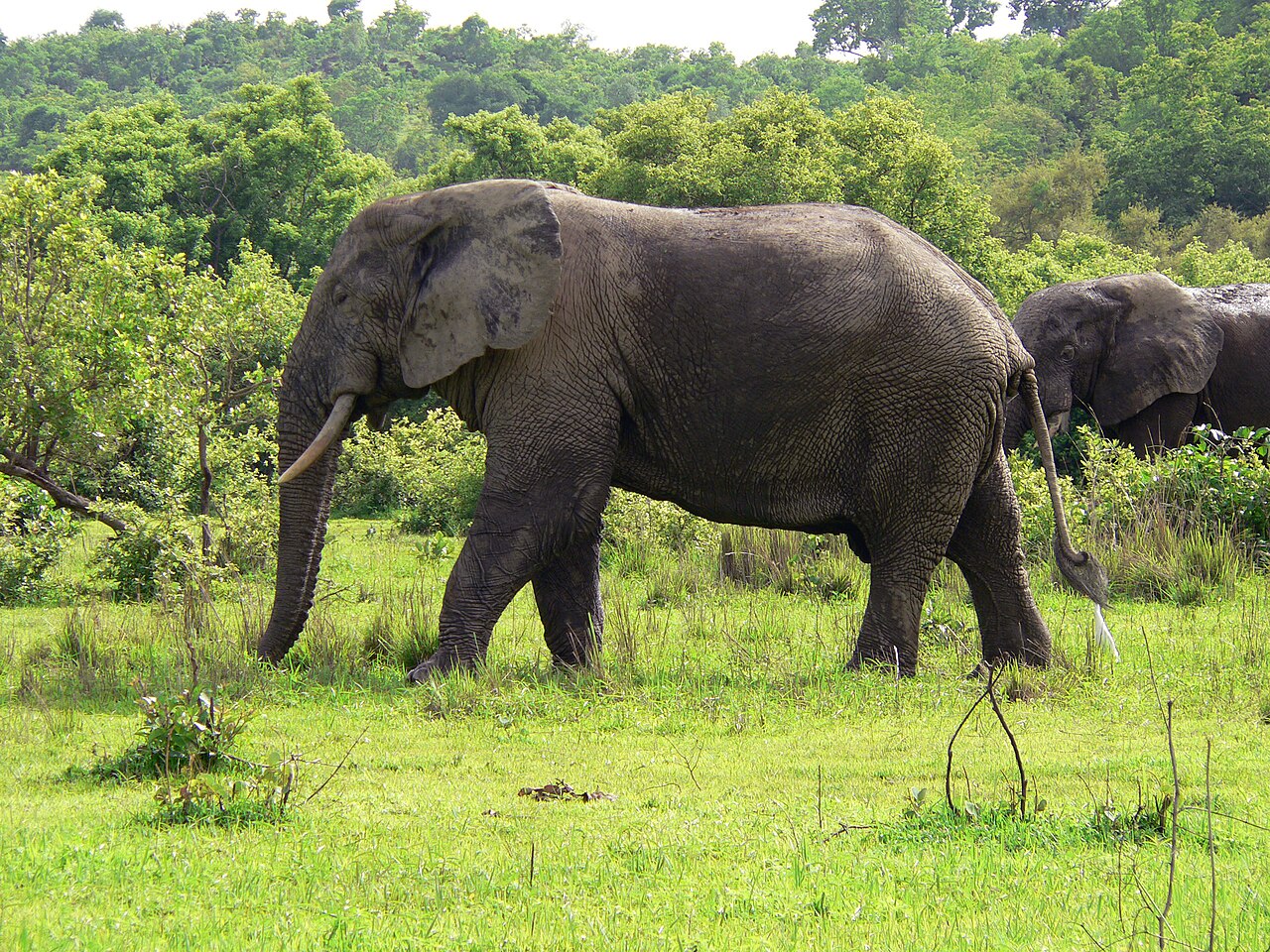
Ghana's largest wildlife reserve, about 4,577 km² of savanna woodland in the north. Hundreds of elephants live here, along with antelopes, buffaloes, baboons and warthogs. Visitors go out on walking and driving safaris.
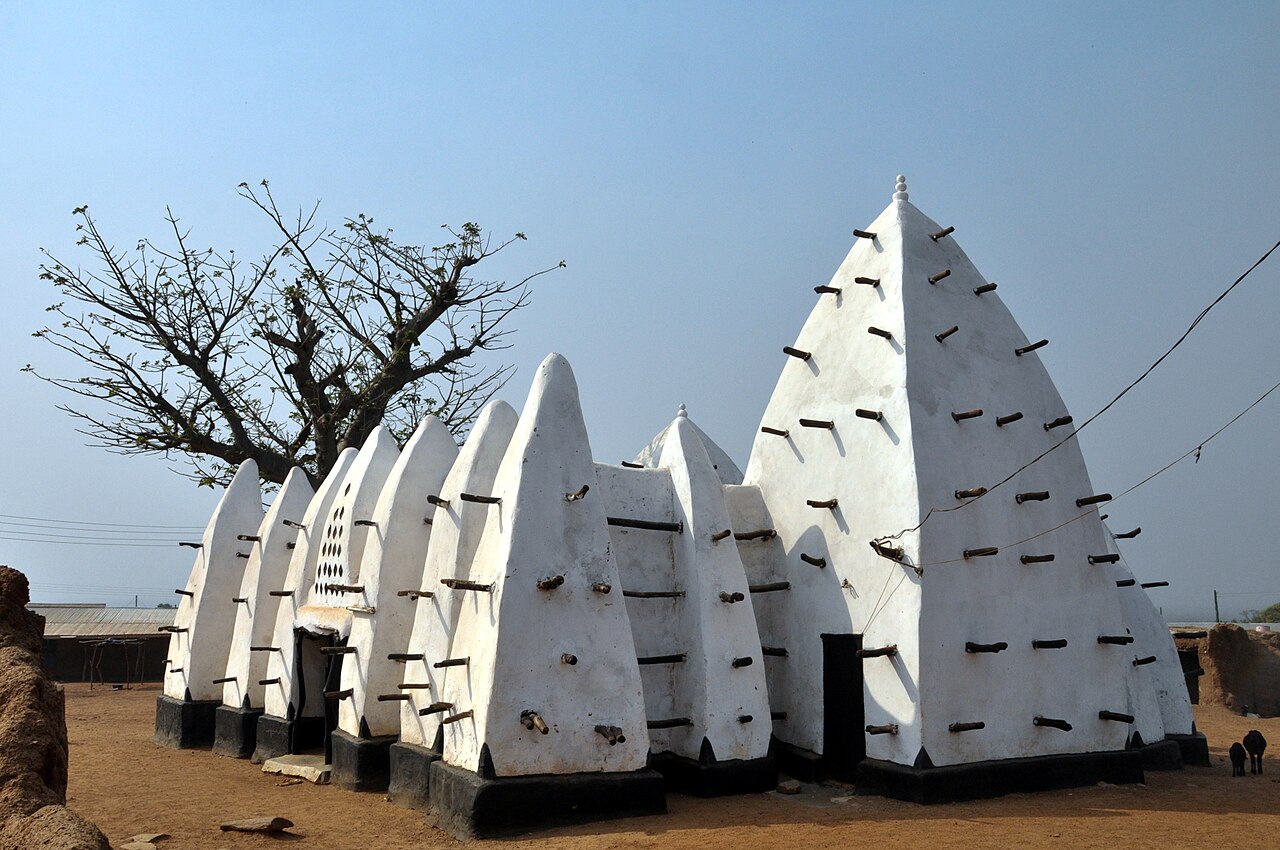
A small white mud mosque in the Sudanese style, with two pyramid-shaped towers and rounded buttresses studded with wooden beams. Local tradition dates it to 1421, which would make it the oldest mosque in Ghana. It stands in the village of Larabanga, 4 km from the entrance to Mole National Park, and has been carefully restored with traditional mud plaster.
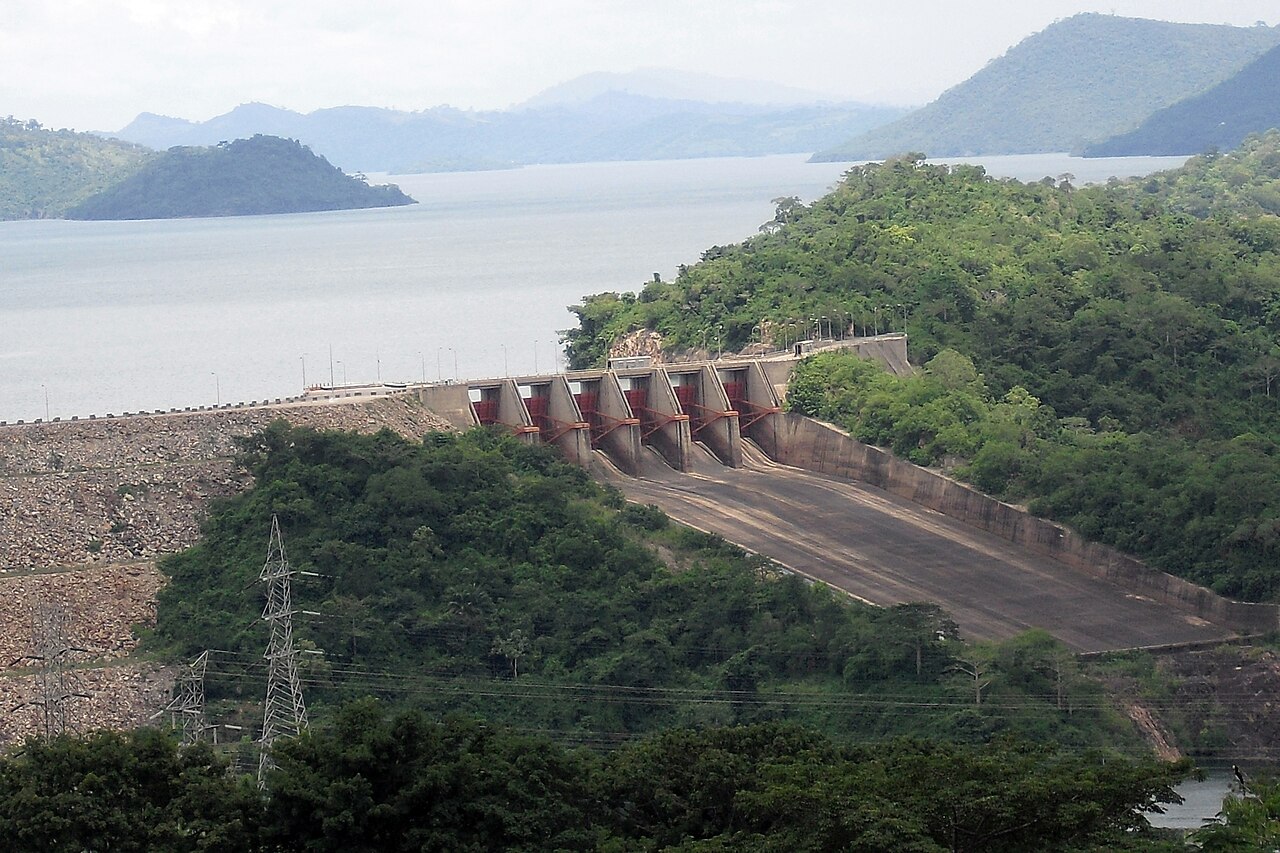
A rock-fill dam 660 m long and 114 m high across the Volta gorge, completed in 1965. Behind it lies Lake Volta, which stretches about 400 km north and covers 8,502 km², about 3.6% of Ghana. Its power station supplies a large share of Ghana's electricity, and boats cruise the lake from Akosombo.
Ghana took its name at independence from the ancient Ghana Empire, a trading empire of West Africa from about the 3rd to the 12th century. Its rulers' title is thought to mean 'ruler of gold'.
The Prime Meridian, the line of 0° longitude that runs through Greenwich in London, passes through the port city of Tema. Ghana is the country nearest to the point in the Atlantic where the Prime Meridian crosses the equator.
As of 2026, Lake Volta is the largest artificial lake in the world by surface area. It covers 8,502 km², about 3.6% of Ghana.
Lake Bosomtwe, Ghana's only natural lake, sits in a crater made by a meteorite about 1.07 million years ago. Glassy stones thrown out by the impact have been found as far away as Ivory Coast.
As of 2026, Ghana is one of the world's leading exporters of cocoa beans, and its neighbour Ivory Coast is the largest. Tradition credits a Ghanaian blacksmith, Tetteh Quarshie, with bringing cocoa beans home from the island of Fernando Po (now Bioko) in the 1870s, though missionaries had also grown cocoa earlier.
Akan children are named after the day of the week they were born. Kwame is a boy born on Saturday and Kofi a boy born on Friday, as with Kwame Nkrumah and Kofi Annan. The Golden Stool itself is called Sika Dwa Kofi, 'the Golden Stool born on a Friday'.
The Golden Stool, the sacred throne of the Asante, must never touch the ground. It is set on a blanket, and at an enthronement the new king is lowered and raised over it without touching it.
Ghana's flag was designed in 1957 by the artist and teacher Theodosia Okoh. The black star in its centre gave the national football team its nickname, the Black Stars, who won the Africa Cup of Nations in 1963, 1965, 1978 and 1982.
The word kente comes from the Twi word kɛntɛn, 'basket', because early cloths looked like woven baskets. Kente is woven in narrow strips on a treadle loom, and the strips are sewn together into a large cloth.
Adinkra symbols are Akan designs that each stand for a saying or idea, and they appear on cloth, pottery, walls and stools. One of the best known, Gye Nyame, stands for the supremacy of God.
The cedi takes its name from the Akan word for the cowry shell. Cowries were used as money on the Gold Coast, alongside coins and gold, until 1901.
In 2019 Ghana produced about 140 tonnes of gold and overtook South Africa as Africa's largest gold producer.
Kofi Annan, born in Kumasi in 1938, led the United Nations as Secretary-General from 1997 to 2006 and shared the 2001 Nobel Peace Prize with the UN.
Twi is a tonal language; in the pronunciations, capitals mark the syllable that stands out most. The letter ɛ sounds like the e in 'set', and ɔ like the o in 'pot'. Pronunciation is written the way it sounds; the capital letters show where the stress goes. Audio is coming soon.
English is understood almost everywhere, but a greeting in Twi is always warmly received.
Most visitors, including British citizens, need a visa arranged before travel. As of 2026 everyone entering Ghana must also show a yellow fever vaccination certificate, and the UK government advises that your passport should be valid for at least 6 months after arrival.
Greetings matter a great deal in Ghana: say good morning or good afternoon and ask how someone is before asking for anything. Eat, give and receive with your right hand; using the left is seen as rude. You may be offered the Ghanaian handshake, which ends with a snap of the fingers.
Prices are in cedis. Mobile money is used everywhere for small and large payments, and many market stalls take only cash or mobile money. As of 2026, Mastercard is not widely accepted. Bargaining is expected in markets, so start low and keep it friendly.
Swimming along Ghana's southern coast can be dangerous because of strong rip currents and undertows, and there are occasional reports of drownings. Swim only where locals say it is safe, never alone, and do not visit beaches alone.
It is illegal to photograph military sites or the airport, so ask before photographing any building with guards. Wearing camouflage or military clothing is illegal. Dress modestly away from the beach.
Malaria is common everywhere, so take antimalarial tablets and use insect repellent and a mosquito net. Drink bottled or filtered water, and avoid swimming in lakes and rivers. For police, fire or ambulance, call 112 or 999.
Roads outside the main towns are often poorly lit, and the UK government advises against driving between towns after dark. Long-distance buses such as those of the State Transport Corporation are more comfortable than crowded tro-tro minibuses.