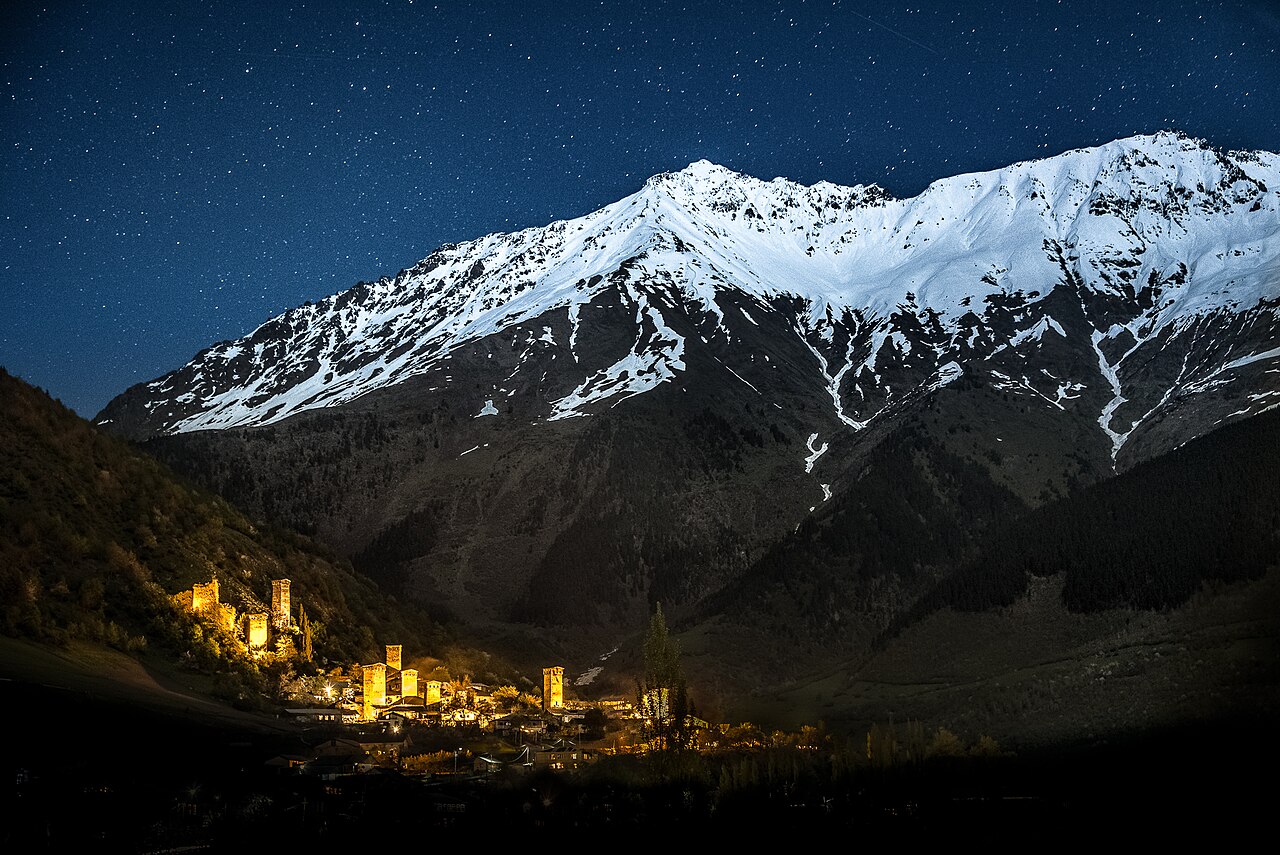
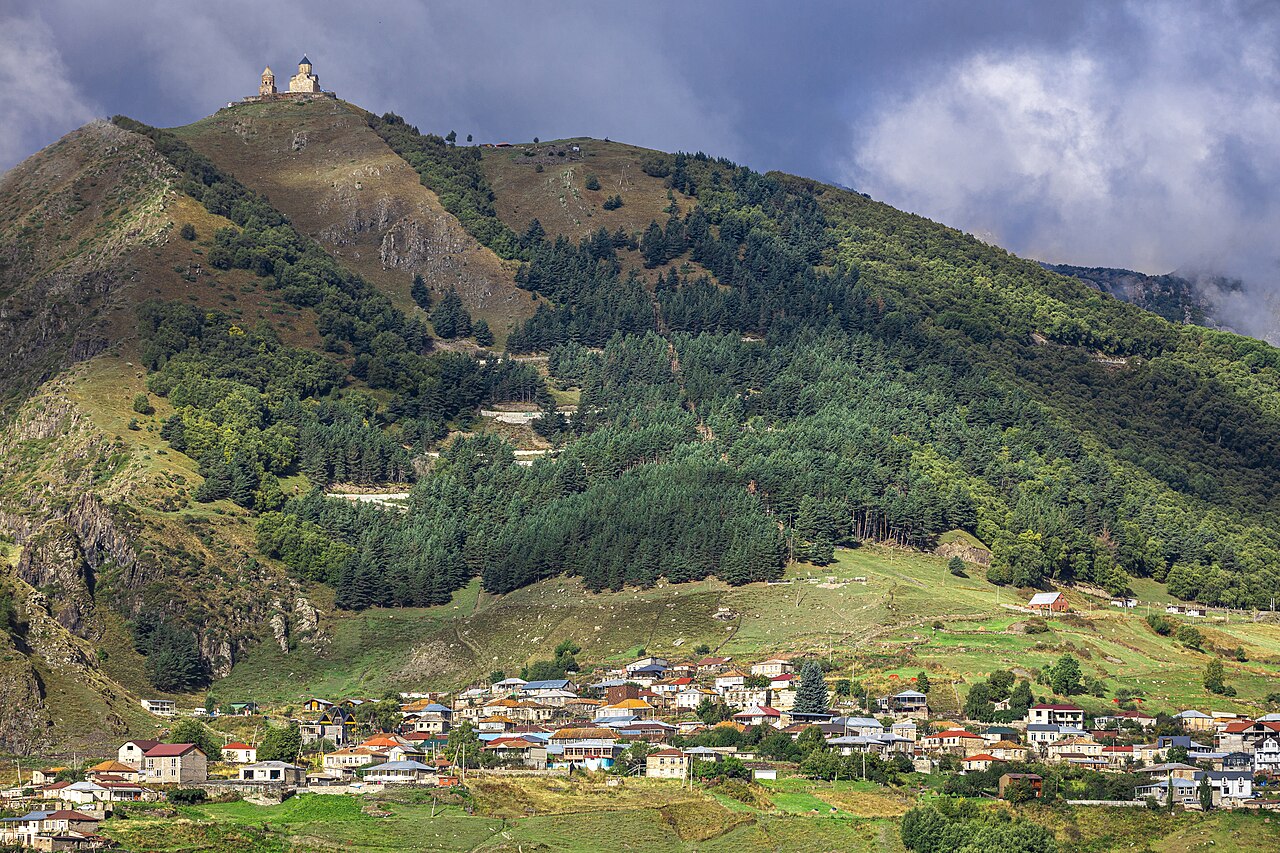
Snowy Caucasus peaks, cave towns and stone towers, a Black Sea coast, and a feast table where the wine has been made in clay jars for about 8,000 years.
Your trip to Georgia
Ready for the trip?
10 questionsAbout 3 minutesNo timer
Explore Georgia
You have explored 0 of 9 parts. Scroll on to discover the rest.
A free large-print PDF. Choose what goes in: facts, map, history, dishes and recipes, phrases, fun facts, a quiz with or without answers. Made for clubs, care homes, libraries and family afternoons.
Georgia is a small, mountainous country in the Caucasus, where Eastern Europe meets Western Asia. The Greater Caucasus range forms its northern edge, with peaks above 5,000 m, and the Black Sea washes its western coast. In between lie green, wet lowlands in the west, drier valleys and vineyards in the east, and high plateaus with lakes in the south. The Likhi Range divides the country into a western half, known in ancient times as Colchis, and an eastern half, known as Iberia.
People have lived here for a very long time: fossils about 1.8 million years old found at Dmanisi are among the earliest human ancestors known outside Africa, and the earliest known evidence of winemaking, from about 6000 BC, also comes from Georgia. The kingdom of Iberia adopted Christianity in the 4th century, and a united Kingdom of Georgia reached its golden age under King David IV and Queen Tamar around 1100 to 1213. Later the land was divided and fought over by larger empires, and it became part of the Russian Empire in the 19th century and of the Soviet Union in 1921. Georgia declared independence again in 1991.
Today about 3.9 million people live in the areas the government controls, and about a third of them live in the capital, Tbilisi. Georgians call their country Sakartvelo and speak Georgian, a language unrelated to any of its neighbours, written in its own rounded alphabet. Visitors come for the old town of Tbilisi, the churches of Mtskheta, the tower villages of Svaneti, the wine country of Kakheti and the beaches of Batumi, and above all for the famous hospitality of the Georgian table.
CapitalTbilisi
PopulationAbout 3.9 million (2024 census, which did not cover Abkhazia and South Ossetia)
Official languageGeorgian. The constitution also gives Abkhaz official status within Abkhazia
CurrencyGeorgian lari (GEL), divided into 100 tetri. It replaced a temporary coupon currency in 1995
AreaAbout 69,700 km² within its internationally recognised borders
GovernmentUnitary parliamentary republic. The prime minister leads the government; the president is head of state with a largely ceremonial role and, since 2024, is chosen by an electoral college rather than by popular vote
Highest mountainShkhara, about 5,200 m, on the border with Russia above the Svaneti region
Longest riverThe Rioni is the longest river flowing only through Georgia; it runs west to the Black Sea at Poti. The larger Mtkvari (Kura) rises in Turkey, flows through Tbilisi and continues to the Caspian Sea
NeighboursRussia to the north, Azerbaijan to the southeast, Armenia and Turkey to the south; the Black Sea lies to the west
Georgia's story runs from some of the earliest humans outside Africa and the first known winemakers, through the ancient kingdoms of Colchis and Iberia and an early conversion to Christianity, to a medieval golden age. Mongol and later Ottoman and Persian invasions split the country apart, and it was absorbed by the Russian Empire in the 19th century. A short-lived independent republic in 1918 was followed by seven decades of Soviet rule, and Georgia regained its independence in 1991.
6000 BC
The earliest known winemaking
At Neolithic villages in the Kvemo Kartli region, such as Gadachrili Gora, archaeologists have found pottery jars with chemical traces of grape wine from about 6000 BC. As of 2026 this is the earliest known evidence of winemaking anywhere, and Georgians still make wine in large clay jars called qvevri.
AD 337
Iberia adopts Christianity
King Mirian III of Iberia, in eastern Georgia, made Christianity the state religion after the preaching of Saint Nino, a woman from Cappadocia. Georgian tradition often gives the date as 326; many historians place it in the 330s. The first church was built at Mtskheta, the old capital, where Svetitskhoveli Cathedral stands today.
1008
Bagrat III unites Georgia
Bagrat III, already king of Abkhazia in the west and ruler of Kartli, inherited his father's lands and the title 'King of the Georgians' in 1008, then added Kakheti by 1010, joining most Georgian lands into a single kingdom. He is remembered as Bagrat the Unifier, and his great cathedral in Kutaisi, Bagrati, still stands.
1106
Gelati Monastery is founded
King David IV, later called David the Builder, founded Gelati Monastery near Kutaisi as a centre of learning. Its academy gathered scholars and translators, and David was buried at its gate. Gelati is now a UNESCO World Heritage Site.
1121
The Battle of Didgori
On 12 August 1121, at Didgori, about 40 km west of Tbilisi, David IV's army defeated a much larger Seljuk force. The next year he took Tbilisi back after centuries of Muslim rule and made it his capital.
1184
Tamar begins her reign
Tamar became sole ruler in 1184 and reigned until 1213, the first woman to rule Georgia in her own right. She held the title king (mepe), not queen. Under her the kingdom reached its greatest size and power, and the cave monastery of Vardzia was carved and painted. The epic poem The Knight in the Panther's Skin by Shota Rustaveli is dated to this golden age.
1226
Tbilisi is sacked
The Khwarezmian ruler Jalal ad-Din captured and destroyed Tbilisi. Mongol invasions followed, and later the campaigns of Timur. By the late 15th century the united kingdom had broken into several kingdoms and principalities, fought over by the Ottoman and Persian empires.
1783
The Treaty of Georgievsk
King Heraclius II of Kartli-Kakheti, in eastern Georgia, signed a treaty making his kingdom a protectorate of Russia, which promised to defend it and keep its royal family on the throne. When a Persian army sacked Tbilisi in 1795, Russia did not come to help.
1801
Russia annexes eastern Georgia
Breaking the promises of 1783, the Russian Empire annexed Kartli-Kakheti and removed the Bagrationi royal family. Western Georgian lands were absorbed over the following decades. In the late 19th century a national revival grew around the writer Ilia Chavchavadze.
1918
The Democratic Republic of Georgia
After the Russian Revolution, Georgia declared independence on 26 May 1918. The new democratic republic gave women the vote, and 26 May is still Independence Day.
1921
The Red Army invades
In February 1921 Soviet Russia's Red Army invaded, and on 25 February it entered Tbilisi. The government went into exile and Georgia became part of the Soviet Union. Joseph Stalin, a Georgian born in Gori, later led the Soviet Union; his Great Purge of 1936 to 1938 killed or imprisoned many Georgians.
1989
The 9 April tragedy
On 9 April 1989 Soviet troops broke up a peaceful pro-independence demonstration on Rustaveli Avenue in Tbilisi, killing 21 people. The day is now remembered as National Unity Day.
1991
Independence is restored
On 9 April 1991, after a referendum, Georgia declared its independence from the Soviet Union. The 1990s were very hard: a civil war, armed conflicts in Abkhazia and South Ossetia that forced large numbers of people from their homes, and severe shortages of bread, power and heating.
2003
The Rose Revolution
In November 2003, after disputed parliamentary elections, peaceful protesters carrying red roses entered the parliament and President Eduard Shevardnadze resigned. Wide reforms followed, including a new police force that cut everyday corruption sharply.
2008
The August war
In August 2008 fighting around South Ossetia grew into a five-day war between Georgia and Russia, which also involved forces from Abkhazia. A ceasefire was agreed on 12 August, brokered by France on behalf of the European Union. About 192,000 people were displaced at the height of the war. Russia then recognised Abkhazia and South Ossetia as independent states; Georgia and most other countries do not, and an EU monitoring mission has watched the boundary lines since.
2023
EU candidate status
In December 2023 the European Union granted Georgia the status of a candidate for membership. In June 2024 EU leaders said the process had in effect stopped, and as of September 2026 no accession talks have begun.
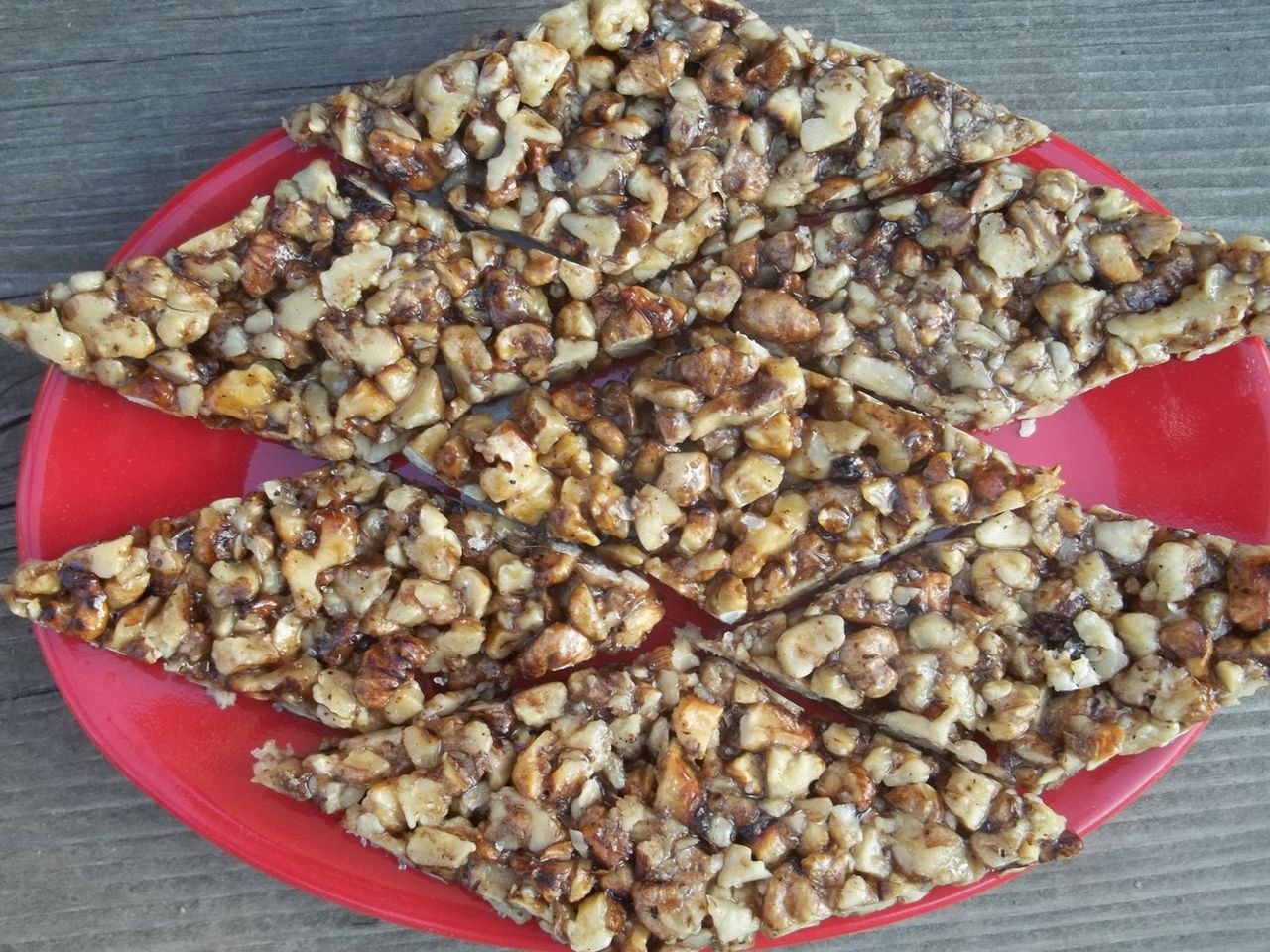
Georgian food is built on walnuts, garlic, fresh herbs such as coriander, tarragon and dill, sour plums and pomegranates, good cheese and bread, and wine. Every region has its own dishes: cheese breads from Imereti and Adjara, dumplings from the eastern mountains, walnut sauces from the west, lamb stews and grilled meat from Kakheti. The great social meal is the supra, a feast led by a toastmaster called the tamada. Cold dishes such as pkhali, aubergine rolls, cheese, fresh herbs and bread cover the table first; hot dishes such as khinkali, grilled meat, stews and cheese breads arrive later, often all at once, with wine throughout. Fruit and sweets such as churchkhela and gozinaki come at the end, especially at New Year.
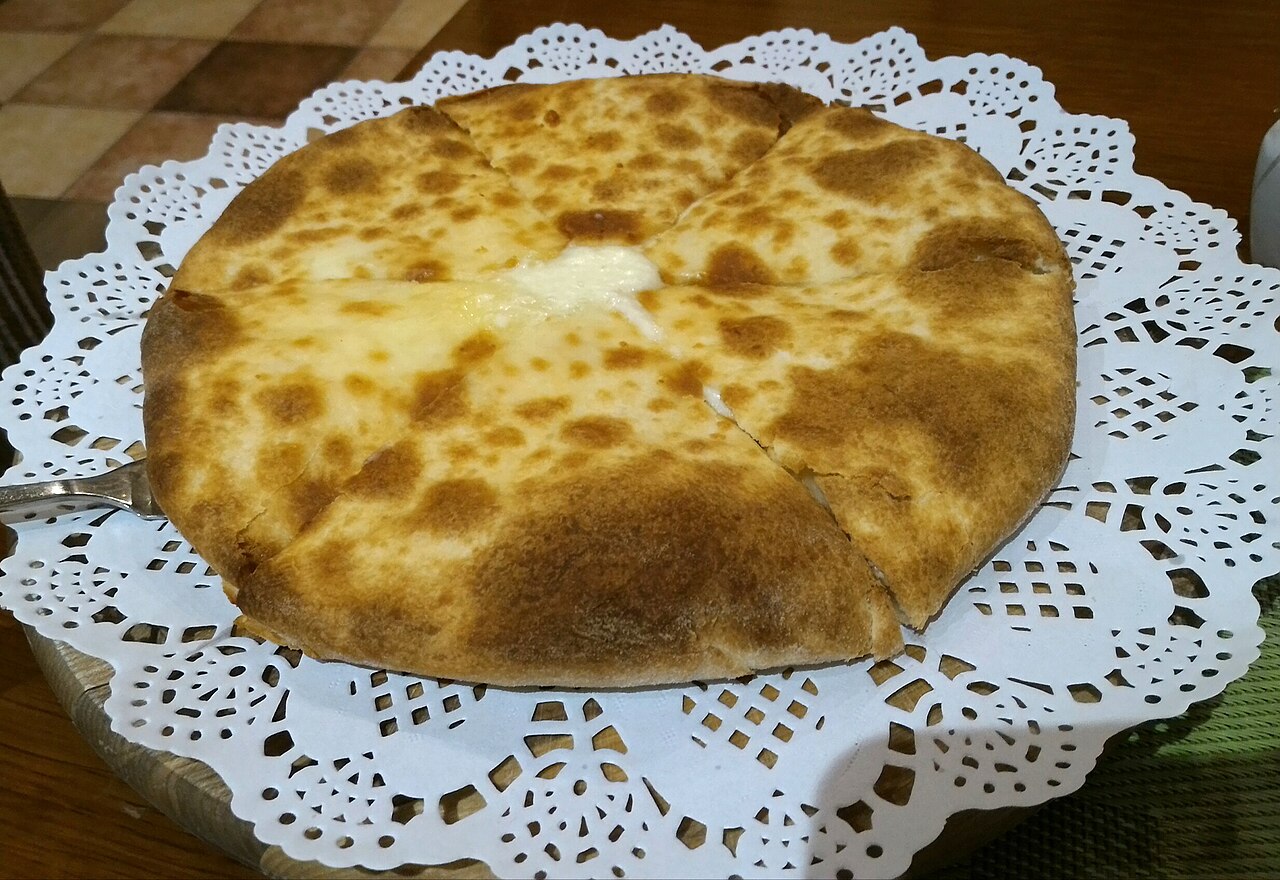
Khachapuri, cheese-filled bread, is Georgia's national dish, and the round Imeretian kind is the most common. A soft yeast dough is filled with salty white Imeretian cheese and baked until golden. It is eaten warm at almost every meal, from street stalls to feasts. The Megrelian version (megruli) has more cheese melted on top.
Economists at Tbilisi State University use a 'khachapuri index', the cost of making one khachapuri, to compare prices between Georgian cities.
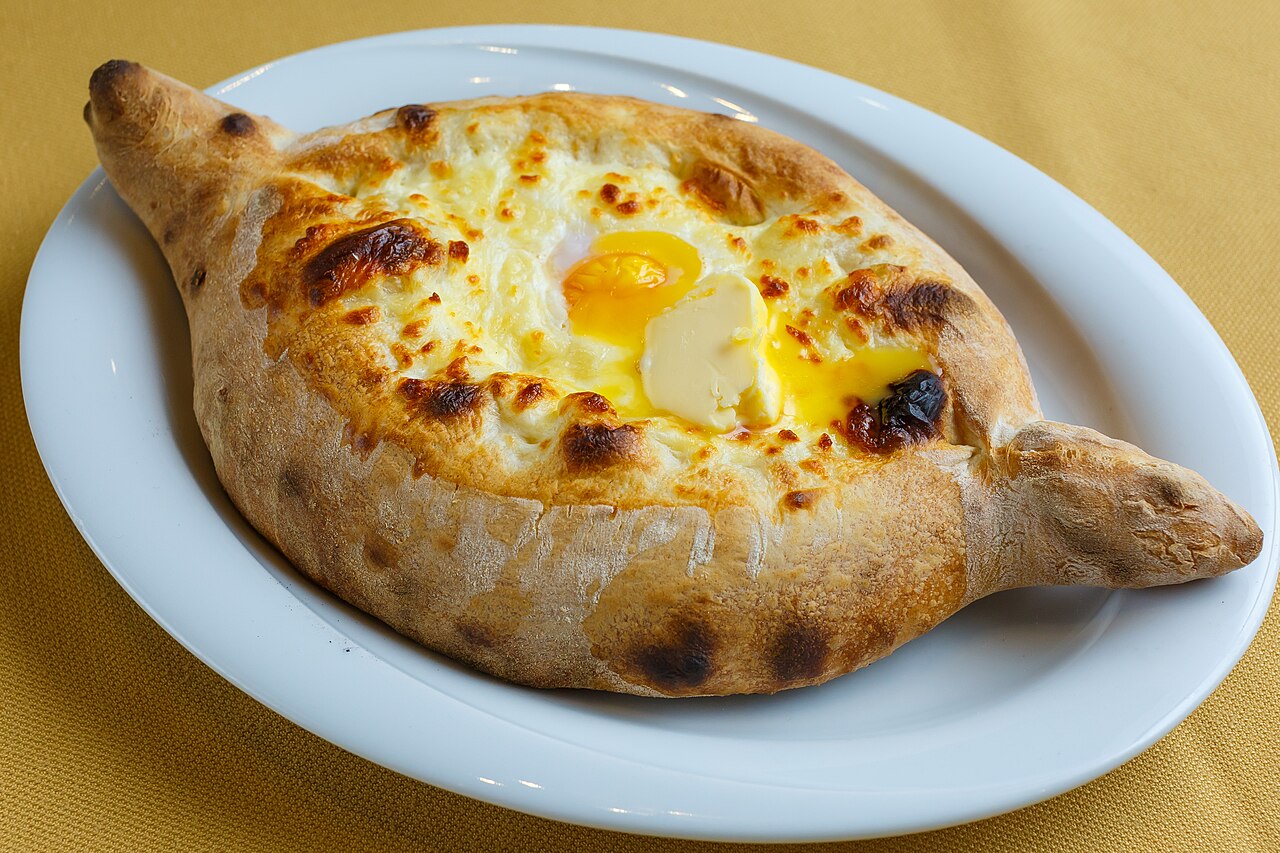
A boat-shaped khachapuri filled with melted cheese and served with a raw egg yolk and a knob of butter in the middle. You stir the yolk and butter into the hot cheese, then tear off pieces of the crust and dip them in. Some say the shape stands for a boat, the cheese for the sea and the yolk for the sun.
It is traditionally made with a mix of tangy Imeretian cheese and stretchy sulguni.
See the recipe
Serves 2
1 h 30 min
Ingredients
250 g strong white bread flour, plus extra for dusting
1 teaspoon dried yeast, 1 teaspoon sugar and 1/2 teaspoon salt
150 ml warm milk and 1 tablespoon oil
200 g grated mozzarella (in place of sulguni)
150 g crumbled feta (in place of Imeretian cheese)
2 very fresh eggs, preferably pasteurised, plus 1 beaten egg for glazing
30 g cold butter, cut in two
Method
Mix the flour, yeast, sugar and salt, add the warm milk and oil, and knead for 8 minutes into a soft dough. Cover and leave in a warm place for about 45 minutes until doubled.
Heat the oven to 240 °C. Mix the two cheeses with a splash of water.
Divide the dough in two and roll each piece into an oval about 30 cm long. Spread a quarter of the cheese in a strip along each long edge, roll the edges inwards over the cheese and pinch the two ends together to make a boat.
Fill the middle of each boat with the rest of the cheese, brush the rims with beaten egg and bake for 12 to 15 minutes until golden.
Take the breads out, make a well in the cheese, drop an egg yolk into each and put back in the oven for 1 to 2 minutes. Add the butter and serve at once, stirring the yolk into the cheese. The yolk stays runny: older people, pregnant women, young children and anyone with a weak immune system should use pasteurised eggs or bake the egg until firm.
The mountains of eastern Georgia (Khevi, Pshavi, Mtiuleti, Khevsureti), now the whole country
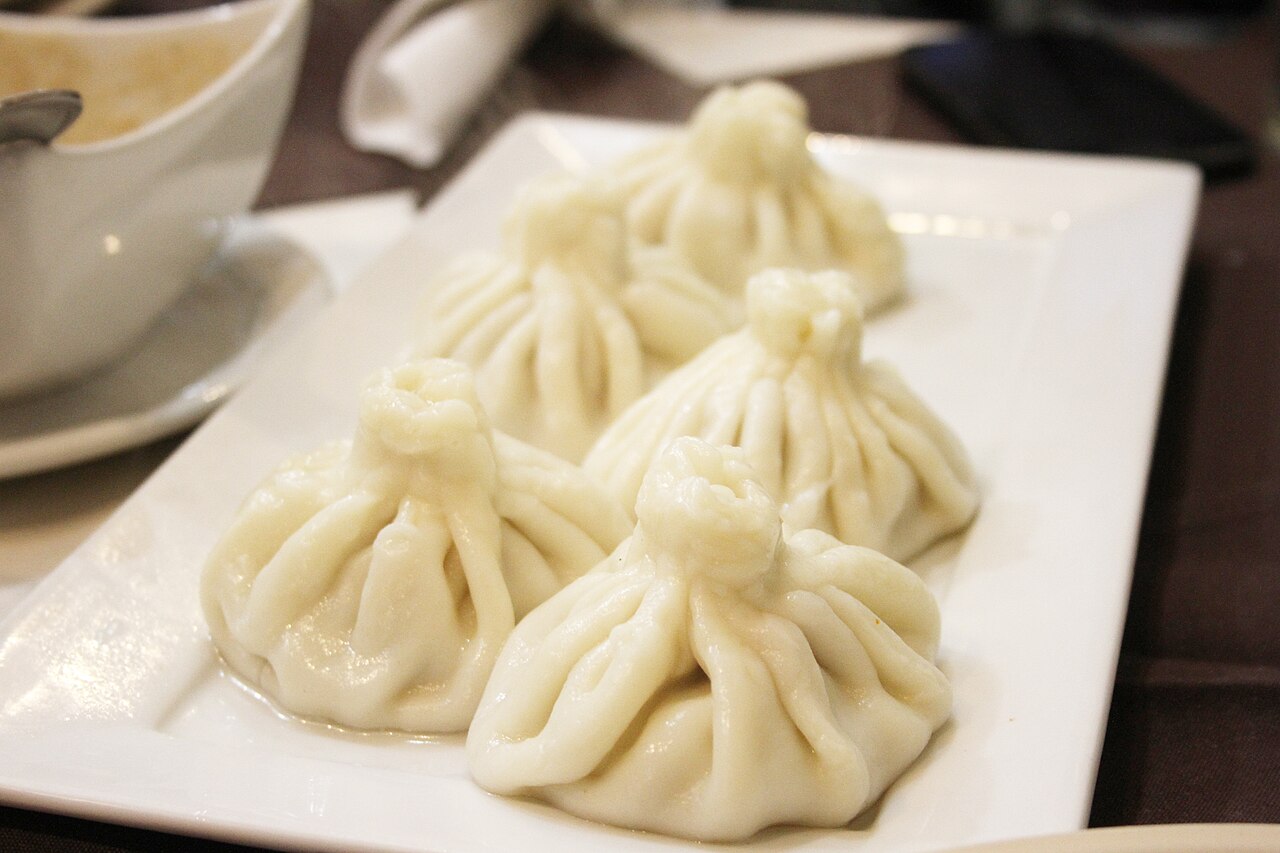
Large twisted dumplings filled with spiced minced meat, often beef and pork, with onion and herbs. Because the meat goes in raw, it releases a hot broth inside while the dumplings boil. Khinkali are eaten with the hands and ground black pepper, often by the dozen. Versions with mushrooms, potato or cheese are also common.
The thick knot of dough on top, called the kudi ('tail'), is used as a handle and left on the plate, so everyone can count how many they have eaten.
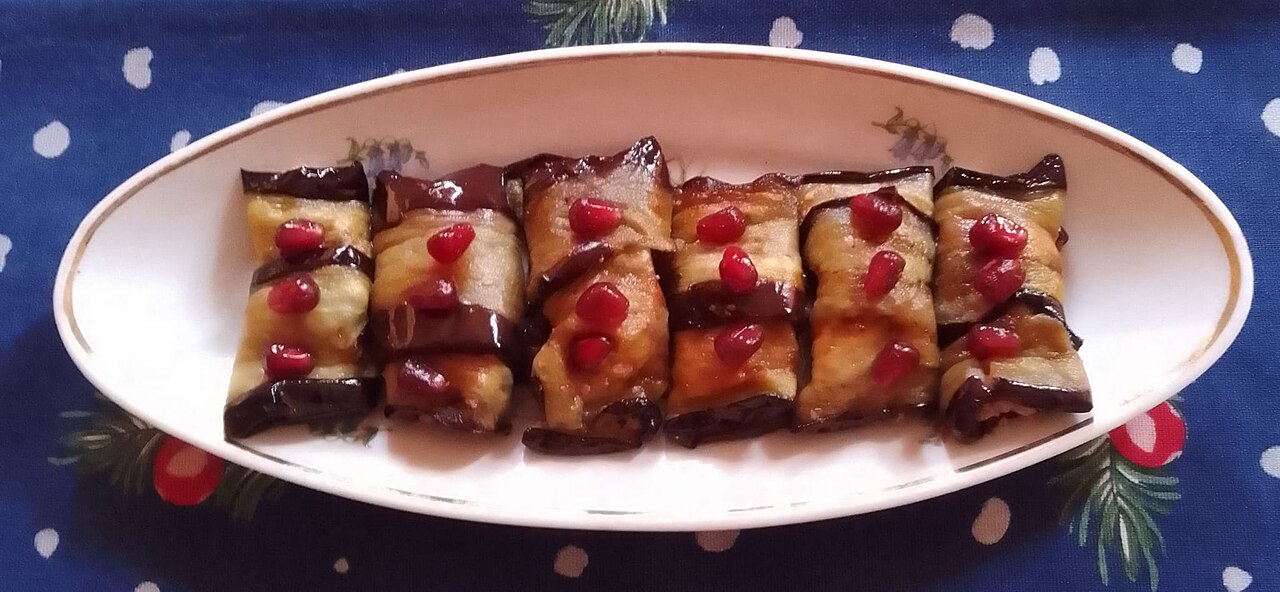
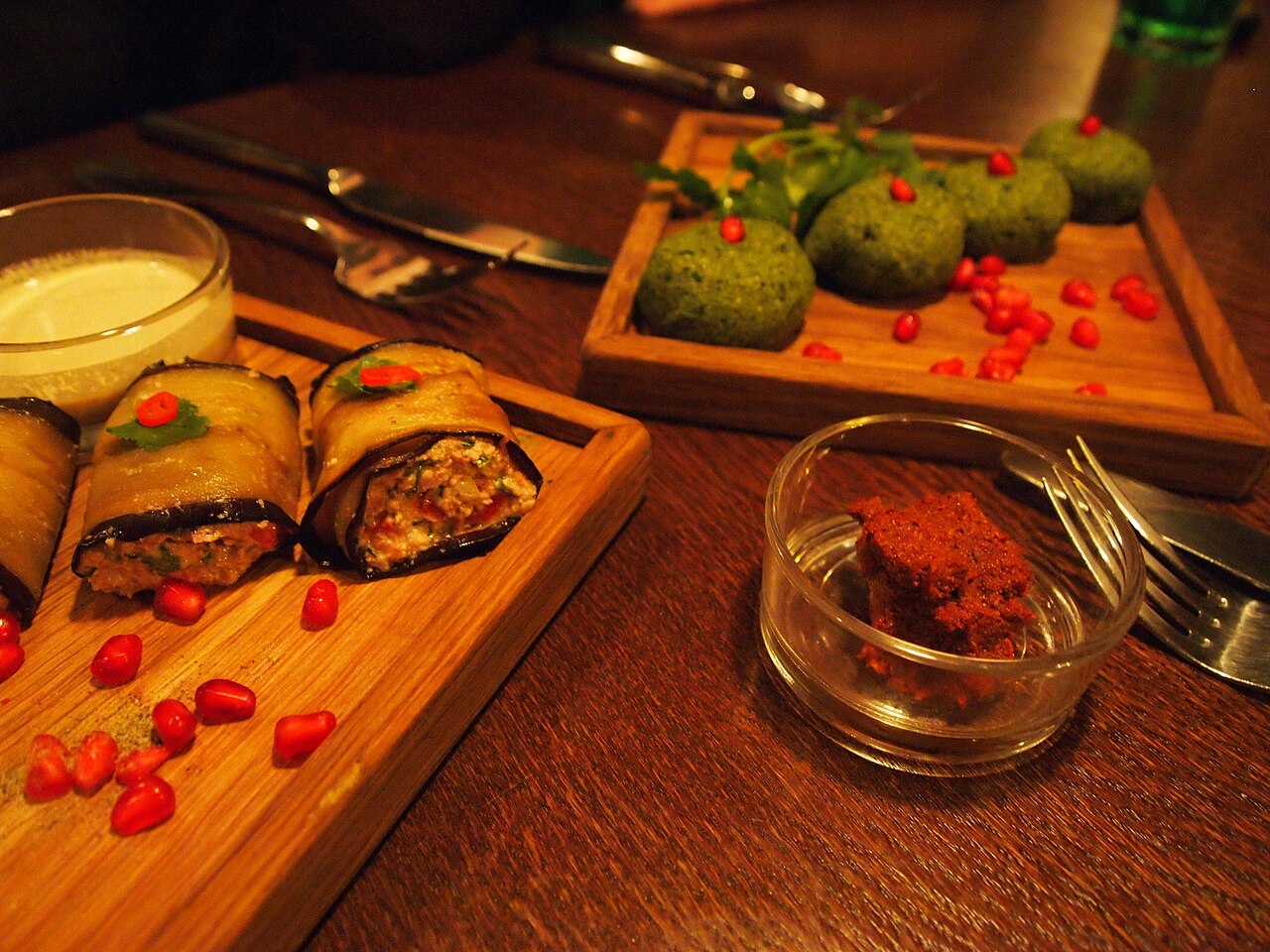
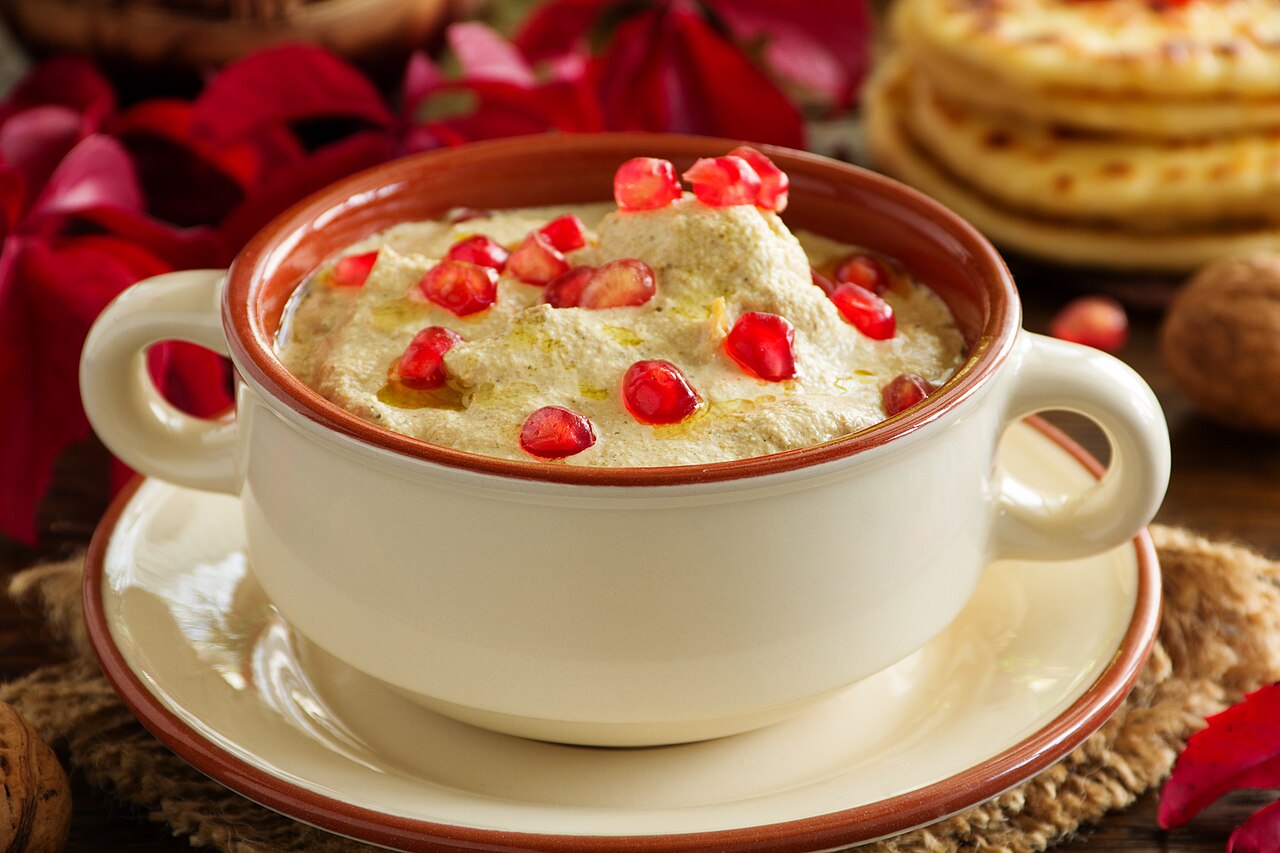
Thin slices of fried aubergine spread with a paste of ground walnuts, garlic, herbs and spices, then rolled up and topped with pomegranate seeds. It is one of the most popular cold dishes on any Georgian table.
See the recipe
Serves 4
50 min
Ingredients
2 medium aubergines
Salt and sunflower oil for frying
150 g shelled walnuts
2 garlic cloves
A handful of fresh coriander, plus a little parsley
1/2 teaspoon ground coriander seed and 1/2 teaspoon ground fenugreek
1 tablespoon white wine vinegar, a pinch of chilli, and about 4 tablespoons water
Seeds of half a pomegranate
Method
Cut the aubergines lengthwise into slices about 5 mm thick. Sprinkle with salt and leave for 20 minutes, then pat dry.
Fry the slices in hot oil for 2 to 3 minutes on each side until soft and golden. Drain on kitchen paper and let them cool.
Blend the walnuts, garlic, herbs, spices, vinegar and a pinch of salt with enough water to make a thick, spreadable paste.
Spread a spoonful of paste over each aubergine slice and roll it up from the narrow end.
Arrange on a plate, scatter with pomegranate seeds and chill for an hour before serving. The dish contains walnuts, so warn guests with nut allergies.
Finely chopped cooked vegetables mixed with a paste of walnuts, garlic, vinegar and herbs, shaped into balls or patties and topped with pomegranate seeds. Restaurants usually serve three kinds together: green spinach, deep red beetroot and white bean.
See the recipe
Serves 4
30 min
Ingredients
500 g fresh spinach
100 g shelled walnuts
1 garlic clove
1 small onion, very finely chopped
A handful of fresh coriander
1/2 teaspoon ground coriander seed and a pinch of ground fenugreek
1 tablespoon white wine vinegar, salt and a pinch of chilli
Pomegranate seeds to finish
Method
Put the spinach in boiling salted water for 1 minute, drain, cool under cold water and squeeze out as much water as you can with your hands.
Blend the walnuts, garlic, fresh coriander, spices, vinegar and a pinch of salt into a thick paste.
Chop the spinach finely and mix it with the walnut paste and the onion. Taste and add salt or vinegar.
Shape into small balls or flat patties, press a few pomegranate seeds on top, and chill for at least 30 minutes. It contains walnuts.
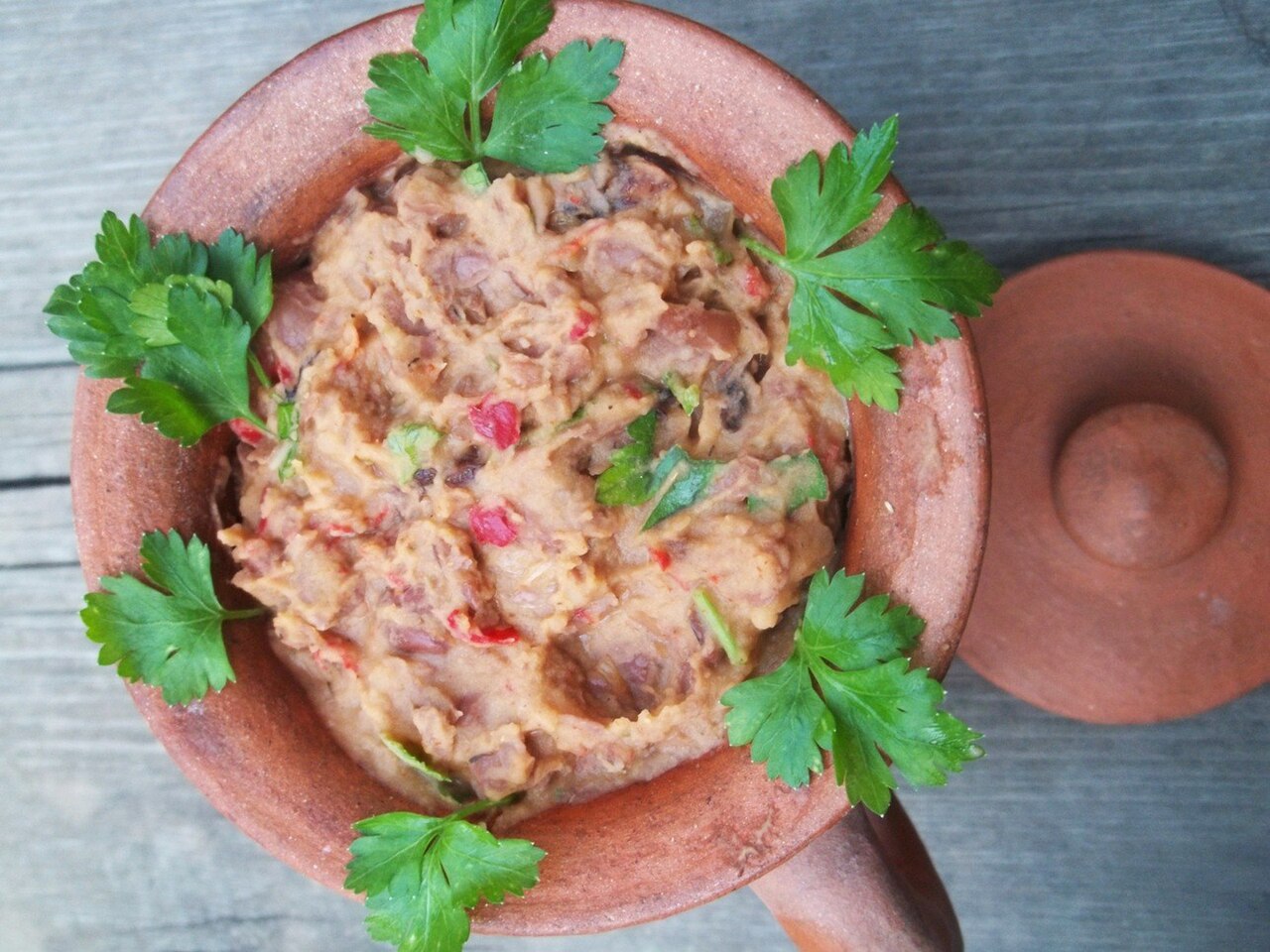
A dish of beans cooked with onion, garlic, coriander and spices, sometimes with walnuts. It is often served hot in a clay pot with mchadi cornbread and pickled vegetables. A cold version, mashed with walnuts and vinegar, is served as a starter.
The red kidney beans used today came from the Americas and reached Georgia only after 1500.
See the recipe
Serves 4
40 min
Ingredients
2 tins (400 g each) red kidney beans, drained, or 250 g dried beans soaked overnight and boiled until soft
2 onions, finely chopped
2 tablespoons sunflower oil
2 garlic cloves, crushed
1 teaspoon ground coriander seed and 1/2 teaspoon dried savory or thyme
A pinch of chilli flakes
A large handful of fresh coriander, chopped
1 tablespoon red wine vinegar, salt
Method
Fry the onions gently in the oil for about 10 minutes until soft and golden.
Add the beans with about 200 ml water, the ground coriander, savory and chilli. Simmer for 15 minutes, stirring now and then.
Mash about half of the beans roughly with a spoon so the stew thickens.
Stir in the garlic, vinegar and most of the fresh coriander, and season with salt. Simmer for 2 more minutes.
Serve hot, sprinkled with the rest of the coriander, with cornbread or crusty bread and pickles.
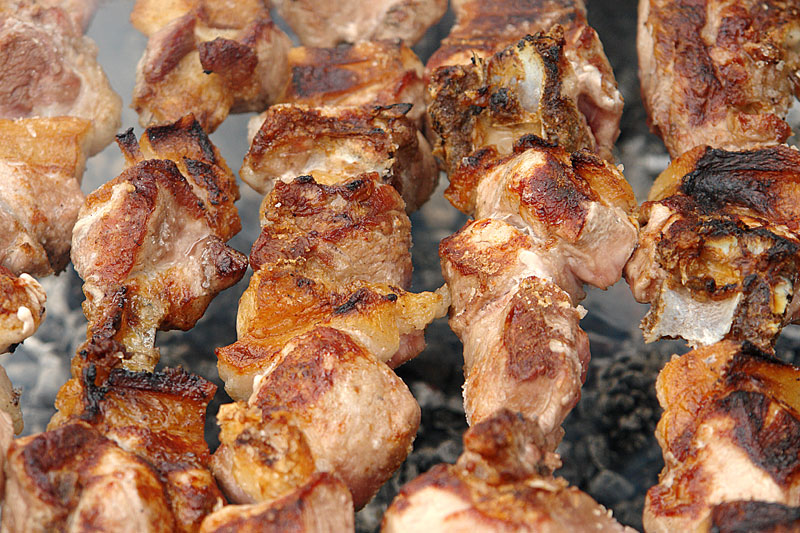
Chunks of pork, lamb or veal threaded on skewers and grilled over hot embers, the Georgian barbecue. It is served simply with raw onion rings and a sour plum sauce called tkemali, and it is a favourite at weekends and feasts outdoors.
Tkemali, made from sour cherry plums, garlic and herbs, is used in Georgia much as ketchup is used elsewhere.
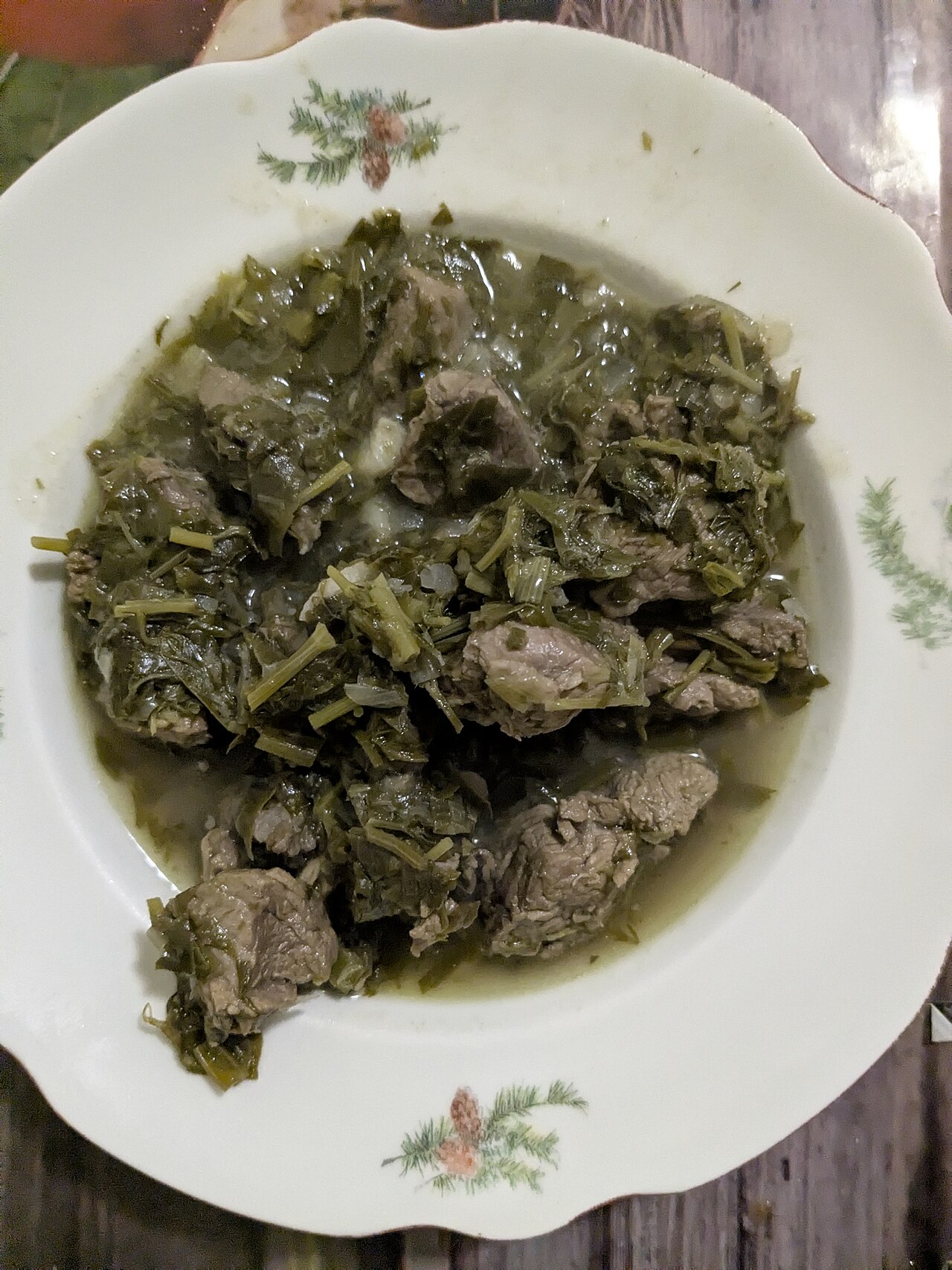
A green, tangy stew of lamb or veal cooked with dry white wine, a large amount of fresh tarragon, other herbs, garlic and sour cherry plums or tkemali sauce. It is one of the most popular dishes in Georgia, and there are also versions with beef or mushrooms.
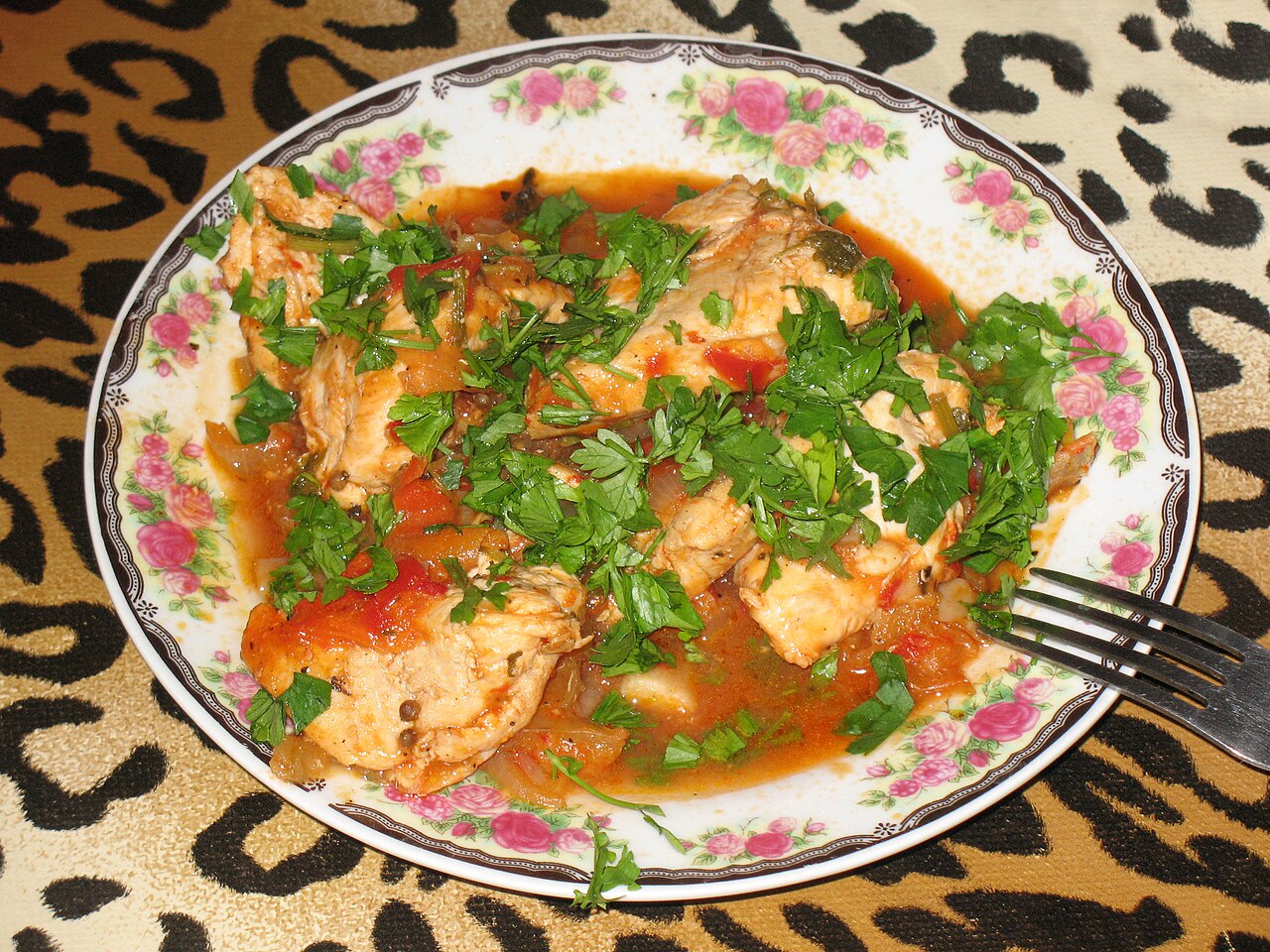
Chicken stewed with onions, tomatoes, garlic and plenty of fresh herbs. The chicken pieces are first browned in a dry pan, without oil, in their own fat.
The name comes from khokhobi, the Georgian word for pheasant, the bird it was first made with.
See the recipe
Serves 4
1 h
Ingredients
1 kg chicken thighs and drumsticks, with skin
3 onions, sliced
600 g ripe tomatoes, peeled and chopped, or 1 tin chopped tomatoes
3 garlic cloves, chopped
1 teaspoon ground coriander seed, 1/2 teaspoon ground fenugreek and a pinch of chilli
A large handful each of fresh coriander, basil and dill, chopped
Salt and pepper
Method
Put the chicken skin side down in a large dry pan over medium heat and brown it well on all sides in its own fat, about 10 minutes.
Add the onions and cook for 10 minutes more, stirring, until soft.
Add the tomatoes, spices, salt and pepper, cover and simmer gently for 30 minutes until the chicken is cooked through.
Stir in the garlic and most of the herbs and cook for 2 more minutes. Serve scattered with the rest of the herbs, with bread to mop up the sauce.
Boiled chicken or turkey served cold in a thick, creamy sauce of ground walnuts, garlic, fenugreek, coriander and other spices. The name means 'cold dish'. It is a staple of winter holiday feasts, above all at New Year.
The village of Shkmeri in Racha, now the whole country
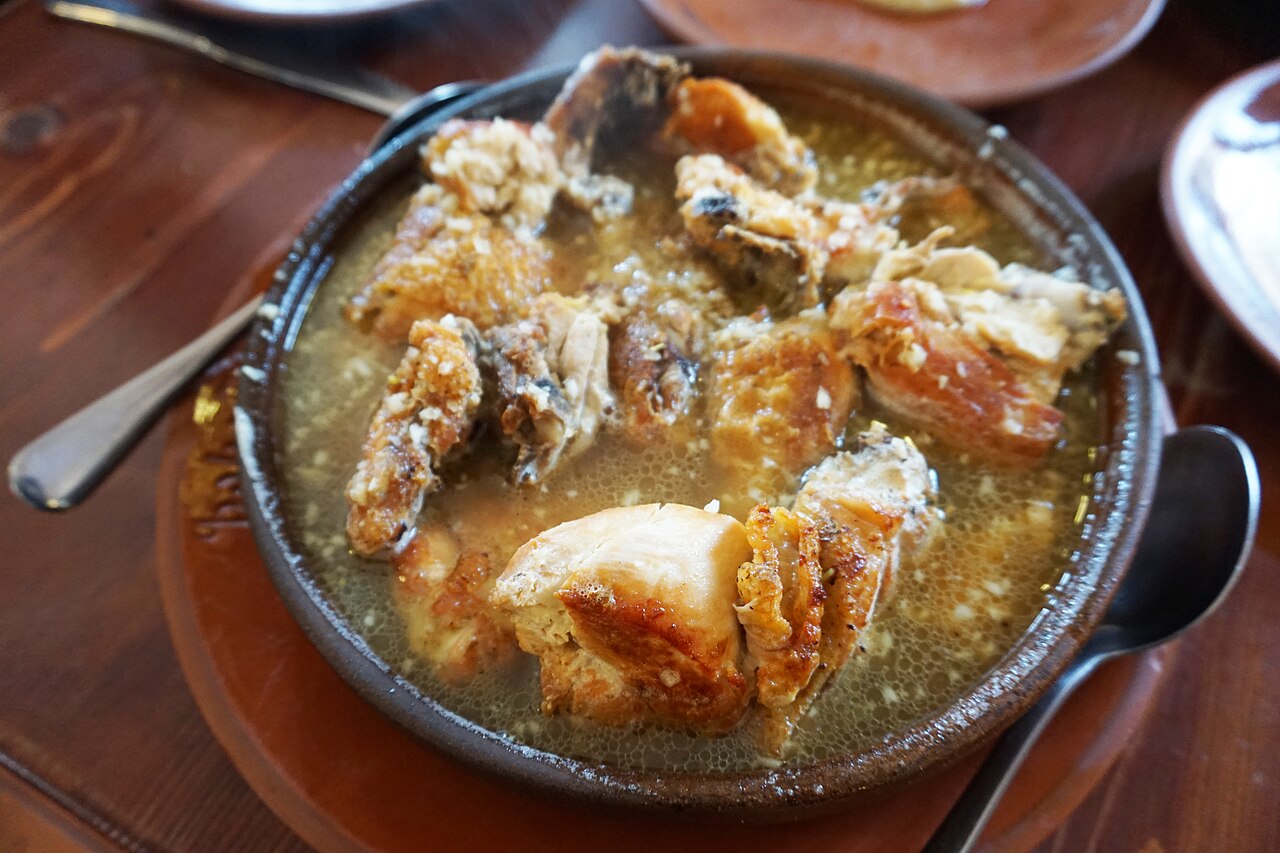
Chicken fried until crisp and then cooked for a short time in a rich sauce of garlic and milk or cream, often served bubbling in a clay dish with bread for dipping.
In 2019 the Japanese restaurant chain Matsuya began serving shkmeruli, and the dish soon became well known across Japan.
The whole country; Samegrelo has its own thicker version
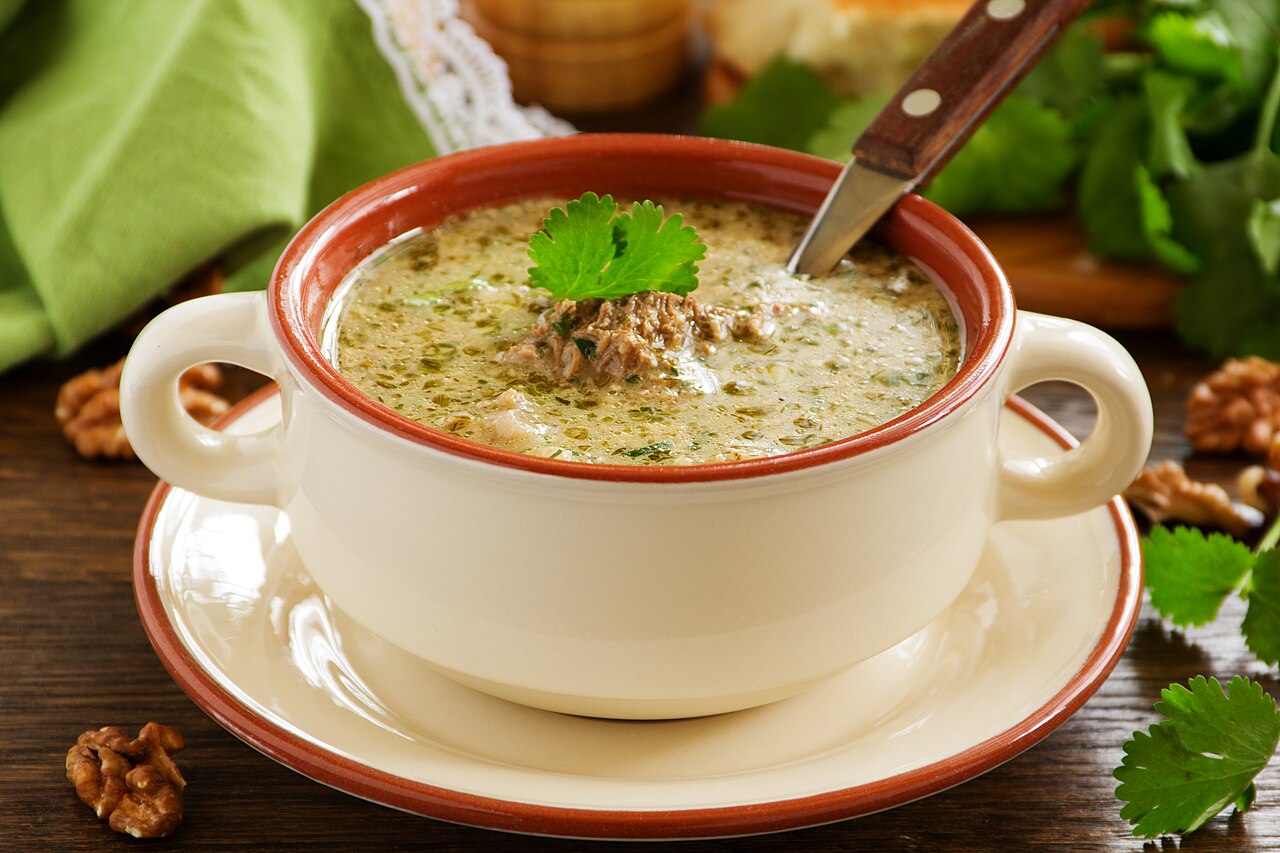
A hearty beef soup made sour with cherry plum purée and thickened with rice and chopped walnuts, flavoured with the spice mix khmeli suneli and lots of fresh coriander. In Samegrelo it is made as a thick stew without rice and served with ghomi, a cornmeal porridge.
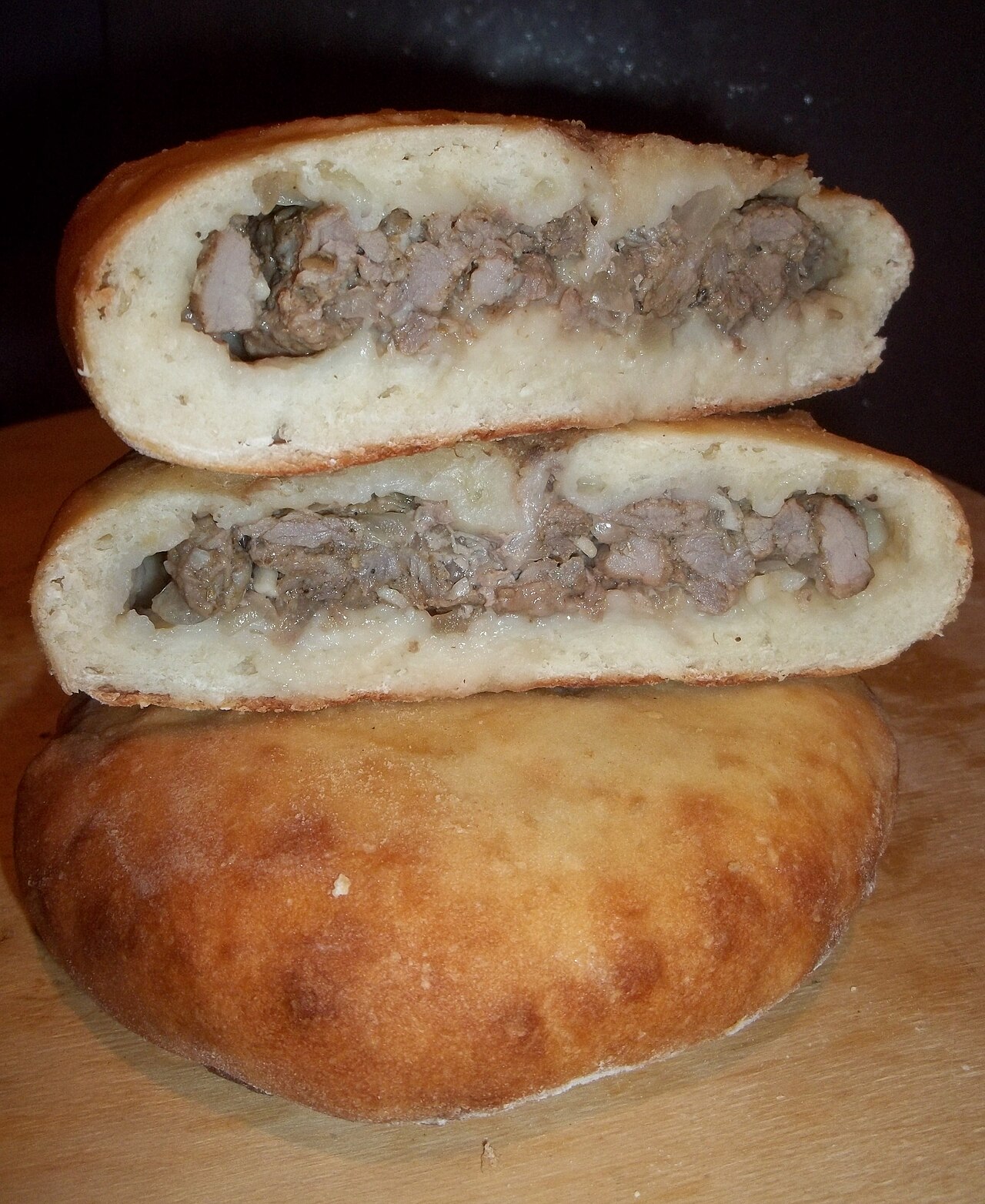
A round, filled bread from Svaneti. The yeast dough is stuffed with chopped beef, pork or lamb seasoned with onion, garlic, and Svan salt, a mix of salt and herbs, then baked. It is filling enough to be a whole meal.
Kubdari was added to Georgia's national list of intangible cultural heritage in 2015.
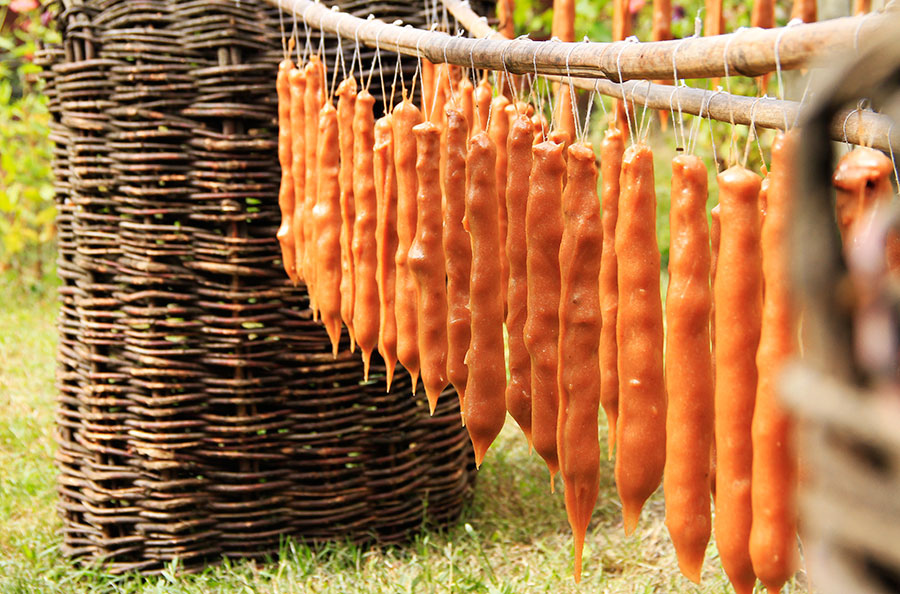
Strings of walnuts or hazelnuts dipped again and again in grape juice thickened with flour, then hung up to dry into chewy sausage-shaped sweets. You see them hanging in bunches at every market. They are a snack between meals and a treat at New Year and Christmas.
Because they are rich in energy and keep well, Georgian soldiers used to carry churchkhela with them.
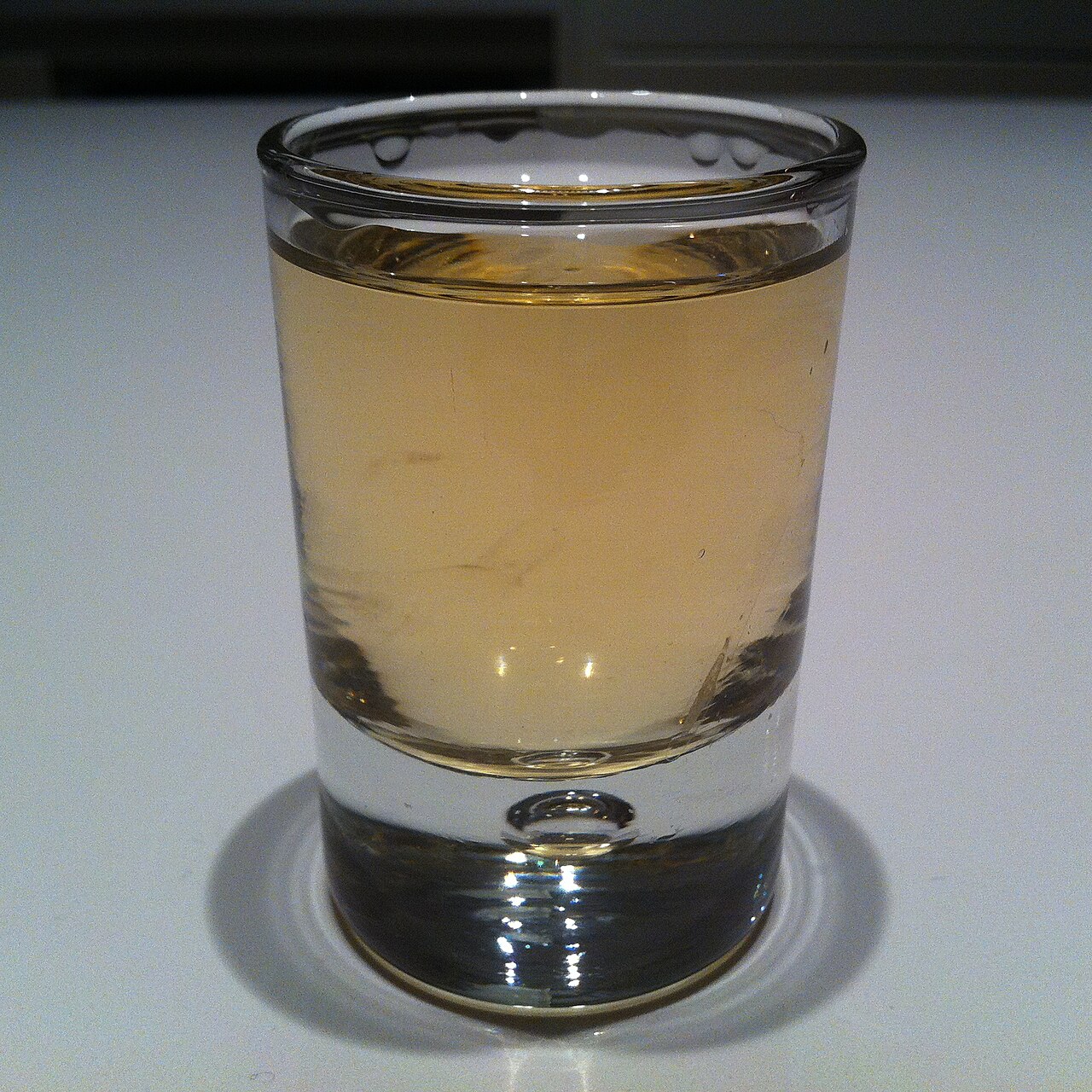
A clear, strong brandy distilled from grape pomace, the skins, seeds and stems left over after winemaking. Shop-bought chacha is usually 40 percent alcohol or more; homemade chacha is often much stronger. It is sipped in small glasses, sometimes flavoured with fruit or tarragon.
In Georgian the word chacha also means the pomace itself, the leftovers in the qvevri jar after the wine is drawn off.
Table manners
At a supra, the tamada (toastmaster) proposes each toast in turn: to peace, to the hosts, to parents, to those no longer here. Wait for the toast before you drink, and if the tamada invites you, add a few words of your own.
Eat khinkali with your hands. Hold it by the knot on top, take a small bite, sip the hot broth, then eat the rest and leave the knot on your plate.
The table is full from the start and more dishes keep coming. Take a little of many dishes rather than a lot of one, because hosts love to keep feeding their guests.
Georgians are famous for their hospitality. If you are invited, your host will usually insist on paying, and arguing about the bill can embarrass them.
Many restaurants add a service charge of about 10 percent to the bill; check before adding a tip.
Homemade wine and chacha are offered generously. It is fine to sip slowly or to politely say you have had enough.
About a third of all Georgians live in Tbilisi, on the Mtkvari River in the east. Nearby are the old capital Mtskheta, the industrial city of Rustavi and Gori. Further east lies Kakheti, the wine region, with Telavi and hilltop Sighnaghi. In the west are Kutaisi, the ancient heart of Colchis, and Batumi on the Black Sea. In the mountains are Mestia in Svaneti, Stepantsminda below Mount Kazbek, the spa town of Borjomi and Akhaltsikhe in the south.
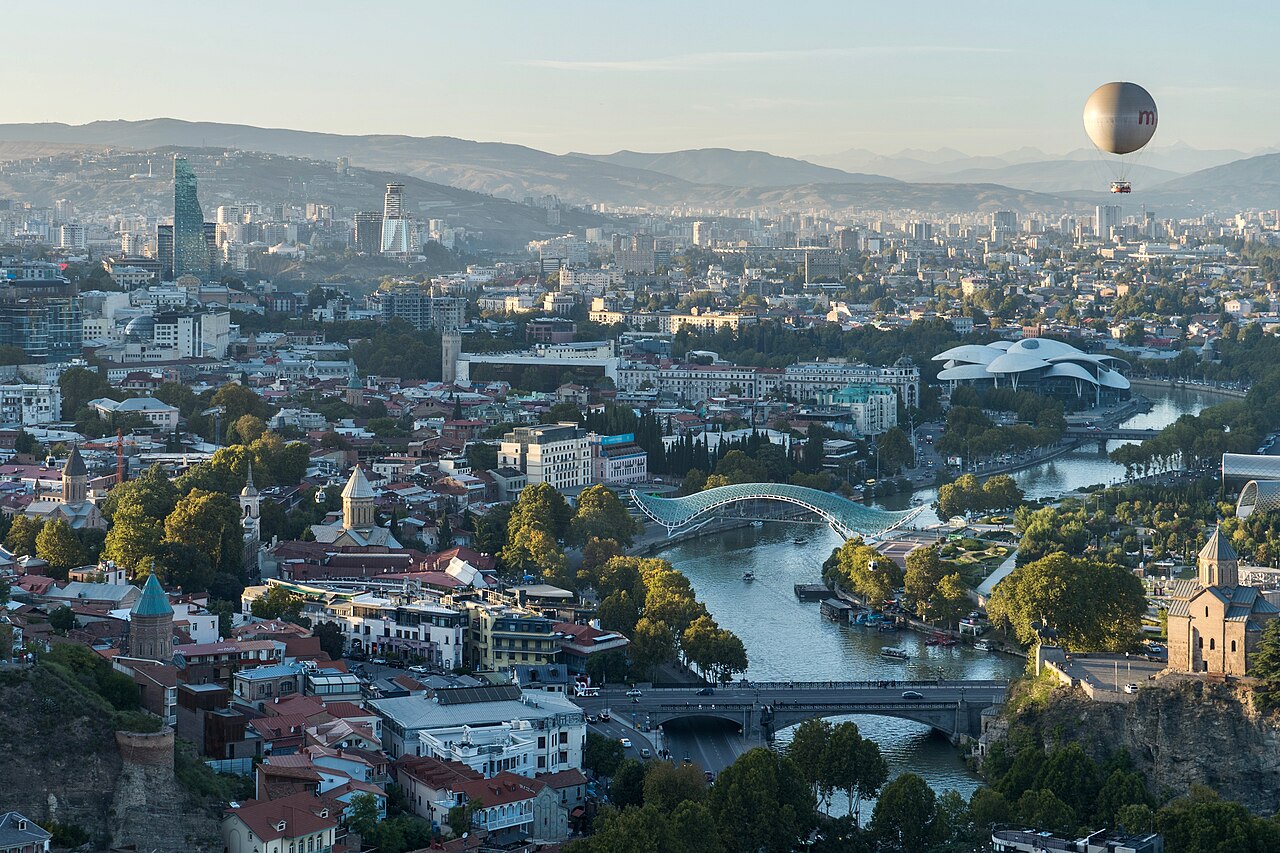
The capital and largest city, home to more than a million people, in a valley on both banks of the Mtkvari River. Legend says King Vakhtang I founded it in the 5th century after his falcon and the pheasant it had caught fell into a hot spring; the name comes from the Georgian word tbili, 'warm'. Its old town mixes churches, a mosque, synagogues, carved wooden balconies and domed sulphur baths below the Narikala fortress.
The old town and the domed sulphur baths of Abanotubani
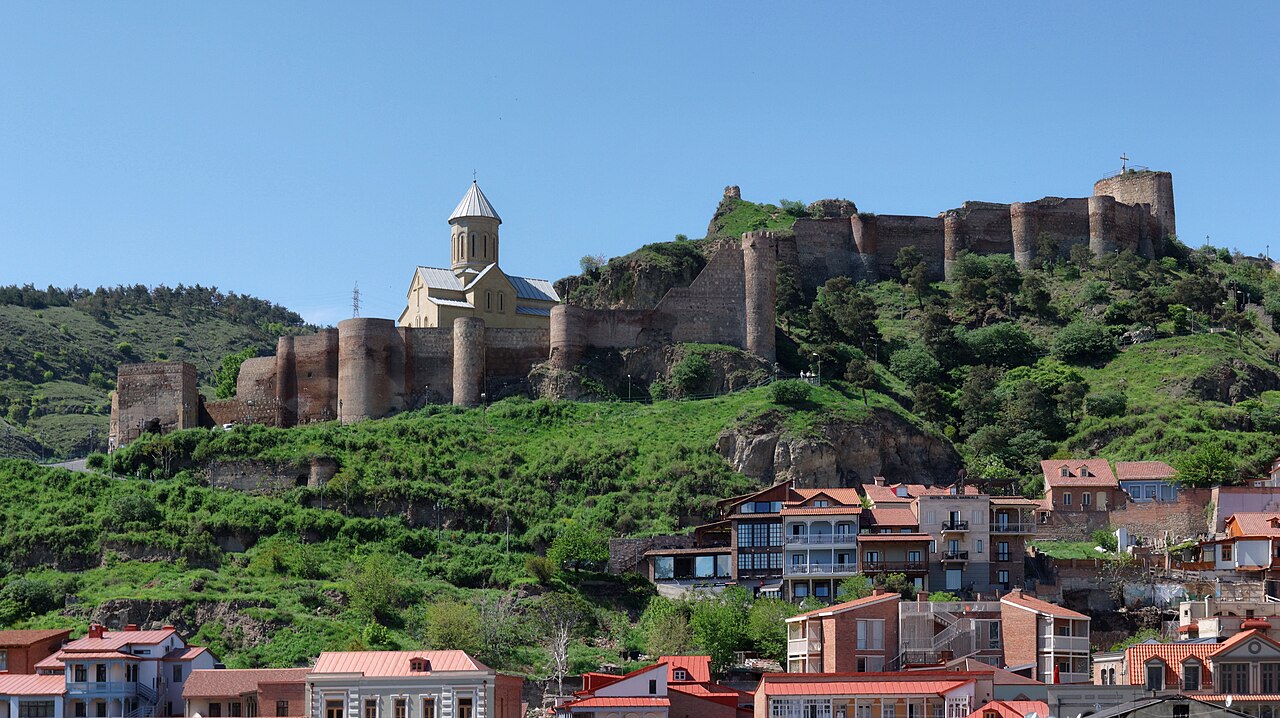
Narikala fortress above the river
Rustaveli Avenue, with the opera house and the Georgian National Museum
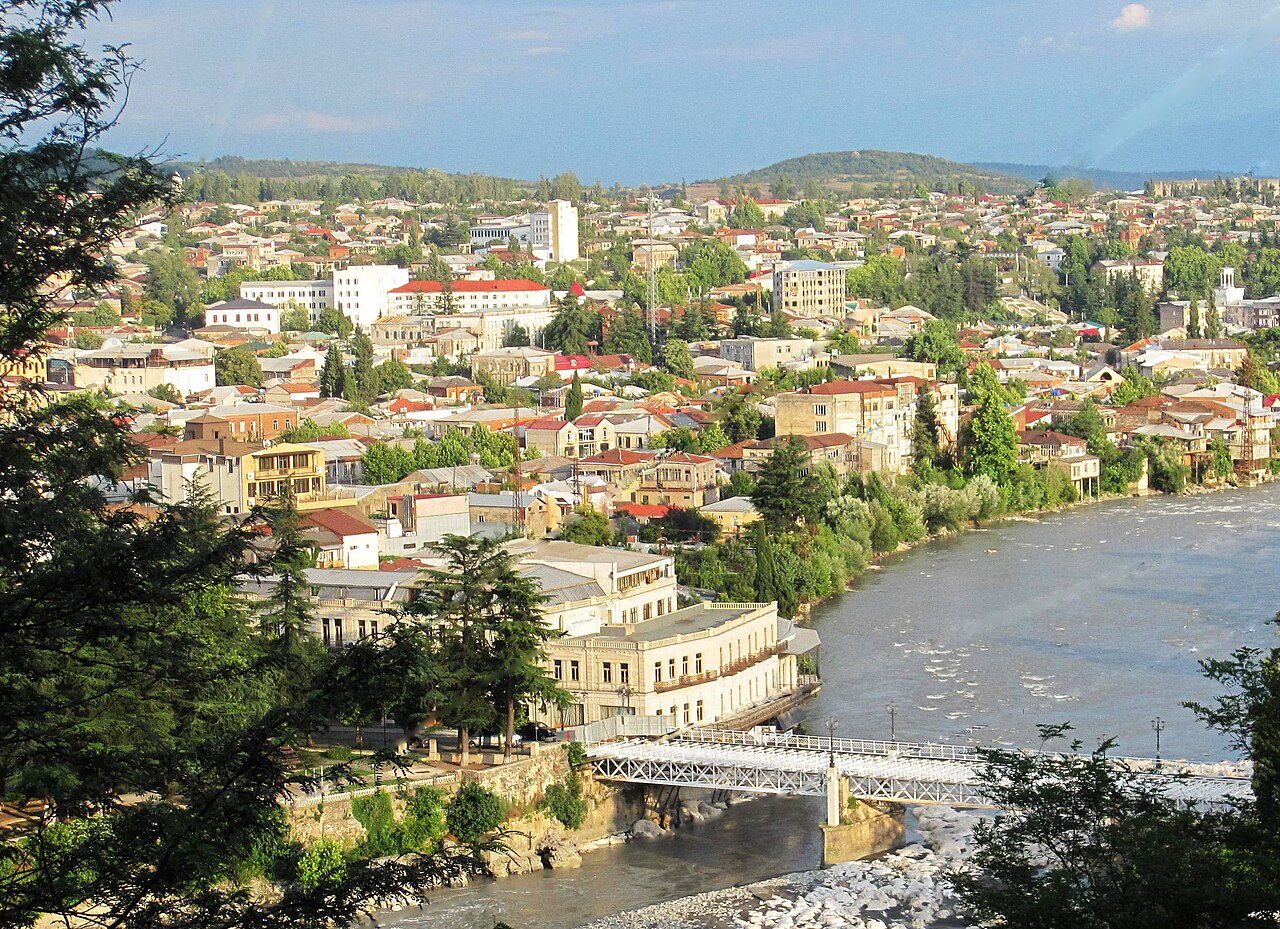
One of the oldest continuously inhabited cities in the world, on the Rioni River. It was a centre of ancient Colchis, linked in Greek legend with Jason and the Golden Fleece, and later the capital of the united Kingdom of Georgia until 1122 and then of the Kingdom of Imereti. From 2012 to 2018 the Georgian parliament met here.
Bagrati Cathedral, built by King Bagrat III
Gelati Monastery, a UNESCO World Heritage Site nearby
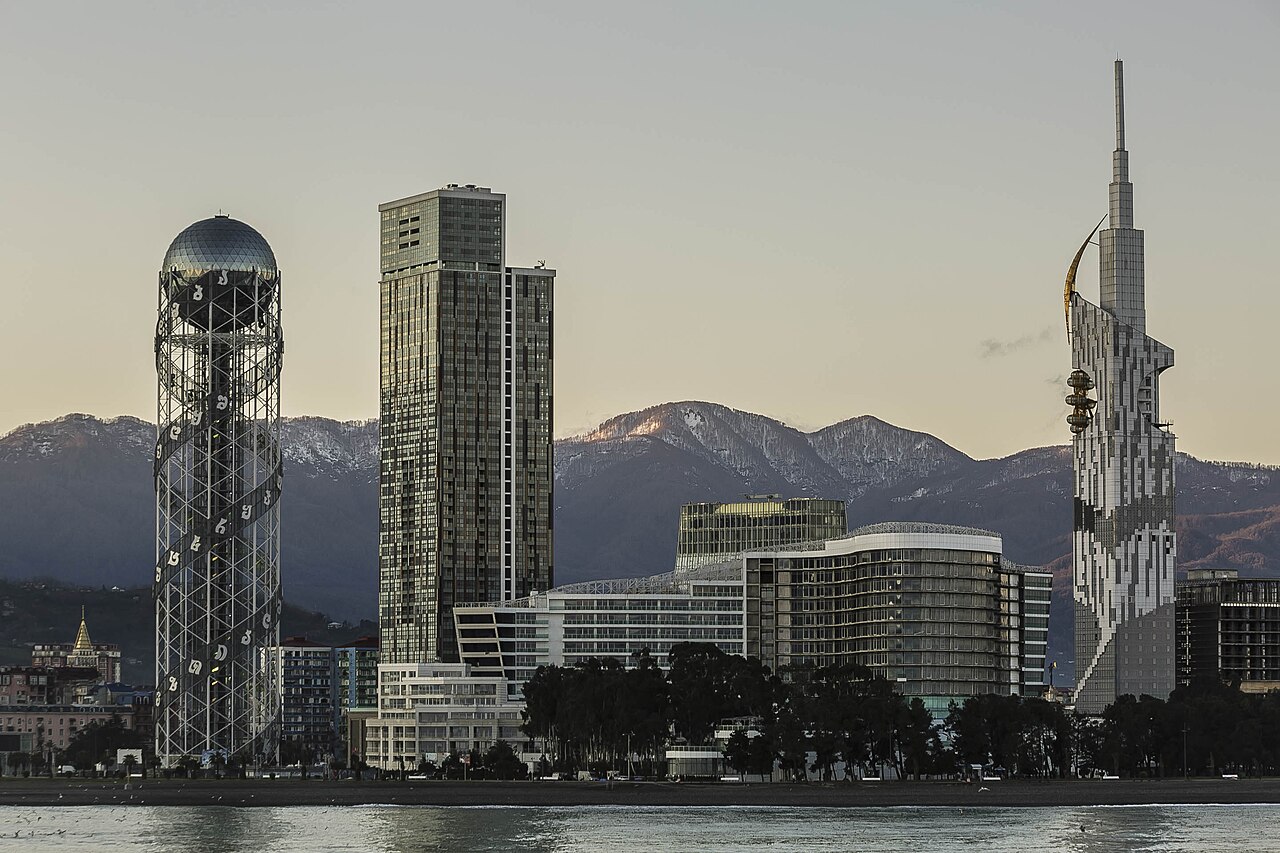
The capital of the Autonomous Republic of Adjara and Georgia's main seaside resort and port, on the Black Sea about 20 km from the border with Turkey. Since 2010 it has filled with modern towers, while its 19th-century old town has been restored. The climate is warm and very wet.
The long seaside boulevard
The Alphabetic Tower, decorated with the letters of the Georgian alphabet
Adjarian khachapuri and the Batumi Botanical Garden
An industrial city on the Mtkvari River, about 20 km southeast of Tbilisi. An ancient town stood here until it was ruined by medieval invasions; the modern city was built in the Soviet era around a large steelworks. It is one of the biggest cities in the country.
The Rustavi steelworks
The Rustavi International Motorpark, a motor racing circuit
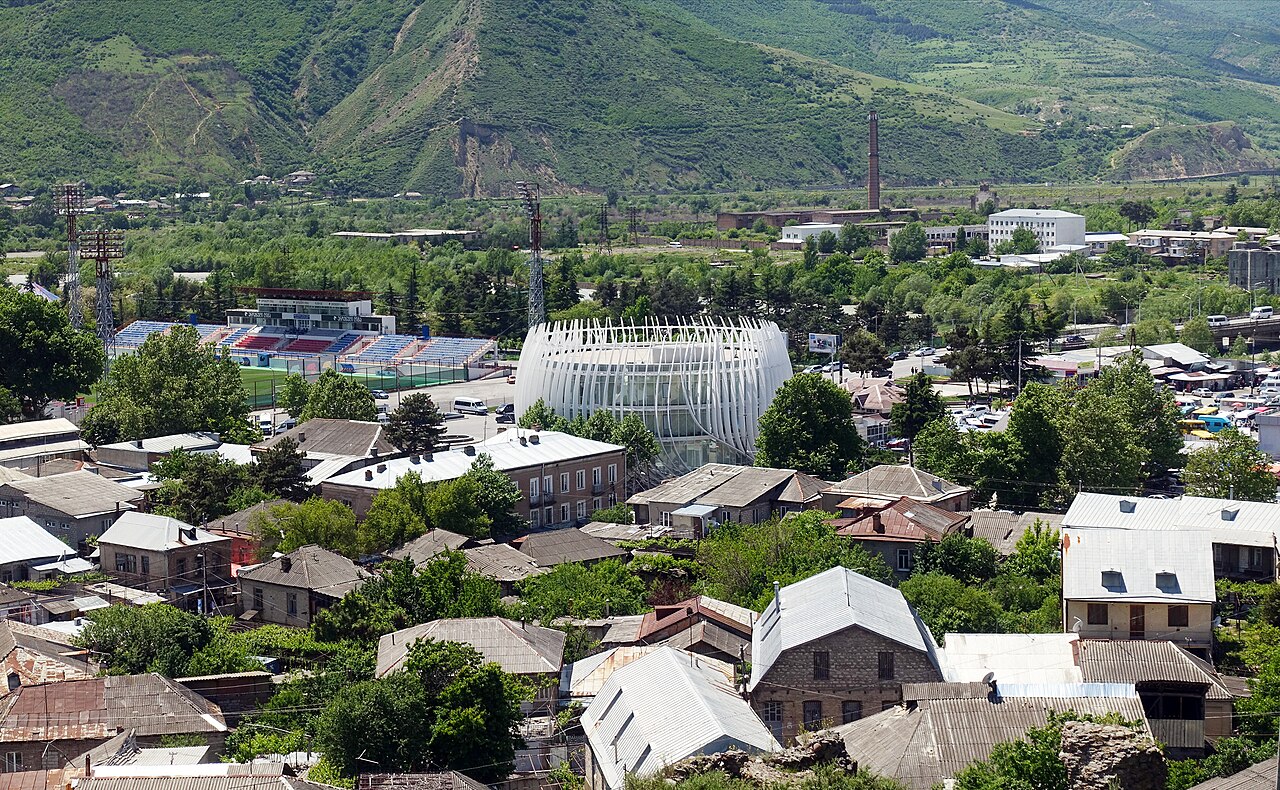
A town where the Mtkvari and Liakhvi rivers meet, about 85 km west of Tbilisi by road, on the main highway between east and west Georgia. A medieval fortress stands on a hill in the centre. Gori is known as the birthplace of Joseph Stalin; the museum there tells the story of his life.
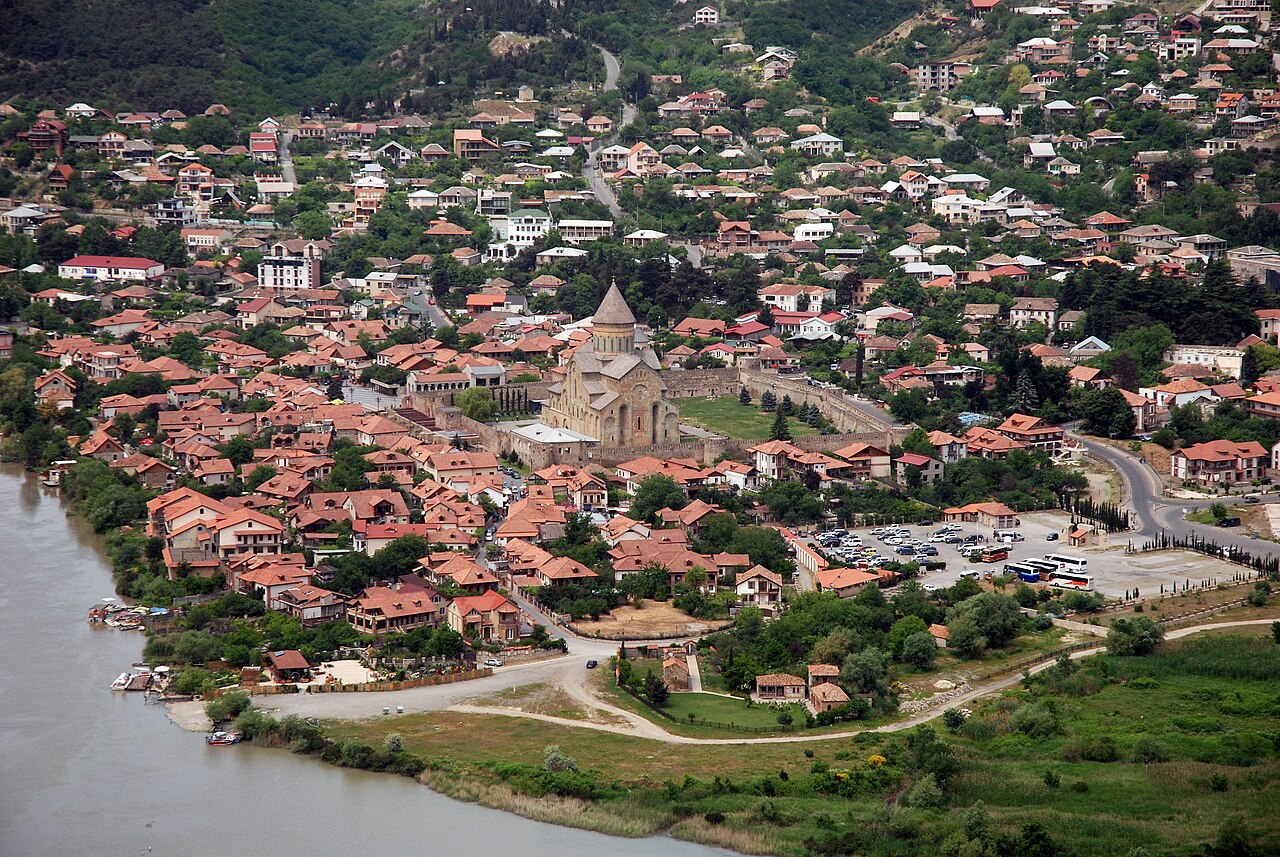
The ancient capital of the Kingdom of Iberia, where the Mtkvari and Aragvi rivers meet, about 20 km north of Tbilisi by road. It is the birthplace of Christianity in Georgia, and the Georgian Orthodox Church calls it the 'Holy City'. Its historic monuments have been a UNESCO World Heritage Site since 1994.
The main town of Kakheti, Georgia's great wine region, on the foothills above the Alazani Valley. From the 10th to the 12th centuries it was the capital of the Kingdom of Kakheti, and later King Heraclius II was born and ruled here.
The fortress and palace of King Heraclius II
Wineries and vineyards of the Alazani Valley
A plane tree in the town centre said to be many centuries old
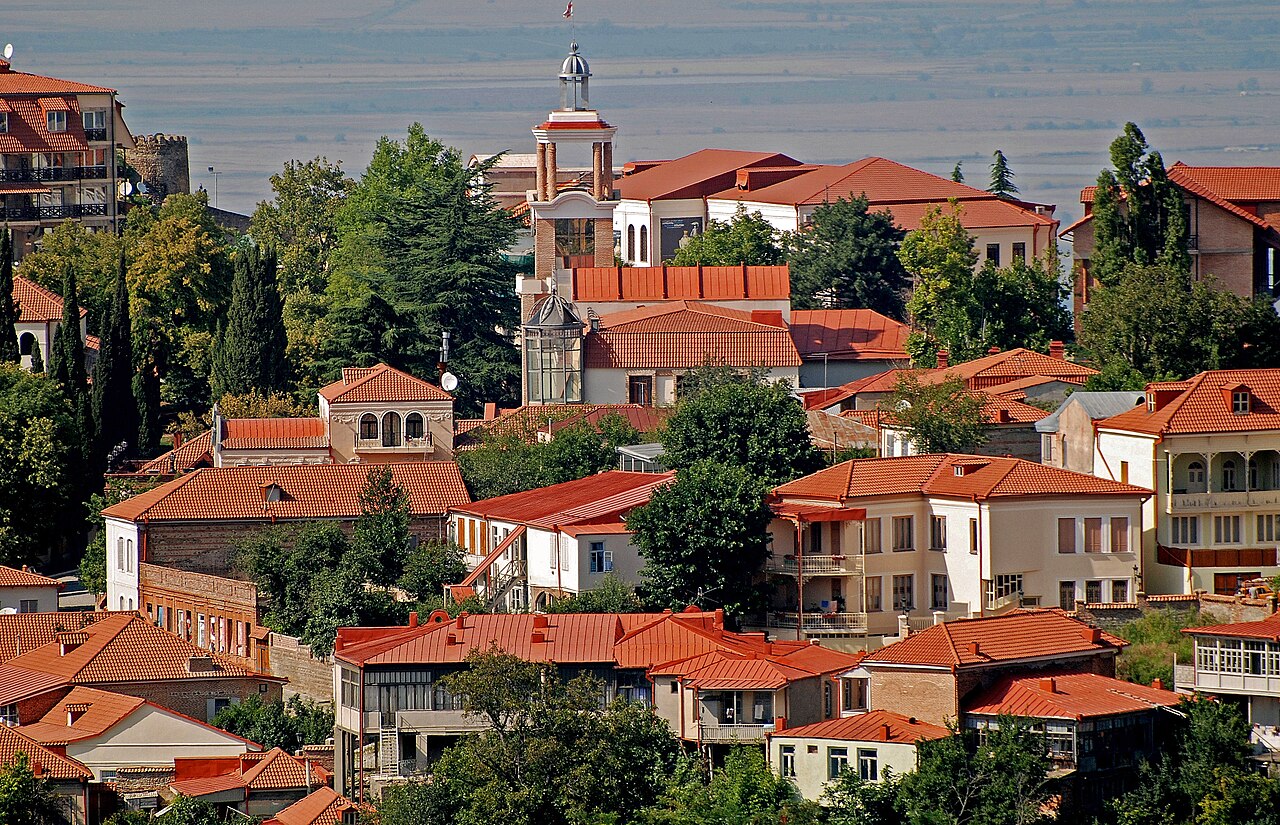
One of Georgia's smallest towns, on a steep hill looking across the Alazani Valley to the Caucasus. King Heraclius II built its long defensive wall in the 18th century. Its pastel houses, balconies and cobbled lanes make it a favourite with visitors.
The main town of Upper Svaneti, at about 1,500 m in the Caucasus Mountains. It is full of medieval stone defensive towers, called Svan towers, and has a small airport. It is the starting point for walks and trips to Ushguli and the high peaks.
A small mountain town, formerly called Kazbegi, at about 1,740 m on the Terek River, about 155 km north of Tbilisi by road along the Georgian Military Road. Mount Kazbek, an old volcano about 5,050 m high, rises just to the west.
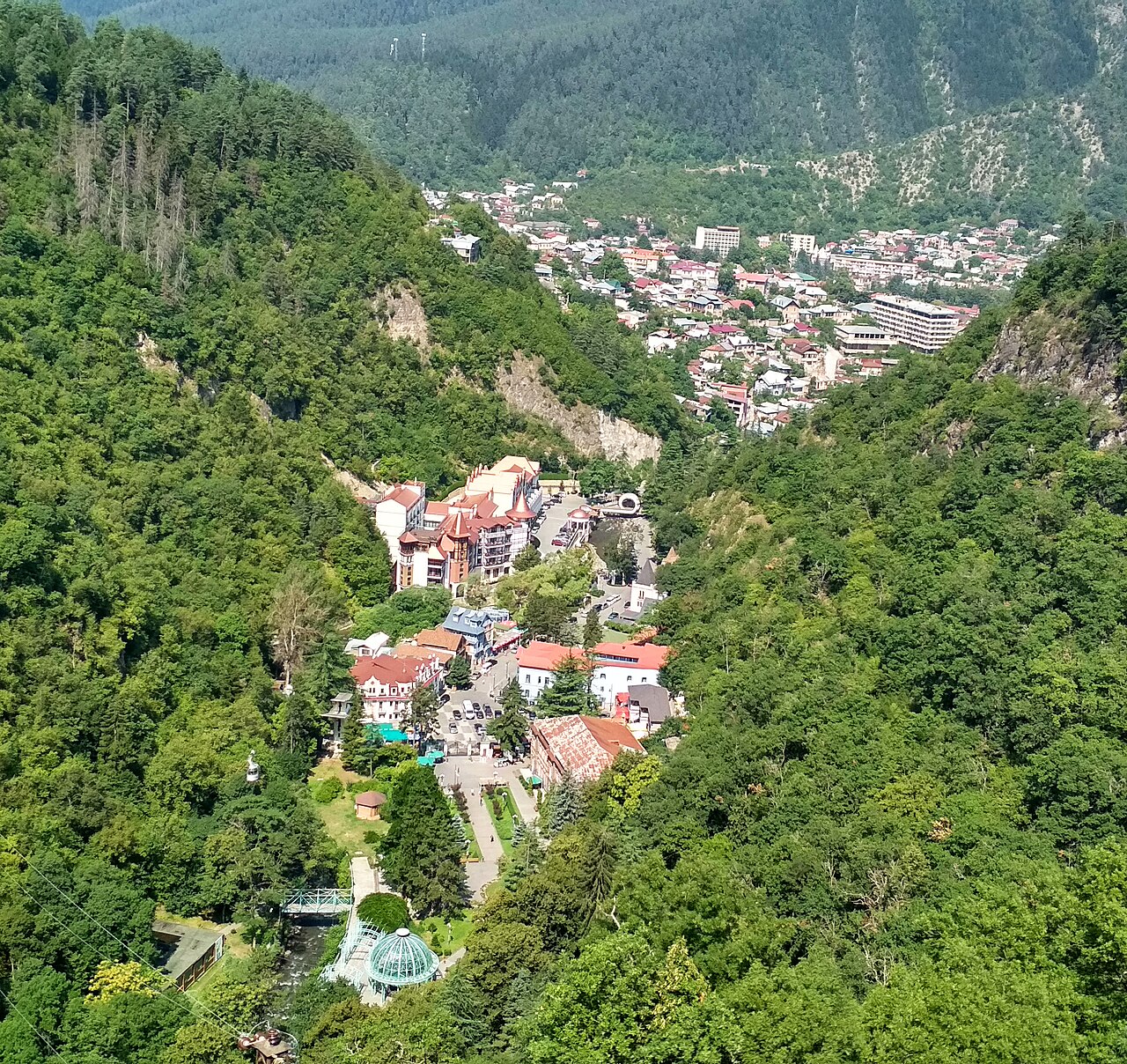
A spa town in a forested gorge of the Mtkvari River, about 165 km from Tbilisi by road. Its salty, fizzy mineral water is bottled and sold across the former Soviet Union and beyond. It stands at the edge of Borjomi-Kharagauli National Park.
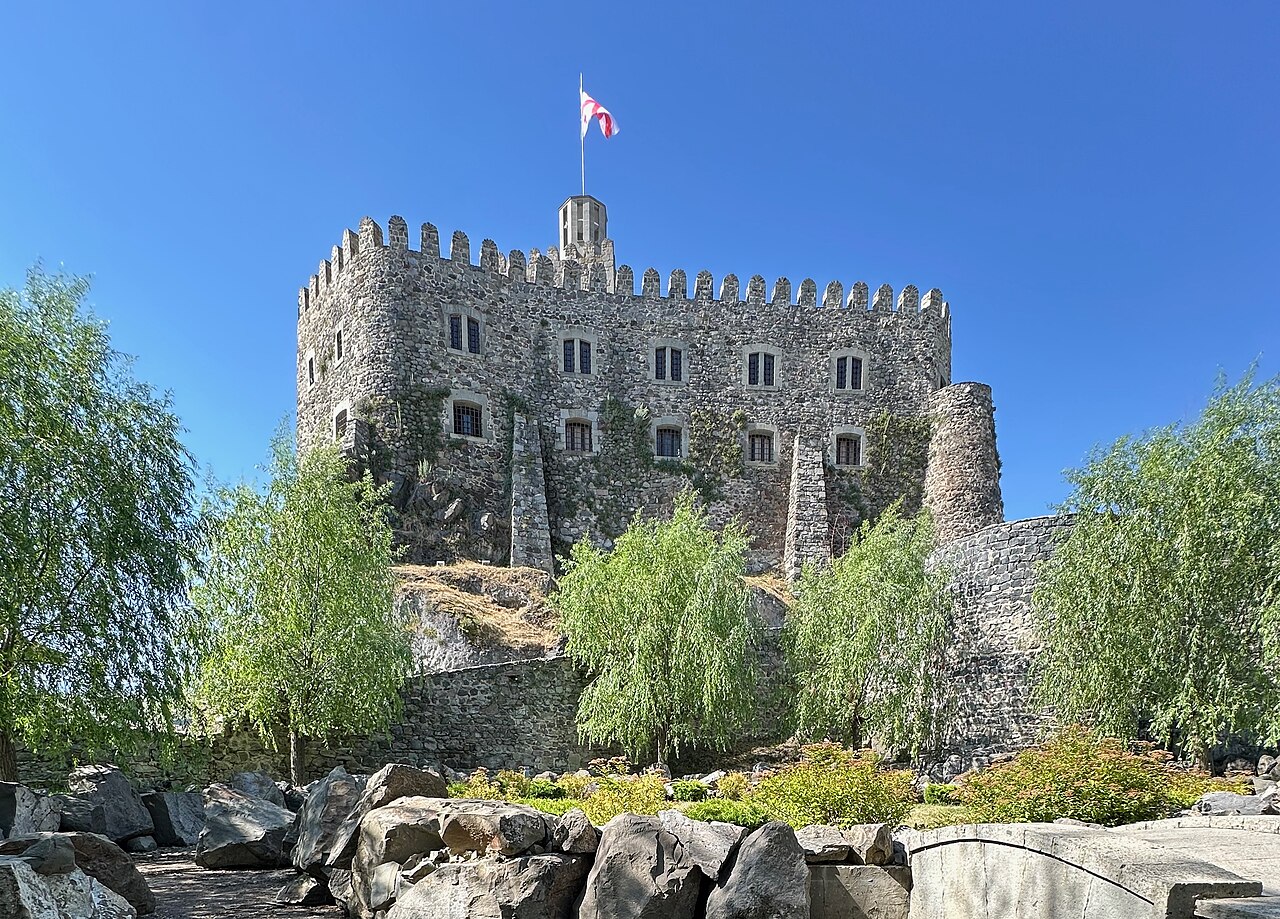
The main town of the southern region of Samtskhe-Javakheti, at about 1,000 m. Its name means 'new fortress'. It was the seat of the Jaqeli princes from the 13th century and was held by the Ottomans for nearly 250 years until 1828.
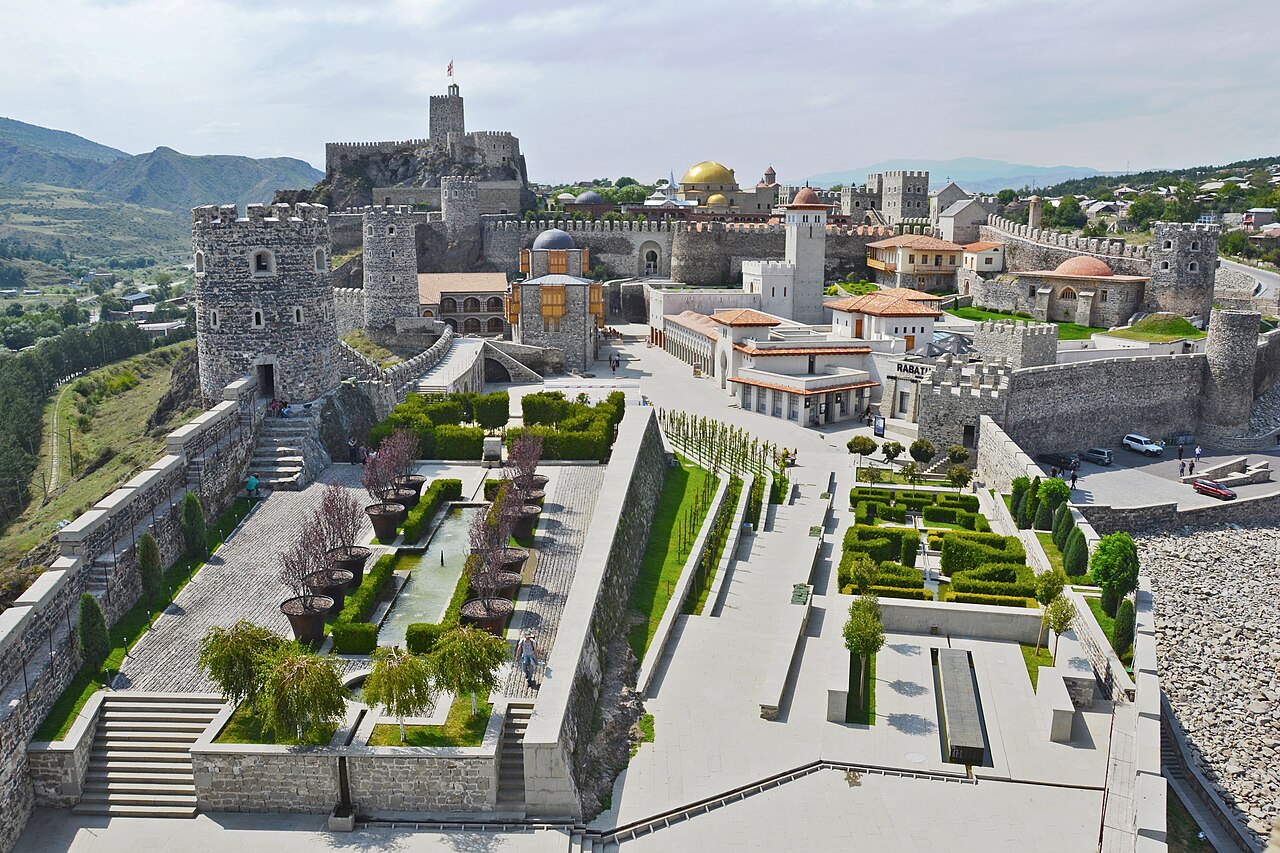
Rabati Castle, the restored fortress above the town
The main base for trips to the cave monastery of Vardzia
A mix of Georgian, Armenian, Jewish and Muslim heritage
An old fortress on a steep ridge above the Mtkvari River and the sulphur baths of Tbilisi. A fort stood here by the 4th century; it was enlarged by Arab rulers and by King David IV, and most of the walls that survive date from the 16th and 17th centuries. The Church of St Nicholas inside was rebuilt in the 1990s. A cable car climbs to it from the riverside.
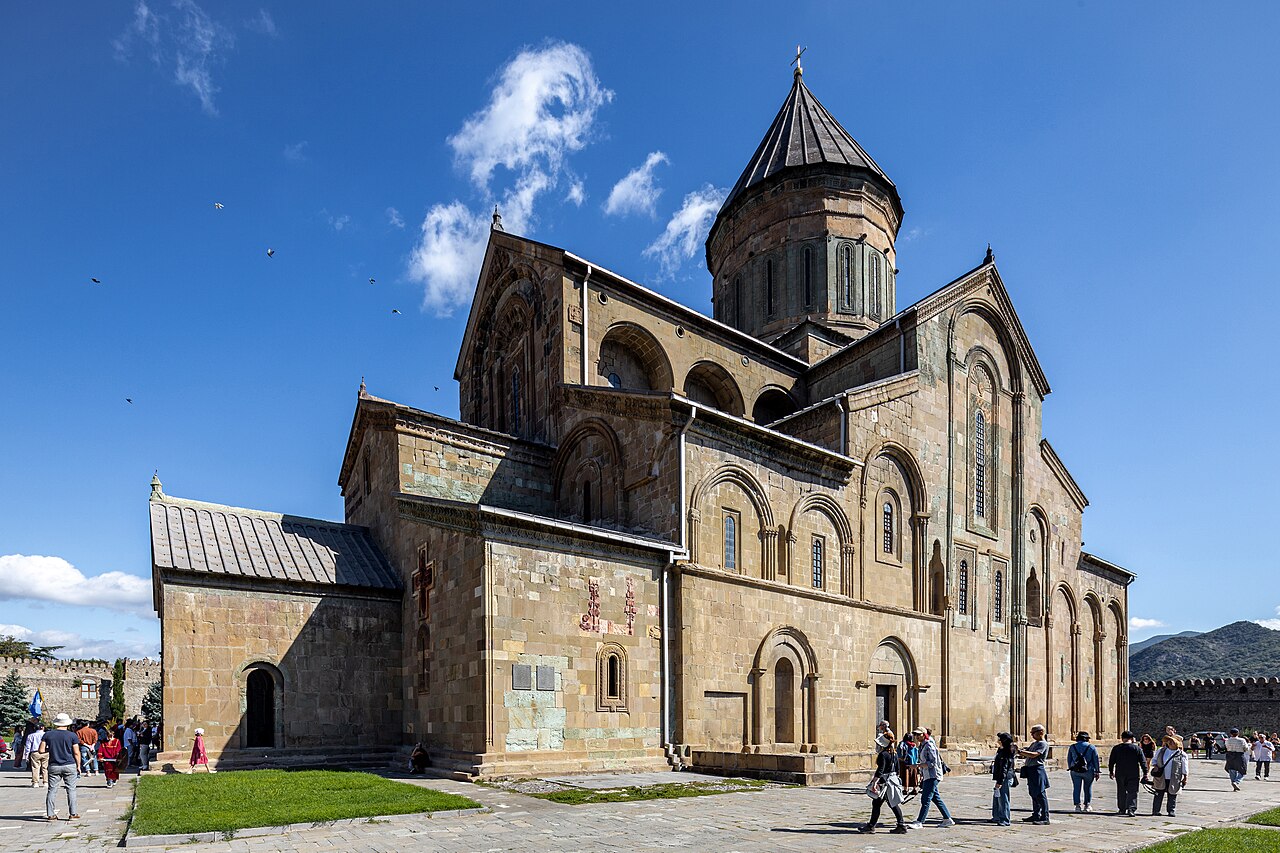
The great cathedral of Mtskheta, built between 1010 and 1029 by the architect Arsukisdze on the site of Georgia's first church from the 4th century. Georgian tradition holds that Christ's robe is buried beneath it. Many Georgian kings are buried here, and it is part of the Historical Monuments of Mtskheta World Heritage Site.
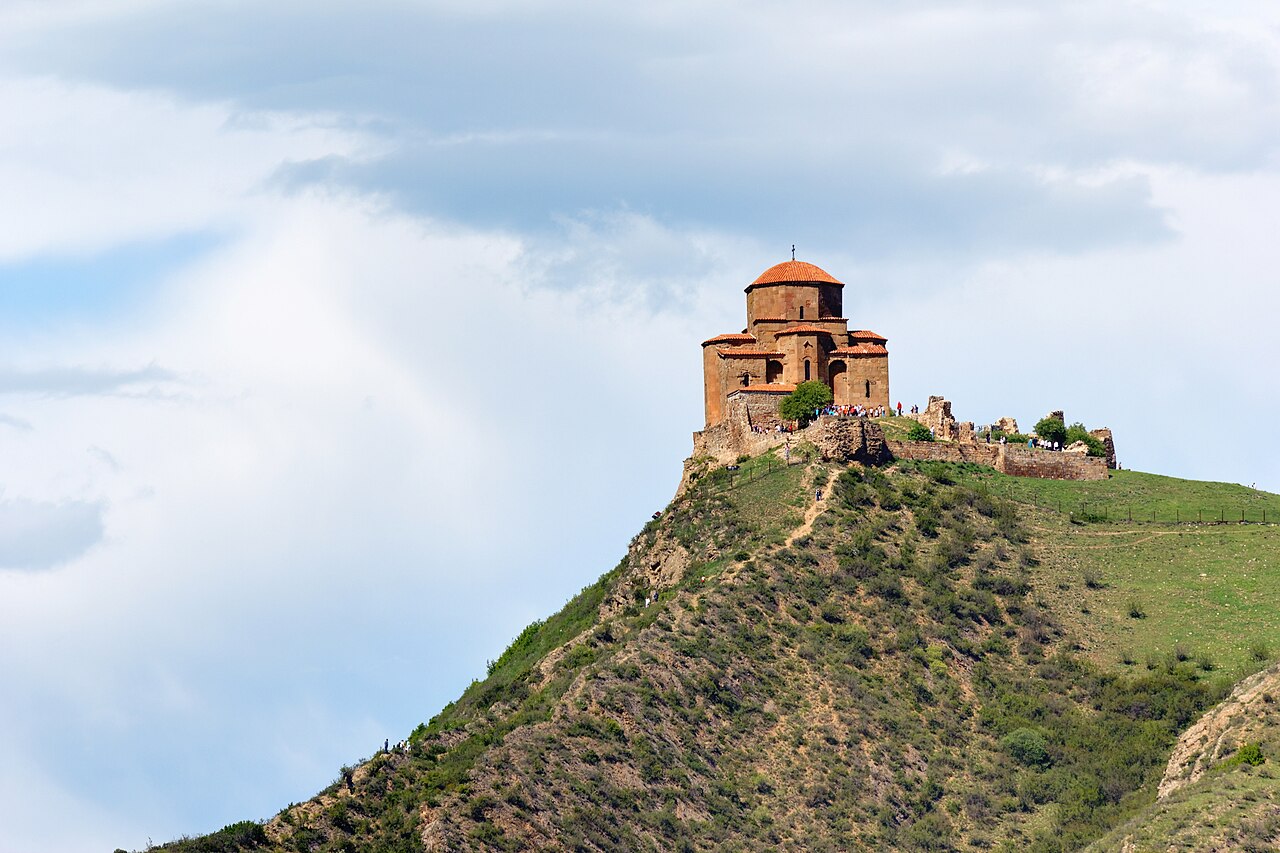
A 6th-century church on a rocky hilltop where the Mtkvari and Aragvi rivers meet, looking down on Mtskheta. Tradition says Saint Nino raised a large wooden cross here; jvari means 'cross'. The church, built around 590 to 605, has survived almost unchanged and gave its name to a whole style of church building.
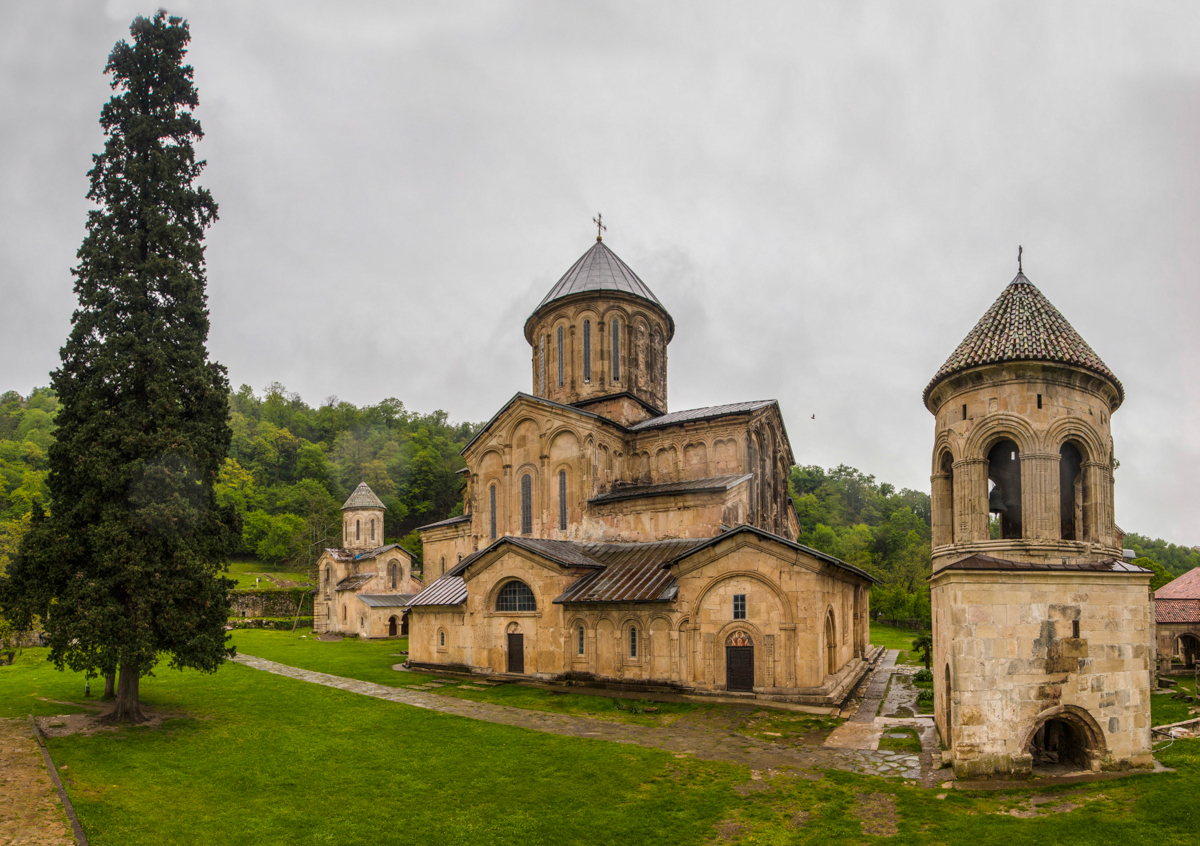
A monastery on a wooded hill a few kilometres northeast of Kutaisi, founded in 1106 by King David IV as a centre of learning. Its main church is famous for a golden 12th-century mosaic of the Virgin and Child and for its wall paintings. David IV is buried by the south gate. It has been a UNESCO World Heritage Site since 1994.
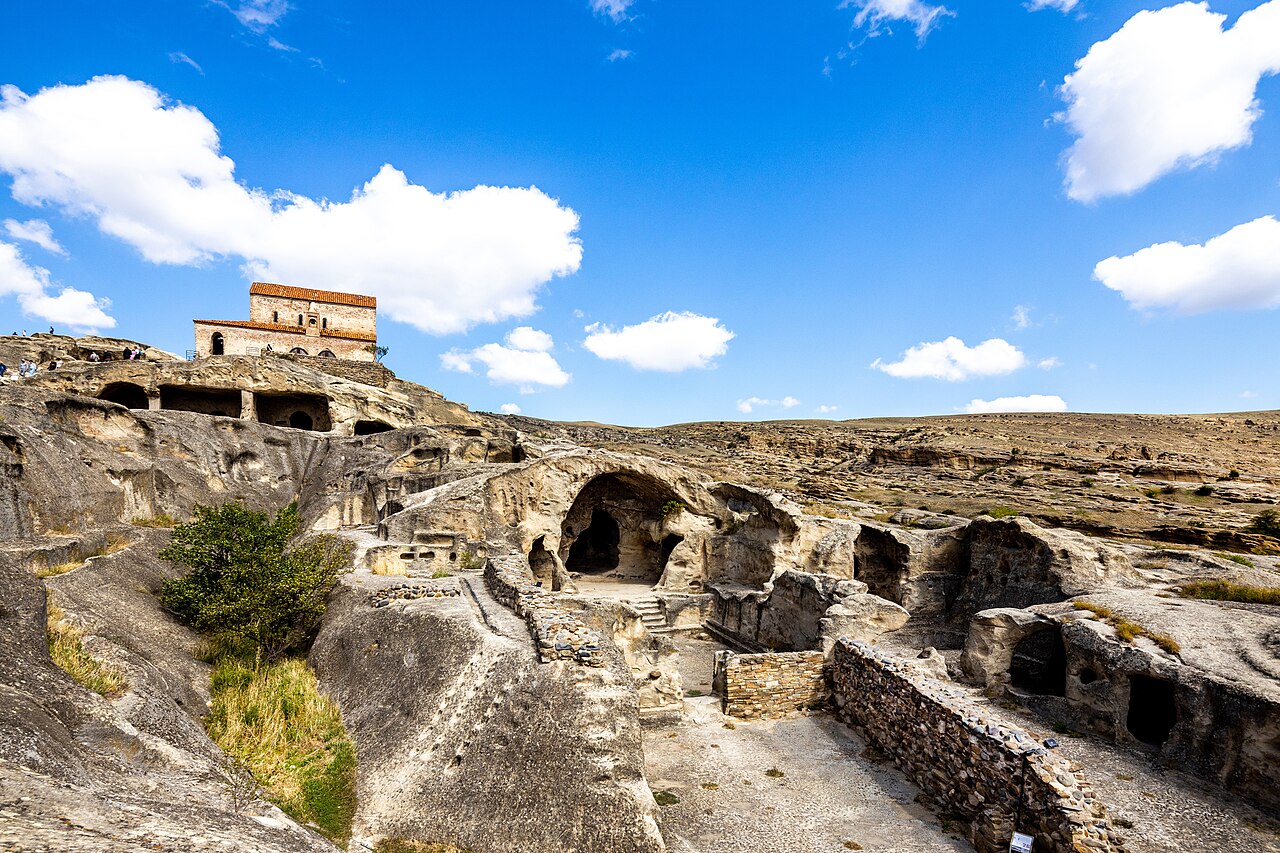
An ancient town carved into a rocky bank of the Mtkvari River, about 10 km east of Gori. Its name means 'the lord's fortress'. Halls, houses, streets and pagan temples cut from the rock date from the early Iron Age to the Middle Ages, and a brick church stands at the top.
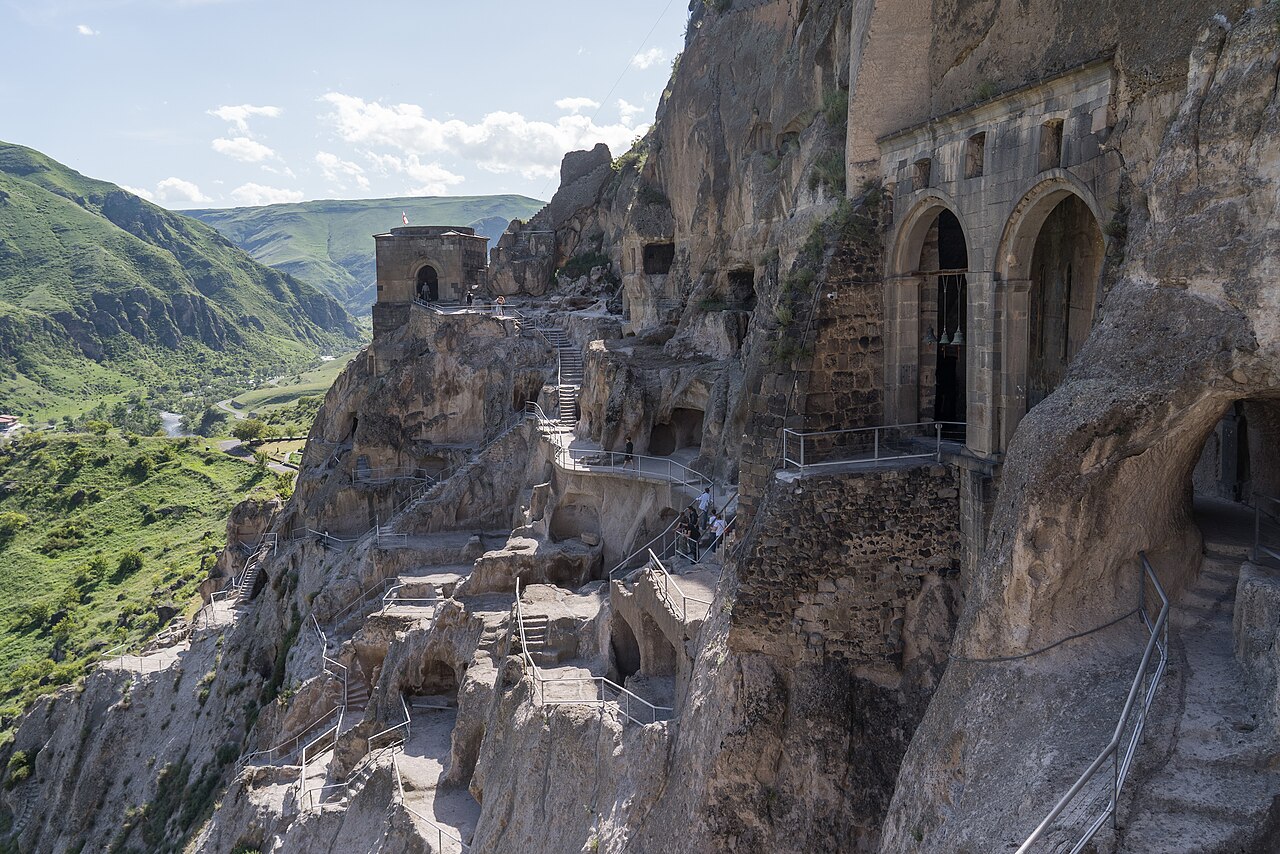
A cave monastery carved into a cliff above the Mtkvari River in the far south. It was cut mainly in the late 12th century under King Giorgi III and Queen Tamar, with hundreds of rooms stretching for about 500 m along the cliff and up to 19 levels. The Church of the Dormition inside has wall paintings from the 1180s, including a portrait of Tamar. The pin marks the monastery itself; Akhaltsikhe, about 60 km away, is the usual base for a visit.
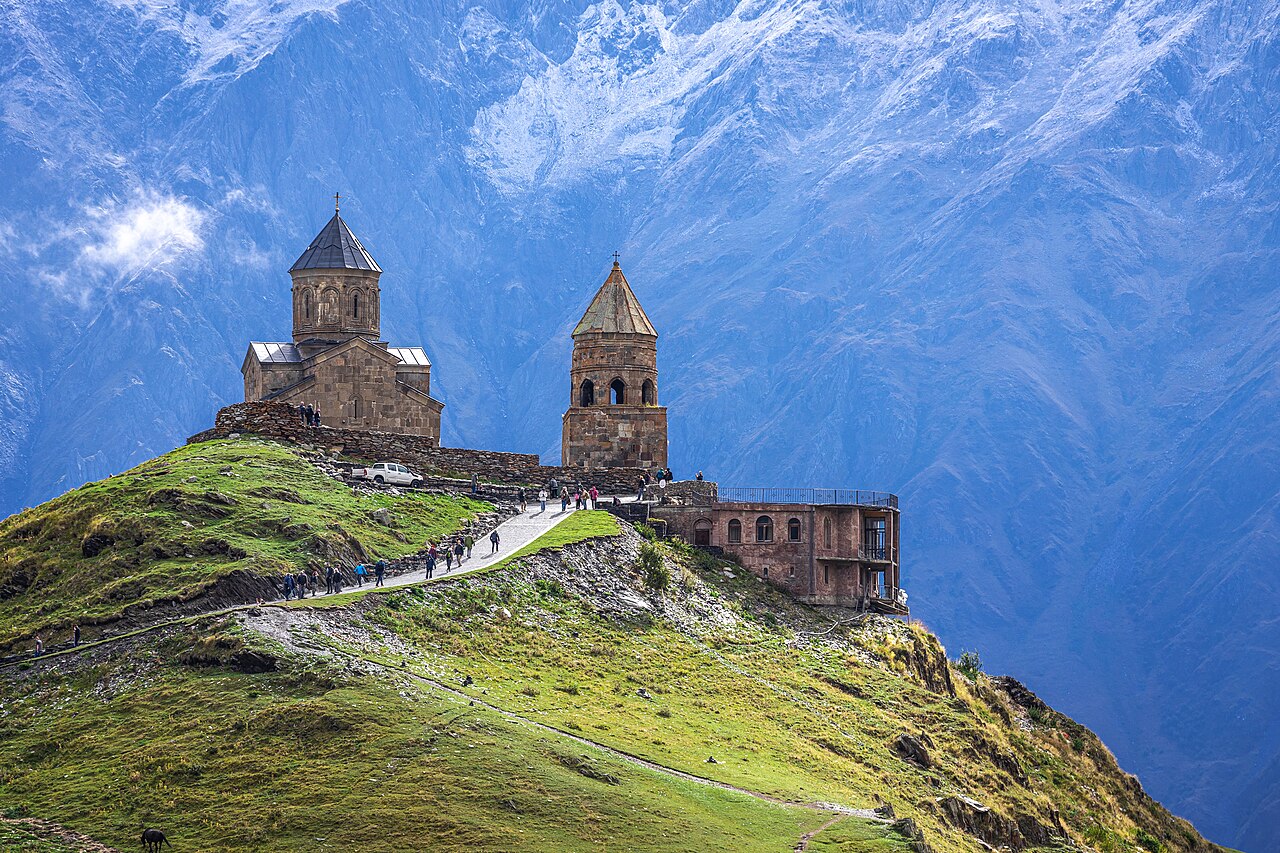
A 14th-century church and bell tower standing alone on a ridge at about 2,170 m, high above Stepantsminda, with Mount Kazbek behind it. It is one of the most photographed places in Georgia. You can walk up in about two hours or go by car.
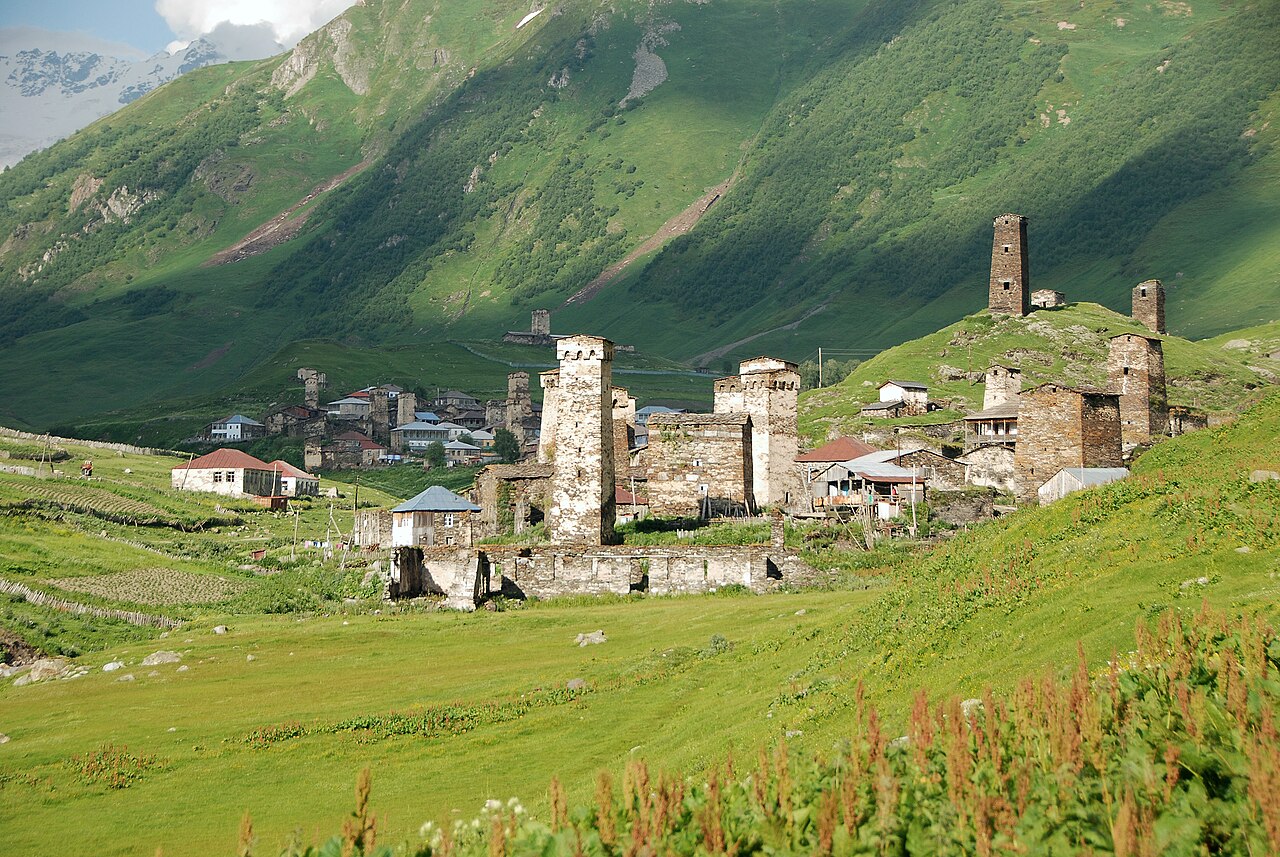
A community of small villages at about 2,100 m at the head of the Enguri valley, below Shkhara, Georgia's highest mountain. It is one of the highest permanently inhabited places in Europe, and its many stone Svan towers were mostly built between the 9th and 12th centuries. Snow covers it for about half the year. It is part of the Upper Svaneti World Heritage Site.
The fortress of Akhaltsikhe, first built in the 9th century and home to the Jaqeli princes. Inside the walls are a church, a mosque with a golden dome and a museum. It was heavily restored in 2011 and 2012.
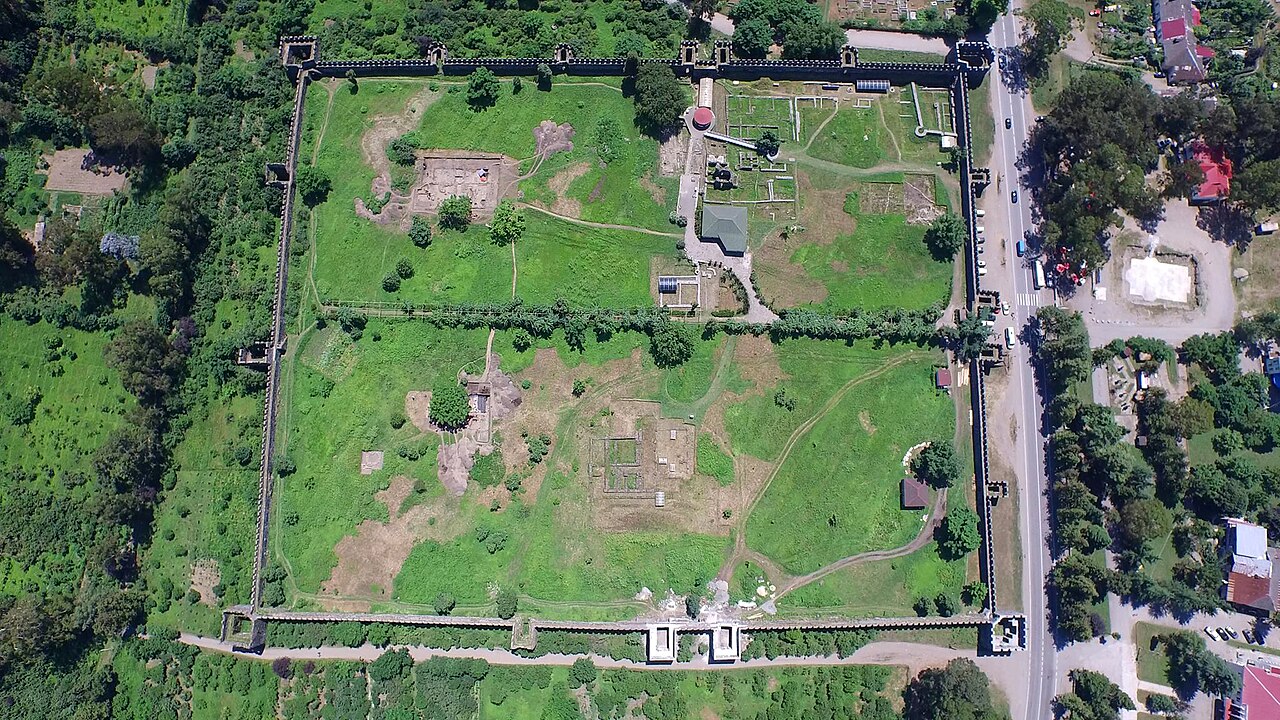
A Roman fortress on the Black Sea coast about 15 km south of Batumi, at the mouth of the Chorokhi River. Known in ancient times as Apsaros, it was a well-defended Roman town by the 2nd century AD. Its rectangular walls and towers still stand, and tradition holds that the Apostle Matthias is buried inside.
As of 2026, the earliest known evidence of winemaking comes from Georgia: jars with traces of grape wine from about 6000 BC.
02
Georgians still ferment wine in qvevri, large egg-shaped clay jars buried in the ground. UNESCO added this traditional method to its list of intangible cultural heritage in 2013.
03
Fossils about 1.8 million years old found at Dmanisi, southwest of Tbilisi, are the earliest well-dated remains of early humans found anywhere in Europe and Asia.
04
Modern Georgian is written in its own alphabet, Mkhedruli, with 33 letters and no separate capital letters in everyday writing. The living culture of Georgia's three scripts was added to UNESCO's intangible heritage list in 2016.
05
In Georgian, mama means 'father' and deda means 'mother'.
06
Georgians count in twenties: 40 is ormotsi, 'two twenties', and 60 is samotsi, 'three twenties'.
07
The Georgian folk song Chakrulo is on the Golden Records carried into space by the Voyager 1 and Voyager 2 probes in 1977.
08
Georgian polyphonic singing, with three voices weaving together, was proclaimed a masterpiece of intangible heritage by UNESCO in 2001.
09
Georgians call their country Sakartvelo, 'the land of the Kartvelians'. The English name Georgia probably comes from the Persian name for Georgians, Gurj, not from Saint George.
10
Tbilisi takes its name from the Georgian word tbili, 'warm', because of the hot sulphur springs on which the city was built.
11
Ancient Greek myth placed the Golden Fleece, sought by Jason and the Argonauts, in Colchis, the old name for western Georgia.
12
Ushguli in Svaneti, at about 2,100 m, is one of the highest permanently inhabited settlements in Europe.
13
Rugby union is one of Georgia's most popular sports, and the national team is nicknamed the Lelos, after lelo, an old village ball game very similar to rugby.
Written in the Georgian alphabet; the Latin spelling comes first. Stress is light and usually falls on the first syllable Pronunciation is written the way it sounds; the capital letters show where the stress goes. Audio is coming soon.
Greetings
gamarjoba (გამარჯობა)GAH-mar-joh-bahhello
nakhvamdis (ნახვამდის)NAKH-vahm-dees (kh as in Scottish 'loch')goodbye
madloba (მადლობა)MAHD-loh-bahthanks
Basics
diakh (დიახ)DEE-akhyes (polite)
ara (არა)AH-rahno
bodishi (ბოდიში)BOH-dee-sheesorry, excuse me
Family
deda (დედა)DEH-dahmother
mama (მამა)MAH-mahfather
megobari (მეგობარი)MEH-goh-bah-reefriend
Food and drink
puri (პური)POO-reebread
ghvino (ღვინო)GHVEE-noh (gh like a French r)wine
kveli (ყველი)KVEH-lee (a hard k from the throat)cheese
tskali (წყალი)TSKAH-leewater
supra (სუფრა)SOO-prahfeast (literally 'tablecloth')
Before you go, check your government's official travel warnings. As of September 2026, the UK government, for example, advises against all travel to Abkhazia and South Ossetia, and against all but essential travel next to the boundary lines around them. These lines are often unmarked, so do not wander near them, and do not try to enter Georgia from Russia through either region: under Georgian law that is illegal.
Bring health insurance
As of September 2026, all visitors must have health and accident insurance covering at least 30,000 lari for their whole stay, and airlines or border officers may ask to see it. British citizens, for example, can visit for up to a year without a visa, but check the rules for your own passport.
Pay in lari, carry cash
Prices are sometimes quoted in US dollars or euros, but you must pay in lari. Cards work in cities, but outside the main towns ATMs are few, so take enough cash when you head into the countryside or the mountains.
Dress for churches
Georgia is a traditional Orthodox Christian country. In churches and monasteries, women are expected to cover their heads and wear a skirt, and men should not wear shorts. Carry a light scarf when sightseeing.
Emergency number
Dial 112 for police, ambulance or fire. It is the single emergency number across Georgia.
Keep away from demonstrations
As of September 2026, political demonstrations take place often in central Tbilisi, especially on Rustaveli Avenue near the parliament, and sometimes turn tense. Avoid large gatherings and follow local news.
Respect the mountains
Roads to Svaneti, Kazbegi and Tusheti are long and winding and can close after heavy snow. Altitude sickness is possible at places such as Gudauri and Mount Kazbek. Go slowly, allow extra days, and use a guide for high walks.
Tipping
Many restaurants add a service charge of about 10 percent to the bill. If it is not included, leaving around 10 percent for good service is appreciated.
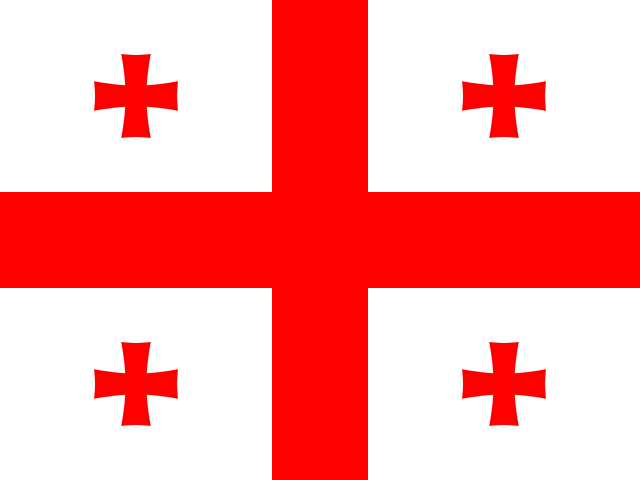
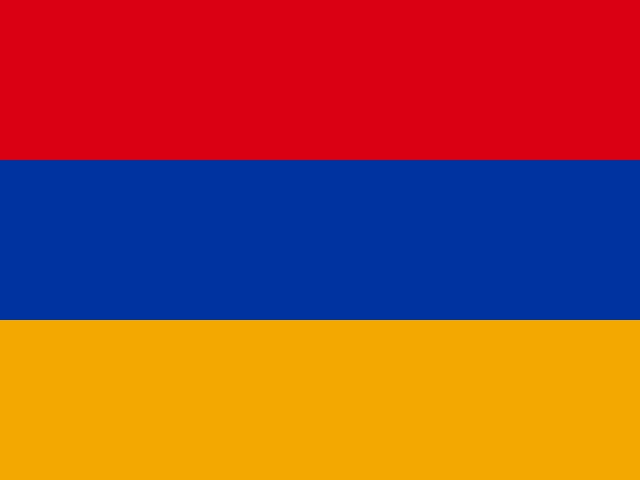 Armenia
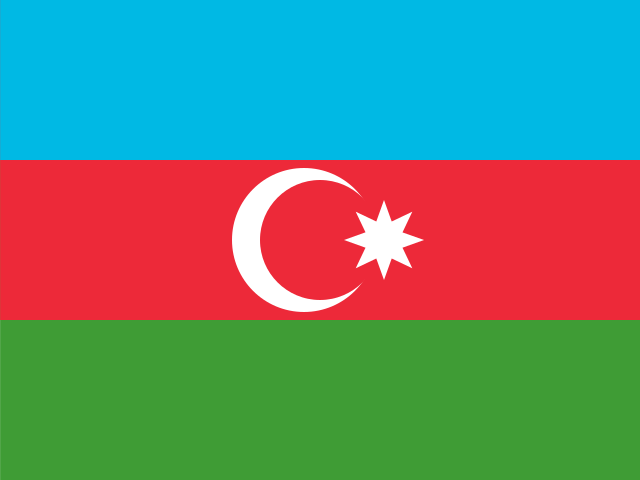 Azerbaijan
 Russia
 Türkiye