World Stroll
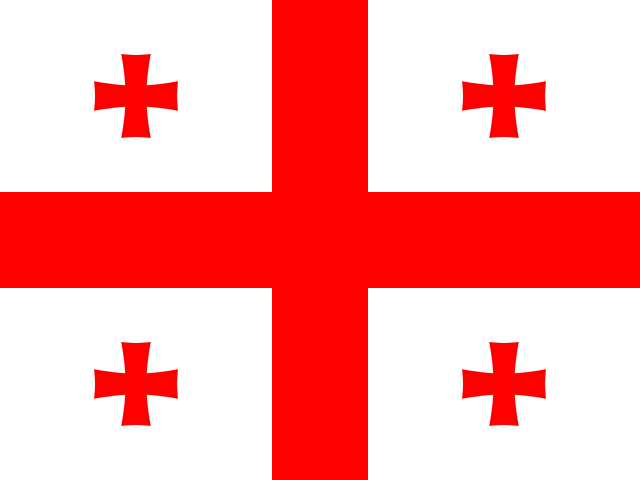
Flag of Georgia
Travel guide

Learn Georgia before you go

Snowy Caucasus peaks, cave towns and stone towers, a Black Sea coast, and a feast table where the wine has been made in clay jars for about 8,000 years.
Take the full trip
CapitalTbilisi
CurrencyGeorgian lari (GEL), divided into 100 tetri. It replaced a temporary coupon currency in 1995
Official languageGeorgian. The constitution also gives Abkhaz official status within Abkhazia
Drives on theRight
Calling code+995

10 phrases to learn

In Georgian (ქართული). Capital letters show the stressed part. Tap the heart to practise a phrase later.

Gamarjoba (გამარჯობა)
GAH-mar-joh-bah
Hello
The everyday greeting, at any time of day
Gagimarjos (გაგიმარჯოს)
GAH-gee-mar-johs
Hello (in reply)
Answering someone who has said gamarjoba to you
Dila mshvidobisa (დილა მშვიდობისა)
DEE-lah MSHVEE-doh-bee-sah
Good morning
Greeting someone in the morning
Saghamo mshvidobisa (საღამო მშვიდობისა)
SAH-ghah-moh MSHVEE-doh-bee-sah
Good evening
Greeting someone in the evening
Rogora khart? (როგორა ხართ?)
ROH-goh-rah KHART
How are you?
Asking politely after someone
Kargad, gmadlobt (კარგად, გმადლობთ)
KAR-gahd, GMAHD-lohbt
Fine, thank you
Answering 'how are you?'
Gmadlobt (გმადლობთ)
GMAHD-lohbt
Thank you (polite)
Thanking anyone you do not know well
Arapris (არაფრის)
AH-rah-prees
You're welcome
Answering when someone thanks you
Tu sheidzleba (თუ შეიძლება)
TOO sheh-EEDZ-leh-bah
Please (literally 'if possible')
Asking for something politely
Bodishi (ბოდიში)
BOH-dee-shee
Sorry, excuse me
Apologising or squeezing past someone

At the table

  • At a supra, the tamada (toastmaster) proposes each toast in turn: to peace, to the hosts, to parents, to those no longer here. Wait for the toast before you drink, and if the tamada invites you, add a few words of your own.
  • Eat khinkali with your hands. Hold it by the knot on top, take a small bite, sip the hot broth, then eat the rest and leave the knot on your plate.
  • The table is full from the start and more dishes keep coming. Take a little of many dishes rather than a lot of one, because hosts love to keep feeding their guests.
  • Georgians are famous for their hospitality. If you are invited, your host will usually insist on paying, and arguing about the bill can embarrass them.
  • Many restaurants add a service charge of about 10 percent to the bill; check before adding a tip.
  • Homemade wine and chacha are offered generously. It is fine to sip slowly or to politely say you have had enough.

Local tips

Check official travel advice first

Before you go, check your government's official travel warnings. As of September 2026, the UK government, for example, advises against all travel to Abkhazia and South Ossetia, and against all but essential travel next to the boundary lines around them. These lines are often unmarked, so do not wander near them, and do not try to enter Georgia from Russia through either region: under Georgian law that is illegal.

Bring health insurance

As of September 2026, all visitors must have health and accident insurance covering at least 30,000 lari for their whole stay, and airlines or border officers may ask to see it. British citizens, for example, can visit for up to a year without a visa, but check the rules for your own passport.

Pay in lari, carry cash

Prices are sometimes quoted in US dollars or euros, but you must pay in lari. Cards work in cities, but outside the main towns ATMs are few, so take enough cash when you head into the countryside or the mountains.

Dress for churches

Georgia is a traditional Orthodox Christian country. In churches and monasteries, women are expected to cover their heads and wear a skirt, and men should not wear shorts. Carry a light scarf when sightseeing.

Emergency number

Dial 112 for police, ambulance or fire. It is the single emergency number across Georgia.

Keep away from demonstrations

As of September 2026, political demonstrations take place often in central Tbilisi, especially on Rustaveli Avenue near the parliament, and sometimes turn tense. Avoid large gatherings and follow local news.

Respect the mountains

Roads to Svaneti, Kazbegi and Tusheti are long and winding and can close after heavy snow. Altitude sickness is possible at places such as Gudauri and Mount Kazbek. Go slowly, allow extra days, and use a guide for high walks.

Tipping

Many restaurants add a service charge of about 10 percent to the bill. If it is not included, leaving around 10 percent for good service is appreciated.

Dishes to try

  • Imeruli khachapuri (იმერული ხაჭაპური): Khachapuri, cheese-filled bread, is Georgia's national dish, and the round Imeretian kind is the most common. A soft yeast dough is filled with salty white Imeretian cheese and baked until golden. It is eaten warm at almost every meal, from street stalls to feasts. The Megrelian version (megruli) has more cheese melted on top.
  • Adjarian khachapuri (აჭარული ხაჭაპური): A boat-shaped khachapuri filled with melted cheese and served with a raw egg yolk and a knob of butter in the middle. You stir the yolk and butter into the hot cheese, then tear off pieces of the crust and dip them in. Some say the shape stands for a boat, the cheese for the sea and the yolk for the sun.
  • Khinkali (ხინკალი): Large twisted dumplings filled with spiced minced meat, often beef and pork, with onion and herbs. Because the meat goes in raw, it releases a hot broth inside while the dumplings boil. Khinkali are eaten with the hands and ground black pepper, often by the dozen. Versions with mushrooms, potato or cheese are also common.
  • Badrijani nigvzit (ბადრიჯანი ნიგვზით): Thin slices of fried aubergine spread with a paste of ground walnuts, garlic, herbs and spices, then rolled up and topped with pomegranate seeds. It is one of the most popular cold dishes on any Georgian table.
  • Pkhali (ფხალი): Finely chopped cooked vegetables mixed with a paste of walnuts, garlic, vinegar and herbs, shaped into balls or patties and topped with pomegranate seeds. Restaurants usually serve three kinds together: green spinach, deep red beetroot and white bean.
  • Lobio (ლობიო): A dish of beans cooked with onion, garlic, coriander and spices, sometimes with walnuts. It is often served hot in a clay pot with mchadi cornbread and pickled vegetables. A cold version, mashed with walnuts and vinegar, is served as a starter.
  • Mtsvadi (მწვადი): Chunks of pork, lamb or veal threaded on skewers and grilled over hot embers, the Georgian barbecue. It is served simply with raw onion rings and a sour plum sauce called tkemali, and it is a favourite at weekends and feasts outdoors.
  • Chakapuli (ჩაქაფული): A green, tangy stew of lamb or veal cooked with dry white wine, a large amount of fresh tarragon, other herbs, garlic and sour cherry plums or tkemali sauce. It is one of the most popular dishes in Georgia, and there are also versions with beef or mushrooms.

Cities to see

  • Tbilisi (capital): The old town and the domed sulphur baths of Abanotubani, Narikala fortress above the river, Rustaveli Avenue, with the opera house and the Georgian National Museum.
  • Kutaisi: Bagrati Cathedral, built by King Bagrat III, Gelati Monastery, a UNESCO World Heritage Site nearby, Prometheus Cave, a large show cave nearby.
  • Batumi: The long seaside boulevard, The Alphabetic Tower, decorated with the letters of the Georgian alphabet, Adjarian khachapuri and the Batumi Botanical Garden.
  • Rustavi: The Rustavi steelworks, The Rustavi International Motorpark, a motor racing circuit.
  • Gori: Gori Fortress on its hill, The rock-cut town of Uplistsikhe nearby, The Stalin Museum.
  • Mtskheta: Svetitskhoveli Cathedral, Jvari Monastery on the hill across the river, Samtavro Monastery.

Landmarks and the city map are on the Georgia trip