 Laos
Laos Thailand
 Vietnam
The oldest dated Khmer inscription
A stone inscription found at Angkor Borei, in today's Takéo Province south of Phnom Penh, is dated 611. It is the oldest dated text written in the Khmer language, from the time of the kingdom of Chenla.
A free large-print PDF. Choose what goes in: facts, map, history, dishes and recipes, phrases, fun facts, a quiz with or without answers. Made for clubs, care homes, libraries and family afternoons.
Cambodia lies between Thailand, Laos and Vietnam, with a short coast on the Gulf of Thailand. Most of the country is a low, flat plain of rice fields around the Tonlé Sap, the largest freshwater lake in Southeast Asia, and the Mekong River, which crosses the east of the country from north to south. Forested hills and mountains rise along the edges, and the highest peak, Phnom Aural, stands in the Cardamom Mountains in the southwest.
From the 9th to the 15th century this was the heart of the Khmer Empire, whose kings built Angkor Wat and hundreds of other stone temples. Later centuries brought pressure from Siam and Vietnam, and France ruled the country as a protectorate from 1863 until independence in 1953. Between 1975 and 1979 the Khmer Rouge regime caused the deaths of about 2 million people, roughly a quarter of the population, by a commonly cited estimate. Peace returned slowly after the Paris agreements of 1991 and a United Nations mission, and the monarchy was restored in 1993.
Today Cambodia is home to about 17.5 million people, most of them Khmer and Theravada Buddhist. Rice and fish from the rivers and the great lake are the base of daily life and of the food, and visitors come for the temples, the riverside capital Phnom Penh, the colonial towns of the south and the islands of the coast.
Chinese records describe a trading kingdom called Funan on the lower Mekong from about the 1st century AD, followed by the kingdom of Chenla. From 802 the Khmer Empire, soon centred on Angkor, at its height controlled much of mainland Southeast Asia. After Angkor was abandoned the kingdom grew weaker between Siam and Vietnam, until France made it a protectorate. The 20th century brought independence, civil war, the Khmer Rouge regime and, after 1991, a slow return to peace.
A stone inscription found at Angkor Borei, in today's Takéo Province south of Phnom Penh, is dated 611. It is the oldest dated text written in the Khmer language, from the time of the kingdom of Chenla.
On the Kulen hills north of Angkor, Prince Jayavarman II declared himself universal ruler and independent of Java. Historians use this year as the start of the Khmer Empire, which lasted until the 15th century.
King Suryavarman II ruled from 1113 to about 1150, one of the most powerful periods of the empire. During his reign Angkor Wat was built as a Hindu temple dedicated to the god Vishnu.
Often called Cambodia's greatest king, the Buddhist Jayavarman VII built the walled city of Angkor Thom with the Bayon temple at its centre, as well as Ta Prohm, roads, rest houses and more than 100 hospital chapels across the empire.
The Chinese envoy Zhou Daguan arrived at Angkor in August 1296 and stayed for about a year. His account of daily life, markets, festivals and the royal court is the most detailed eyewitness description of Angkor that survives.
Around 1431 armies of the Siamese kingdom of Ayutthaya attacked the capital at Angkor. The court soon moved south towards Phnom Penh, and Angkor was no longer the royal capital, though Angkor Wat remained a place of Buddhist worship.
Longvek, the royal capital of the 16th century and a busy trading town, was captured by Siamese forces in 1594. For the next two centuries Cambodia was often squeezed between the growing powers of Siam and Vietnam.
In August 1863 King Norodom signed a treaty placing his kingdom under the protection of France. Cambodia later became part of French Indochina, and the royal capital settled at Phnom Penh, where Norodom built a new Royal Palace.
Under a treaty between France and Siam, the northwestern provinces of Battambang, Siem Reap and Sisophon, ruled by Siam since 1795, were returned to Cambodia. With them came the temples of Angkor.
After a campaign led by the young King Norodom Sihanouk, Cambodia became fully independent on 9 November 1953, which is still celebrated as Independence Day.
After five years of civil war, the Khmer Rouge entered Phnom Penh on 17 April 1975 and emptied the cities. Money, markets, schools and religion were abolished, and people were forced to work in the countryside. Estimates of the dead range from about 1 to 3 million; a commonly cited figure is 2 million, about a quarter of the population, killed by execution, starvation, overwork and disease.
Vietnamese forces, joined by Cambodian opponents of the regime, captured Phnom Penh on 7 January 1979 and ended Khmer Rouge rule. Fighting with Khmer Rouge forces in the border regions went on for many years.
On 23 October 1991 peace agreements were signed in Paris by nineteen countries, with Cambodia's four warring factions taking part. A United Nations mission, UNTAC, then ran much of the country, brought refugees home and organised an election.
After the UN-organised election in May 1993, a new constitution made Cambodia a constitutional monarchy again, and Norodom Sihanouk returned to the throne in September 1993.
The Extraordinary Chambers in the Courts of Cambodia, a court set up by Cambodia and the United Nations, worked from 2006 to 2022. It convicted three senior Khmer Rouge figures. Its last appeal judgment, in September 2022, upheld the genocide conviction of Khieu Samphan, the former head of state of Democratic Kampuchea.
UNESCO listed three places of Khmer Rouge repression, the Tuol Sleng and M-13 prisons and the Choeung Ek killing field, as the Cambodian Memorial Sites. They are kept as places of remembrance, learning and reflection.
A Cambodian meal is not served in courses. Rice comes with everything, and a sour soup, a salty or fried fish and some vegetables are set out together, so each person balances sour, salty, sweet and bitter by combining them. Fish from the Mekong and the Tonlé Sap is eaten two or three times a day, and prahok, a fermented fish paste, seasons many dishes. Kroeung, a fresh paste of lemongrass, galangal, garlic, shallots, turmeric and kaffir lime, gives curries and soups their scent. Compared with Thai food, Cambodian dishes usually use less chilli and sugar and more aromatic herbs, and chilli sauces are on the table for those who want heat. French rule left baguettes and coffee with condensed milk, and Chinese cooks brought noodles and stir-frying.
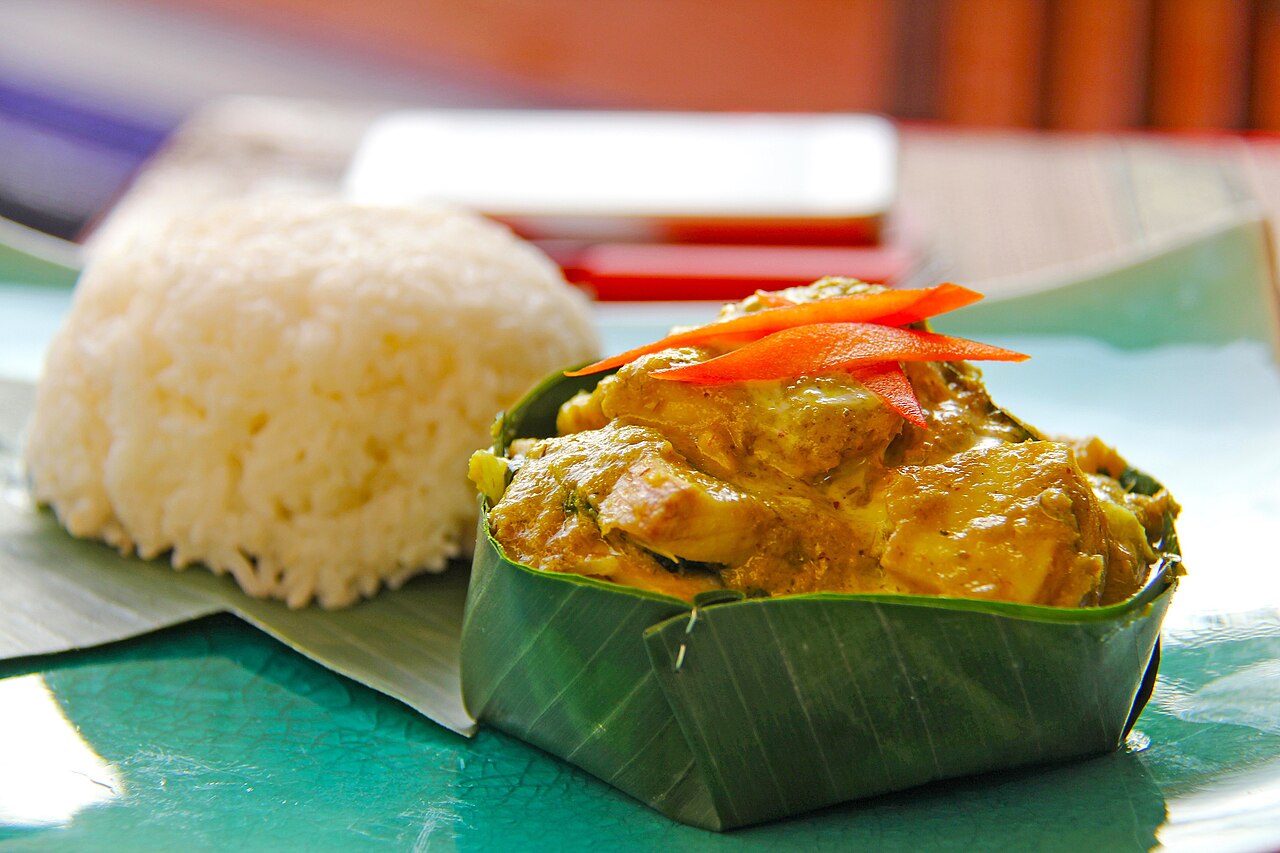
Pieces of freshwater fish in a mixture of kroeung paste, coconut milk and egg, steamed in a cup of banana leaves until it sets to a soft, mousse-like curry. It is topped with a spoon of thick coconut cream and strips of kaffir lime leaf and eaten with rice. Many see it as Cambodia's national dish.
The fish is traditionally laid on leaves of the noni tree (great morinda) inside the banana-leaf cup. Outside Cambodia, cooks often use spinach or chard instead.
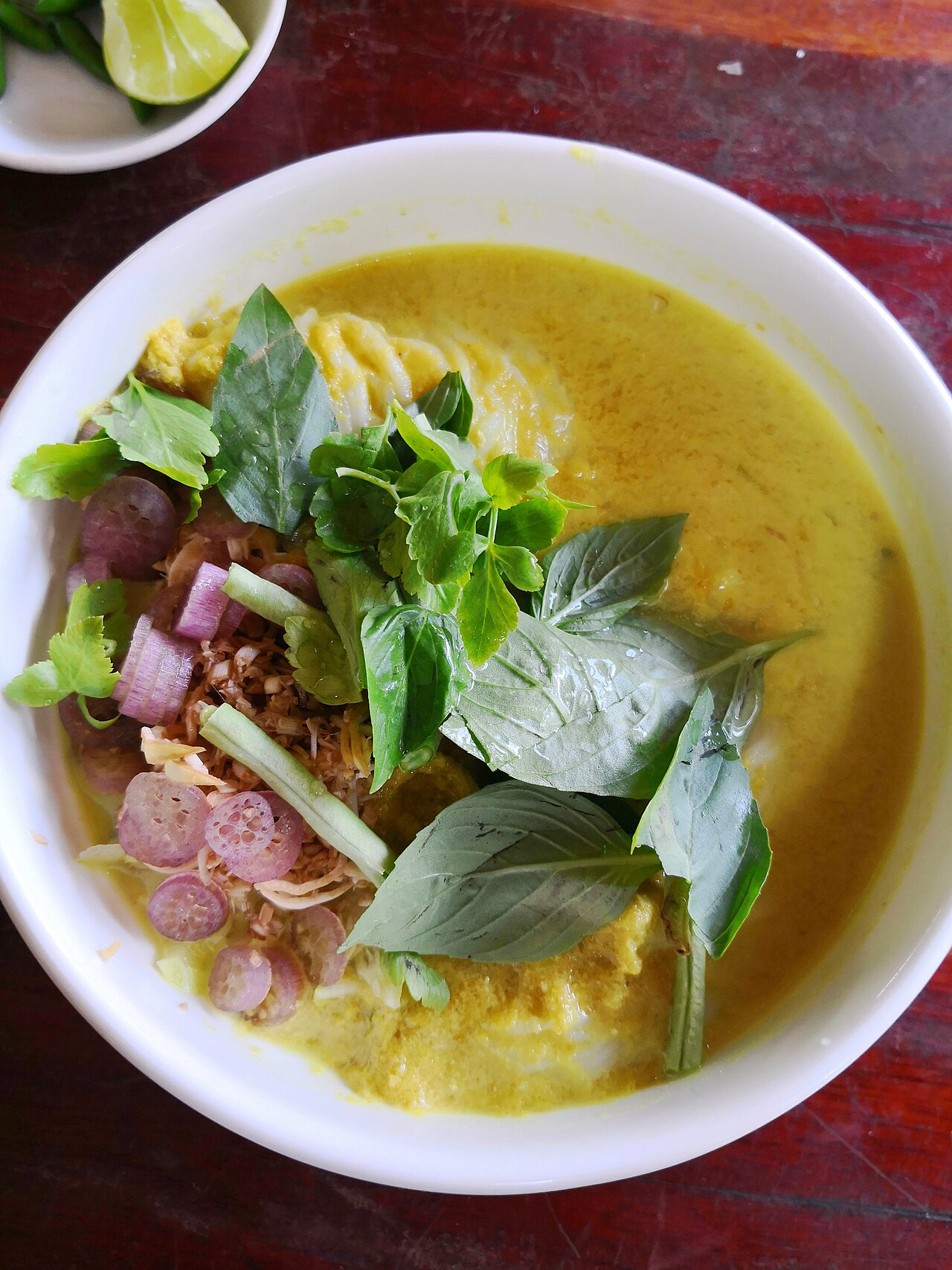
Soft, lightly fermented rice noodles, freshly made each morning, served cold with a warm green fish curry of lemongrass, turmeric, prahok and coconut milk. Diners heap fresh herbs, banana flower, cucumber and bean sprouts on top. It is the classic Cambodian breakfast, sold by women carrying baskets or at market stalls.
The noodles are made by soaking and grinding rice, pressing the dough and squeezing it through small holes straight into boiling water.
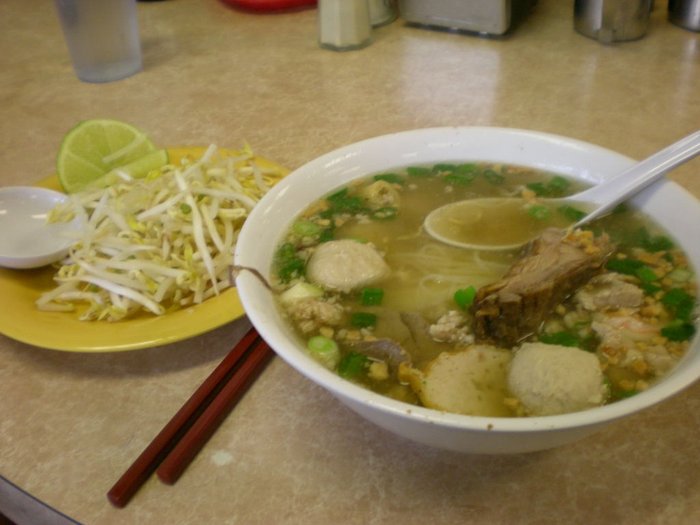
A clear pork-bone broth, sweetened a little with dried squid, poured over thin rice noodles and topped with minced pork, slices of pork, shrimp or offal. At the table each person adds lime, chilli, garlic oil, bean sprouts and herbs. It is one of the most popular breakfasts in the country.
The dish is so linked to the capital that in Vietnam it is called hủ tiếu Nam Vang, 'Phnom Penh noodle soup'.
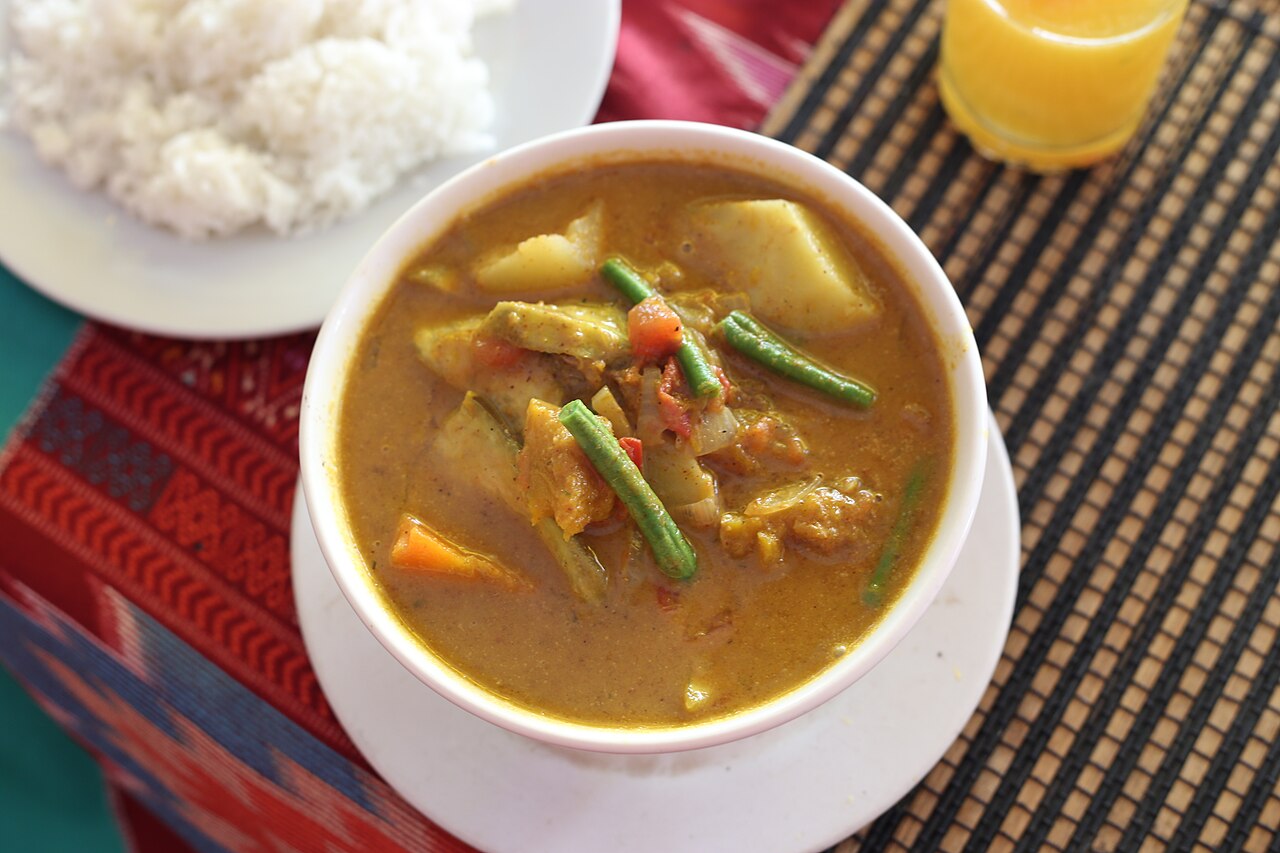
A mild, fragrant curry of chicken or beef simmered in coconut milk with red kroeung paste, lemongrass and spices, with chunks of sweet potato, potato, carrot, onion and long beans. It is eaten with rice, with fresh rice noodles, or with a crusty baguette for dipping, a habit from French times.
The Khmer word kari is believed to come from Tamil, and the sweet potato is what sets Cambodian curries apart from other Asian curries. In the countryside curries are a treat, kept for holidays because spices and fresh coconut milk take time and money.
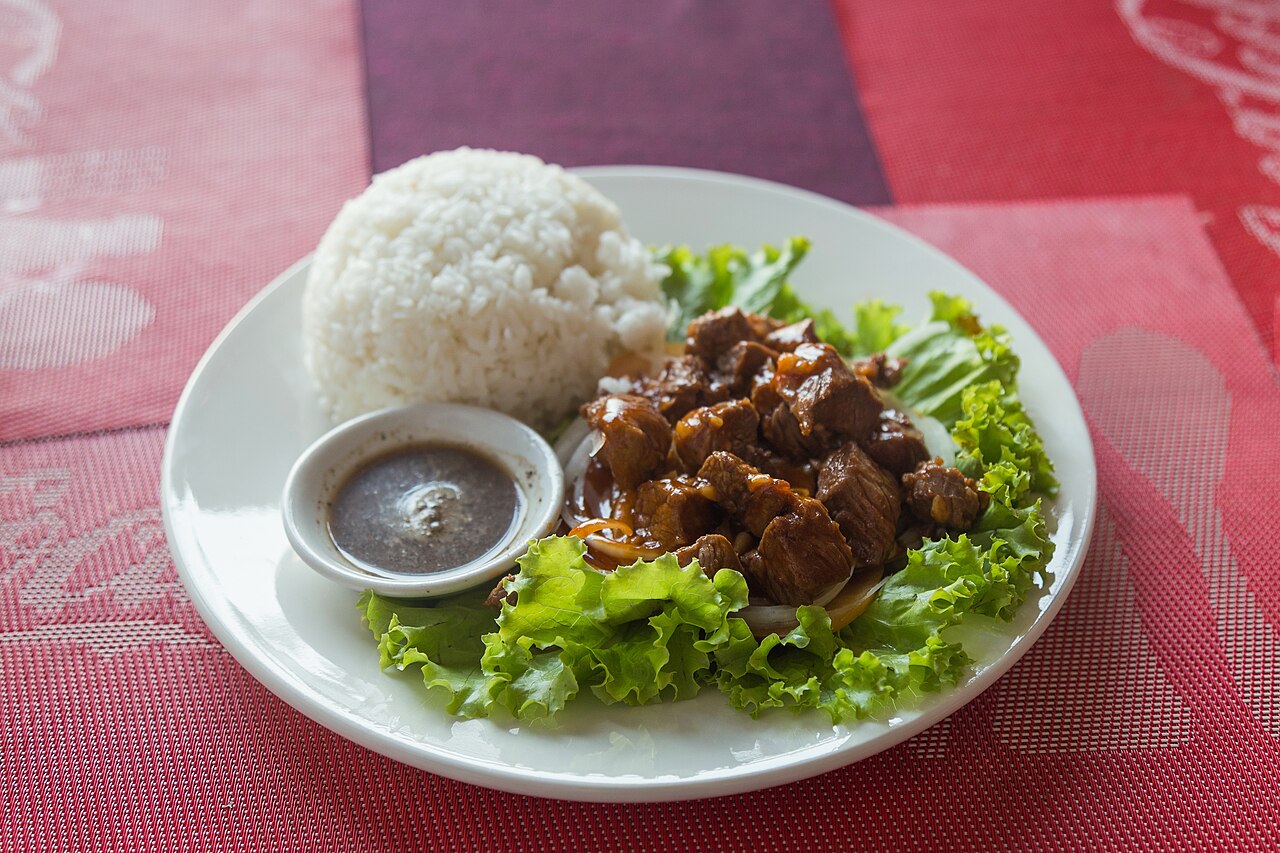
Strips of beef stir-fried in a dark, glossy sauce of oyster sauce, soy sauce and a little sugar, served on lettuce, tomato and onion with rice. The key is the dip: lime juice with salt and plenty of black pepper, ideally from Kampot. Some cafés top it with a fried egg.
The first Cambodian version used good steak seared in French butter. The everyday version today uses cheaper cuts and Chinese oyster sauce.
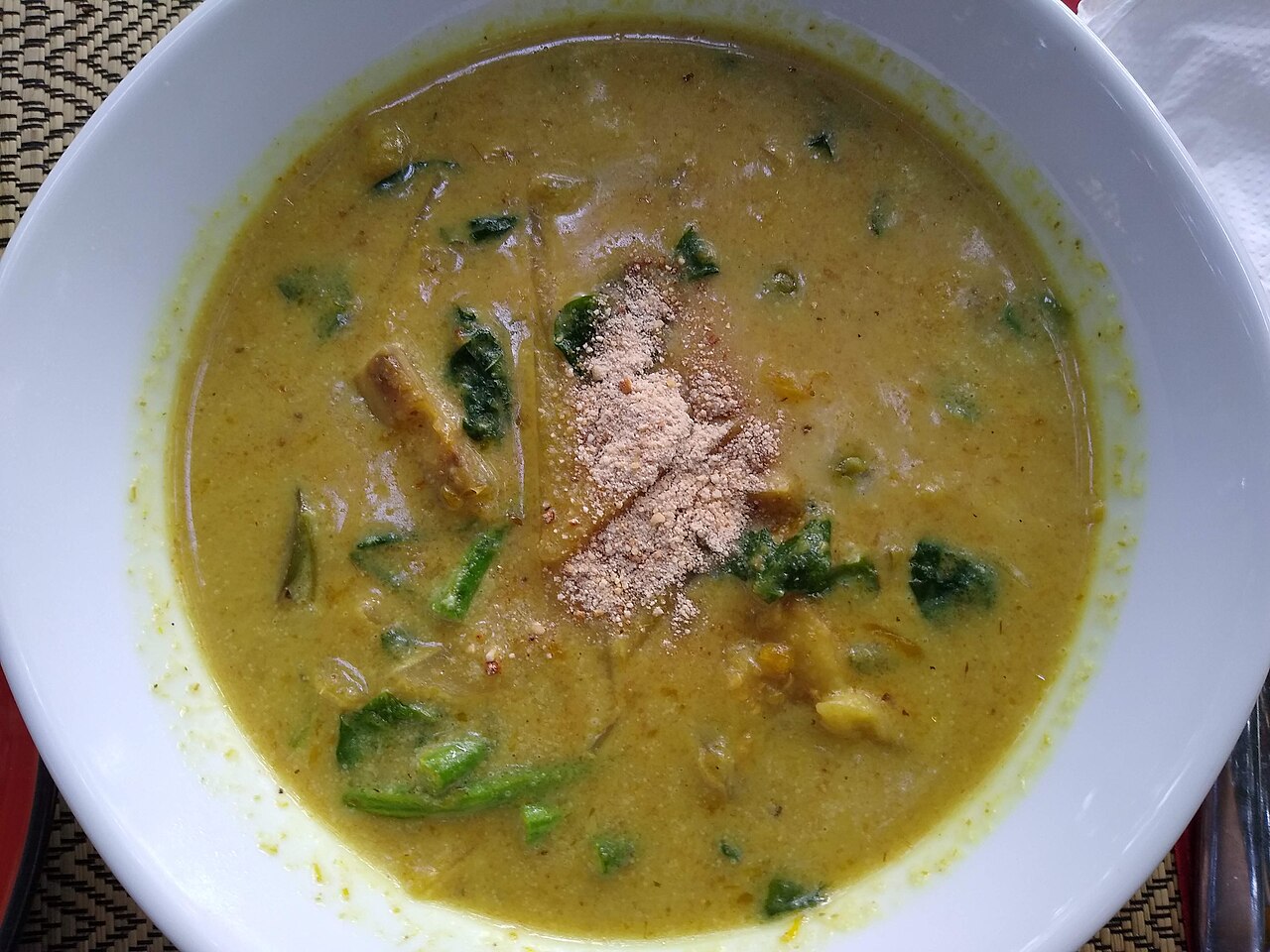
A thick green soup of kroeung, prahok and toasted ground rice, with catfish, pork or chicken and a great mix of vegetables and fruit: green papaya, pumpkin, eggplant, long beans, green banana and leaves. It is sometimes called Cambodian ratatouille.
The name means 'stirred soup'. A folk tale says a king named it after watching the cooks stir it without stopping.
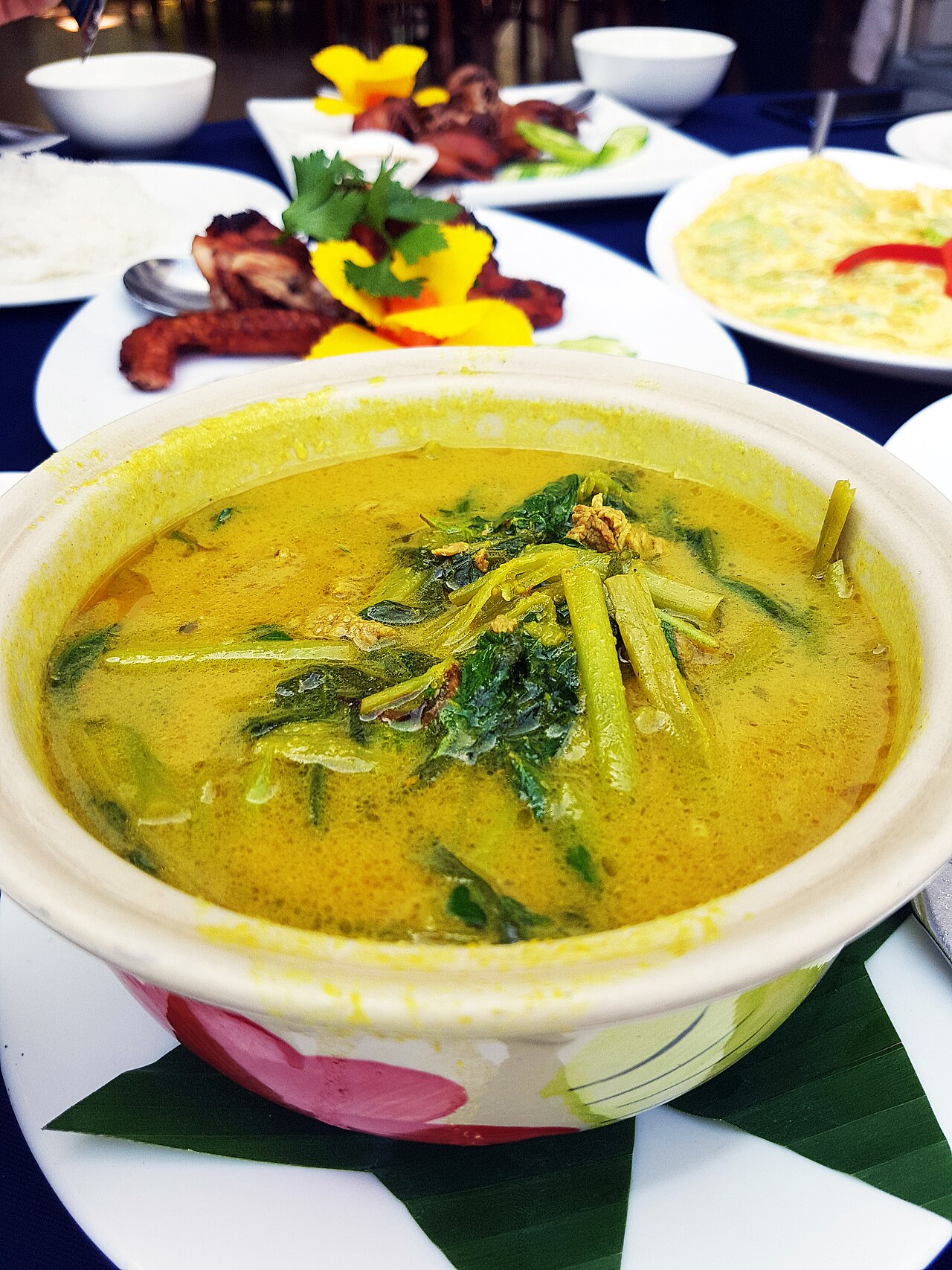
Sour soups made tangy with tamarind and filled with fish, chicken, pork or beef and vegetables such as pineapple, tomato, water spinach and lotus stems. A light sour soup is part of almost every family meal.
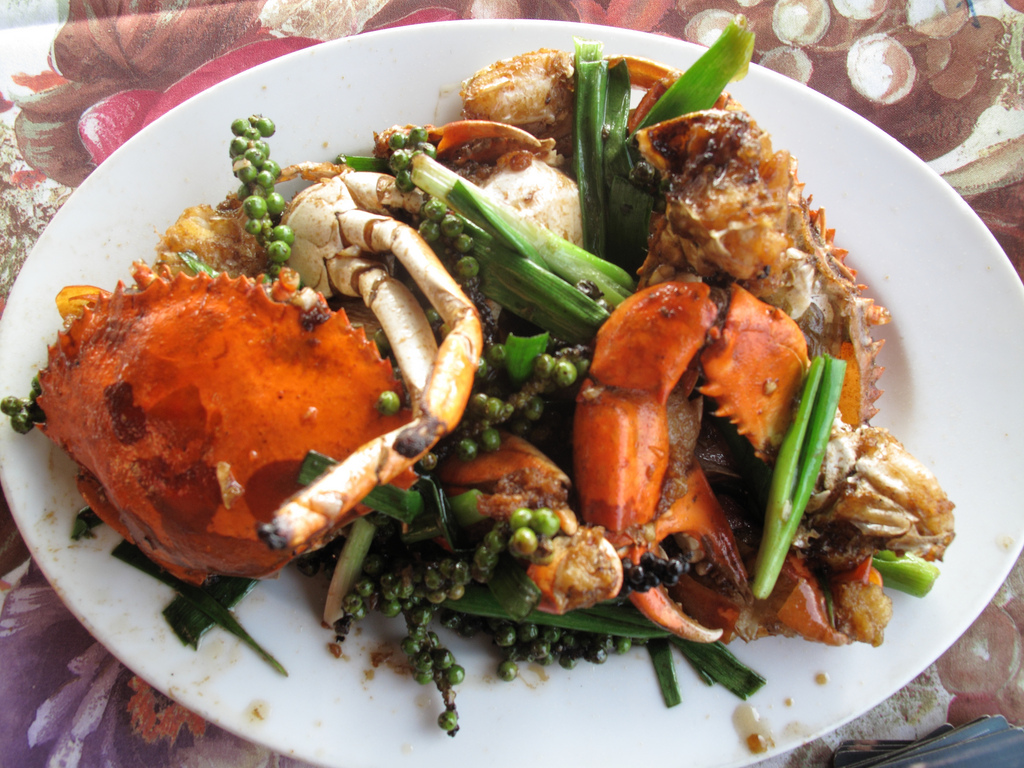
Fresh crabs from the Kep crab market, stir-fried with garlic, spring onion and whole strands of fresh green Kampot peppercorns, which are fragrant and gently hot. It is eaten with the fingers at simple seaside restaurants.
Kampot pepper has been grown in the region since at least the 13th century and has been a protected geographical indication in the European Union since 2016.
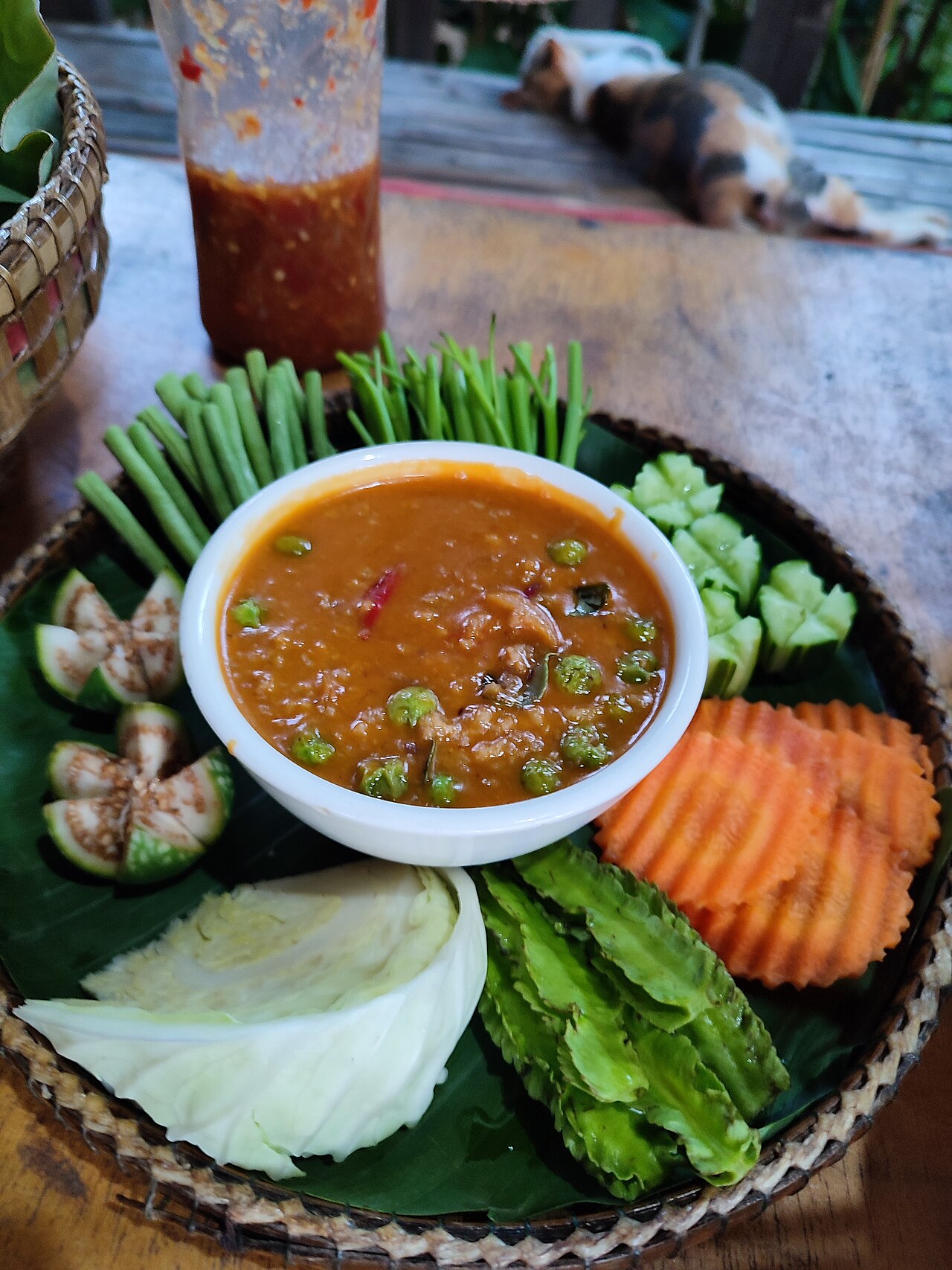
A rich dip of prahok, the fermented fish paste, simmered with minced pork, coconut milk, kroeung and tamarind. It is served with raw and blanched vegetables such as cucumber, long beans, eggplant and cabbage for dipping.
Prahok began as a way to preserve the huge catches of small fish from the Tonlé Sap. Its liquid is skimmed off and used as fish sauce.
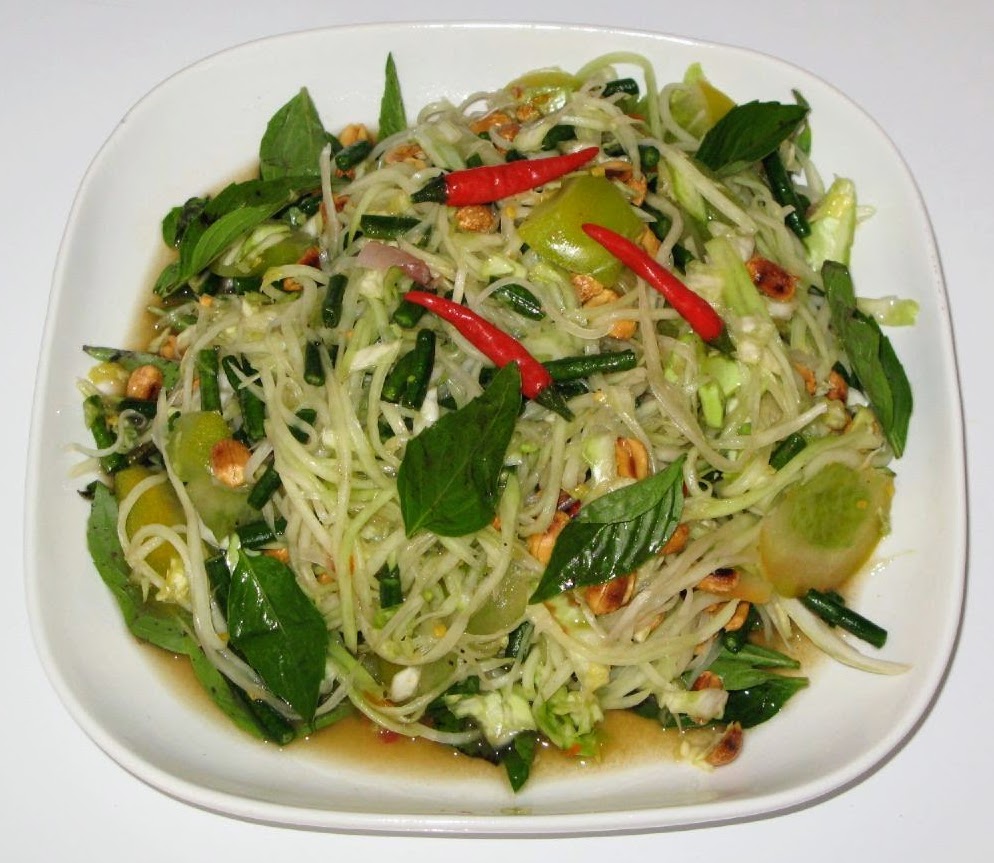
Green papaya salad, pounded in a mortar with garlic, chillies, lime juice, palm sugar, tomatoes, long beans and fish sauce or fermented fish. Many sellers add salted crab or dried shrimp. The name means 'pounded papaya'.
The Khmer word l'hong means papaya, and bok means to pound, which is exactly how the salad is made.
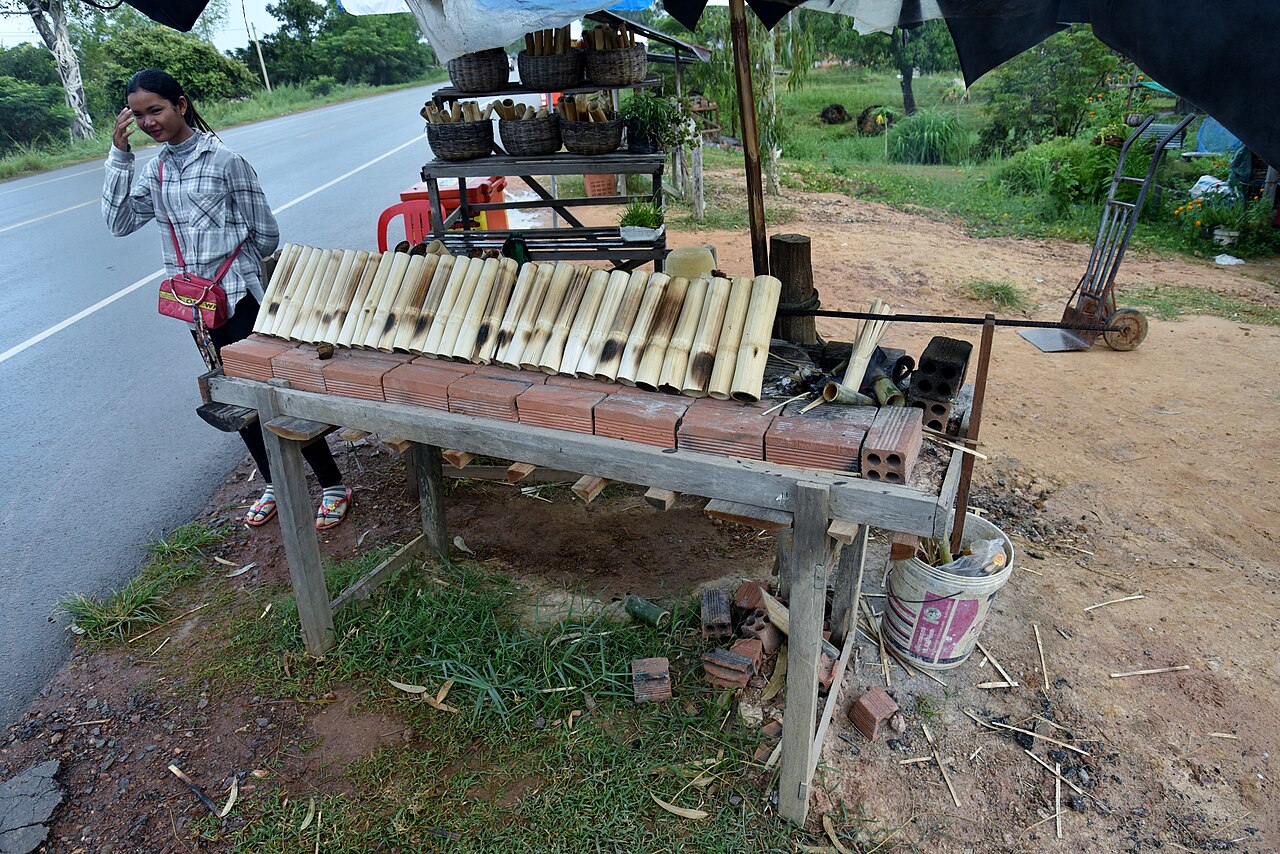
Sticky rice mixed with coconut milk, grated coconut, palm sugar and black-eyed beans, packed into bamboo tubes and roasted over a fire for about an hour and a half. You peel back the charred bamboo to eat the sweet rice inside. Sellers line the roads, especially near Battambang.
Rice has been cooked in bamboo in this region since ancient times, and in the Khmer Empire kralan is said to have served as rations for soldiers.
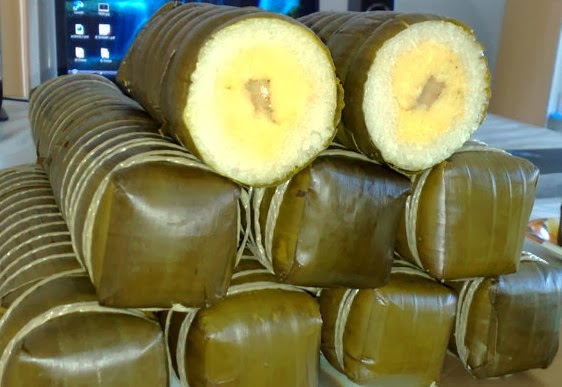
A cylinder of sticky rice wrapped in banana leaves and steamed, filled with banana (num ansom chek) or with mung beans and pork. It is made in large batches for the New Year in April and for Pchum Ben, the festival of the ancestors.
In April 2015 cooks in Siem Reap made a num ansom weighing about 4 tonnes, which Guinness World Records recognised as the largest sticky rice cake.
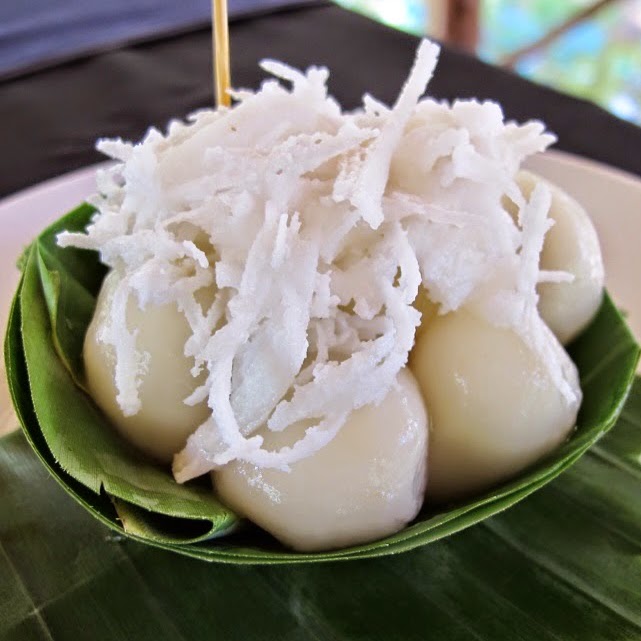
Small balls of glutinous rice dough with a piece of palm sugar hidden inside, boiled until they float and rolled in fresh grated coconut. When you bite one, the melted sugar runs out.
Soft rice cakes like these can be a choking risk for small children and older people, so cut them in half for anyone who has trouble swallowing.
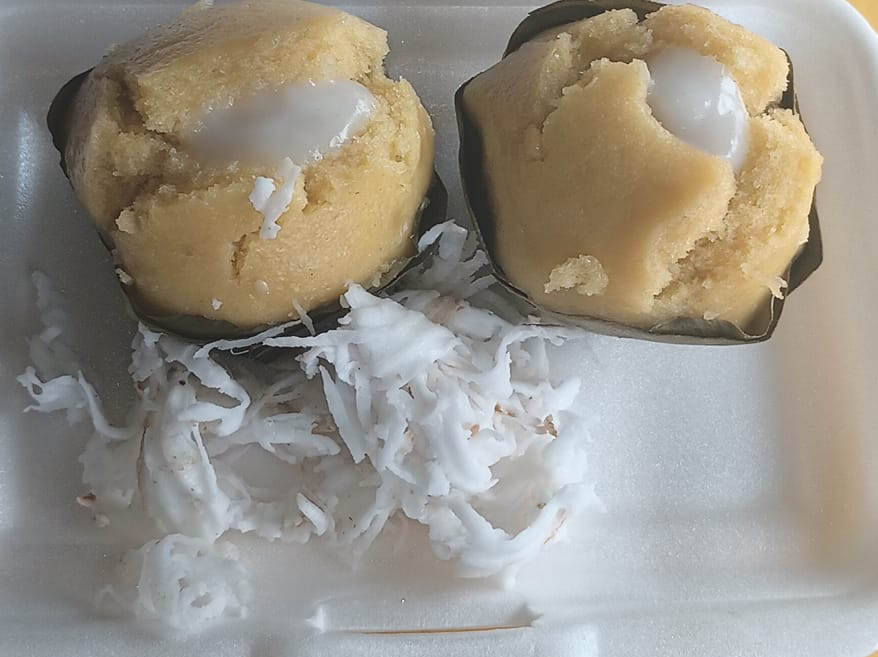
Little steamed cakes of rice flour and palm sugar, left to ferment overnight so they turn light and spongy, then served with coconut cream or grated coconut. They are sold in sets of four to six.
Palm sugar from Kampong Speu Province, used in many Cambodian sweets, is a protected geographical indication in Cambodia and the European Union.
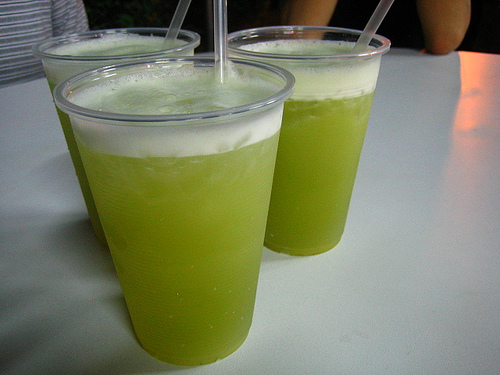
Fresh sugarcane stalks pressed through a roller machine on the spot and poured over ice, sometimes with a squeeze of kumquat or lime to balance the sweetness. It is one of the most popular street drinks on a hot afternoon.
Most Cambodians still live in the countryside, and Phnom Penh is by far the largest city. The historic heart of the country lies around the Tonlé Sap: Siem Reap near the temples of Angkor, Battambang to the west and Kampong Thom to the east. The Mekong carries river towns such as Kampong Cham and Kratié, while the south coast has the port of Sihanoukville, the pepper town of Kampot and the seaside village of Kep. In the far north, Preah Vihear is the base for two of the country's great temple sites.
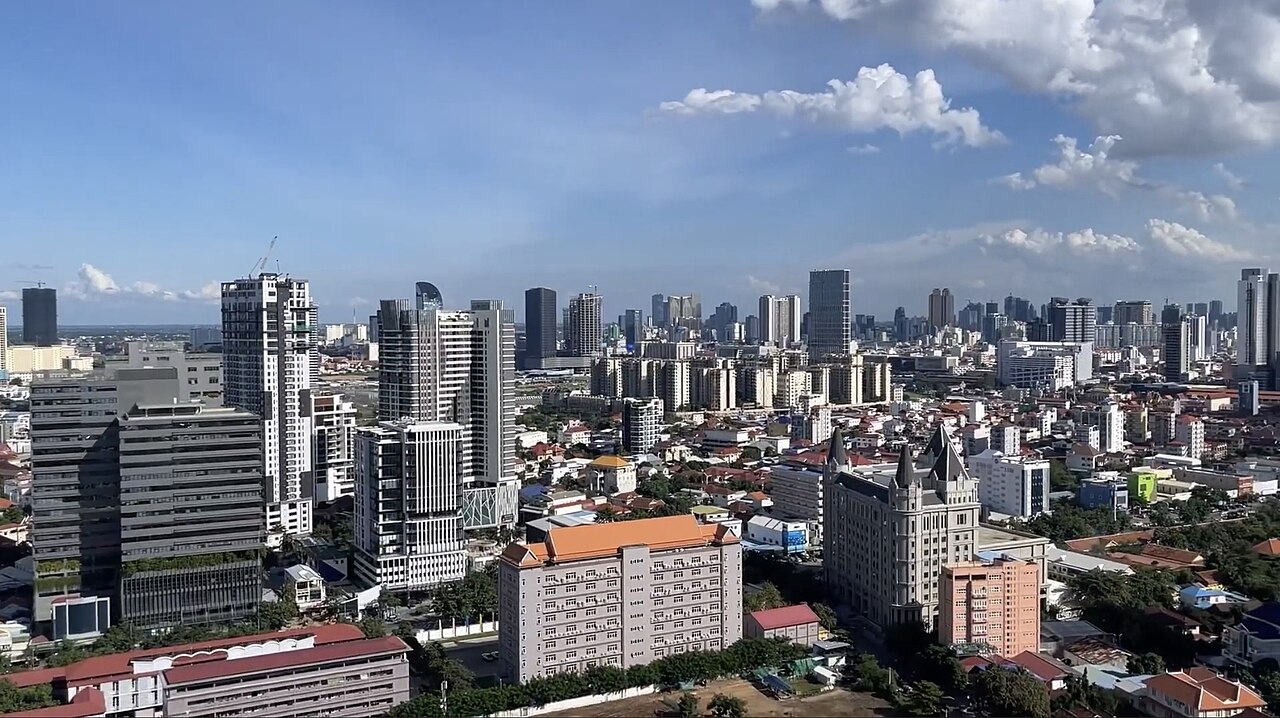
The capital, home to more than 2 million people, at the meeting point of the Mekong and Tonlé Sap rivers, called Chaktomuk, 'four faces'. Legend says a woman named Penh found Buddha statues floating in the river in 1372 and built a hill shrine for them, Wat Phnom, which gave the city its name: 'Penh's hill'.
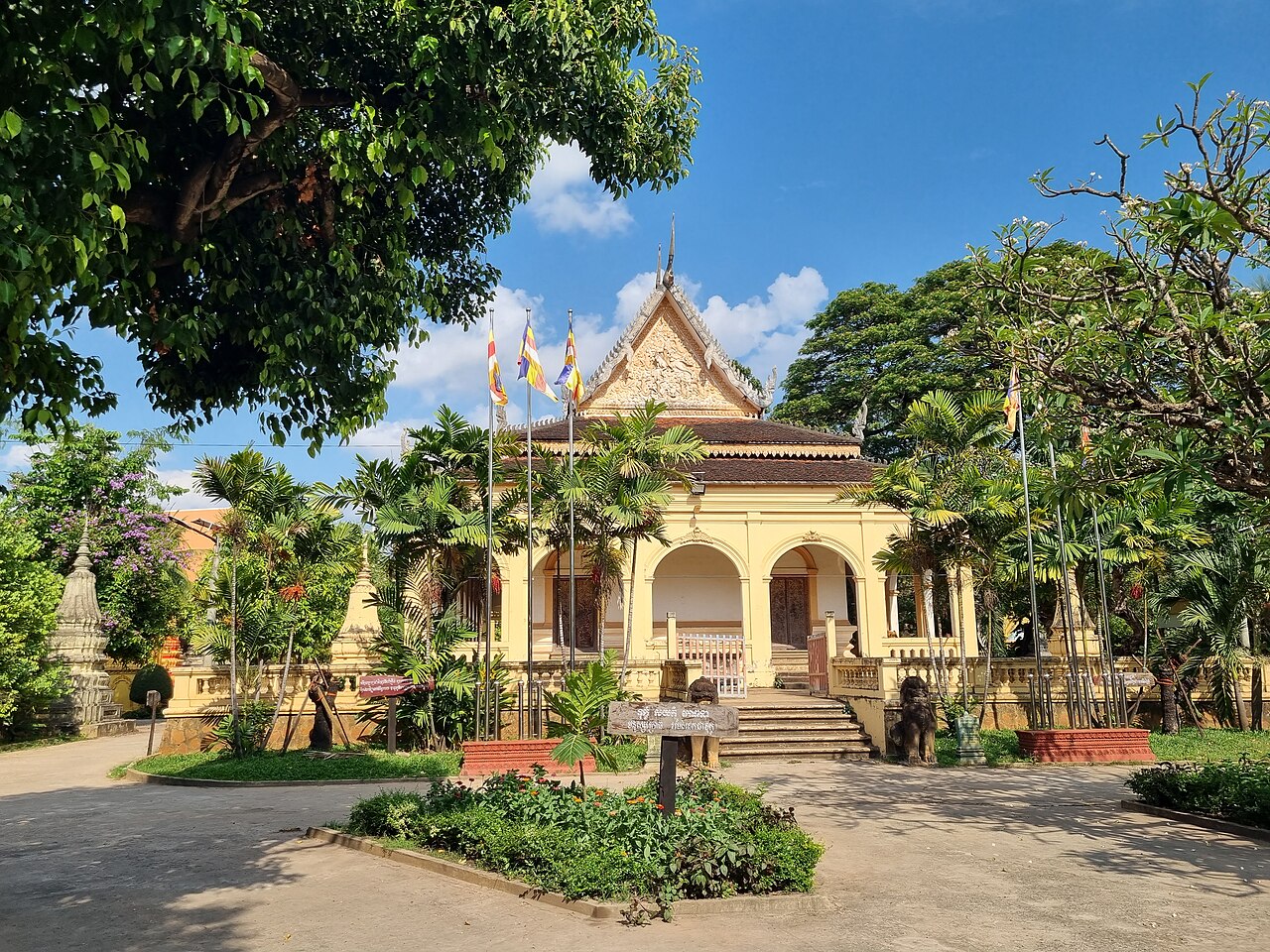
The second-largest city and the gateway to the temples of Angkor, about 6 km to the north. Around the Old Market are French colonial shophouses, and the city is known for its food, apsara dance performances, silk farms and trips to the floating villages of the great lake.
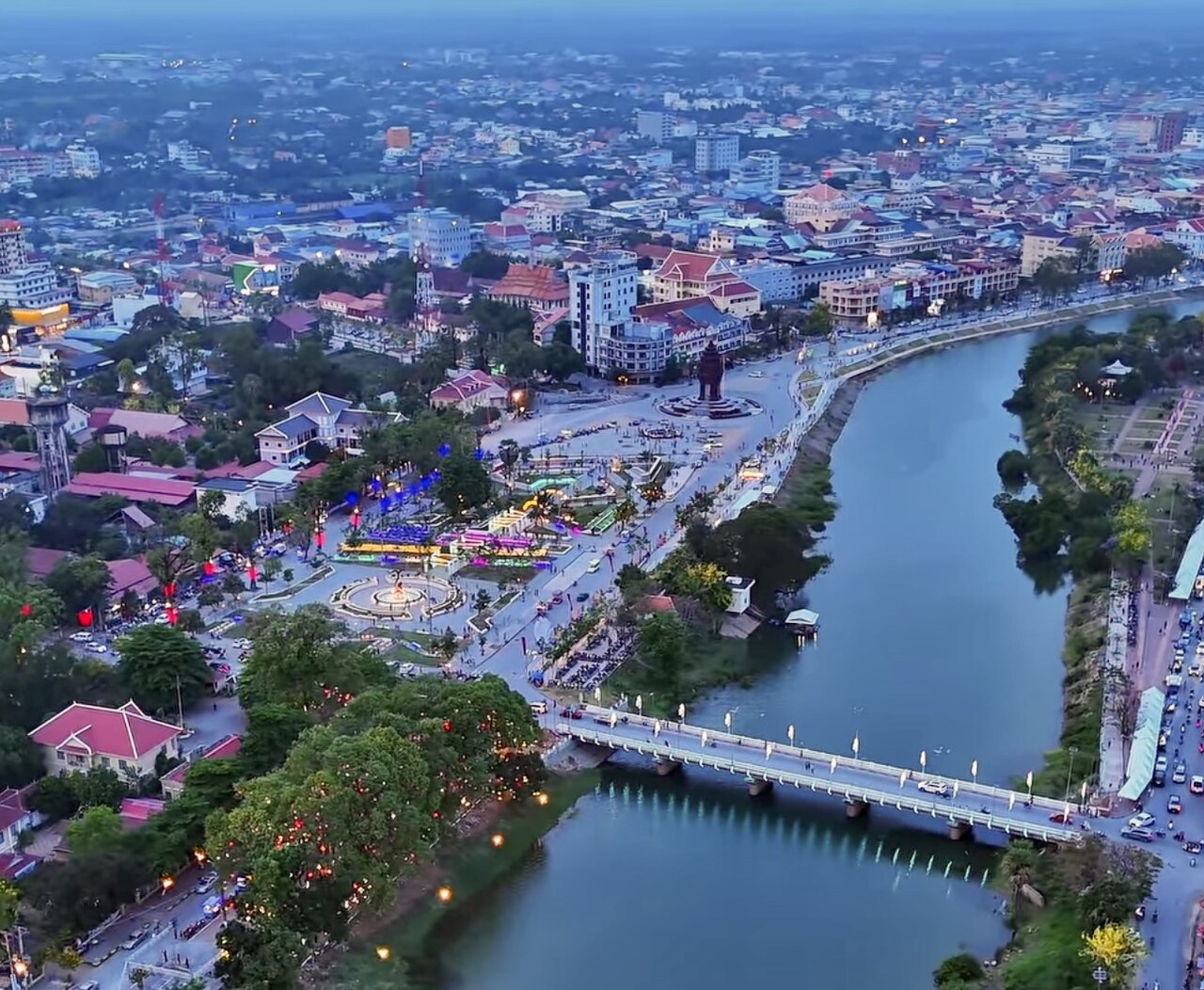
A relaxed riverside city with some of the best-kept French colonial streets in the country, surrounded by rich rice land. It was ruled by Siam from 1795 to 1907. In 2023 UNESCO named it a City of Gastronomy.
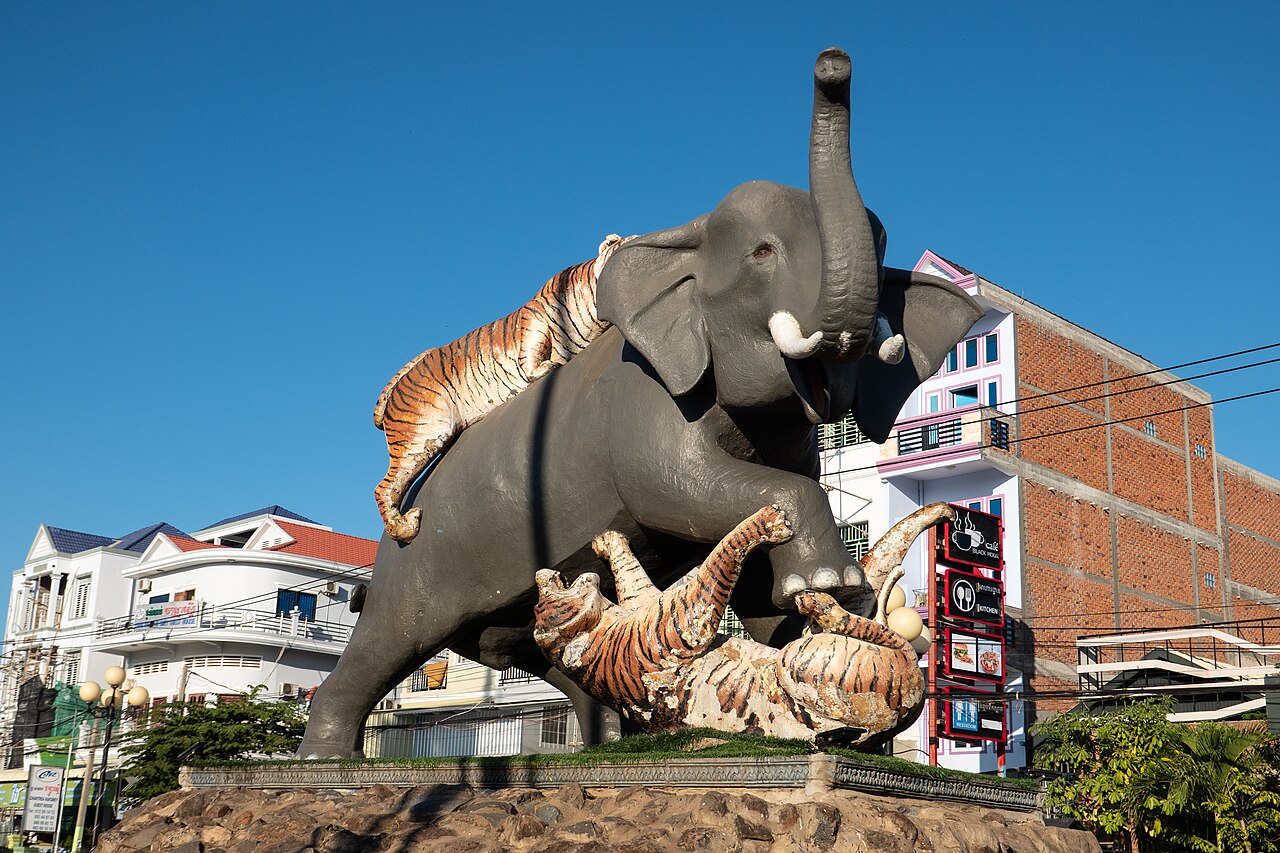
A quiet provincial capital on the main road between Phnom Penh and Siem Reap. It is the base for visiting Sambor Prei Kuk, the brick temples of the old Chenla capital, about 30 km to the north.
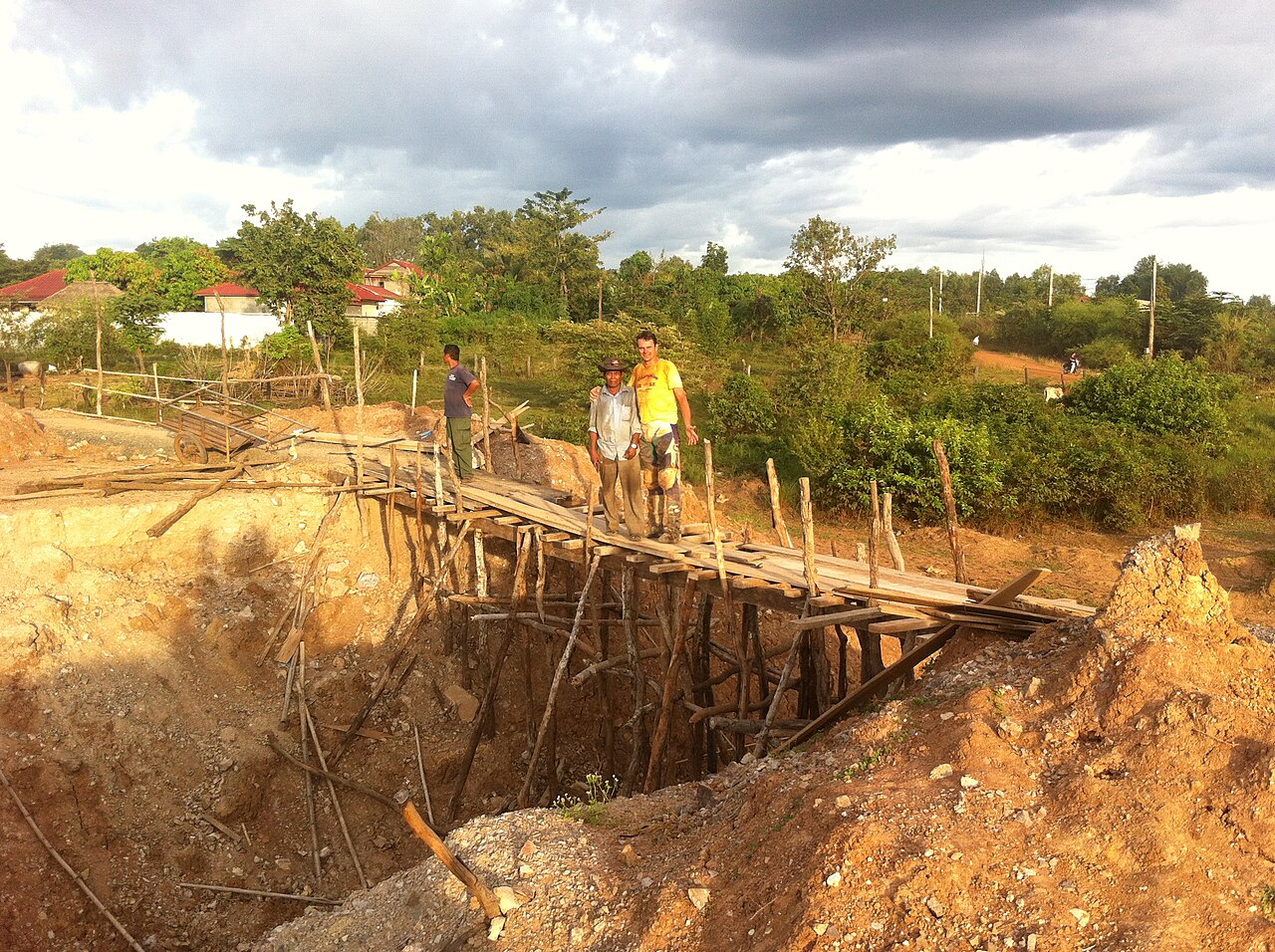
A small provincial capital, formerly called Tbeng Meanchey, in the forested north. It is a base for visiting the temple ruins of Koh Ker and the cliff-top temple of Preah Vihear on the Dângrêk escarpment.
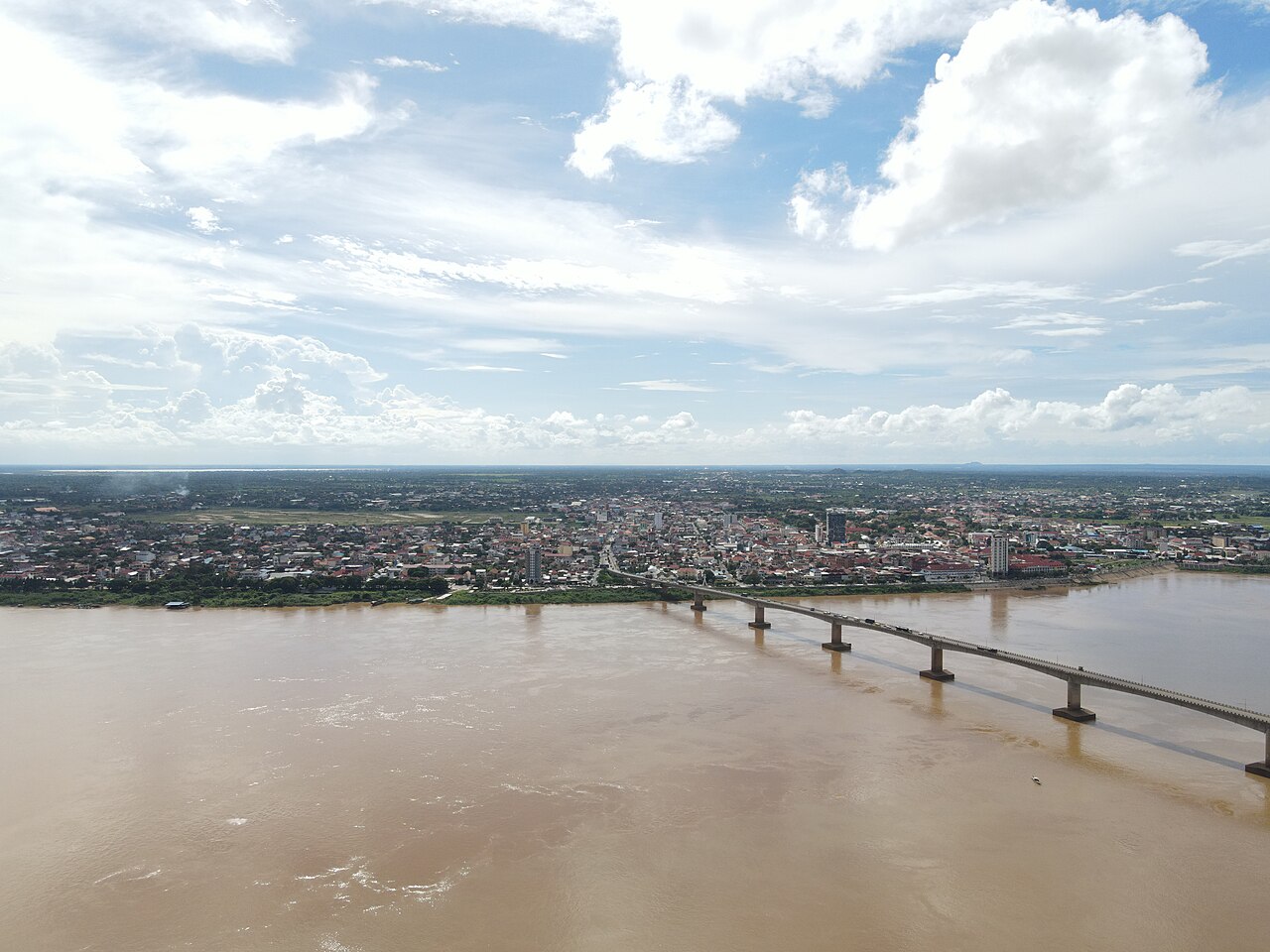
A Mekong river town about 124 km northeast of Phnom Penh. Its Kizuna Bridge was the first bridge in Cambodia to span the Mekong. The name means 'port of the Cham', the Muslim Cham people who live along this stretch of river.
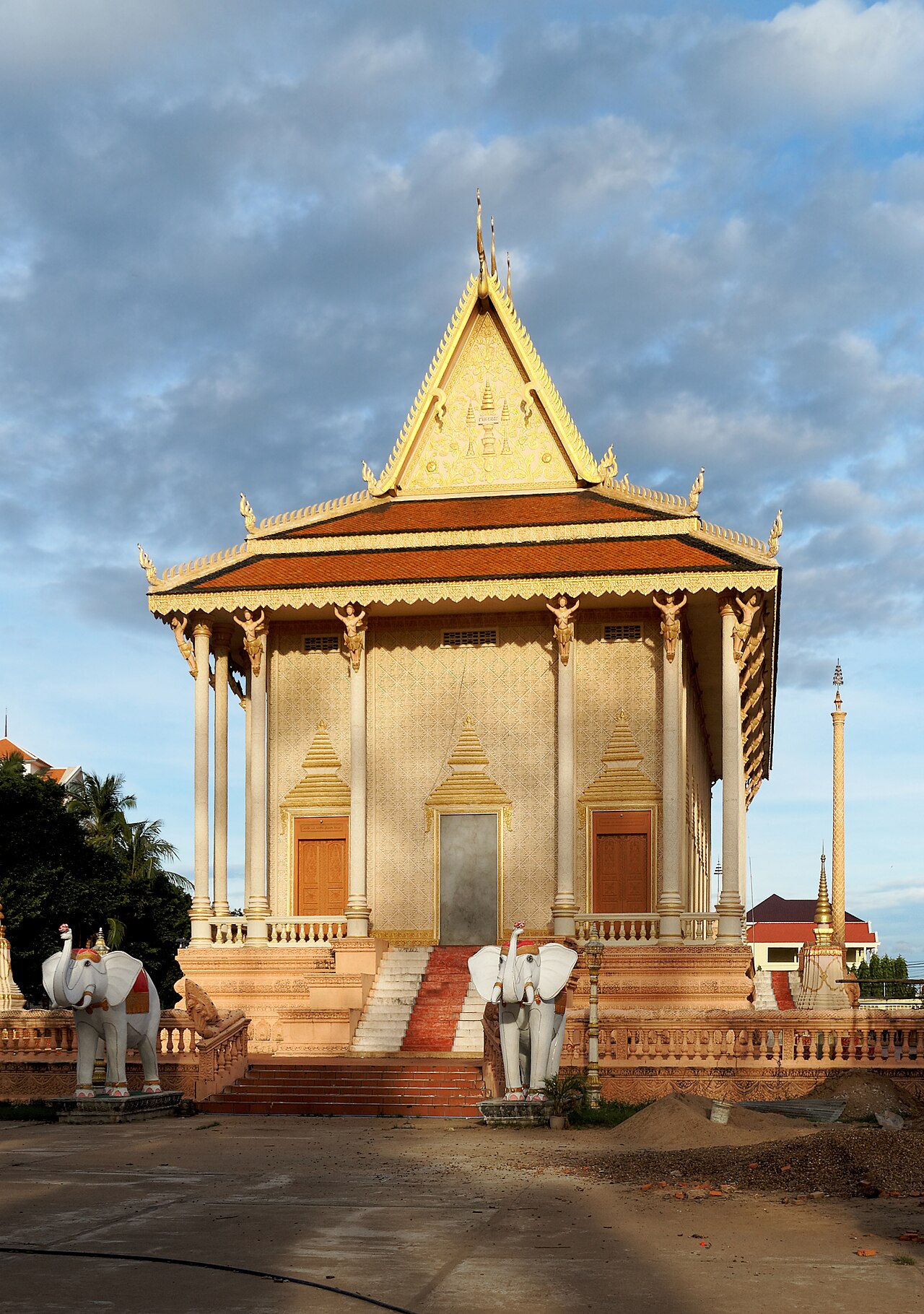
A small riverside town of French colonial buildings on the Mekong, with sandy islands in the river. North of the town, boats take visitors to watch the rare Irrawaddy dolphins that live in this stretch of the Mekong.
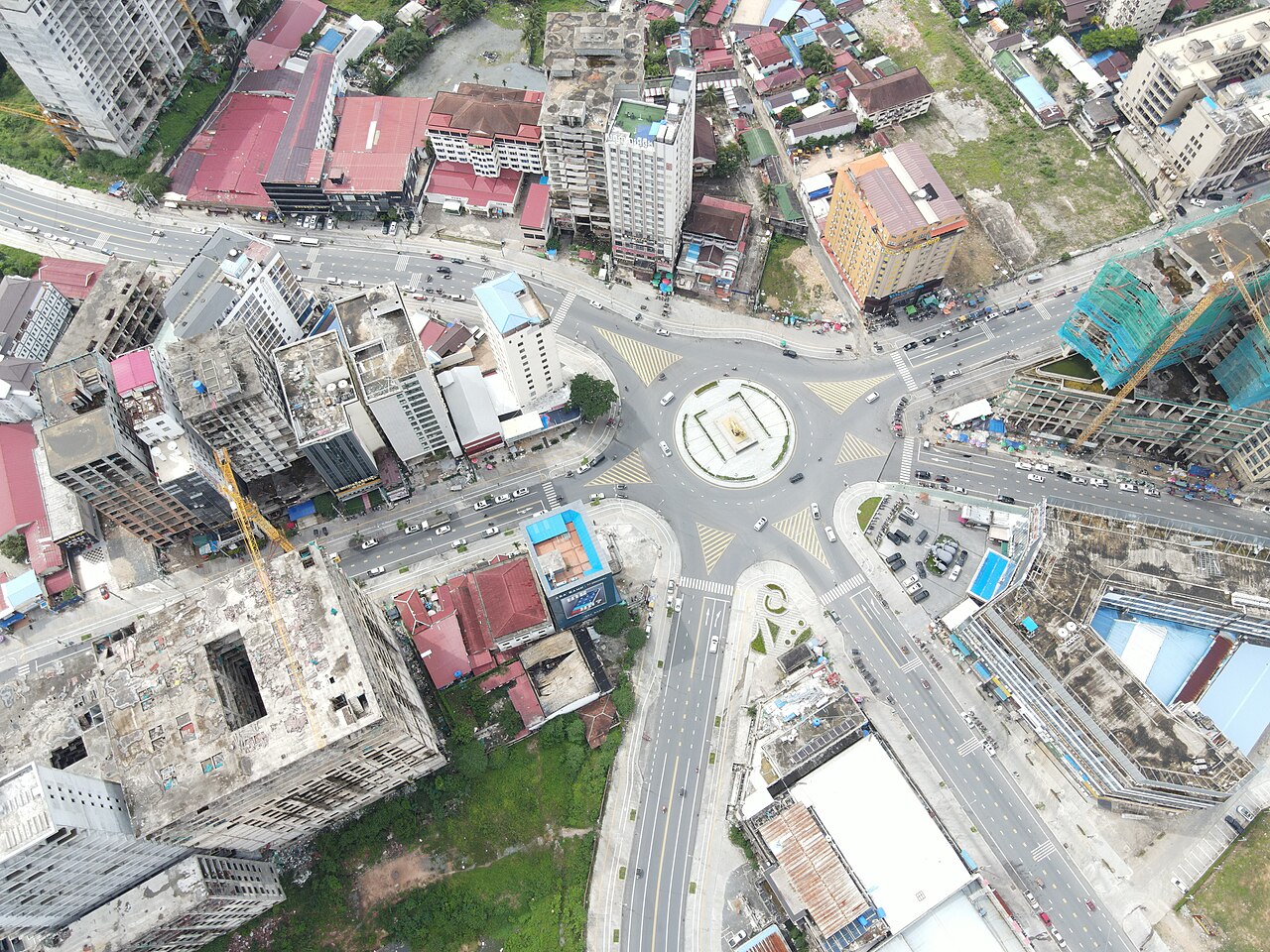
Cambodia's only deep-water port, built from 1955 and named after King Norodom Sihanouk. It has a string of beaches and is the departure point for ferries to islands such as Koh Rong.
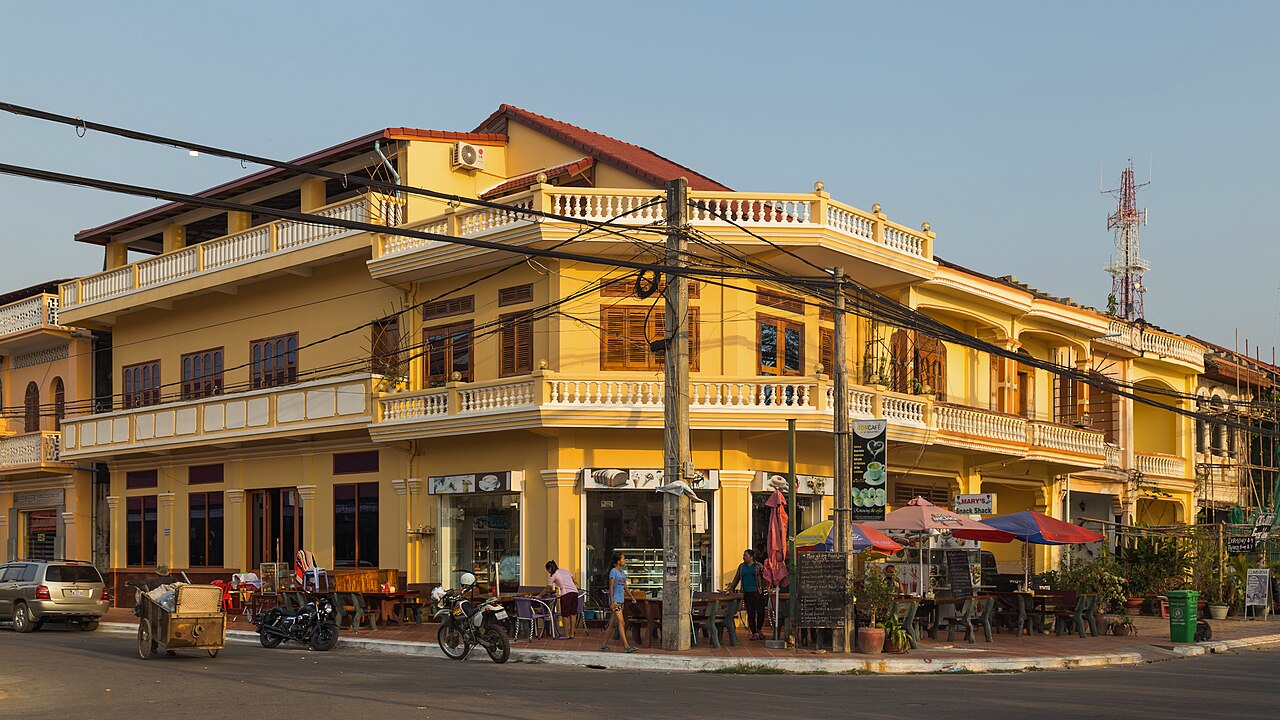
A sleepy riverside town of 19th-century French colonial buildings, about 5 km from the sea below the Elephant Mountains. The countryside around it grows the famous Kampot pepper, and above it stands the old French hill station on Bokor Mountain.
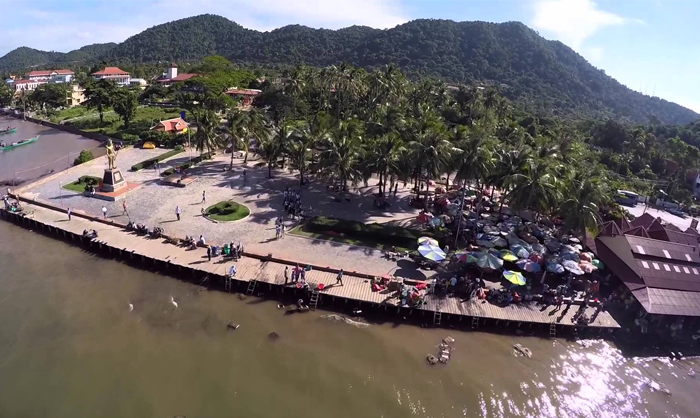
A small seaside town that was a smart French and Cambodian resort in the 1950s and 1960s. It is the capital of Kep, the smallest province in Cambodia, and is best known for its crab market, where the catch is cooked with green Kampot pepper.
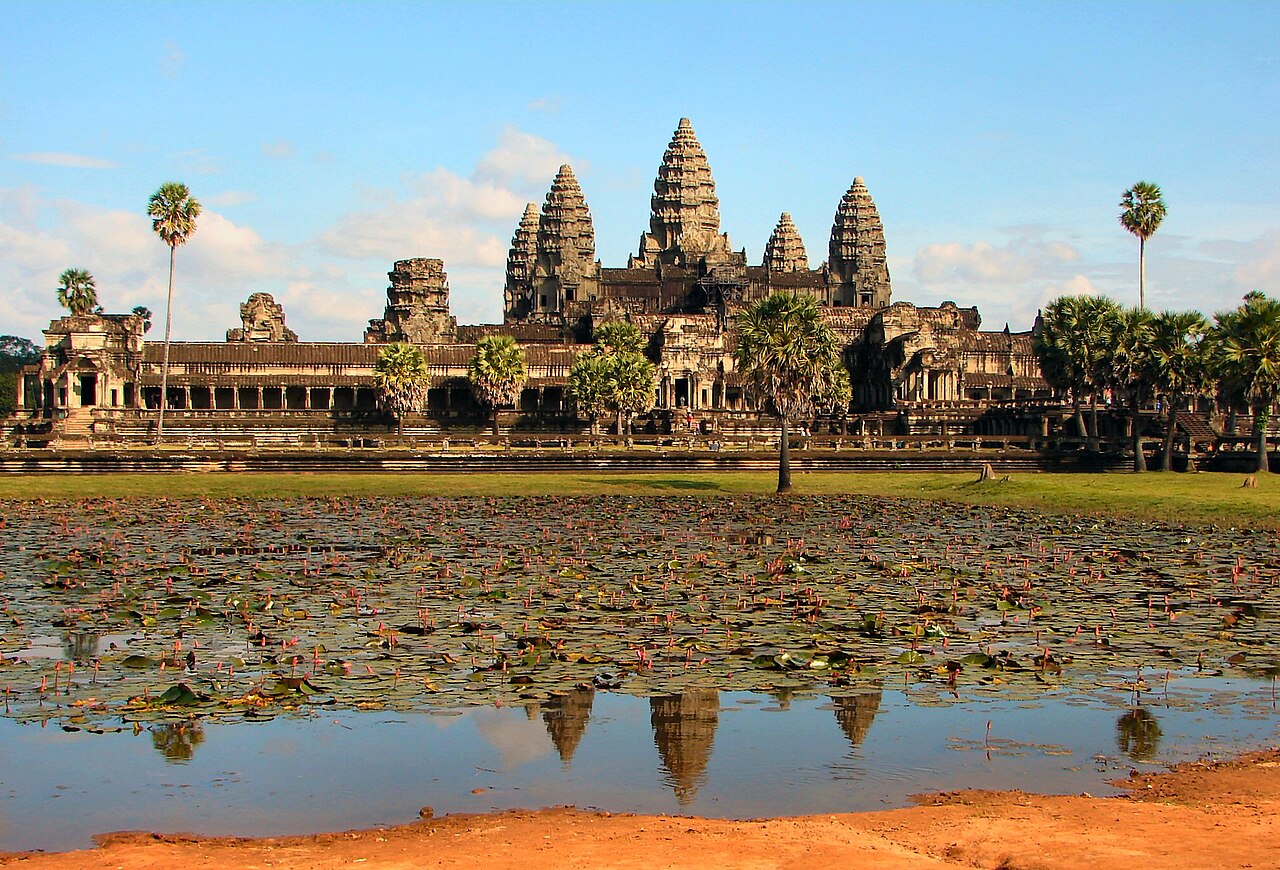
Built between about 1113 and 1150 for King Suryavarman II as a Hindu temple to Vishnu, and a Buddhist temple since the late 13th century. Its five towers stand for Mount Meru, home of the gods, and its galleries hold long carved stories. Unlike most Angkor temples it faces west. It appears on the national flag and is part of the Angkor World Heritage Site, listed in 1992.
UNESCO World Heritage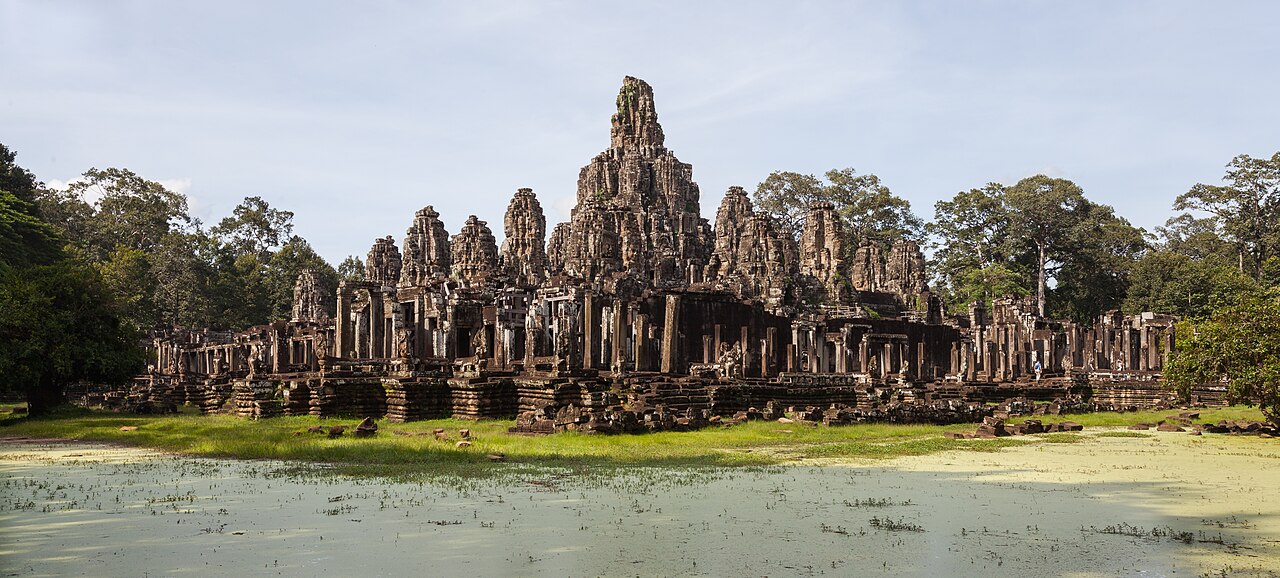
The state temple of Jayavarman VII at the centre of his walled city, Angkor Thom, built in the late 12th or early 13th century. Its many towers carry huge, calm smiling faces looking in every direction, and its walls show scenes of battles, markets and kitchens.
UNESCO World Heritage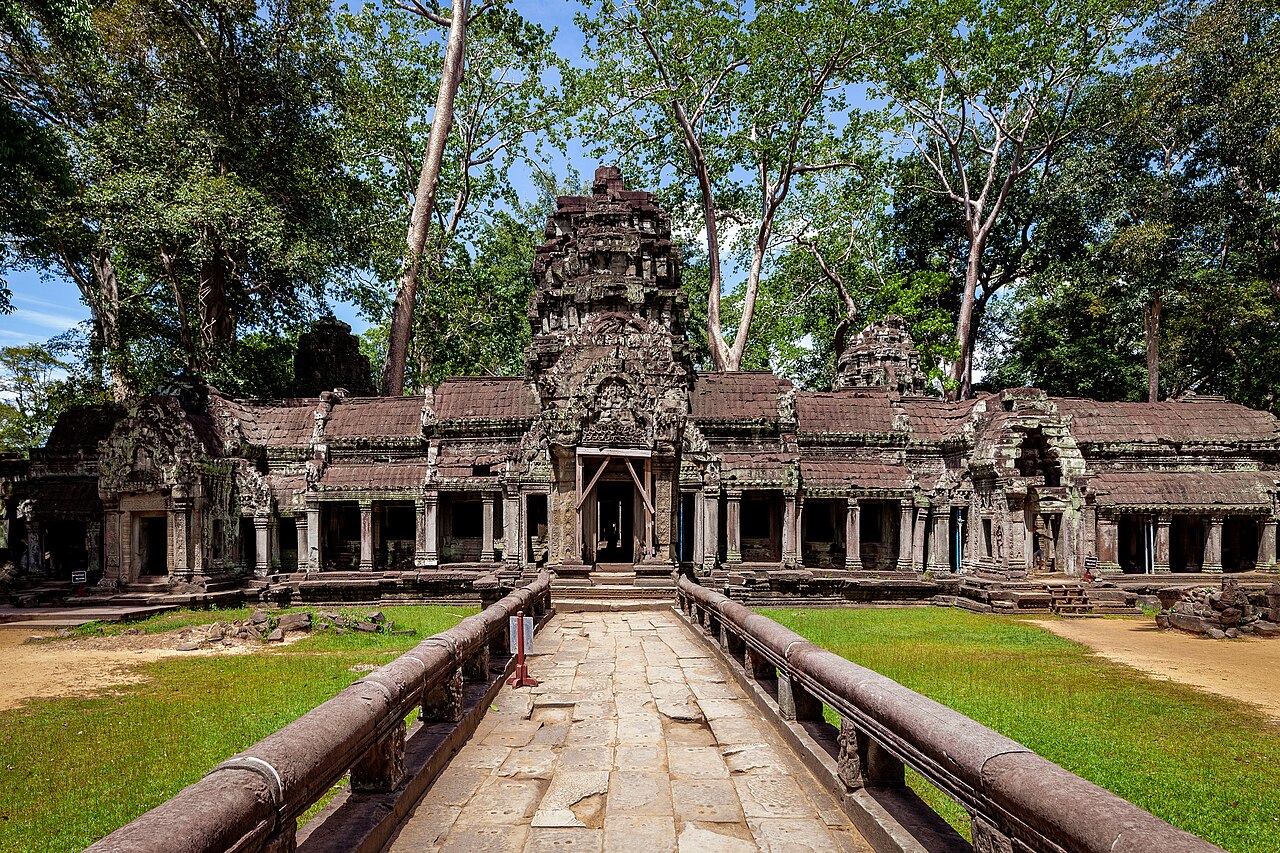
A Buddhist monastery that Jayavarman VII founded in the late 12th century and dedicated to his mother. After it was abandoned, giant silk-cotton and fig trees grew over the stones, and they have been left in place. It became famous worldwide from the film Lara Croft: Tomb Raider (2001).
UNESCO World Heritage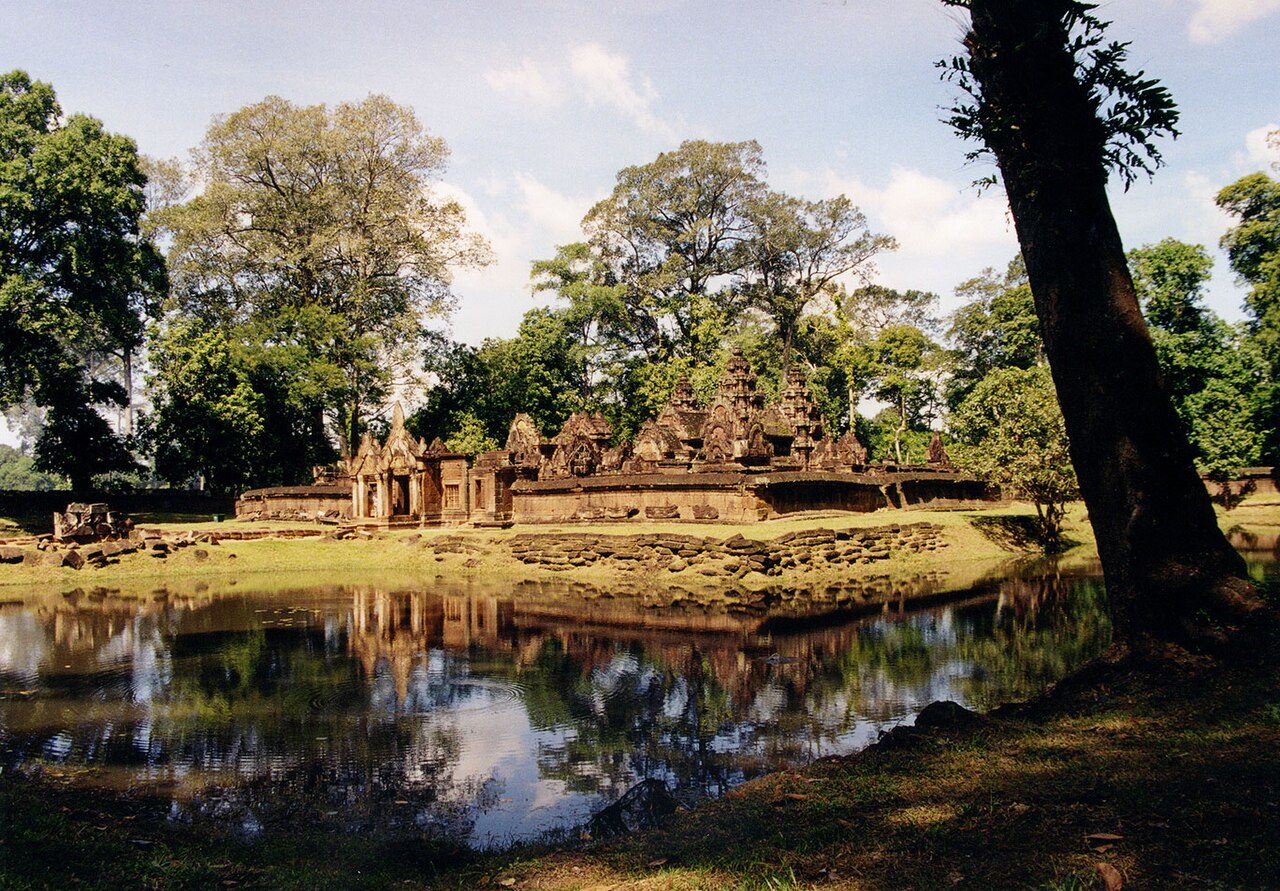
A small temple to Shiva, consecrated in 967 and built not by a king but by royal counsellors. It is made of red sandstone, which glows pink in the late sun, carved with such fine detail that it is often called the jewel of Khmer art. It lies about 25 km northeast of the main Angkor temples.
UNESCO World Heritage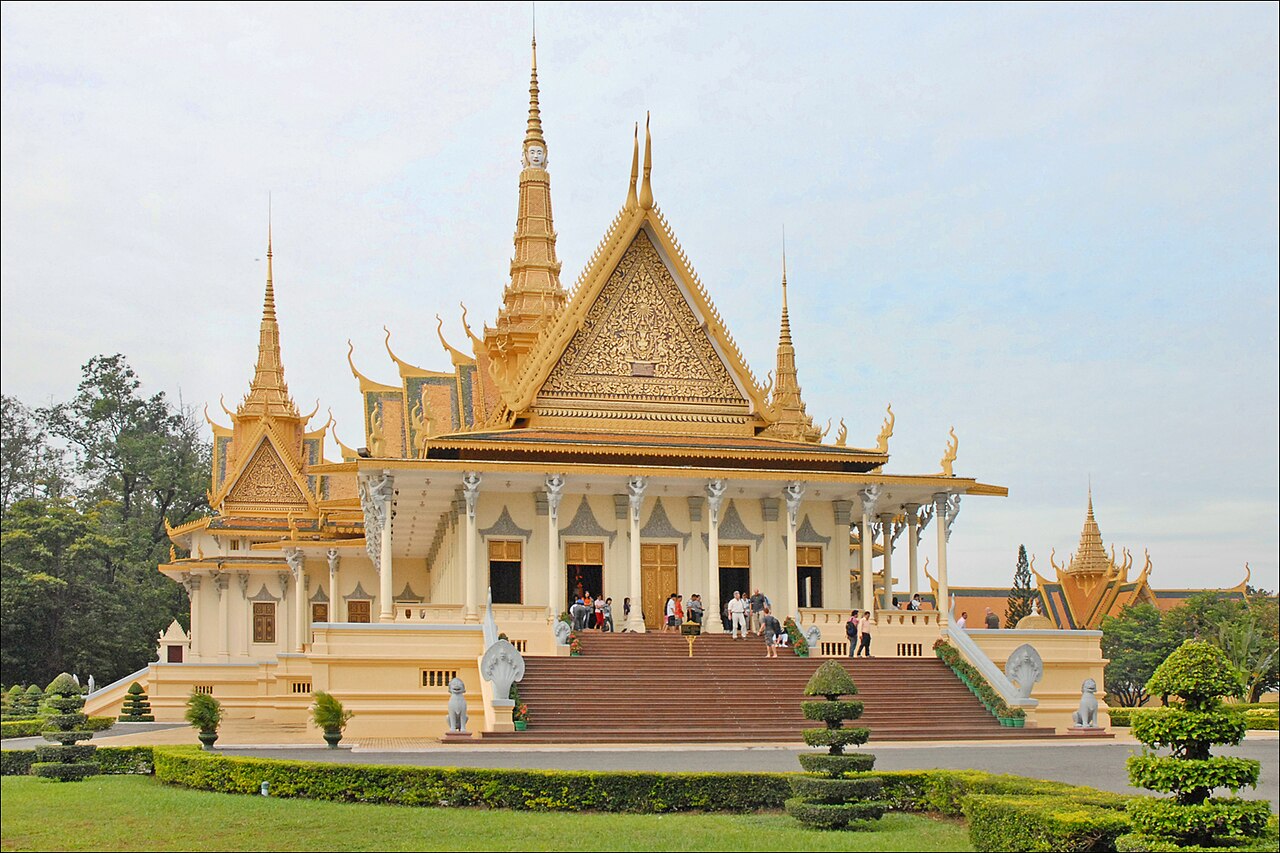
The official home of the King of Cambodia, first built by King Norodom from 1866 on the riverfront at Chaktomuk, with golden roofs and the Throne Hall. In the same grounds, the Silver Pagoda has a floor of 5,329 silver tiles and holds a small green crystal Buddha and a life-size gold Buddha set with thousands of diamonds.
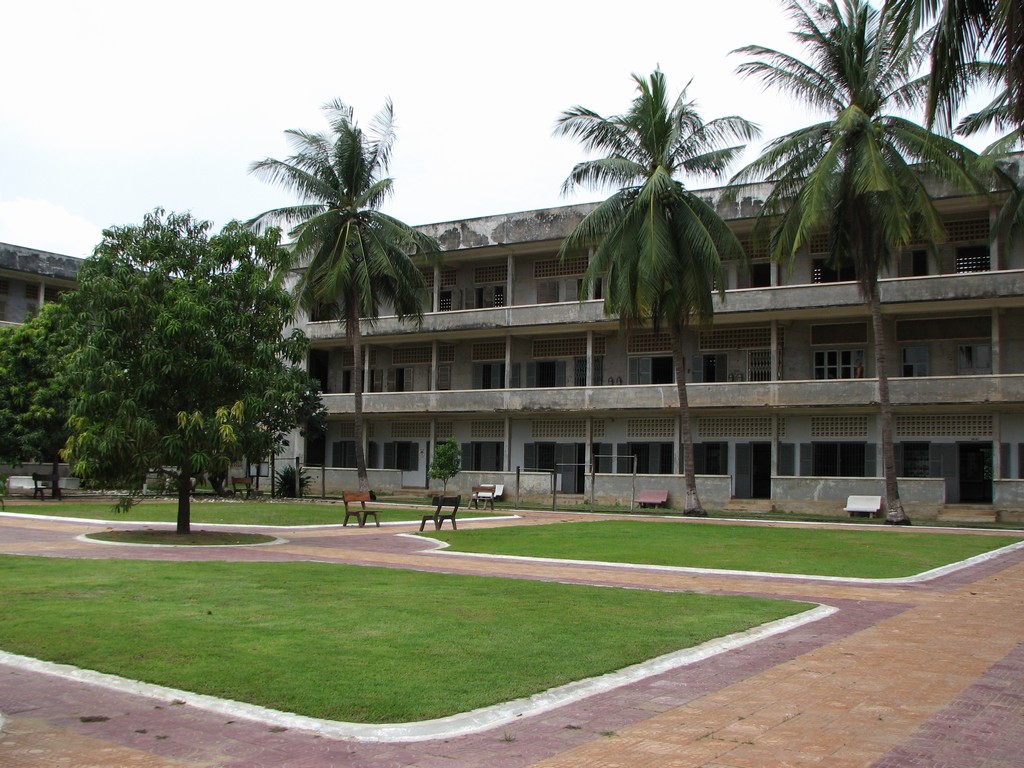
A former high school that the Khmer Rouge turned into Security Prison 21 (S-21). An estimated 20,000 people were held here between 1976 and 1979, and very few survived. Since 1980 it has been a museum of photographs and records, and in 2025 it became part of the Cambodian Memorial Sites World Heritage Site. Visitors are asked to be quiet and respectful.
UNESCO World Heritage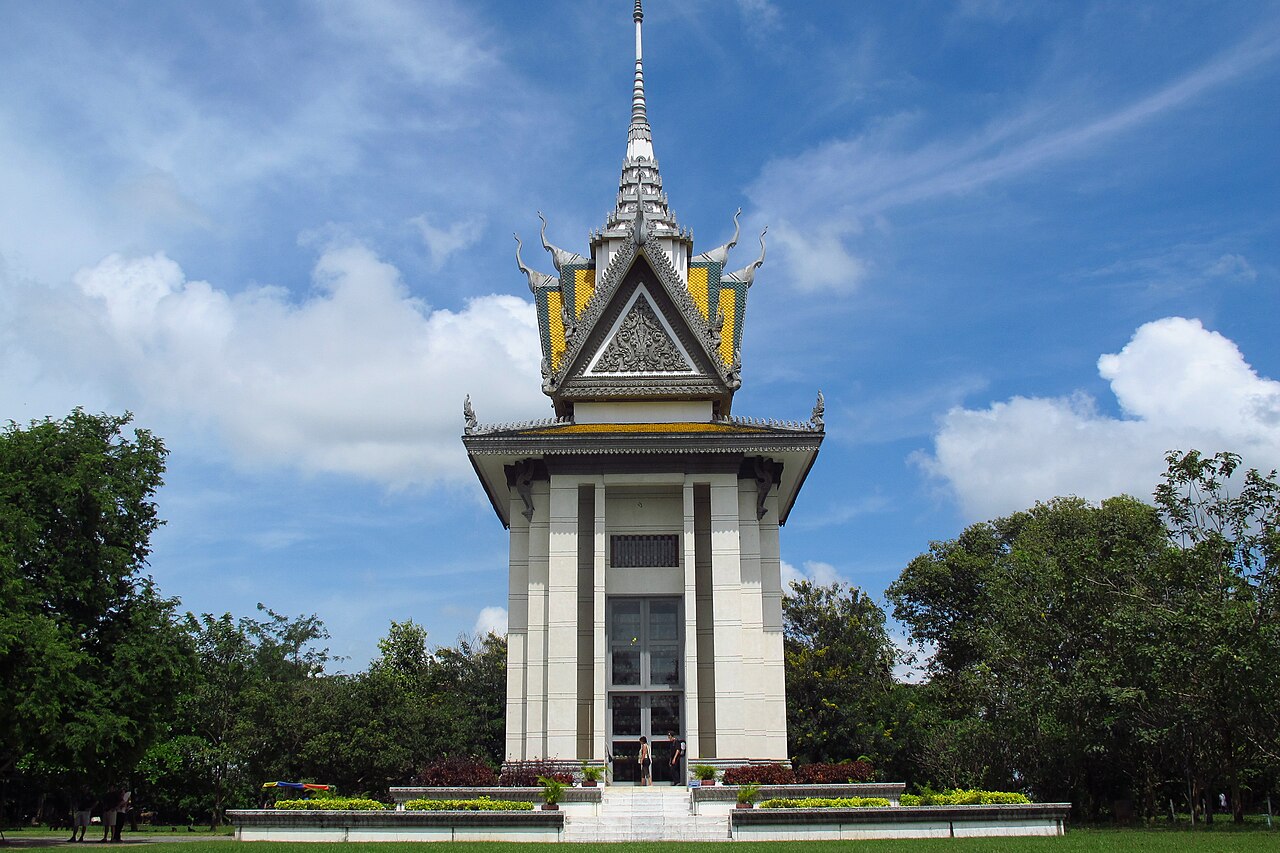
A former orchard about 17 km south of central Phnom Penh, used from 1977 to 1979 as a killing field for prisoners of S-21. A Buddhist memorial stupa holds the remains of victims found here. It is part of the Cambodian Memorial Sites, listed by UNESCO in 2025.
UNESCO World Heritage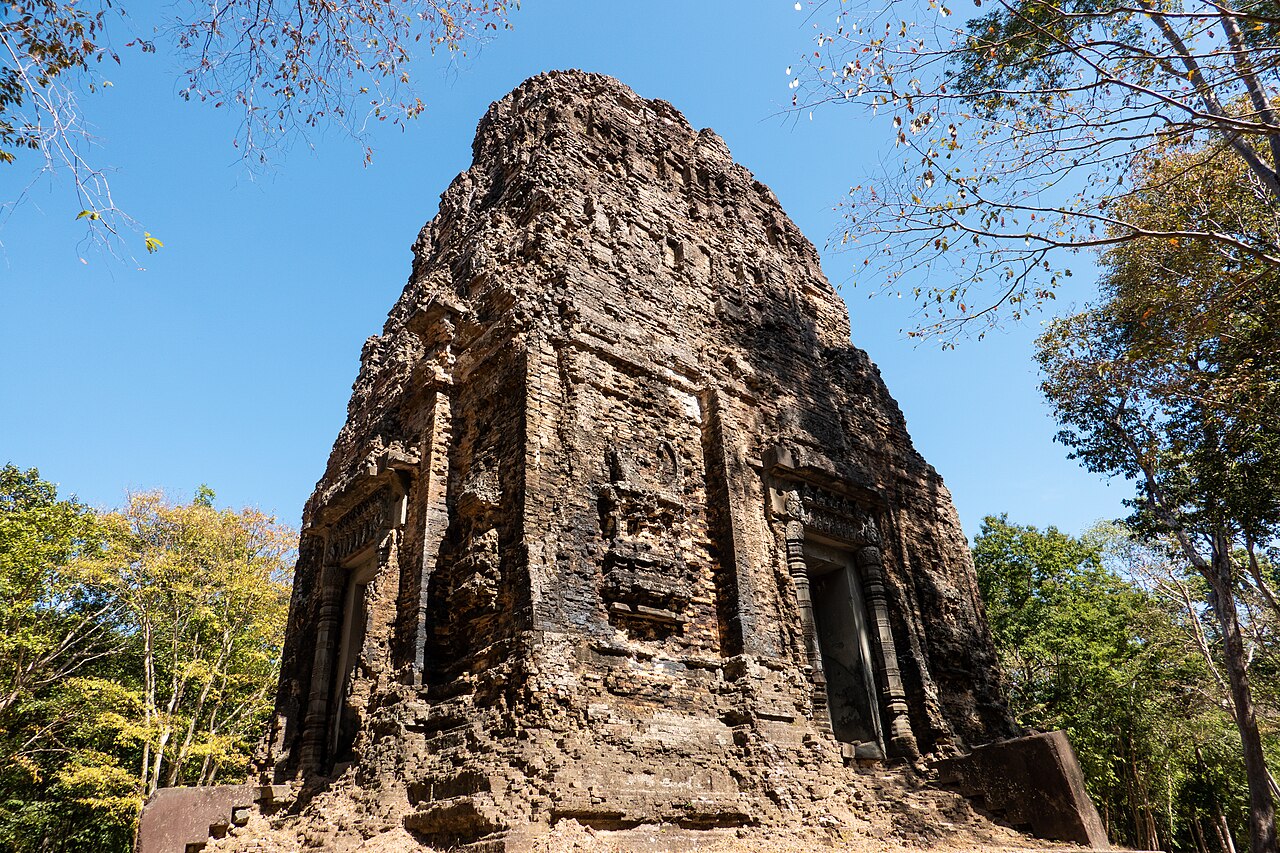
The ruins of Ishanapura, capital of the Chenla kingdom in the 7th century, long before Angkor. Dozens of brick temples, some of them unusual octagonal towers, stand in the forest among ponds and lion statues. It was listed by UNESCO in 2017.
UNESCO World Heritage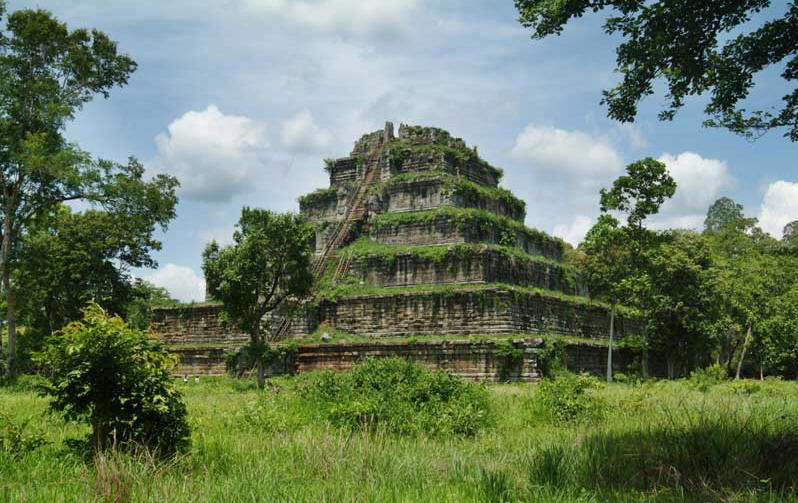
For a short time, from 928 to 944, this remote site was the capital of the Khmer Empire under King Jayavarman IV and his son. Its main temple, the Prang, is a seven-tiered pyramid 36 m high rising from the forest, and dozens of other temples lie around it. It was listed by UNESCO in 2023.
UNESCO World Heritage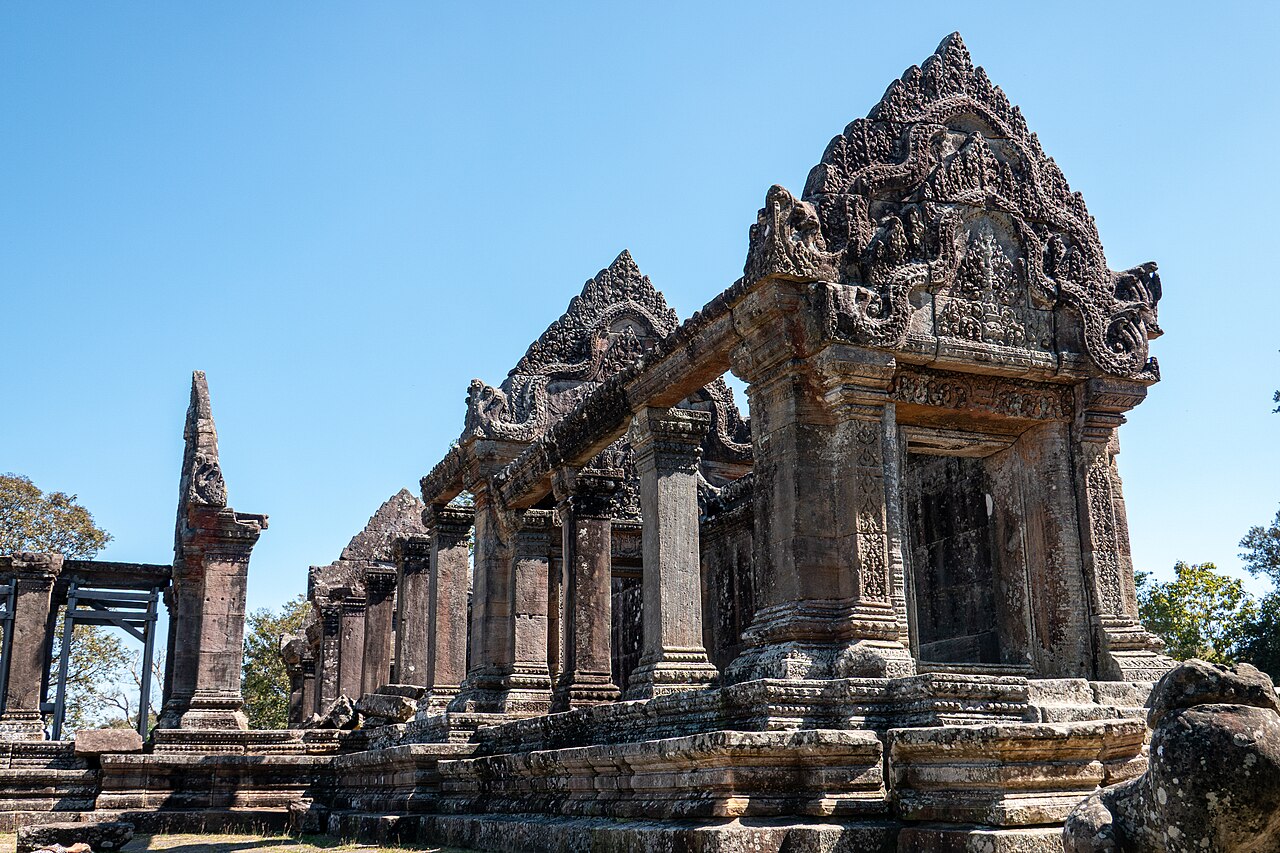
A Hindu temple dedicated to Shiva, built over several centuries on top of a 525 m cliff of the Dângrêk Mountains, with views far over the Cambodian plain. It runs along a north to south path of stairs and gateways for about 800 m. The International Court of Justice ruled in 1962 that the temple lies in Cambodia, and UNESCO listed it in 2008. The border area nearby has seen armed clashes, including in 2025, so check current travel advice before going.
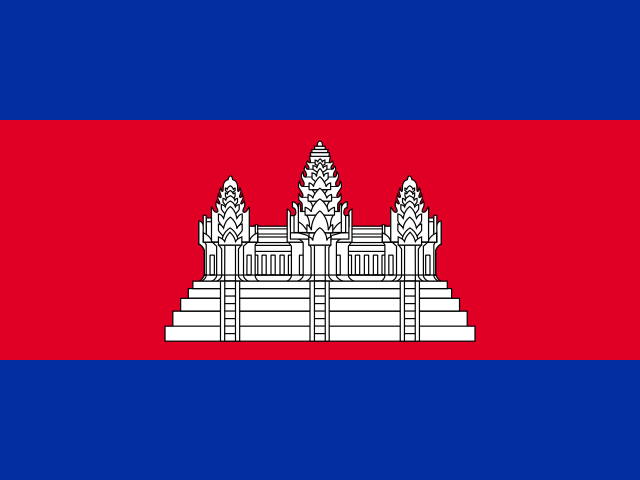
UNESCO World HeritageA drawing of Angkor Wat has been on almost every Cambodian flag since around 1875. The present design, a white Angkor Wat on a red band between two blue ones, was first adopted in 1948 and readopted on 24 September 1993, when the monarchy was restored.
Every year the Tonlé Sap River changes direction. In the rainy season the swollen Mekong pushes water up the river into the great lake, which grows from about 2,500 km² in the dry season to as much as 16,000 km². When the rains end, the river turns and drains the lake back into the Mekong.
Bon Om Touk, the Water Festival, marks the turning of the Tonlé Sap River each autumn with three days of long-boat races, illuminated boats and fireworks on the river in Phnom Penh.
Cambodia's king is not simply the eldest son of the last one. Since 1993 the king has been chosen from the royal family by the Royal Council of the Throne, which makes Cambodia one of the few elective monarchies in the world.
The Khmer script has 33 consonant letters in modern use, and each can carry many vowel signs above, below and beside it. The oldest dated inscription in Khmer was carved in 611.
Under the Khmer Rouge, from 1975 to 1980, Cambodia had no money at all. The riel used today has been issued since 20 March 1980.
According to a 2007 study using satellite images, greater Angkor was the largest pre-industrial city in the world, spreading over nearly 3,000 km² of houses, rice fields, canals and reservoirs.
Cambodians give the fruits in their markets a royal court: the durian is the king, the mangosteen the queen, the sapodilla the prince and the milk fruit the princess.
By one estimate, Cambodian Americans own about 90 percent of the independent doughnut shops in California. Many were started by refugees who arrived in the late 1970s and 1980s.
Rare Irrawaddy dolphins, which have a round head and no beak, live in the Mekong north of Kratié. As of mid-2026, conservationists estimated only about 118 of them in the Cambodian Mekong, though the number has been slowly rising.
Khmer New Year falls on 13 or 14 April, at the end of the harvest and the hottest time of the year, and is celebrated over three days with visits to pagodas, water splashing and games.
Angkor Wat faces west, towards the setting sun, while most temples at Angkor face east. That is why the famous sunrise photographs show the sun coming up behind its towers.
As of September 2026, Cambodia has five UNESCO World Heritage Sites: Angkor (1992), Preah Vihear (2008), Sambor Prei Kuk (2017), Koh Ker (2023) and the Cambodian Memorial Sites (2025).
In 2018 the Khmer Rouge Tribunal found two of the regime's leaders, Nuon Chea and Khieu Samphan, guilty of genocide against Cambodia's Vietnamese minority. Khieu Samphan's conviction was upheld on appeal on 22 September 2022.
Pronunciation is written the way it sounds; the capital letters show where the stress goes. Audio is coming soon.
Cambodia uses two currencies side by side. Prices for hotels, tours and larger items are often in US dollars, while market food and small change are in riel, usually counted at 4,000 riel to the dollar. Carry clean, untorn dollar notes, because damaged ones are often refused, and spend your riel before you leave.
Temples, including the ruins of Angkor, are still holy places. Wear clothes that cover your shoulders and knees; at the top level of Angkor Wat you may be turned away otherwise, and a scarf over the shoulders is not always accepted. Take off your shoes and hat before entering a pagoda.
Foreign visitors need an Angkor Pass for one, three or seven days. Buy it only at the official ticket centre on the road from Siem Reap or on the official Angkor Enterprise website. Your photo is printed on the pass, and it is checked at the main temples. Come early: the park opens at 5 in the morning and the first hours are cooler and quieter.
Cambodians greet, thank and apologise with the sampeah: palms together in front of the chest and a slight bow. The higher the hands, the more respect. Never touch anyone's head, do not point your feet at people or Buddha images, and women should not touch a monk or hand him anything directly.
Decades of war left landmines and unexploded bombs in parts of rural Cambodia, especially in the northwest. Much has been cleared, but stay on well-used paths and roads, and never pass a red sign with a skull and crossbones.
Tuk-tuks, often a motorbike pulling a small carriage, are the easy way to get around towns. Agree the price before you set off, or book through a ride-hailing app such as Grab or PassApp, which shows the fare in advance.
The dry season runs from November to April and is the most comfortable time to visit, though April is very hot, often close to 40 °C. The rains come from May to October, with short, heavy downpours and a green, flooded landscape around the Tonlé Sap.
Since September 2025 international flights to Phnom Penh use Techo International Airport, about 19 km south of the city, which replaced the old airport. Allow extra time to reach it, especially in afternoon traffic.