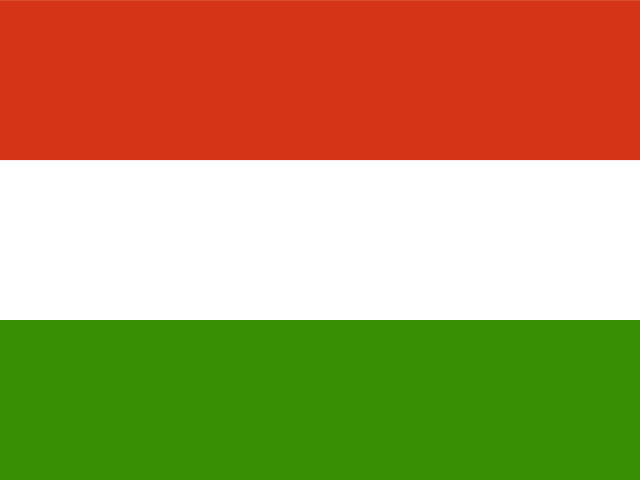
Hungary trivia: 46 questions and answers
The country at a glance
What is the capital of Hungary?
- A. Budapest
- B. Debrecen
- C. Szeged
- D. Pécs
Show the answer
Budapest. Budapest is the capital and by far the largest city, home to about 1.7 million people on both banks of the Danube.
As of September 2026, which currency is used in Hungary?
- A. Hungarian forint
- B. Euro
- C. Czech koruna
- D. Polish złoty
Show the answer
Hungarian forint. Hungary pays in the Hungarian forint (Ft). It joined the EU in 2004 but has not adopted the euro.
Hungary has no sea coast.
True or false?
Show the answer
True. True. Hungary is landlocked in the Carpathian Basin. It borders seven countries, all of them by land.
What is the highest mountain in Hungary?
- A. Kékes
- B. Triglav
- C. Grossglockner
- D. Dinara
Show the answer
Kékes. Kékes, in the Mátra mountains, is Hungary's highest point at 1,014 m. The others are the highest peaks of Slovenia, Austria and Croatia.
History
Which army defeated the Hungarians at the Battle of Mohács in 1526?
- A. The Ottoman army
- B. The Mongol army
- C. The Russian army
- D. The French army
Show the answer
The Ottoman army. The Ottoman army of Suleiman the Magnificent won at Mohács, and King Louis II died while fleeing.
Buda, Óbuda and Pest were officially united into one city called Budapest in 1873.
True or false?
Show the answer
True. True. The three towns on the two banks of the Danube were united in 1873 and given the new name Budapest.
The Treaty of Trianon in 1920 made Hungary larger than before.
True or false?
Show the answer
False. False. Hungary lost 71% of its territory and about two thirds of its population under the Treaty of Trianon.
Which king issued the Golden Bull of 1222, which limited the power of the king?
- A. Andrew II
- B. Matthias Corvinus
- C. Stephen I
- D. Louis II
Show the answer
Andrew II. Andrew II was forced by his nobles to issue the Golden Bull in 1222, one of the first documents in Europe to limit a king's power.
In August 1989, during the Pan-European Picnic, a border gate was opened between Hungary and which country?
- A. Austria
- B. Slovakia
- C. Romania
- D. Serbia
Show the answer
Austria. The gate to Austria near Sopron was opened on 19 August 1989, and several hundred East Germans crossed to the West.
Who led the defenders of Eger Castle against the Ottomans in 1552?
- A. István Dobó
- B. Lajos Kossuth
- C. Imre Nagy
- D. Árpád
Show the answer
István Dobó. István Dobó and about 2,100 defenders held Eger against a much larger Ottoman army.
Food and drink
The Hungarian word gulyás, which gave goulash its name, originally meant what?
- A. A cattle herder
- B. A fisherman
- C. A baker
- D. A soldier
Show the answer
A cattle herder. Gulya means a herd of cattle and gulyás means a cattle herder: the dish began as the meal of herdsmen on the plains.
What is the main ingredient of halászlé, the fisherman's soup?
- A. River fish such as carp
- B. Beef
- C. Chicken
- D. Cabbage
Show the answer
River fish such as carp. Halászlé is a hot paprika soup made with river fish such as carp, from the banks of the Danube and the Tisza.
What is on top of a Dobos torte?
- A. A hard, shiny layer of caramel
- B. Whipped cream and cherries
- C. Marzipan and almonds
- D. Fresh strawberries
Show the answer
A hard, shiny layer of caramel. The Dobos torte has thin sponge layers with chocolate buttercream and a hard, shiny layer of caramel on top, which kept it fresh longer.
Lángos is a deep-fried flatbread, usually topped with sour cream and grated cheese.
True or false?
Show the answer
True. True. Lángos is fried until crisp, rubbed with garlic and topped with sour cream and cheese. Its name comes from láng, meaning flame.
Which Hungarian sweet is known in English as chimney cake?
- A. Kürtőskalács
- B. Lángos
- C. Főzelék
- D. Lecsó
Show the answer
Kürtőskalács. Kürtőskalács is sweet dough wound around a cone and roasted over charcoal. Kürtő means stovepipe, and the hollow cake looks like a chimney.
Hortobágy pancakes were first made by herdsmen on the Hortobágy plain.
True or false?
Show the answer
False. False. Despite the name, the dish has nothing to do with the Hortobágy region. It was invented for the 1958 World's Fair in Brussels.
Many Hungarians traditionally do not clink glasses when drinking beer.
True or false?
Show the answer
True. True. The story says Austrian officers clinked beer glasses to celebrate the execution of 13 Hungarian generals in 1849, and many Hungarians still avoid it.
Cities
Which city on the Tisza is known as the home of paprika and winter salami?
- A. Szeged
- B. Sopron
- C. Győr
- D. Esztergom
Show the answer
Szeged. Szeged, Hungary's third-largest city, is famous for its paprika and for the Pick winter salami.
Sopron lies on Hungary's border with Austria.
True or false?
Show the answer
True. True. Sopron sits right on the Austrian border, and after a vote in 1921 it chose to stay in Hungary.
In which city were 43 Hungarian kings crowned in the Middle Ages?
- A. Székesfehérvár
- B. Debrecen
- C. Szeged
- D. Miskolc
Show the answer
Székesfehérvár. Székesfehérvár was the royal seat of medieval Hungary: 43 kings were crowned there and 15 were buried there.
The largest church in Hungary is the basilica in Esztergom.
True or false?
Show the answer
True. True. Esztergom Basilica, on the Danube north-west of Budapest, is the largest church in Hungary.
Landmarks
In which style was the Hungarian Parliament Building on the Danube built?
- A. Neo-Gothic
- B. Moorish Revival
- C. Art Nouveau
- D. Modernist
Show the answer
Neo-Gothic. Imre Steindl designed the Parliament in neo-Gothic style. It opened in 1902 and is the largest building in Hungary.
The Széchenyi Bath in Budapest is fed by natural hot springs.
True or false?
Show the answer
True. True. The Széchenyi Bath in City Park, opened in 1913, is one of the largest spa complexes in Europe. Its water comes from two hot springs of about 74°C and 77°C.
What is the Dohány Street Synagogue in Budapest known for?
- A. It is the largest synagogue in Europe
- B. It is the seat of Hungary's parliament
- C. It stands on the shore of Lake Balaton
- D. It is a Roman amphitheatre
Show the answer
It is the largest synagogue in Europe. It is the largest synagogue in Europe, with 3,000 seats, built between 1854 and 1859 in a Moorish style.
What is special about Lake Hévíz, near Keszthely?
- A. It is a warm thermal lake where you can swim all year
- B. It is a salt lake by the sea
- C. It is a frozen mountain lake
- D. It is an artificial reservoir
Show the answer
It is a warm thermal lake where you can swim all year. It is a warm thermal lake where you can swim all year. Lake Hévíz is fed by warm springs: about 33 to 35°C in summer and about 22°C in winter. It is the largest thermal lake in Europe where you can swim.
What is Pannonhalma, founded in 996 near Győr?
- A. A Benedictine monastery
- B. A royal palace
- C. A Roman amphitheatre
- D. A thermal bath
Show the answer
A Benedictine monastery. Pannonhalma Archabbey is a Benedictine monastery on a hilltop, with a library of about 400,000 books. It is a UNESCO World Heritage site.
As of 2026, Eger Castle is on the UNESCO World Heritage List.
True or false?
Show the answer
False. False. Eger Castle is famous for the siege of 1552 but is not a World Heritage site. Hungary's sites include Budapest's Danube banks, Pannonhalma, Hortobágy, Pécs, Tokaj and Hollókő.
What kind of landscape is the Hortobágy National Park?
- A. A wide grassy plain, the puszta
- B. A high mountain range
- C. A large lake
- D. A thick pine forest
Show the answer
A wide grassy plain, the puszta. Hortobágy is a wide grassy plain, the puszta, the largest semi-natural grassland in Europe, with grey cattle and horses tended by mounted herdsmen.
Fun facts
In which year did Ernő Rubik invent the Rubik's Cube?
- A. 1974
- B. 1954
- C. 1994
- D. 1934
Show the answer
1974. Ernő Rubik invented his cube in 1974. It was first called the Magic Cube and went on sale around the world in 1980.
The escape artist Harry Houdini was born in Budapest.
True or false?
Show the answer
True. True. Houdini was born Erik Weisz in Budapest in 1874 and moved to the United States with his family as a small boy.
Hungarian is distantly related to which languages?
- A. Finnish and Estonian
- B. Slovak and Czech
- C. German and Dutch
- D. Romanian and Italian
Show the answer
Finnish and Estonian. Hungarian is a Uralic language, distantly related to Finnish and Estonian and not to the languages of its neighbours.
In Hungarian, the family name normally comes before the given name.
True or false?
Show the answer
True. True. Kovács István has the family name Kovács and the given name István, though most Hungarians switch the order in a foreign language.
Budapest's first metro line opened in 1996.
True or false?
Show the answer
False. False. Metro Line 1 opened in 1896, a hundred years earlier. It was the first electrified underground railway on the European mainland.
Albert Szent-Györgyi, who won the Nobel Prize in 1937, is credited with first isolating which vitamin?
- A. Vitamin C
- B. Vitamin A
- C. Vitamin D
- D. Vitamin B12
Show the answer
Vitamin C. Szent-Györgyi is credited with first isolating vitamin C and won the Nobel Prize in Physiology or Medicine in 1937.
About how deep is Lake Balaton on average?
- A. About 3 metres
- B. About 30 metres
- C. About 100 metres
- D. About 300 metres
Show the answer
About 3 metres. About 3 metres: Lake Balaton is 78 km long but very shallow, only about 3.3 metres deep on average.
What did László Bíró, born in Budapest, patent?
- A. The ballpoint pen
- B. The telephone
- C. The typewriter
- D. The camera
Show the answer
The ballpoint pen. The ballpoint pen: Bíró patented the first commercially successful modern ballpoint pen, which is why a ballpoint is called a 'biro' in Britain.
Words
What does the Hungarian word 'kenyér' mean?
- A. Bread
- B. Water
- C. Cheese
- D. Wine
Show the answer
Bread. Kenyér (KEN-yair) means bread, which Hungarians eat with almost every meal.
The Hungarian word 'nem' means 'yes'.
True or false?
Show the answer
False. False. Nem means no. Yes is igen (EE-gen).
What does 'bal' mean in Hungarian?
- A. Left
- B. Right
- C. Today
- D. Cheap
Show the answer
Left. Bal means left, and jobb means right.
Phrases
How do you say 'thank you' in Hungarian?
- A. Köszönöm
- B. Szívesen
- C. Elnézést
- D. Viszontlátásra
Show the answer
Köszönöm. Köszönöm (KUH-suh-num) means thank you. The reply is szívesen, you're welcome.
What do Hungarians say when raising a glass for a toast?
- A. Egészségedre!
- B. Jó étvágyat!
- C. Jó éjszakát!
- D. Nem értem
Show the answer
Egészségedre!. Egészségedre! means 'to your health'. Jó étvágyat is said before eating.
'Szívesen' is what you say when someone thanks you.
True or false?
Show the answer
True. True. Szívesen (SEE-veh-shen) means you're welcome.
Local customs and tips
Which single number can you call in Hungary for police, ambulance and fire?
- A. 112
- B. 104
- C. 105
- D. 107
Show the answer
112. 112 reaches police, ambulance and fire. 104 is only the ambulance, 105 only the fire brigade and 107 only the police.
In Hungary you may drink one small beer before driving.
True or false?
Show the answer
False. False. Hungary has zero tolerance: it is illegal to drink any alcohol and then drive.
As of 2026, from what age can people travel free on Budapest's public transport?
- A. 65
- B. 60
- C. 70
- D. 75
Show the answer
65. People aged 65 and over travel free in Budapest; a passport or ID card is enough to prove your age.
In Budapest you need a new single ticket when you change from the metro to a tram or bus.
True or false?
Show the answer
True. True. One single ticket covers changes between metro lines, but you need a new ticket when you change to a tram, bus or trolleybus, or you could be fined.
Answer key
The country at a glance
- A. Budapest
- A. Hungarian forint
- True
- A. Kékes
History
- A. The Ottoman army
- True
- False
- A. Andrew II
- A. Austria
- A. István Dobó
Food and drink
- A. A cattle herder
- A. River fish such as carp
- A. A hard, shiny layer of caramel
- True
- A. Kürtőskalács
- False
- True
Cities
- A. Szeged
- True
- A. Székesfehérvár
- True
Landmarks
- A. Neo-Gothic
- True
- A. It is the largest synagogue in Europe
- A. It is a warm thermal lake where you can swim all year
- A. A Benedictine monastery
- False
- A. A wide grassy plain, the puszta
Fun facts
- A. 1974
- True
- A. Finnish and Estonian
- True
- False
- A. Vitamin C
- A. About 3 metres
- A. The ballpoint pen
Words
- A. Bread
- False
- A. Left
Phrases
- A. Köszönöm
- A. Egészségedre!
- True
Local customs and tips
- A. 112
- False
- A. 65
- True
More about Hungary
- The trip to HungaryMap, story, food, phrases and a friendly quiz.
- Hungary word searchCities and dishes in large print.
- Hungarian words crosswordLearn a few words while you solve it.
- Colour the flag of HungaryPrint it or colour it in on the screen.
- Hungarian rootsA family guide: history, recipes and words for the grandchildren.
- Before you goPhrases, customs and tips for travellers.
- Printable packLarge print, with a quiz and answers.