World Stroll
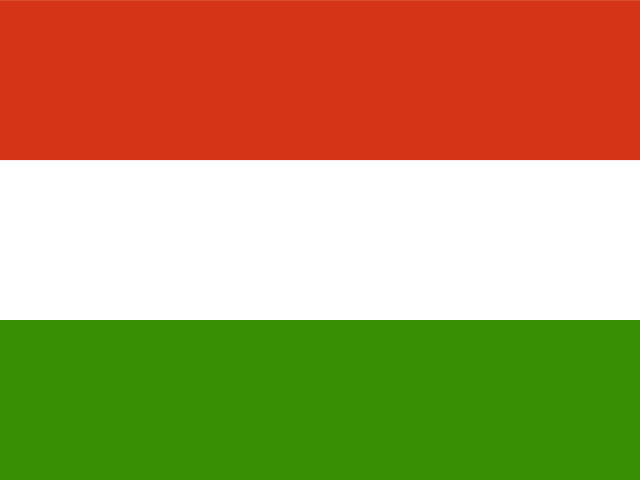
Flag of Hungary
Travel guide

Learn Hungary before you go

A landlocked land of wide plains, thermal baths and paprika, with the Danube running through its grand capital, Budapest.
Take the full trip
CapitalBudapest
CurrencyHungarian forint (Ft, HUF)
Official languageHungarian
Drives on theRight
Calling code+36

10 phrases to learn

In Hungarian. Capital letters show the stressed part. Tap the heart to practise a phrase later.

Jó reggelt!
yoh REG-gelt
Good morning
Greeting someone early in the morning, before about 9 a.m.
Jó napot!
yoh NO-pot
Good day, hello
The polite greeting for most of the day, in shops and with strangers
Jó estét!
yoh ESH-tayt
Good evening
Greeting someone in the evening
Jó éjszakát!
yoh AY-so-kaat
Good night
Saying goodbye late at night or before bed
Viszontlátásra
VEE-sont-laa-taash-ro
Goodbye
Leaving a shop, a restaurant or people you don't know well
Szervusz
SER-voos
Hello (friendly)
Greeting someone you know
Köszönöm, jól
KUH-suh-num, yohl
Fine, thank you
Answering 'How are you?'
Örvendek
UR-ven-dek
Nice to meet you
Meeting someone for the first time
Szívesen
SEE-veh-shen
You're welcome
Answering when someone thanks you
Elnézést
EL-nay-zaysht
Excuse me
Getting someone's attention

At the table

  • Before eating, people wish each other 'Jó étvágyat' (enjoy your meal).
  • When glasses are raised, people say 'Egészségedre' (to your health).
  • Many Hungarians still do not clink beer glasses. The story says Austrian officers clinked beer to celebrate the execution of 13 Hungarian generals in 1849.
  • Lunch is the main meal of the day and usually begins with soup.
  • Bread is served with almost every meal.
  • In the countryside a glass of pálinka is often offered to guests on arrival.

Local tips

Forints, not euros

As of September 2026 Hungary uses the forint, not the euro. Where euros are accepted, change usually comes back in forints. Cards work in larger shops and restaurants, but small places may take cash only, so carry some forints. Cash machines are easy to find.

Tip about 10%, but check the bill

Some restaurants add a service charge (szervizdíj) of 10 to 12%, which must be shown on the menu, and then no tip is expected. Otherwise about 10% is usual. Hungarians tell the waiter the total they want to pay rather than leaving money on the table.

Free transport from 65

As of 2026, people aged 65 and over travel free on Budapest's public transport; a passport or ID card proves your age. Since March 2024 people aged 65 and older generally travel free on Hungary's trains and long-distance buses too. InterCity trains may need a paid seat ticket.

Validate every ticket

In Budapest, stamp a paper ticket at the entrance to the metro, or straight after boarding a bus, tram or trolleybus. One ticket covers changes between metro lines, but you need a new ticket when you change to another vehicle, such as from the metro to a tram. Inspectors give fines.

Look at prices before you order

Some bars and restaurants that tourists are led to charge very high prices. Always ask to see the menu with prices, check the bill before you pay, and be careful if a taxi driver or a stranger recommends a bar.

Carry your passport

Visitors must show ID if the police ask, and a photocopy is not accepted, so keep your passport with you.

Emergency number: 112

Call 112 for police, ambulance or fire in Hungary.

Driving rules

Drive on the right. Hungary has zero tolerance for alcohol: you may not drink any alcohol at all before driving. Dipped headlights must be on outside towns even in daytime, and motorways need an e-vignette bought in advance.

Dishes to try

  • Goulash (gulyás): A rich, red soup of beef, onions, potatoes and vegetables, seasoned with plenty of paprika and caraway. In Hungary gulyás is usually a soup, while a thicker meat stew is called pörkölt.
  • Fisherman's soup (halászlé): A bright red, hot and spicy soup of carp or mixed river fish, made with a strong fish broth and generous amounts of hot paprika.
  • Chicken paprikash (paprikás csirke): Chicken slowly simmered in a creamy paprika sauce finished with sour cream, traditionally served with nokedli, small soft egg dumplings.
  • Pörkölt (pörkölt): A thick stew of boneless meat, usually beef or pork, slowly cooked with plenty of onion and sweet paprika, with less liquid than goulash.
  • Stuffed cabbage (töltött káposzta): Cabbage or sauerkraut leaves rolled around minced pork, rice, onion and spices, slowly cooked in a pot with more sauerkraut and paprika, and served with sour cream on top.
  • Lecsó (lecsó): A thick stew of yellow peppers, tomatoes and onions cooked in lard or oil with paprika. It is eaten on its own with bread, with sausage, or as a side dish.
  • Curd cheese noodles with bacon (túrós csusza): Small homemade noodles mixed with crumbled fresh curd cheese (túró), topped with thick sour cream and crispy fried bacon, then warmed in the oven.
  • Hortobágy pancakes (hortobágyi palacsinta): Thin pancakes filled with a paprika stew of veal or other meat, rolled up and covered with the creamy sauce and a spoon of sour cream.

Cities to see

  • Budapest (capital): The Parliament on the Danube, Buda Castle and its hill, Thermal baths.
  • Debrecen: The Reformed Great Church, Its August flower festival, The Hortobágy National Park nearby.
  • Szeged: Paprika, Winter salami, Its university.
  • Miskolc: Diósgyőr Castle, The cave bath at Miskolctapolca, The Bükk hills.
  • Pécs: The Early Christian Necropolis, The mosque of Pasha Qasim, Hungary's oldest university.
  • Győr: Its baroque old town, The meeting of three rivers, Pannonhalma Archabbey nearby.

Landmarks and the city map are on the Hungary trip