A landlocked land of wide plains, thermal baths and paprika, with the Danube running through its grand capital, Budapest.
Hungary lies in the middle of the Carpathian Basin in Central Europe and has no coast. Much of the country is flat lowland, above all the Great Hungarian Plain in the east. Two great rivers cross it from north to south: the Danube, which runs through Budapest, and the Tisza. In the west lies Lake Balaton, the largest lake in Central Europe.
The Hungarians, or Magyars, arrived in the Carpathian Basin as a union of seven tribes at the end of the 9th century. Stephen I became the first king around the year 1000. After a crushing defeat by the Ottomans at Mohács in 1526 the kingdom was split in three for about 150 years, and later it became half of Austria-Hungary. After the First World War the Treaty of Trianon left Hungary with less than a third of its old territory.
Questions to ask the older generation
Memories fade faster than photos. Ask these over a meal or a phone call, and write the answers down.
Which town or region of Hungary did our family come from? Was it near Debrecen, Szeged, Miskolc?
Who was the first in the family to leave Hungary, when, and why?
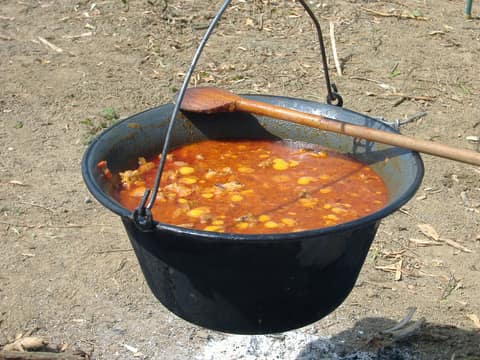
Which dishes from Hungary were cooked at home? Did anyone make Goulash or Fisherman's soup?
Does anyone in the family still speak Hungarian, or use a few words of it?
Were there songs, prayers, games or holidays from Hungary that the family kept?
Are there old photos, letters or documents from Hungary? Who has them?
If you could visit Hungary together, where would you go first?
A short history of Hungary
Hungary's story runs from horse-riding tribes who settled the Carpathian Basin, through a medieval Christian kingdom, Ottoman wars and the Habsburg empire, to the revolutions of 1848 and 1956 and a peaceful return to democracy in 1989.
AD 895
The Magyars settle the Carpathian Basin
A union of seven Hungarian tribes, led by Grand Prince Álmos and his son Árpád, moved from the steppes north of the Black Sea into the Carpathian Basin, completing the move around 895. Árpád's family ruled Hungary for the next 400 years.
1222
The Golden Bull
King Andrew II was forced by his nobles to issue the Golden Bull, one of the first documents in Europe to place limits on a king's power. It even gave nobles the right to resist a king who broke the law.
1458
Matthias Corvinus becomes king
Matthias, son of the general John Hunyadi, was elected king. A Renaissance ruler and patron of learning, he built up a great library, the Bibliotheca Corviniana, and a powerful standing army that even took Vienna.
1541
The Ottomans take Buda
The Ottomans captured Buda, and Hungary was split into three parts: a Habsburg-ruled strip in the north and west, a Hungarian-ruled east that became the Principality of Transylvania, and an Ottoman province in the centre.
1848
The revolution of 1848
On 15 March 1848 crowds in Pest pushed through a list of twelve demands for reform. A war of independence against the Habsburgs followed, led by Lajos Kossuth, and was defeated in August 1849 with the help of Russian armies.
1873
Budapest is born
The separate towns of Buda, Óbuda and Pest were officially united into one city with the new name Budapest. It grew quickly into one of the great cities of Europe.
1956
The 1956 Revolution
On 23 October 1956 protests in Budapest grew into an uprising against the communist government and Soviet control. Soviet tanks crushed it in November. Thousands were killed and about a quarter of a million people fled the country.
2004
Hungary joins the EU
On 1 May 2004 Hungary became a member of the European Union, five years after joining NATO. It joined the Schengen area in 2007.