Guatemala trivia: 40 questions and answers
The country at a glance
What is the capital of Guatemala?
- A. Guatemala City
- B. Antigua Guatemala
- C. Quetzaltenango
- D. Flores
Show the answer
Guatemala City. Guatemala City is the capital and largest city. Antigua was the capital in Spanish times, until the earthquakes of 1773.
What is the currency of Guatemala?
- A. Quetzal
- B. Colón
- C. Lempira
- D. Córdoba
Show the answer
Quetzal. The currency is the quetzal (GTQ), named after the national bird. The colón, lempira and córdoba are or were the currencies of other Central American countries.
Which volcano in Guatemala is the highest point in Central America?
- A. Tajumulco
- B. Pacaya
- C. Fuego
- D. Agua
Show the answer
Tajumulco. Volcán Tajumulco, about 4,200 m high in the department of San Marcos, is the highest point in Central America.
Guatemala shares a land border with Nicaragua.
True or false?
Show the answer
False. False. Guatemala's neighbours are Mexico, Belize, Honduras and El Salvador. Nicaragua lies further south, beyond Honduras.
History
Which Spanish conquistador led the campaign into the Guatemalan highlands in 1524?
- A. Pedro de Alvarado
- B. Francisco Pizarro
- C. Vasco Núñez de Balboa
- D. Hernando de Soto
Show the answer
Pedro de Alvarado. Pedro de Alvarado, sent from Mexico by Hernán Cortés, led the campaign and founded the first Spanish capital near Iximche.
Guatemala celebrates its Independence Day on 15 September.
True or false?
Show the answer
True. True. The Act of Independence of Central America was signed in Guatemala City on 15 September 1821.
The capital was moved away from Antigua after a volcanic eruption in 1773.
True or false?
Show the answer
False. False. It was the Santa Marta earthquakes of 1773 that ruined Antigua. A volcanic mudflow had destroyed the earlier capital at Ciudad Vieja in 1541.
Nojpetén, the last independent Maya capital, taken by the Spanish in 1697, stood on an island in which lake?
- A. Lake Petén Itzá
- B. Lake Atitlán
- C. Lake Izabal
- D. Lake Amatitlán
Show the answer
Lake Petén Itzá. Nojpetén, the capital of the Itza, was on an island in Lake Petén Itzá. The town of Flores stands there today.
Which prize did the K'iche' Maya activist Rigoberta Menchú receive in 1992?
- A. The Nobel Peace Prize
- B. The Nobel Prize in Literature
- C. An Olympic gold medal
- D. The Pulitzer Prize
Show the answer
The Nobel Peace Prize. Rigoberta Menchú received the Nobel Peace Prize in 1992 for her work for the rights of Indigenous peoples.
Food and drink
Which thick stew of toasted seeds, chillies and tomatoes is often called Guatemala's national dish?
- A. Pepián
- B. Tapado
- C. Fiambre
- D. Atol de elote
Show the answer
Pepián. Pepián is a stew of chicken or beef in a sauce of toasted pumpkin and sesame seeds, chillies and tomatoes. Tapado is a seafood soup, fiambre a cold salad and atol de elote a corn drink.
Fiambre, a huge cold salad, is traditionally made for Día de Todos los Santos on 1 November.
True or false?
Show the answer
True. True. Families prepare fiambre once a year for All Saints' Day and share it with relatives.
Paches, eaten especially on Thursdays, are tamales made from what instead of corn?
- A. Potato
- B. Cassava
- C. Plantain
- D. Chickpeas
Show the answer
Potato. Paches are made from mashed potato with tomato sauce, a piece of meat and a hot green chilli, wrapped in leaves.
Rellenitos, little fried balls of sweet plantain, are filled with what?
- A. Black beans with chocolate and cinnamon
- B. Ham and cheese
- C. Pineapple jam
- D. Pork in tomato sauce
Show the answer
Black beans with chocolate and cinnamon. The filling is black beans with chocolate and cinnamon, and the rellenitos are served dusted with sugar or with honey.
Tapado, a coconut milk soup of fish and shellfish from Livingston, is a dish of which people?
- A. The Garifuna
- B. The K'iche'
- C. The Mam
- D. The Xinca
Show the answer
The Garifuna. Tapado is a dish of the Garifuna, who live mainly in Livingston and Puerto Barrios on the Caribbean coast.
Kak'ik, the red soup of the Verapaz region, is traditionally made with fish.
True or false?
Show the answer
False. False. Kak'ik is made with turkey. Its name comes from Q'eqchi' words for red and hot.
Cities
Which city is known by its K'iche' Maya nickname, Xela?
- A. Quetzaltenango
- B. Huehuetenango
- C. Chichicastenango
- D. Retalhuleu
Show the answer
Quetzaltenango. Quetzaltenango is called Xela, short for Xelajú, 'under ten mountains'. Retalhuleu's nickname is Reu.
There is no road link between Livingston and the rest of Guatemala.
True or false?
Show the answer
True. True. Livingston, at the mouth of the Río Dulce, is reached by boat, from Puerto Barrios or up the river.
Landmarks
As of 2026, how many UNESCO World Heritage Sites does Guatemala have?
- A. 2
- B. 4
- C. 6
- D. 8
Show the answer
4. Guatemala has 4: Antigua Guatemala (1979), Tikal National Park (1979), Quiriguá (1981) and Tak'alik Ab'aj (2023).
Which volcanic lake, up to 340 m deep, is the deepest lake in Central America?
- A. Lake Atitlán
- B. Lake Izabal
- C. Lake Petén Itzá
- D. Lake Amatitlán
Show the answer
Lake Atitlán. Lake Atitlán fills a huge volcanic crater and reaches about 340 m deep. Three volcanoes rise from its southern shore.
Which building in Guatemala City holds Kilometre Zero, the point from which road distances are measured?
- A. The National Palace of Culture
- B. The Basilica of Esquipulas
- C. The Castle of San Felipe de Lara
- D. The Church of Santo Tomás
Show the answer
The National Palace of Culture. Kilometre Zero is in the National Palace of Culture on the central square, built from 1939 to 1943.
At Semuc Champey, the Cahabón River disappears under a natural limestone bridge topped with turquoise pools.
True or false?
Show the answer
True. True. The river plunges under a 300 m limestone bridge, and the name means 'where the river hides under the earth' in Q'eqchi'.
In which town is the basilica of the Black Christ, the greatest pilgrimage site in Central America?
- A. Esquipulas
- B. Antigua Guatemala
- C. Chichicastenango
- D. Flores
Show the answer
Esquipulas. The Black Christ, carved in 1594, is in the basilica of Esquipulas, in the east of the country.
Fun facts
The quetzal, Guatemala's currency, is named after what?
- A. A bird
- B. A Maya king
- C. A volcano
- D. A river
Show the answer
A bird. It is named after a bird, the resplendent quetzal, the national bird with long green tail feathers.
Tikal appears in the first Star Wars film, released in 1977.
True or false?
Show the answer
True. True. Tikal was used as the rebel base on the moon Yavin 4.
Which Guatemalan writer won the Nobel Prize in Literature in 1967?
- A. Miguel Ángel Asturias
- B. Gabriel García Márquez
- C. Pablo Neruda
- D. Octavio Paz
Show the answer
Miguel Ángel Asturias. Miguel Ángel Asturias, author of El Señor Presidente and Men of Maize, won in 1967. The others were from Colombia, Chile and Mexico.
Guatemala won its first Olympic gold medal at the London Games in 2012.
True or false?
Show the answer
False. False. In 2012 Erick Barrondo won silver in race walking, the first Olympic medal. The first gold came in 2024, when Adriana Ruano won the women's trap shooting.
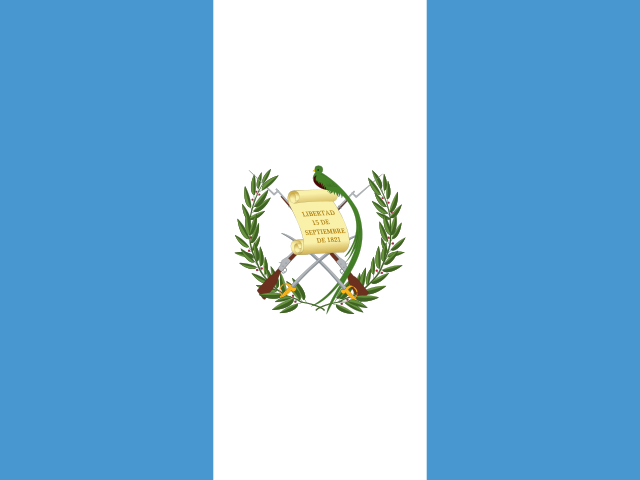
Which bird sits on top of the coat of arms on Guatemala's flag?
- A. The resplendent quetzal
- B. The harpy eagle
- C. The scarlet macaw
- D. The keel-billed toucan
Show the answer
The resplendent quetzal. The resplendent quetzal stands above the scroll with the date 15 September 1821, as a symbol of liberty.
On 1 November, the towns of Sumpango and Santiago Sacatepéquez are famous for what?
- A. Giant kites
- B. Sawdust carpets
- C. Running with bulls
- D. Floating lanterns
Show the answer
Giant kites. They make and fly giant kites of tissue paper and bamboo for All Saints' Day. UNESCO recognised the craft in 2024.
Guatemala's national flower is a white orchid called the monja blanca.
True or false?
Show the answer
True. True. The monja blanca, or white nun, has been the national flower since 1934 and appears on the 50-centavo coin.
Words
What does "chapín" mean in Guatemala?
- A. A Guatemalan
- B. A kid
- C. Money
- D. A dog
Show the answer
A Guatemalan. Chapín is an informal, friendly word for a Guatemalan; a Guatemalan woman is a chapina.
If you order a "shuco" from a street stall in Guatemala City, what do you get?
- A. A hot dog
- B. A cup of coffee
- C. A fruit juice
- D. A corn drink
Show the answer
A hot dog. You get a hot dog: a shuco is the Guatemalan hot dog, often with guacamole, cabbage and mayonnaise. The word literally means dirty.
In K'iche' Maya, "maltiox" means thank you.
True or false?
Show the answer
True. True. Maltiox (mahl-tee-OHSH) is thank you in K'iche', the most widely spoken Maya language in Guatemala.
In Guatemala, a "camioneta" is usually a small boat.
True or false?
Show the answer
False. False. A camioneta is a bus, often a brightly painted old school bus. A small motor boat is a lancha.
Phrases
How do you ask for the bill in a restaurant?
- A. La cuenta, por favor
- B. ¡Buen provecho!
- C. Con permiso
- D. Mucho gusto
Show the answer
La cuenta, por favor. "La cuenta, por favor" means "The bill, please".
How do you ask "May I take a photo?" in Spanish?
- A. ¿Puedo tomar una foto?
- B. ¿Cuánto cuesta?
- C. ¿Dónde está el baño?
- D. ¿Habla inglés?
Show the answer
¿Puedo tomar una foto?. "¿Puedo tomar una foto?" means "May I take a photo?". Always ask before photographing people.
Someone thanks you. Which reply, meaning "with pleasure", is very common in Guatemala?
- A. Con gusto
- B. Con permiso
- C. Buen provecho
- D. Disculpe
Show the answer
Con gusto. "Con gusto" means "with pleasure" and is the usual friendly reply to gracias in Guatemala.
Local customs and tips
Roughly when is the rainy season in most of Guatemala?
- A. May to October
- B. November to April
- C. January to March
- D. August to December
Show the answer
May to October. The rains fall mostly from about May to October. The dry season runs from about November to April.
As of September 2026, British visitors need a visa for any stay in Guatemala.
True or false?
Show the answer
False. False. As of September 2026, British visitors can stay up to 90 days without a visa, a period shared with El Salvador and Nicaragua under the CA-4 agreement.
In Maya villages it is polite to ask before photographing people.
True or false?
Show the answer
True. True. Many people, especially women and children, do not want to be photographed by strangers. Ask first and accept a no.
As of 2026, which of these is an official phone number for the police in Guatemala?
- A. 110
- B. 999
- C. 000
- D. 15
Show the answer
110. The police number is 110. 999 is used in the United Kingdom, 000 in Australia and 15 is a medical line in France.
Answer key
The country at a glance
- A. Guatemala City
- A. Quetzal
- A. Tajumulco
- False
History
- A. Pedro de Alvarado
- True
- False
- A. Lake Petén Itzá
- A. The Nobel Peace Prize
Food and drink
- A. Pepián
- True
- A. Potato
- A. Black beans with chocolate and cinnamon
- A. The Garifuna
- False
Cities
- A. Quetzaltenango
- True
Landmarks
- B. 4
- A. Lake Atitlán
- A. The National Palace of Culture
- True
- A. Esquipulas
Fun facts
- A. A bird
- True
- A. Miguel Ángel Asturias
- False
- A. The resplendent quetzal
- A. Giant kites
- True
Words
- A. A Guatemalan
- A. A hot dog
- True
- False
Phrases
- A. La cuenta, por favor
- A. ¿Puedo tomar una foto?
- A. Con gusto
Local customs and tips
- A. May to October
- False
- True
- A. 110
More about Guatemala
- The trip to GuatemalaMap, story, food, phrases and a friendly quiz.
- Guatemala word searchCities and dishes in large print.
- Guatemalan words crosswordLearn a few words while you solve it.
- Colour the flag of GuatemalaPrint it or colour it in on the screen.
- Guatemalan rootsA family guide: history, recipes and words for the grandchildren.
- Before you goPhrases, customs and tips for travellers.
- Printable packLarge print, with a quiz and answers.