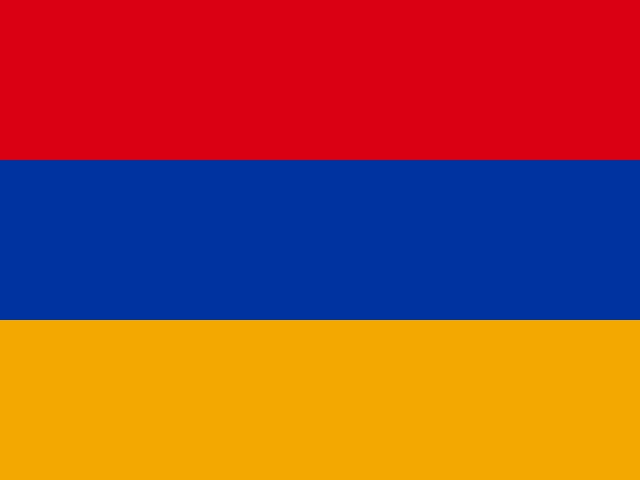
Armenia trivia: 46 questions and answers
The country at a glance
What is the capital of Armenia?
- A. Yerevan
- B. Gyumri
- C. Vanadzor
- D. Vagharshapat
Show the answer
Yerevan. Yerevan is the capital and by far the largest city. More than a third of Armenia's people live there.
What is the currency of Armenia?
- A. Dram
- B. Lari
- C. Manat
- D. Lira
Show the answer
Dram. The Armenian dram (AMD) was introduced in November 1993. The lari is Georgia's currency, the manat Azerbaijan's and the lira Turkey's.
Mount Ararat, the national symbol of Armenia, lies inside Armenia's borders.
True or false?
Show the answer
False. False. Mount Ararat stands in Turkey, although it can be seen clearly from Yerevan and appears on Armenia's coat of arms.
Which of these countries does NOT share a border with Armenia?
- A. Russia
- B. Georgia
- C. Iran
- D. Turkey
Show the answer
Russia. Russia does not border Armenia. Armenia's neighbours are Georgia to the north, Azerbaijan to the east, Iran to the south and Turkey to the west.
Which is the highest mountain inside Armenia?
- A. Mount Aragats
- B. Mount Ararat
- C. Mount Elbrus
- D. Mount Kazbek
Show the answer
Mount Aragats. Mount Aragats, at 4,090 m, is the highest point in Armenia. Ararat is higher but lies in Turkey, Elbrus is in Russia and Kazbek is in Georgia.
History
Who created the Armenian alphabet around the year 405?
- A. Mesrop Mashtots
- B. Gregory the Illuminator
- C. Tigranes the Great
- D. Vardan Mamikonian
Show the answer
Mesrop Mashtots. The monk and scholar Mesrop Mashtots created the alphabet around 405. Its first task was a translation of the Bible.
According to tradition, who converted King Tiridates III to Christianity?
- A. Gregory the Illuminator
- B. Mesrop Mashtots
- C. Vardan Mamikonian
- D. Argishti I
Show the answer
Gregory the Illuminator. Gregory the Illuminator converted the king, after being held, as tradition says, for 13 years in a pit at Khor Virap. He is Armenia's patron saint.
Armenians remember the victims of the Armenian genocide each year on 24 April.
True or false?
Show the answer
True. True. On 24 April 1915 the Ottoman authorities arrested hundreds of Armenian community leaders in Constantinople, and the day is now the Armenian Genocide Remembrance Day.
The Armenian army won the Battle of Avarayr in 451.
True or false?
Show the answer
False. False. The Armenians lost the battle and their leader Vardan Mamikonian was killed, but their resistance continued, and in 484 they won the right to keep their Christian faith.
The medieval Armenian Kingdom of Cilicia lay on the coast of which sea?
- A. The Mediterranean Sea
- B. The Black Sea
- C. The Caspian Sea
- D. The Red Sea
Show the answer
The Mediterranean Sea. Cilicia lay on the Mediterranean Sea, in what is now southern Turkey. Its kings ruled from 1198 until 1375.
Food and drink
Which thin Armenian bread, baked in a clay oven called a tonir, was added to UNESCO's intangible heritage list in 2014?
- A. Lavash
- B. Gata
- C. Matnakash
- D. Zhingyalov hats
Show the answer
Lavash. Lavash, large paper-thin sheets of bread, was inscribed by UNESCO in 2014 as an expression of culture in Armenia.
What does the name of the Armenian barbecue, khorovats, mean?
- A. Grilled
- B. Boiled
- C. Stuffed
- D. Baked
Show the answer
Grilled. Khorovats means 'grilled'. It is meat, often pork or lamb, grilled on skewers over embers.
What is stuffed with rice, dried fruit, nuts and honey and baked to make ghapama?
- A. A whole pumpkin
- B. A whole lamb
- C. A melon
- D. A cabbage
Show the answer
A whole pumpkin. Ghapama is a whole pumpkin stuffed with rice, dried fruit, nuts, butter and honey, and cut into wedges at the table.
Khash, a broth of beef or lamb feet, is traditionally eaten early in the morning in winter.
True or false?
Show the answer
True. True. Khash simmers all night and is eaten on winter mornings with garlic, salt and crumbled dried lavash.
Zhingyalov hats is a flatbread filled with minced lamb.
True or false?
Show the answer
False. False. Zhingyalov hats is filled with a mound of chopped wild and garden greens, often 10 to 20 kinds, and is popular during Lent.
The cool, salty Armenian drink tan is made from what?
- A. Yogurt and water
- B. Apricot juice
- C. Grape juice
- D. Black tea
Show the answer
Yogurt and water. Yogurt and water: tan is matsun, the Armenian yogurt, mixed with water and salt, and the classic drink with khorovats on a hot day.
Sweet sujukh, strings of nuts dipped in thickened grape juice, is known by what name in neighbouring Georgia?
- A. Churchkhela
- B. Khachapuri
- C. Khinkali
- D. Pkhali
Show the answer
Churchkhela. In Georgia the same sweet is called churchkhela. Khachapuri is cheese bread, khinkali are dumplings and pkhali is a vegetable and walnut spread.
Cities
Which city was called Leninakan in Soviet times?
- A. Gyumri
- B. Vanadzor
- C. Vagharshapat
- D. Yerevan
Show the answer
Gyumri. Gyumri was called Alexandropol under Russian rule and Leninakan in Soviet times. Vanadzor was called Kirovakan.
Which city, often called Armenia's spiritual capital, is the seat of the Catholicos, the head of the Armenian Apostolic Church?
- A. Vagharshapat
- B. Yerevan
- C. Gyumri
- D. Goris
Show the answer
Vagharshapat. Vagharshapat, also known as Etchmiadzin, is home to the Mother See and Etchmiadzin Cathedral.
Jermuk is a mountain spa town known for its hot springs and mineral water.
True or false?
Show the answer
True. True. Jermuk's name comes from an Armenian word for a warm mineral spring, and its water is bottled and sold across the region.
Vanadzor is Armenia's second-largest city.
True or false?
Show the answer
False. False. Vanadzor is the third-largest city. Gyumri is the second-largest.
Landmarks
Which monastery, partly carved into the cliffs of a gorge, is named after a spear?
- A. Geghard
- B. Noravank
- C. Tatev
- D. Haghpat
Show the answer
Geghard. Geghard means 'spear', after the spear said to have wounded Jesus, which was once kept at the monastery.
What does the name of the monastery Khor Virap mean?
- A. Deep pit
- B. New monastery
- C. Swallow's fortress
- D. Seven springs
Show the answer
Deep pit. Khor Virap means 'deep pit', after the pit where Gregory the Illuminator was held, according to tradition. Noravank means 'new monastery' and Tsitsernakaberd 'swallow's fortress'.
The Temple of Garni is a Greek-style temple with columns.
True or false?
Show the answer
True. True. It is built in the Ionic order and is usually dated to the first century AD. It was rebuilt from its original stones between 1969 and 1975.
The monastery of Sevanavank still stands on an island in Lake Sevan.
True or false?
Show the answer
False. False. When the lake was partly drained in the Soviet era, the water fell by about 20 m and the island became a peninsula.
What is the Wings of Tatev?
- A. A cable car to Tatev Monastery
- B. A bell tower at Tatev Monastery
- C. A mountain railway
- D. A folk dance festival
Show the answer
A cable car to Tatev Monastery. It is a cable car to Tatev Monastery, about 5.7 km long, that crosses the Vorotan gorge in about 12 minutes.
As of 2026, which of these monasteries is part of a UNESCO World Heritage Site?
- A. Haghpat Monastery
- B. Tatev Monastery
- C. Noravank
- D. Khor Virap
Show the answer
Haghpat Monastery. Haghpat Monastery, together with nearby Sanahin, is a UNESCO World Heritage Site. Armenia's other two sites are Etchmiadzin with Zvartnots, and Geghard with the upper Azat valley.
The memorial at Tsitsernakaberd in Yerevan honours whom?
- A. The victims of the Armenian genocide
- B. The victims of the 1988 earthquake
- C. The kings of ancient Armenia
- D. The builders of Yerevan
Show the answer
The victims of the Armenian genocide. Tsitsernakaberd, built in 1967, is Armenia's official memorial to the victims of the Armenian genocide. Thousands of people lay flowers there every 24 April.
Fun facts
The duduk, a gentle Armenian woodwind instrument, is traditionally made from the wood of which tree?
- A. Apricot
- B. Oak
- C. Pine
- D. Birch
Show the answer
Apricot. The duduk is traditionally made of apricot wood, and in Armenian it is also called tsiranapogh, 'apricot pipe'.
Where does aybuben, the Armenian word for 'alphabet', come from?
- A. The names of its first two letters
- B. The name of its creator
- C. The name of an ancient king
- D. The name of a monastery
Show the answer
The names of its first two letters. Aybuben comes from the names of its first two letters, ayb and ben, just as 'alphabet' comes from the Greek alpha and beta.
Archaeologists found a leather shoe about 5,500 years old in the Areni-1 cave in Armenia.
True or false?
Show the answer
True. True. The shoe was found in 2008 and, as of 2026, is the oldest leather shoe found anywhere. The same cave held one of the oldest known wineries.
Chess has been part of the curriculum in Armenian public schools since the 2011 to 2012 school year.
True or false?
Show the answer
True. True. Chess is hugely popular in Armenia, and its men's team won the Chess Olympiad in 2006, 2008 and 2012.
Most of the world's Armenians live in Armenia itself.
True or false?
Show the answer
False. False. About 3 million people live in Armenia, while by some estimates about 8 million Armenians live abroad, above all in Russia, the United States and France.
Lake Sevan, the largest lake in the Caucasus, lies at roughly what height above sea level?
- A. About 1,900 m
- B. About 400 m
- C. About 900 m
- D. About 3,500 m
Show the answer
About 1,900 m. Lake Sevan lies at about 1,900 m above sea level and covers about 1,240 km².
Words
Which Armenian word means 'thank you'?
- A. shnorhakalutyun
- B. barev
- C. tstesutyun
- D. ayo
Show the answer
shnorhakalutyun. Shnorhakalutyun means 'thank you'. Barev means 'hello', tstesutyun 'goodbye' and ayo 'yes'.
What does the Armenian word 'sar' mean?
- A. Mountain
- B. Lake
- C. Church
- D. Bread
Show the answer
Mountain. Sar means 'mountain'. A lake is lich, a church yekeghetsi and bread hats.
Added after a name, as in 'Anna jan', the Armenian word 'jan' means 'dear'.
True or false?
Show the answer
True. True. Jan is an affectionate word put after a name or a word like 'mother', and you will hear it everywhere.
What does the Armenian word 'ayo' mean?
- A. Yes
- B. No
- C. Hello
- D. Please
Show the answer
Yes. Ayo means 'yes'. 'No' is voch, 'hello' is barev and 'please' is khndrem.
Phrases
'Barev dzez' means 'Good night'.
True or false?
Show the answer
False. False. Barev dzez is the polite 'Hello'. 'Good night' is bari gisher.
What do Armenians say when they raise a glass in a toast?
- A. Kenatsd!
- B. Tstesutyun!
- C. Bari luys!
- D. Neroghutyun!
Show the answer
Kenatsd!. Kenatsd! means 'Cheers!' or 'To your health!'. Tstesutyun is 'goodbye', bari luys 'good morning' and neroghutyun 'sorry'.
At what time of day do you greet someone with 'Bari luys'?
- A. In the morning
- B. In the afternoon
- C. In the evening
- D. Late at night
Show the answer
In the morning. You say it in the morning: bari luys means 'Good morning', literally 'good light'. In the evening you say bari yereko.
How do you ask for the bill in an Armenian restaurant?
- A. Hashivy, khndrum em
- B. Chem haskanum
- C. Inchpes ek?
- D. Shnorhavor!
Show the answer
Hashivy, khndrum em. Hashivy, khndrum em means 'The bill, please'. Chem haskanum is 'I don't understand', Inchpes ek? is 'How are you?' and Shnorhavor! is 'Congratulations!'
Local customs and tips
As of September 2026, from which of these neighbouring countries can ordinary travellers enter Armenia by land?
- A. Georgia
- B. Turkey
- C. Azerbaijan
Show the answer
Georgia. Georgia, like Iran, has open road crossings into Armenia. The land borders with Turkey and Azerbaijan have long been closed to ordinary travellers.
When visiting an Armenian church, it is respectful to cover your shoulders and knees.
True or false?
Show the answer
True. True. Men also take off their hats, and many women cover their hair with a scarf, which is appreciated but not strictly required of visitors.
What is a pulpulak, seen on street corners in Yerevan?
- A. A small stone drinking fountain
- B. A shared minibus
- C. A sweet pastry
- D. A mountain hut
Show the answer
A small stone drinking fountain. A pulpulak is a small stone drinking fountain with running water, often from mountain springs, and a free way to refill your bottle. The shared minibus is called a marshrutka.
In Armenian villages, markets and small guesthouses you will usually need cash in dram.
True or false?
Show the answer
True. True. Cards work in most places in Yerevan, but outside the capital cash is often the only way to pay.
Answer key
The country at a glance
- A. Yerevan
- A. Dram
- False
- A. Russia
- A. Mount Aragats
History
- A. Mesrop Mashtots
- A. Gregory the Illuminator
- True
- False
- A. The Mediterranean Sea
Food and drink
- A. Lavash
- A. Grilled
- A. A whole pumpkin
- True
- False
- A. Yogurt and water
- A. Churchkhela
Cities
- A. Gyumri
- A. Vagharshapat
- True
- False
Landmarks
- A. Geghard
- A. Deep pit
- True
- False
- A. A cable car to Tatev Monastery
- A. Haghpat Monastery
- A. The victims of the Armenian genocide
Fun facts
- A. Apricot
- A. The names of its first two letters
- True
- True
- False
- A. About 1,900 m
Words
- A. shnorhakalutyun
- A. Mountain
- True
- A. Yes
Phrases
- False
- A. Kenatsd!
- A. In the morning
- A. Hashivy, khndrum em
Local customs and tips
- A. Georgia
- True
- A. A small stone drinking fountain
- True
More about Armenia
- The trip to ArmeniaMap, story, food, phrases and a friendly quiz.
- Armenia word searchCities and dishes in large print.
- Armenian words crosswordLearn a few words while you solve it.
- Colour the flag of ArmeniaPrint it or colour it in on the screen.
- Armenian rootsA family guide: history, recipes and words for the grandchildren.
- Before you goPhrases, customs and tips for travellers.
- Printable packLarge print, with a quiz and answers.