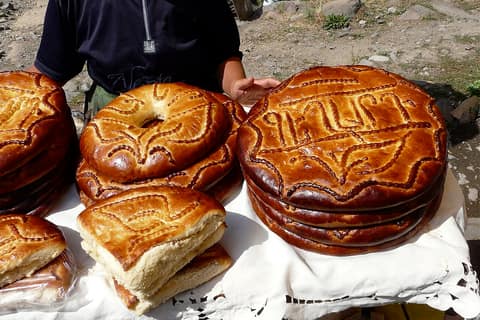
A small mountain country of stone monasteries, apricots and warm bread, with a capital built of pink stone and snowy Mount Ararat on the horizon.
Armenia is a small, landlocked country in the South Caucasus, high in the mountains between the Black Sea and the Caspian Sea. It borders Georgia to the north, Azerbaijan to the east, Iran to the south and Turkey to the west. Almost all of it is highland: about half the land lies above 2,000 m, and the highest peak, Mount Aragats, reaches 4,090 m. The great blue Lake Sevan sits at about 1,900 m above sea level. On clear days the snowy cone of Mount Ararat, the national symbol, rises over Yerevan, although the mountain itself stands across the border in Turkey.
Armenians have lived in these highlands for thousands of years. The Urartian king Argishti I built the fortress of Erebuni, where Yerevan stands today, in 782 BC. Armenia is widely regarded as the first country to adopt Christianity as its state religion, traditionally dated to 301, and around 405 the monk Mesrop Mashtots created the Armenian alphabet, still in use today. Over the centuries the land was ruled or divided by Romans, Persians, Arabs, Byzantines, Mongols, Ottomans and Russians. During the First World War the Armenians of the Ottoman Empire suffered the Armenian genocide. After a short-lived republic and seven decades as a Soviet republic, Armenia became independent in 1991.
Questions to ask the older generation
Memories fade faster than photos. Ask these over a meal or a phone call, and write the answers down.
Which town or region of Armenia did our family come from? Was it near Gyumri, Vanadzor, Vagharshapat (Etchmiadzin)?
Who was the first in the family to leave Armenia, when, and why?
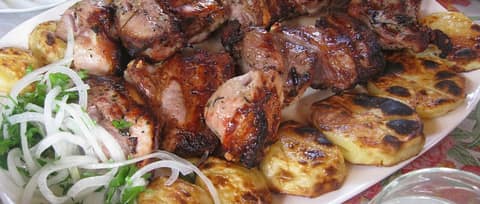
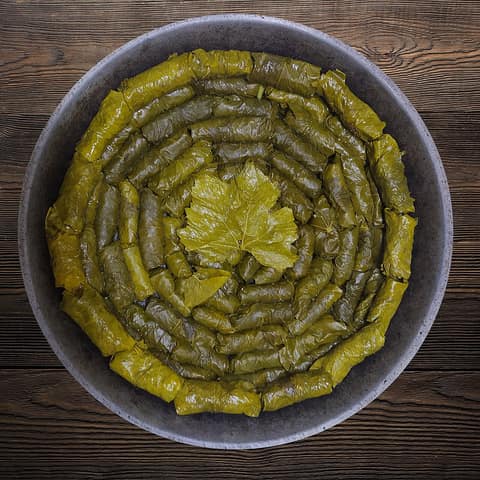
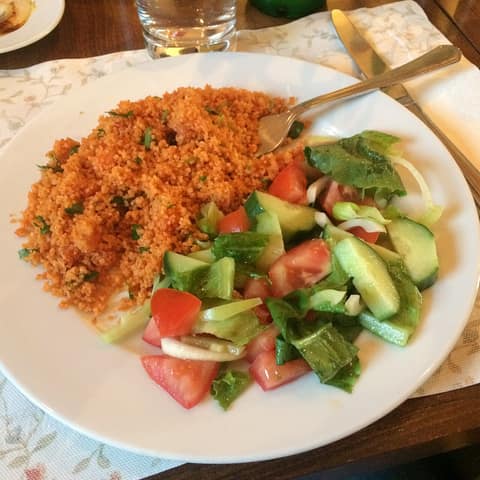
Which dishes from Armenia were cooked at home? Did anyone make Khorovats or Tolma?
Does anyone in the family still speak Armenian, or use a few words of it?
Were there songs, prayers, games or holidays from Armenia that the family kept?
Are there old photos, letters or documents from Armenia? Who has them?
If you could visit Armenia together, where would you go first?
A short history of Armenia
Armenia's story reaches back to the Bronze Age and the kingdom of Urartu, whose fortress of Erebuni grew into Yerevan. The Armenian kingdom was at its largest under Tigranes the Great, adopted Christianity and created its own alphabet, then spent many centuries divided between great empires. In the 20th century Armenians lived through the genocide of 1915, a brief first republic, Soviet rule and the Spitak earthquake. Independent since 1991, Armenia has also been in a long conflict with Azerbaijan over Nagorno-Karabakh, a mountain region that had a large Armenian population and is internationally recognised as part of Azerbaijan. After fighting in 2020 and an Azerbaijani offensive in September 2023, more than 100,000 Karabakh Armenians, almost the entire Armenian population of the region, fled to Armenia.
782 BC
King Argishti I founds Erebuni
Argishti I, king of Urartu, built the fortress of Erebuni on a hill in what is now southern Yerevan. A cuneiform inscription found on the site records the founding, which is why Yerevan counts its age from 782 BC. The name Yerevan is thought to come from Erebuni.
AD 301
Armenia adopts Christianity as its state religion
King Tiridates III made Christianity the religion of the state, a step traditionally dated to 301 (some historians prefer a date around 314). He was converted by Gregory the Illuminator, who, according to tradition, had been held for 13 years in a deep pit at Khor Virap. Soon afterwards the first cathedral was built at Etchmiadzin.
AD 451
The Battle of Avarayr
Armenian forces led by Vardan Mamikonian fought the army of Sasanian Persia, which wanted to force Zoroastrianism on the Armenians. The Armenians lost the battle and Vardan was killed, but resistance continued, and in 484 a treaty allowed Armenians to keep their Christian faith. Vardan is honoured as a saint.
1828
Eastern Armenia passes to Russia
After a war between Russia and Persia, the Treaty of Turkmenchay handed the khanates of Erivan (Yerevan) and Nakhichevan to the Russian Empire. Eastern Armenia, roughly today's country, was now Russian, while Western Armenia stayed under Ottoman rule.
1915
The Armenian genocide begins
On 24 April 1915 the Ottoman authorities arrested hundreds of Armenian community leaders and intellectuals in Constantinople. Mass deportations, death marches to the Syrian desert and massacres followed, and around one million Armenians were killed; estimates range from about 600,000 to 1.5 million. Most historians and many countries recognise these events as genocide, while the Turkish government rejects the term. Armenians remember the victims every year on 24 April.
1920
Armenia becomes a Soviet republic
In late 1920 the Red Army entered Armenia and a Soviet government took power. Under treaties signed in 1921, Mount Ararat and the medieval capital of Ani went to Turkey. Armenia joined the Soviet Union in 1922, first inside a Transcaucasian federation and from 1936 as a republic of its own.
1991
Armenia votes for independence
In a referendum on 21 September 1991, Armenians voted overwhelmingly to leave the Soviet Union. The date is now Independence Day. Armenia joined the United Nations on 2 March 1992.
2001
Armenia marks 1,700 years of Christianity
To celebrate the 1,700th anniversary of Christianity as the state religion, the large Saint Gregory the Illuminator Cathedral was consecrated in Yerevan in 2001. It is the largest Armenian cathedral in the world, and Pope John Paul II visited it that September.