A free large-print PDF. Choose what goes in: facts, map, history, dishes and recipes, phrases, fun facts, a quiz with or without answers. Made for clubs, care homes, libraries and family afternoons.
Indonesia is the world's largest archipelagic state, a chain of islands stretching between the Indian and Pacific oceans. The official survey agency counted 17,380 named islands in 2024, so the usual round figure is about 17,000. The biggest are Sumatra, Java, Sulawesi and the Indonesian parts of Borneo and New Guinea. Volcanoes rise along much of the chain, and the equator runs right across the country.
Hindu and Buddhist kingdoms built great temples such as Borobudur and Prambanan more than a thousand years ago, and Islam spread across most of the islands from the late Middle Ages. From the 1600s the Dutch gradually took control, first through the Dutch East India Company and later as a colony. Indonesia proclaimed its independence on 17 August 1945, and the Netherlands transferred sovereignty at the end of 1949.
With about 285 million people, Indonesia has the fourth-largest population in the world and more Muslims than any other country, and more than half of all Indonesians live on the island of Java. Hundreds of peoples and more than 700 languages share the country, joined by one national language, Indonesian, and the motto Bhinneka Tunggal Ika, 'unity in diversity'.
Jakarta is the capital. A new capital, Nusantara, is being built in East Kalimantan on Borneo, but under Indonesian law the move becomes official only when the president signs a decree, and as of September 2026 that decree has not been issued.
CapitalJakarta
Planned new capitalNusantara, in East Kalimantan on Borneo, still being built; as of 2026 Jakarta remains the capital until a presidential decree makes the move official
PopulationAbout 285 million (2025 survey)
Official languageIndonesian (Bahasa Indonesia)
CurrencyIndonesian rupiah (Rp)
AreaAbout 1.9 million km²
IslandsAbout 17,000 (17,380 named islands in the official 2024 count)
GovernmentPresidential republic with an elected parliament, made up of 38 provinces
Highest mountainPuncak Jaya, 4,884 m, on the island of New Guinea
Longest riverThe Kapuas, about 1,143 km, on Borneo
NeighboursMalaysia, Papua New Guinea and Timor-Leste. Across the sea: Singapore, the Philippines, Australia, Palau, Vietnam, Thailand and India
People have lived on these islands for a very long time: fossils of early humans have been found on Java, and cave paintings on Sulawesi are among the oldest known. Trade by sea brought Indian ideas, Hinduism and Buddhism, and later Islam. Great kingdoms such as Srivijaya on Sumatra and Majapahit on Java grew rich on that trade. From the 1600s the Dutch slowly took control of the islands. The 20th century brought a national movement, Japanese occupation, independence and a difficult road to today's democracy.
AD 671
A Chinese monk visits Srivijaya
The Chinese Buddhist monk Yijing stayed for six months in Srivijaya, a kingdom based near today's Palembang in southern Sumatra. Srivijaya grew into a great sea-trading power and a centre of Buddhist learning, and it dominated the trade routes of the region for several centuries.
AD 780
Work begins on Borobudur
Under the Sailendra dynasty in Central Java, work on the huge Buddhist monument of Borobudur began around 780 and went on in several stages for about fifty years. It is decorated with 2,672 relief panels and originally held 504 statues of the Buddha.
AD 856
Prambanan's great Shiva temple is dedicated
According to an inscription dated 856, a great temple compound for the Hindu god Shiva was inaugurated in Central Java that year. Today it is known as Prambanan, the largest Hindu temple site in Indonesia, with a main tower 47 metres high.
1293
The Majapahit kingdom is founded
After a Mongol army sent by Kublai Khan landed on Java, the prince Raden Wijaya used the confusion to take power and then drove the Mongols out. He was crowned in 1293 as the first king of Majapahit, which became one of the greatest kingdoms in the history of the islands.
1619
The Dutch found Batavia
The Dutch East India Company (VOC), founded in 1602 to trade in spices, destroyed the port town of Jayakarta on Java and built its own fortified town, Batavia, in its place. Batavia became the centre of Dutch power in Asia and is today's Jakarta.
1825
The Java War begins
Prince Diponegoro of Yogyakarta led a great rebellion against Dutch rule in central and eastern Java. The war lasted until 1830 and had disastrous consequences for Java. It ended when Diponegoro was captured during an attempt at peace talks and exiled to Sulawesi, where he died in 1855. He is honoured today as a national hero.
1883
Krakatoa erupts
The volcanic island of Krakatoa, between Java and Sumatra, blew apart in one of the deadliest eruptions ever recorded. The explosion was heard about 4,800 km away, and the eruption and its tsunamis killed at least 36,417 people.
1928
The Youth Pledge
On 28 October 1928, a congress of young nationalists in Batavia pledged themselves to one motherland, one nation and one unifying language: Indonesian. The song 'Indonesia Raya', which later became the national anthem, was played at the congress.
1942
Japan occupies the Dutch East Indies
During the Second World War, Japanese forces invaded the colony, and the Dutch surrendered in March 1942. The occupation lasted until 1945 and brought great hardship: millions of Indonesians were made to do forced labour, and together with famine it cost millions of lives.
1945
Independence is proclaimed
On 17 August 1945, two days after Japan surrendered, Sukarno and Mohammad Hatta read the Proclamation of Indonesian Independence in Jakarta. The next day they were appointed the first president and vice president. 17 August is Independence Day.
1949
The Netherlands transfers sovereignty
The Dutch tried to take back control, and four years of fighting and negotiation followed. Under international pressure, a conference in The Hague agreed the transfer, and on 27 December 1949 the Netherlands formally handed over sovereignty. In 2023 the Netherlands also recognised 17 August 1945 as Indonesia's independence day.
1955
The Bandung Conference
In April 1955, Indonesia hosted leaders of 29 Asian and African countries in the city of Bandung. They spoke for cooperation among newly independent nations and against colonialism, and the meeting was a step towards the Non-Aligned Movement.
1965
The 1965 coup attempt and mass killings
After a failed coup attempt by a group calling itself the 30 September Movement, the army under General Suharto blamed the Communist Party and led a violent purge. In 1965 and 1966 the army and its allies killed at least half a million people, and most estimates range from 500,000 to 1 million. Suharto took over from Sukarno and ruled for more than thirty years. These events are still painful and rarely discussed in Indonesia.
1998
Suharto resigns
During the Asian financial crisis, prices soared and protests and riots spread. On 21 May 1998 Suharto resigned after 32 years in power. The period of reform that followed, called Reformasi, brought free elections, a free press and more power for the regions.
2004
The Indian Ocean tsunami
On 26 December 2004 a huge undersea earthquake off Aceh, in northern Sumatra, set off a tsunami across the Indian Ocean. Indonesia was the worst hit country, with around 170,000 people killed. In the aftermath, the government and the rebel movement in Aceh returned to talks and signed a peace agreement in 2005.
2022
A law for a new capital
In January 2022 parliament passed a law to move the capital from crowded, sinking Jakarta to a new city, Nusantara, being built in East Kalimantan on Borneo. The law says Jakarta stays the capital until the president signs a decree making the move official.
An Indonesian meal has no separate courses. Steamed rice sits in the middle of the table, surrounded by a few dishes to share: meat or fish, a vegetable dish, often a soup, and always a small bowl of sambal, the chilli sauce found on every Indonesian table. People usually eat with a spoon in the right hand and a fork in the left, and there are no knives, because the food is already cut into small pieces. Cooking differs from island to island: rich, spicy coconut dishes from the Minangkabau of West Sumatra, sweeter food in Central Java, and pork dishes in Hindu Bali, while the long history of trade shows in dishes brought by Chinese, Indian, Arab and Dutch influences. In 2018 the tourism ministry promoted five national dishes: soto, satay, nasi goreng, rendang and gado-gado.
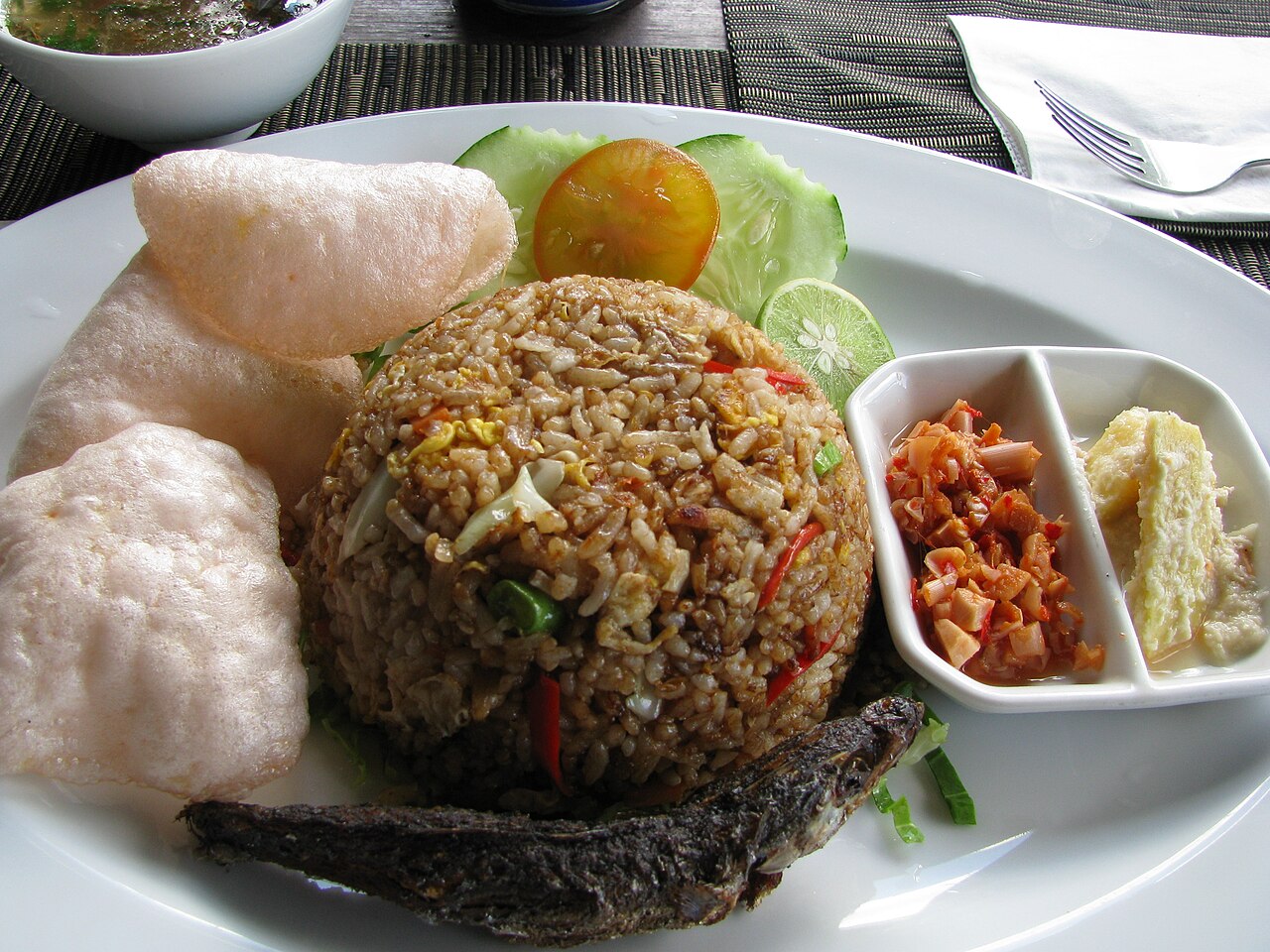
Fried rice, the everyday dish of Indonesia. Cooked rice (often from the day before) is stir-fried with shallots, garlic, chilli and kecap manis, a thick, sweet soy sauce, and topped with a fried egg, crispy fried shallots, cucumber and prawn crackers. People eat it for breakfast, lunch or a late supper from a street cart.
Kecap manis, the sweet soy sauce that gives nasi goreng its dark colour, was developed in Indonesia by adding plenty of local palm sugar to soy sauce.
See the recipe
Serves 2
25 min
Ingredients
400 g cooked long-grain rice, cold (cooked the day before, cooled within an hour and kept covered in the fridge)
3 shallots and 2 cloves garlic, finely chopped
1 red chilli, finely chopped (more or less to taste)
1 teaspoon shrimp paste (optional)
2 tablespoons kecap manis (sweet soy sauce) and 1 teaspoon salty soy sauce
150 g chicken breast or peeled prawns, cut small
3 tablespoons oil
2 eggs
To serve: cucumber and tomato slices, crispy fried shallots and prawn crackers
Method
Heat 2 tablespoons of oil in a wok or large frying pan. Fry the shallots, garlic, chilli and shrimp paste for 2 minutes, until soft and fragrant.
Add the chicken or prawns and stir-fry for 3 to 4 minutes, until cooked through.
Add the rice and break up any lumps. Stir in the kecap manis and soy sauce and stir-fry over high heat for 3 to 4 minutes, until the rice is hot and evenly coloured.
In a separate pan, fry the eggs in the rest of the oil. Cook them until the white is set and the yolk is as firm as you like; for pregnant women, young children, older people or anyone with a weak immune system, cook the yolk until firm.
Serve the rice with a fried egg on top, with cucumber, tomato, fried shallots and prawn crackers on the side.
The Minangkabau people of West Sumatra (also loved in Malaysia and Singapore)
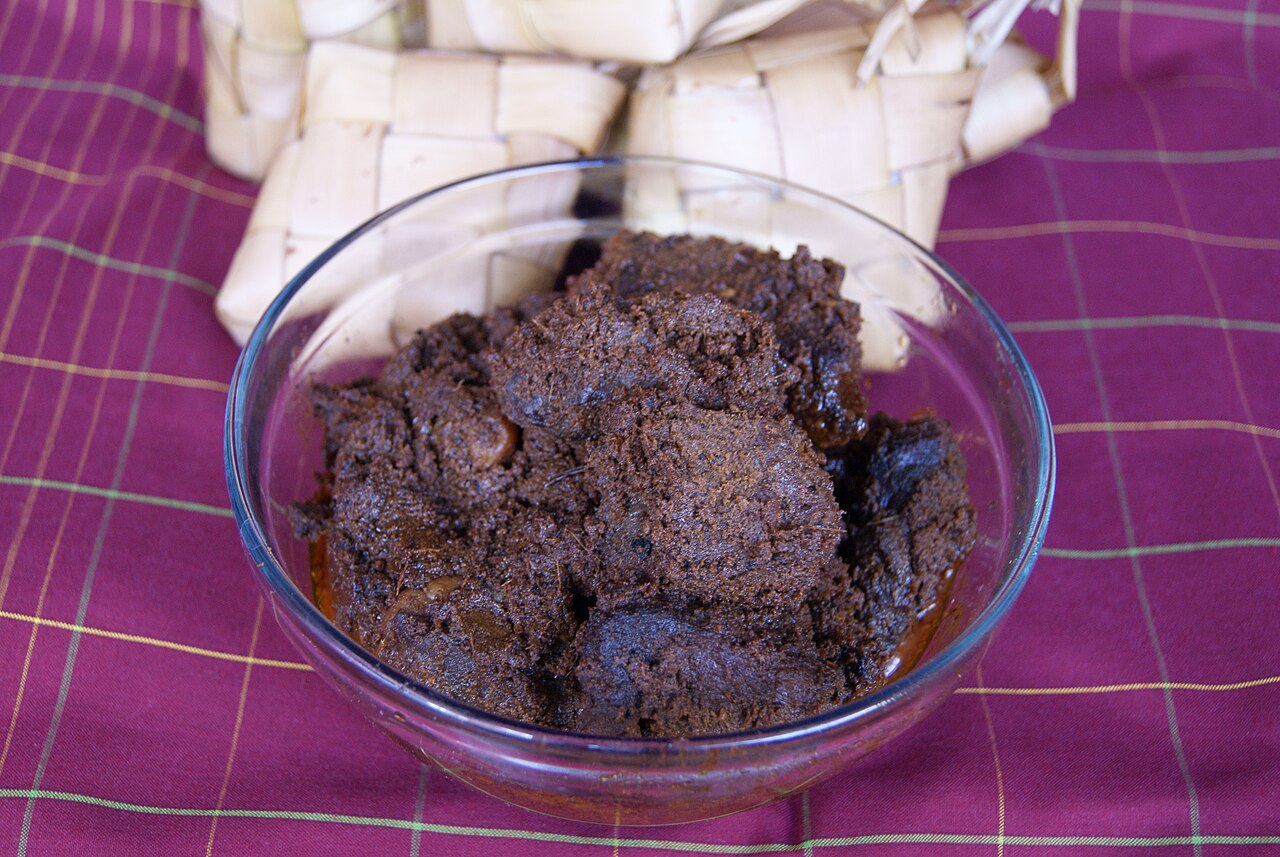
Beef slowly cooked for hours in coconut milk with ginger, galangal, lemongrass, turmeric and chilli, until the liquid has gone and the dark, spicy paste clings to the meat. Traditional rendang is almost dry, which helped it keep for a long time; it is served at weddings, festivals and Eid.
In a 2011 worldwide online poll by CNN International, rendang was voted the most delicious dish in the world.
See the recipe
Serves 6
4 h
Ingredients
1 kg stewing beef (chuck or brisket), cut into 4 cm pieces
For the spice paste: 8 shallots, 5 cloves garlic, a 5 cm piece each of ginger and galangal, a 3 cm piece of fresh turmeric (or 1 teaspoon ground), 6 to 10 dried red chillies (soaked) or fresh chillies
2 stalks lemongrass, bruised
4 makrut (kaffir) lime leaves and 1 turmeric leaf or bay leaf
800 ml coconut milk
4 tablespoons desiccated coconut, toasted in a dry pan until golden, then pounded or blended
1 tablespoon palm sugar or brown sugar and 1 teaspoon salt
2 tablespoons oil
Method
Blend all the spice paste ingredients with a splash of water until smooth.
Heat the oil in a heavy pot and fry the paste for 5 minutes, stirring, until fragrant.
Add the beef, lemongrass and leaves and stir well to coat the meat. Pour in the coconut milk and bring to the boil.
Turn the heat down and simmer uncovered for about 2 hours, stirring from time to time, until the sauce has thickened and the meat is tender.
Add the toasted coconut, sugar and salt. Keep cooking over low heat for 1 to 1.5 hours more, stirring often so it does not stick, until the sauce is thick, dark brown and the oil starts to separate. Serve with steamed rice.
Port cities of Java and Sumatra, now everywhere in Indonesia
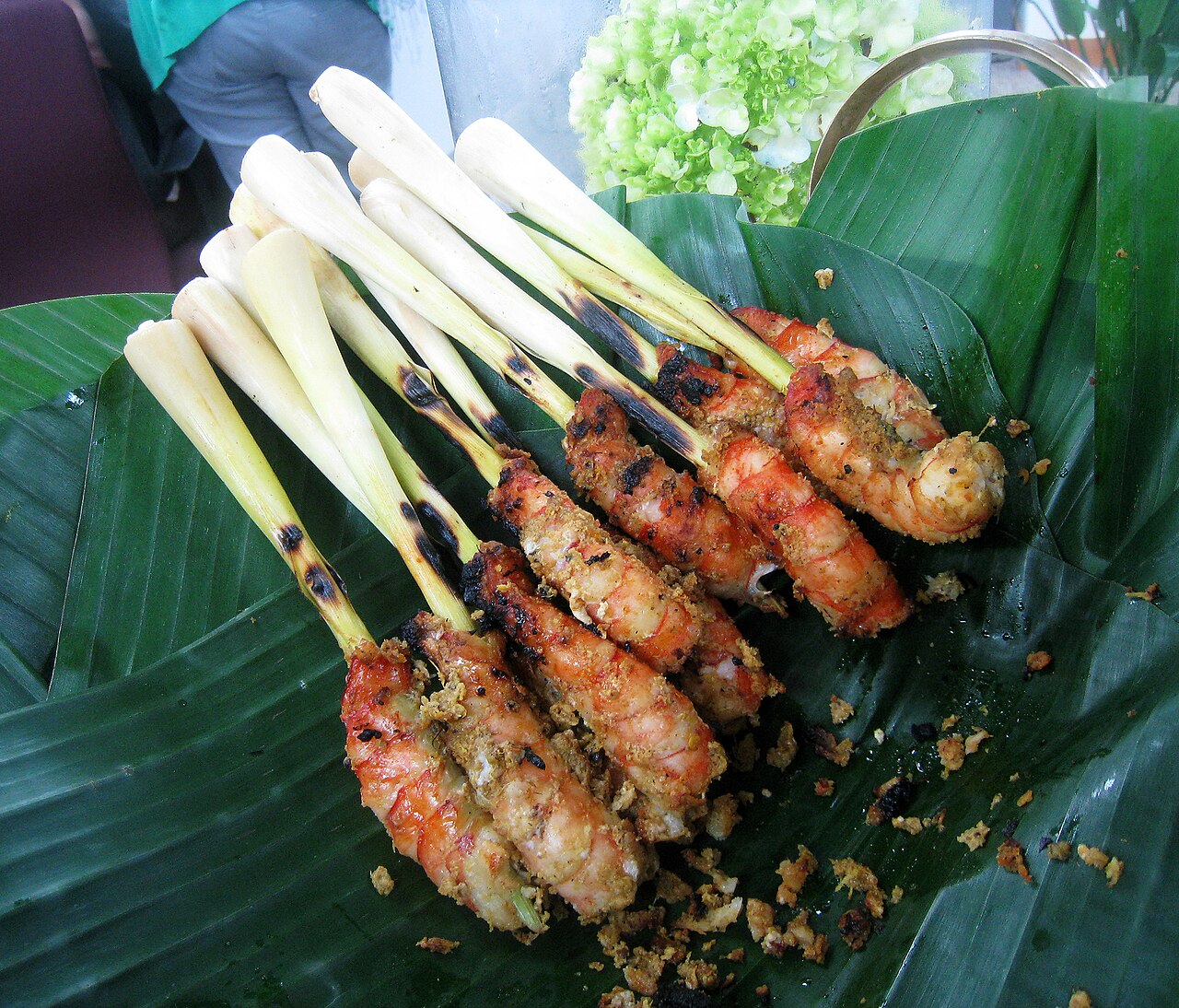
Small pieces of marinated chicken, goat or beef threaded on bamboo skewers and grilled over charcoal, usually served with a peanut sauce, rice cakes and sliced shallots. Satay sellers fan the glowing coals on their street carts in the evening. Sate Madura, from the island of Madura, is one of the best known styles.
Satay was shaped by many visitors: kebabs brought by Muslim traders, Indian spices and Chinese bamboo skewers all came together in the ports of the islands.
See the recipe
Serves 4
1 h
Ingredients
600 g boneless chicken thighs, cut into 2 cm pieces
For the marinade: 3 tablespoons kecap manis, 2 cloves garlic (crushed), 1 teaspoon ground coriander and 1 tablespoon oil
Bamboo skewers, soaked in water for 30 minutes
For the peanut sauce: 150 g roasted unsalted peanuts, 2 cloves garlic, 1 red chilli, 2 tablespoons kecap manis, 1 teaspoon palm or brown sugar, juice of 1 lime and about 250 ml water
To serve: sliced shallots, cucumber and rice cakes or rice
Method
Mix the chicken with the marinade and leave in the fridge for at least 30 minutes.
For the sauce, blend the peanuts, garlic and chilli to a coarse paste. Simmer it in a small pan with the kecap manis, sugar and water for 5 to 8 minutes, stirring, until thick. Add the lime juice and a pinch of salt. Peanuts cause serious allergies, so warn your guests.
Thread the chicken onto the skewers, 4 or 5 pieces each.
Grill over charcoal or under a hot grill for 8 to 10 minutes, turning often, until browned and cooked through with no pink left.
Serve hot with the peanut sauce poured over or on the side, with shallots, cucumber and rice cakes.
West Java and Jakarta (Sundanese and Betawi cooking), now all over Indonesia
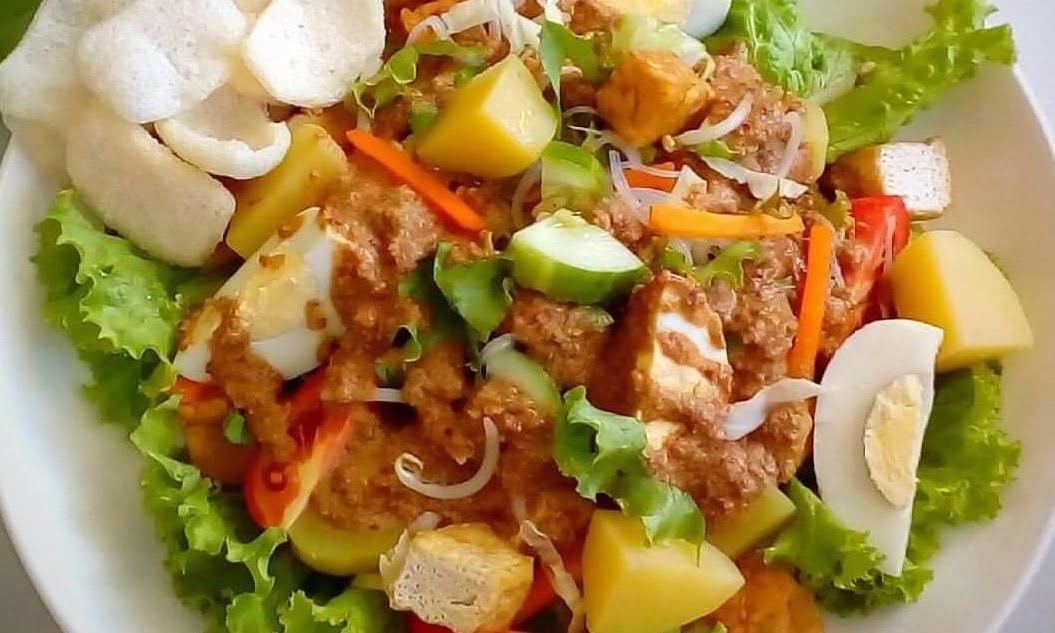
A warm salad of lightly boiled vegetables such as long beans, cabbage, bean sprouts and spinach, with potato, hard-boiled egg, fried tofu, tempeh and rice cake, all covered with a rich peanut sauce and topped with crispy crackers.
The name is often linked to 'digado', to eat something without plain rice, which is why gado-gado comes with rice cake instead.
See the recipe
Serves 4
45 min
Ingredients
2 medium potatoes, peeled and cut into chunks
4 eggs
200 g long beans or green beans, cut into 4 cm lengths
A quarter of a small white cabbage, shredded
150 g bean sprouts and 150 g spinach
200 g firm tofu and 200 g tempeh, cut into slices
Oil for frying and 1 cucumber, sliced
For the sauce: 200 g roasted unsalted peanuts, 2 cloves garlic, 1 or 2 red chillies, 2 tablespoons palm or brown sugar, 1 tablespoon kecap manis, juice of 1 lime, a pinch of salt and about 300 ml warm water
To serve: prawn crackers and crispy fried shallots
Method
Boil the potatoes for 12 to 15 minutes until tender. Boil the eggs for 10 minutes, cool them in cold water, peel and cut into quarters.
Blanch the beans for 3 minutes, the cabbage for 2 minutes, and the bean sprouts and spinach for 1 minute. Drain well. For older people, pregnant women, young children or anyone with a weak immune system, cook the bean sprouts until steaming hot or leave them out.
Fry the tofu and tempeh slices in hot oil for 3 to 4 minutes, until golden. Drain on kitchen paper.
For the sauce, blend the peanuts, garlic, chillies, sugar, kecap manis and salt with the warm water until thick and fairly smooth. Stir in the lime juice. Peanuts cause serious allergies, so warn your guests.
Arrange the vegetables, potatoes, tofu, tempeh, egg and cucumber on plates, pour the sauce over them and top with crackers and fried shallots.
Java, with many regional versions across Indonesia
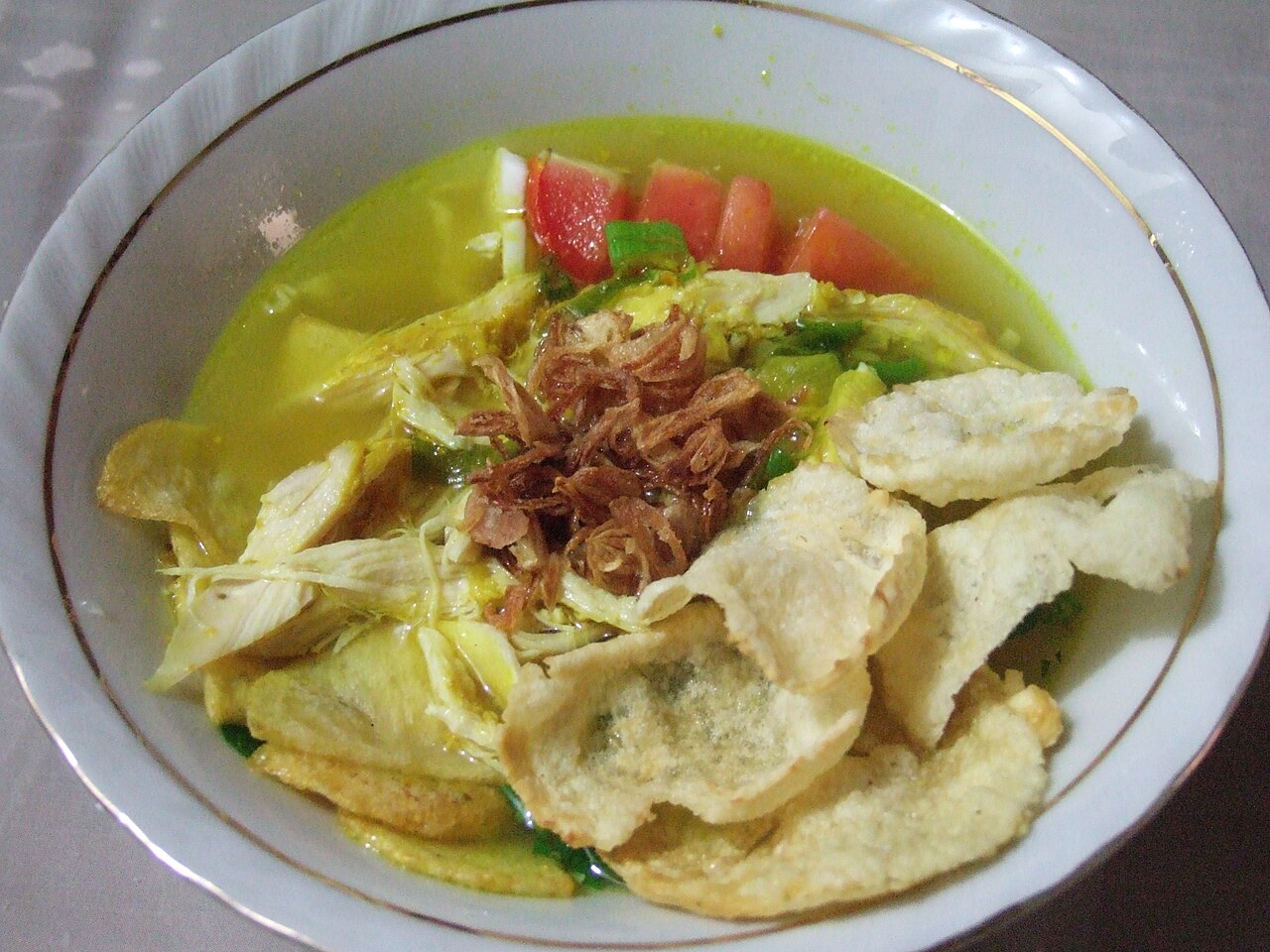
A fragrant yellow chicken soup coloured with turmeric and flavoured with lemongrass, ginger and lime leaves, served with shredded chicken, rice noodles, bean sprouts, boiled egg and fried shallots. Almost every region has its own soto, some clear, some with coconut milk.
One theory says soto grew from a Chinese tripe soup, caudo, sold in Semarang in the 1600s; others think it is a mix of Chinese, Indian and local cooking.
See the recipe
Serves 4
1 h 15 min
Ingredients
4 chicken legs (about 1 kg)
2 litres water
For the paste: 5 shallots, 3 cloves garlic, 3 cm fresh turmeric (or 1 teaspoon ground), 3 cm ginger, 3 candlenuts or macadamia nuts, 1 teaspoon ground coriander
2 stalks lemongrass, bruised, 4 makrut (kaffir) lime leaves and 2 bay leaves
1 tablespoon oil and salt to taste
150 g rice vermicelli, soaked in hot water
150 g bean sprouts, 4 hard-boiled eggs, crispy fried shallots, celery leaves and lime wedges to serve
Method
Put the chicken in a large pot with the water, bring to the boil, skim off the foam and simmer for 20 minutes.
Meanwhile blend the paste ingredients until smooth and fry the paste in the oil for 3 to 4 minutes, until fragrant.
Add the paste, lemongrass and leaves to the pot and simmer for 30 minutes more, until the chicken is cooked through and tender. Season with salt.
Lift out the chicken, remove the skin and bones and shred the meat.
Put noodles, bean sprouts (blanched for 1 minute in boiling water), chicken and half an egg in each bowl, ladle the hot soup over and top with fried shallots and celery leaves. Serve with lime and sambal. For older people, pregnant women, young children or anyone with a weak immune system, cook the bean sprouts until steaming hot or leave them out.
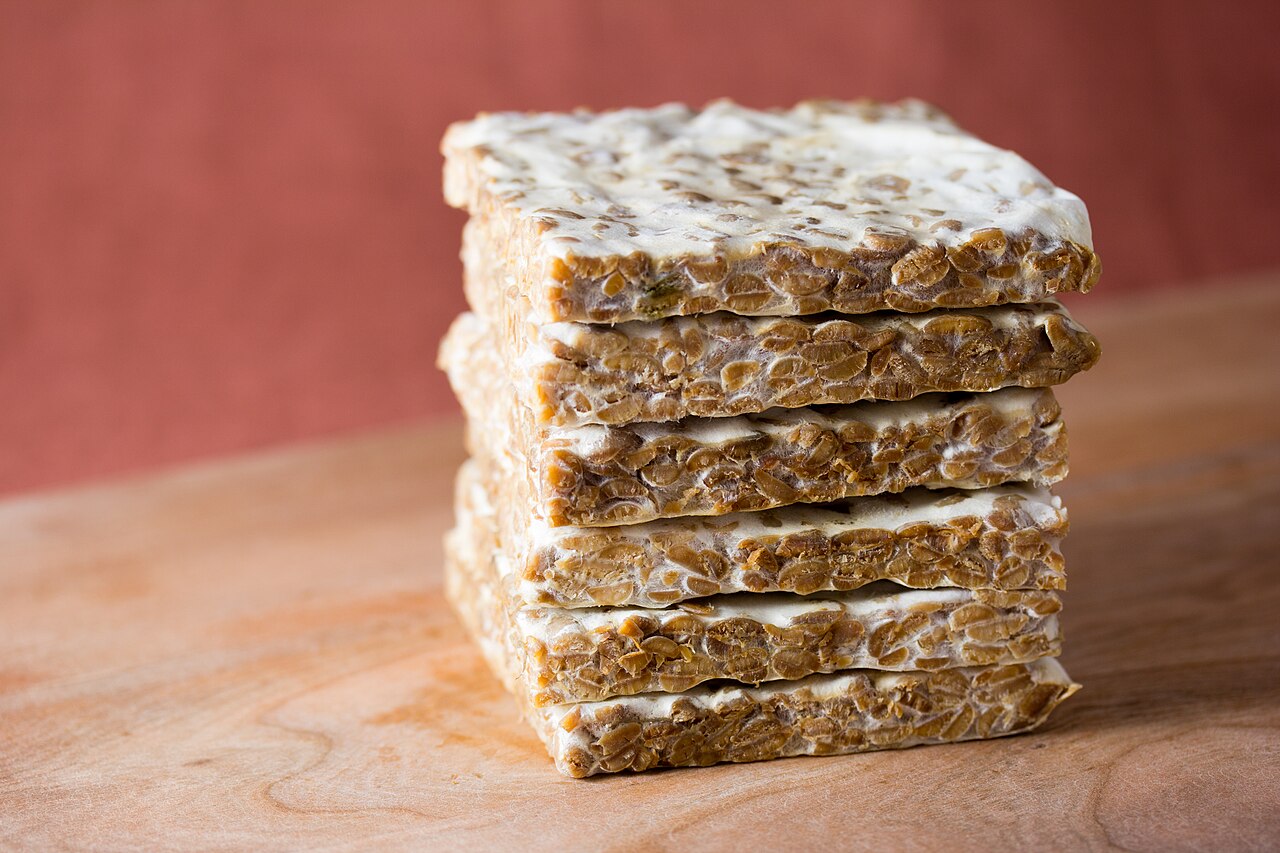
A firm cake of whole soybeans, fermented with a mould that binds them together. It has a nutty, earthy taste and is sliced and fried, simmered in sweet soy sauce or added to curries. Tempeh is an everyday source of protein across Java and a favourite of vegetarians around the world.
Unlike tofu, which is made from soy milk, tempeh keeps the whole bean, so it has more protein and fibre.
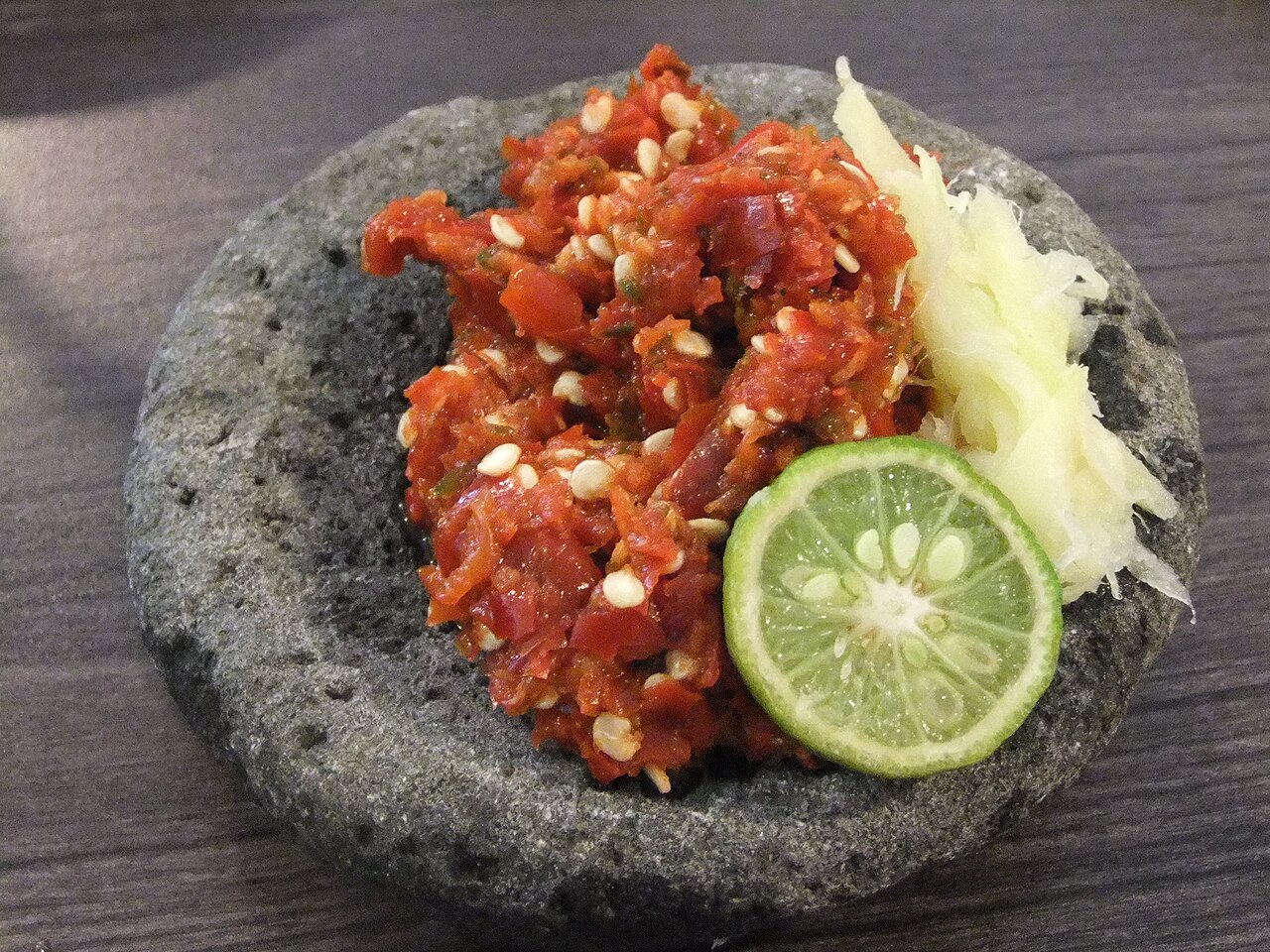
A chilli sauce or paste, usually ground by hand in a stone mortar with shallots, garlic, salt and often lime juice or tomato. Sambal terasi adds fried shrimp paste. There is a small dish of sambal on almost every Indonesian table, and people add as much as they like.
Between 212 and 300 different kinds of sambal have been reported across the islands, from mild to extremely hot.
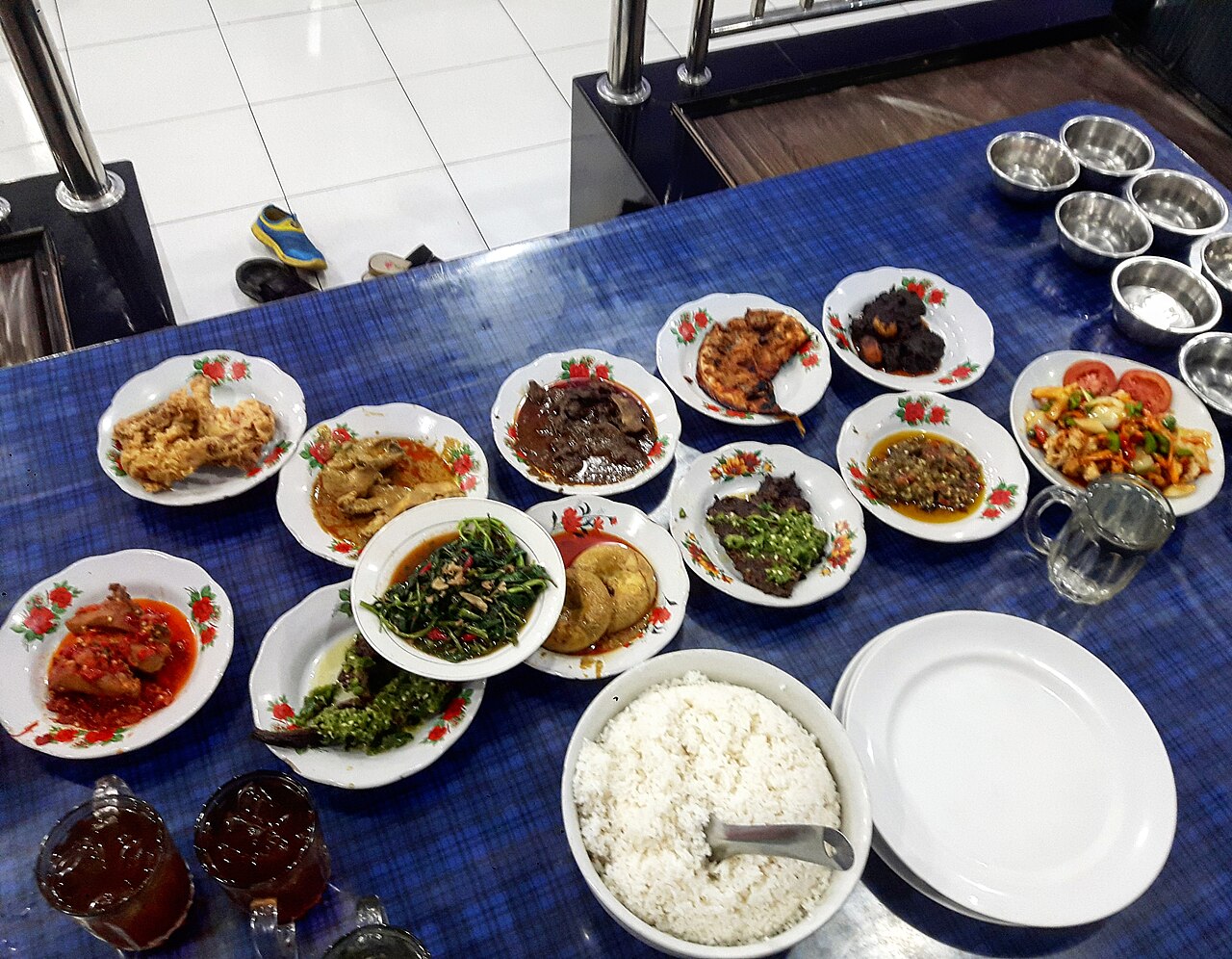
Rice served with a choice of rich, spicy Minangkabau dishes such as rendang, curried chicken, fish and cassava leaves. In Padang restaurants the dishes are stacked high in the front window.
In a traditional 'hidang' Padang restaurant you do not order: the waiter covers the table with many small plates, and you pay only for what you eat.
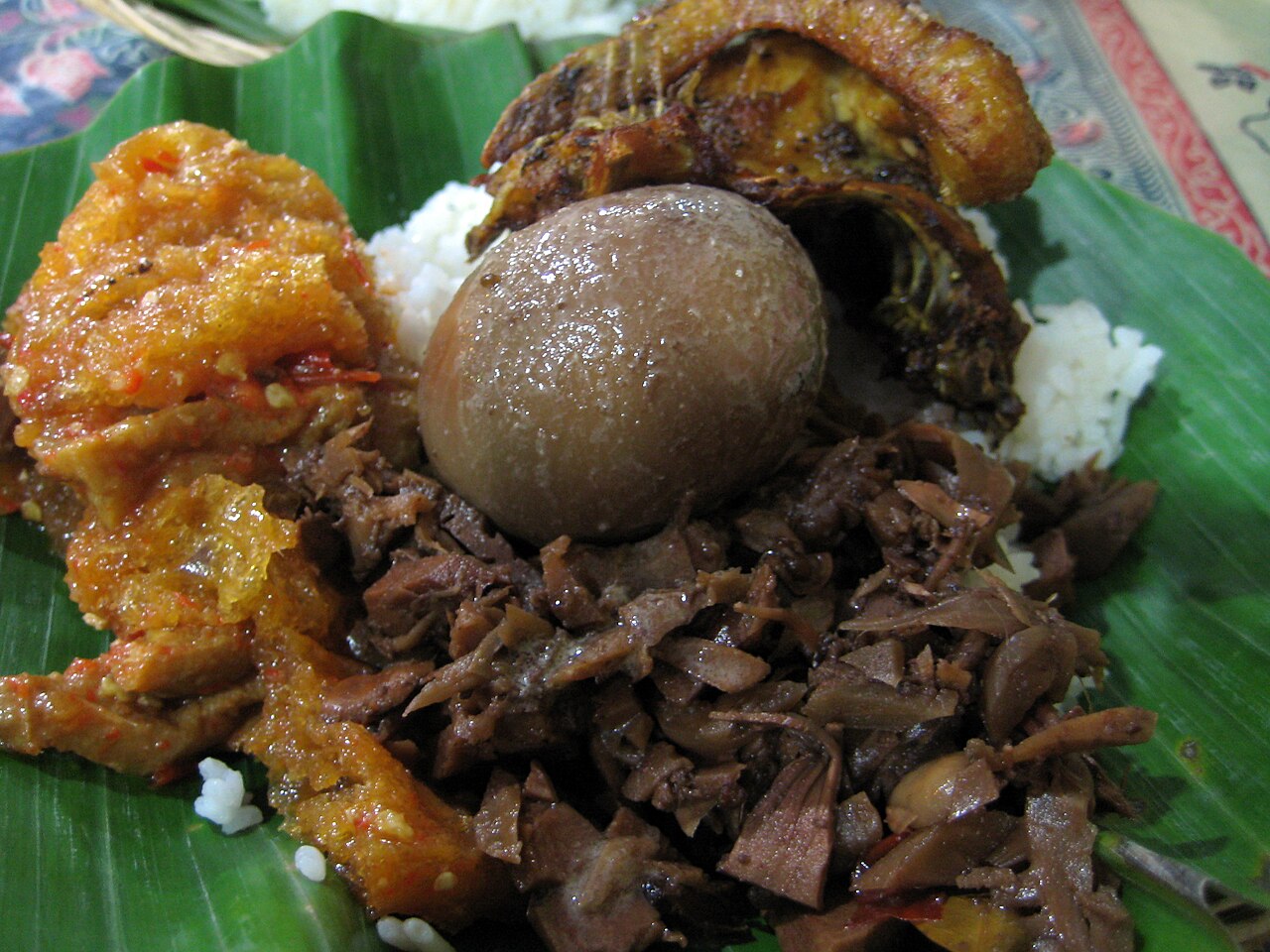
Young, unripe jackfruit stewed for several hours with palm sugar, coconut milk and spices until soft, sweet and brown. It is served with rice, chicken, egg and a spicy stew of beef skin.
Teak leaves are often cooked with the jackfruit, and they give gudeg its reddish-brown colour.
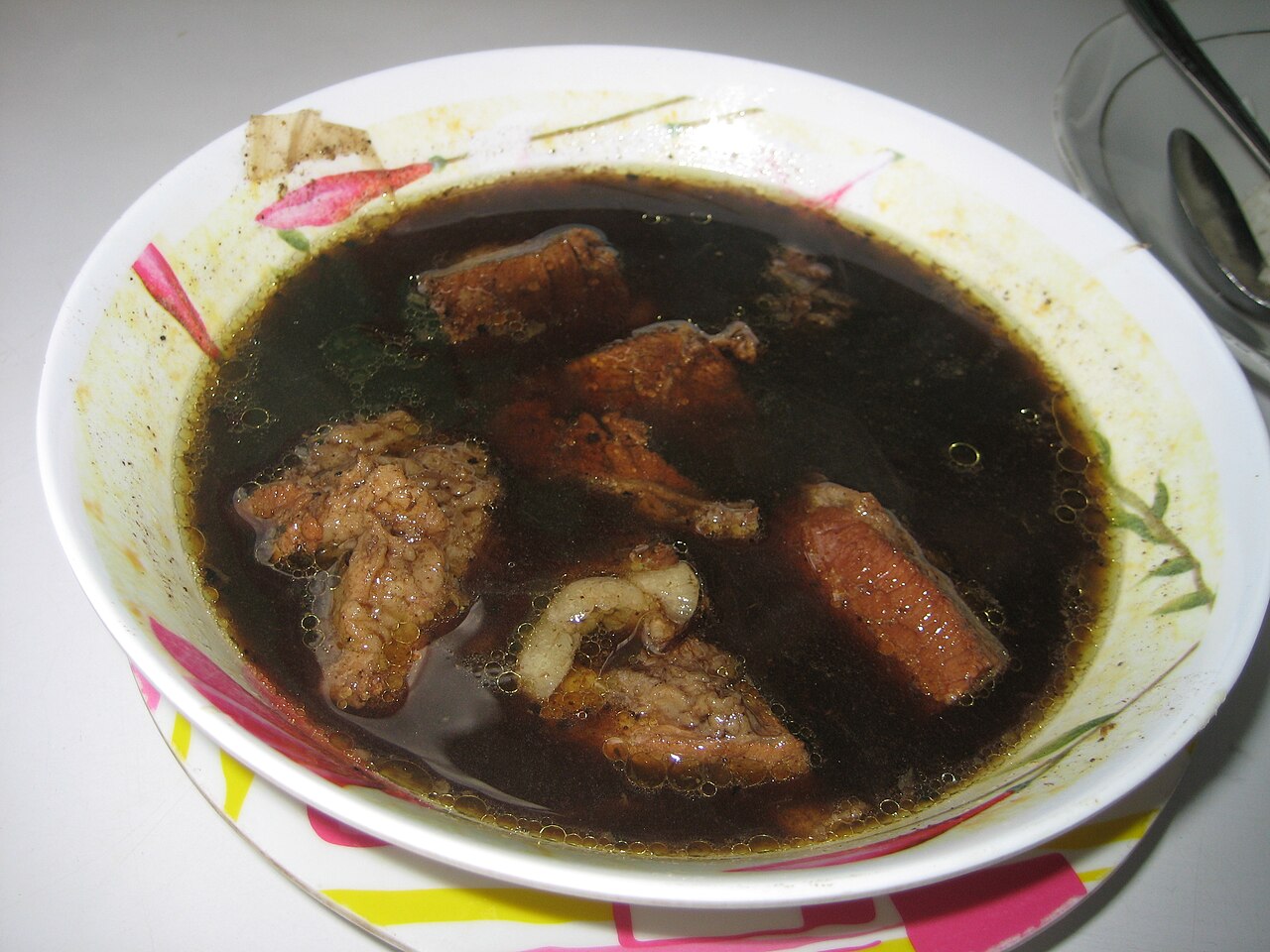
A beef soup made almost black by keluak, the seed of a tropical tree, which gives it a deep, nutty flavour. It is served with rice, bean sprouts, salted egg and prawn crackers.
Fresh keluak seeds contain a poison, hydrogen cyanide, and are made safe to eat by boiling and then fermenting them before they are sold for cooking.
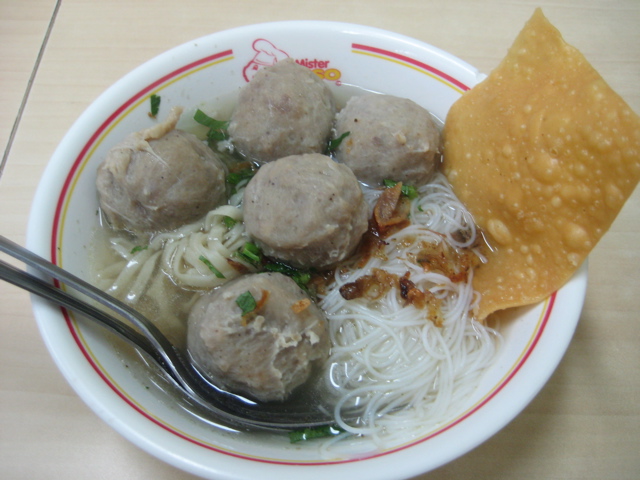
Soft, springy beef meatballs served in a clear hot broth, often with noodles, tofu and fried shallots. Bakso sellers push their carts through towns and villages, and many people enjoy it as an afternoon snack.
The word bakso can mean a single meatball or the whole bowl of meatball soup.
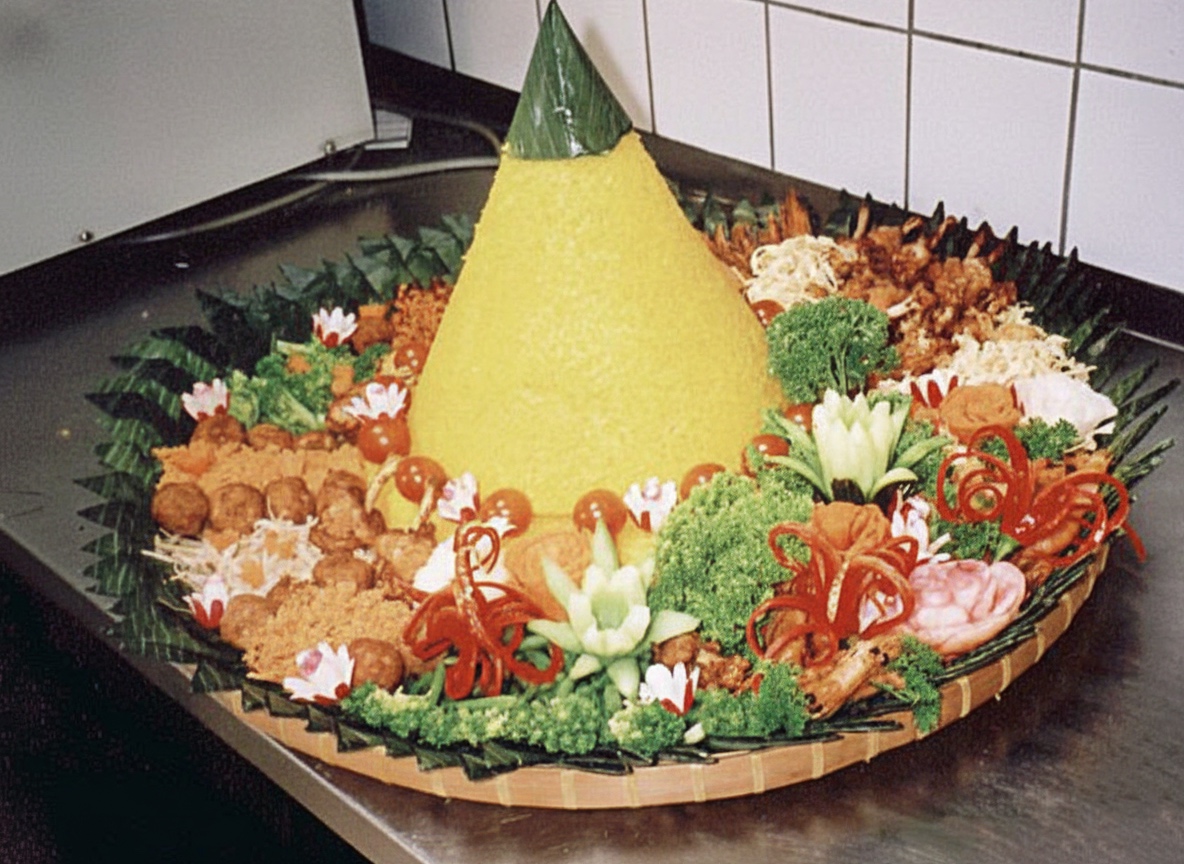
A tall cone of rice, often yellow with turmeric, set on a round bamboo tray and surrounded by vegetables, chicken, egg and other dishes. It is made for celebrations such as birthdays and parties, and for the slametan, a traditional communal feast.
Tumpeng is a symbol of gratitude. In the folklore of Java and Bali, the cone stands for life and the glory of God as the creator of nature, and the dishes around it for the harmony of nature.
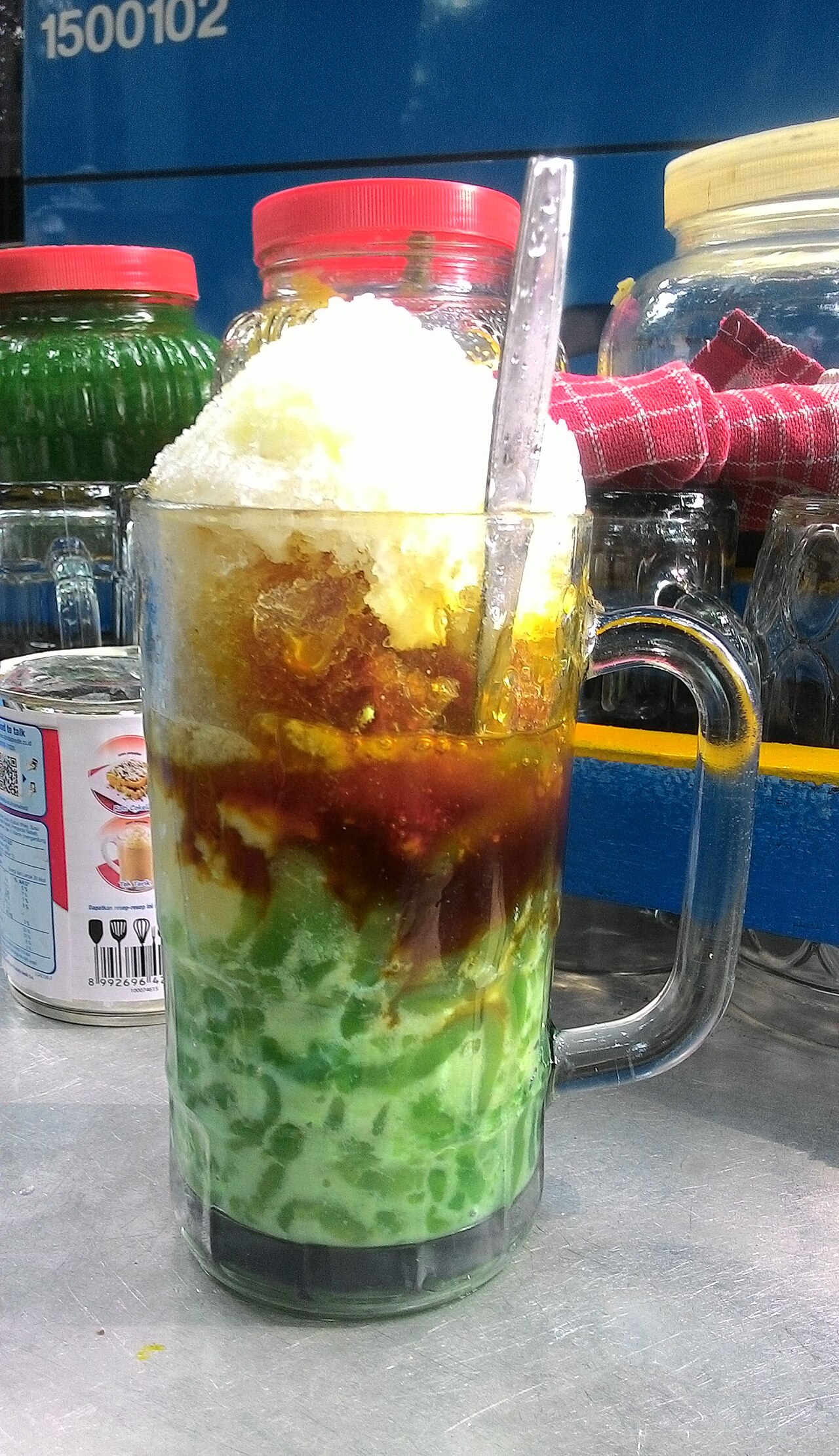
Soft green jelly strands flavoured with pandan leaf, served in coconut milk with palm sugar syrup and shaved ice. It is a favourite cold drink and dessert on a hot afternoon.
Traditional markets across Indonesia (also Malaysia and Singapore)
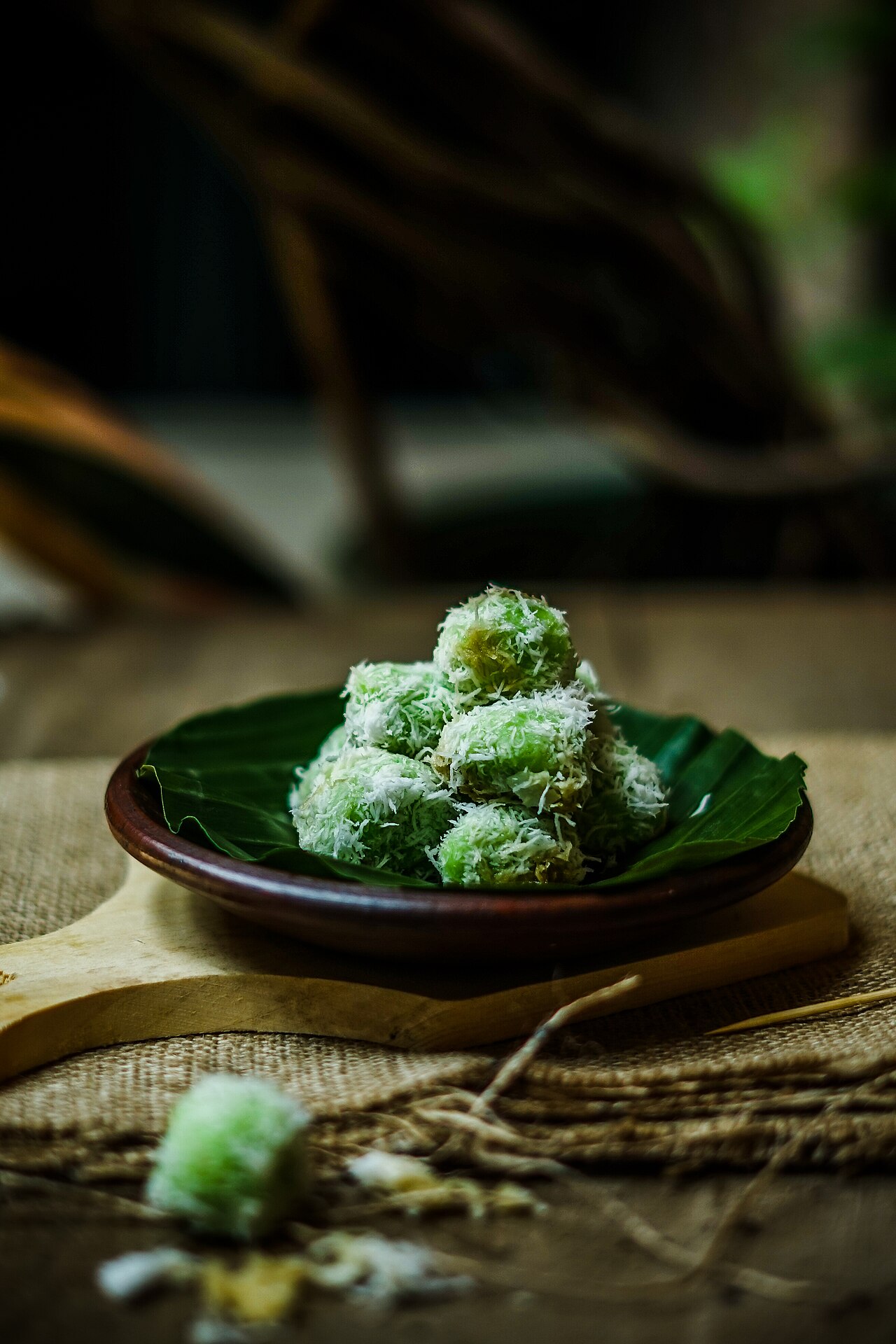
Small green balls of glutinous rice flour, coloured with pandan, filled with palm sugar and rolled in grated coconut. When you bite one, the melted sugar bursts in your mouth. They are soft and sticky, so older people and young children should take small bites and chew well.
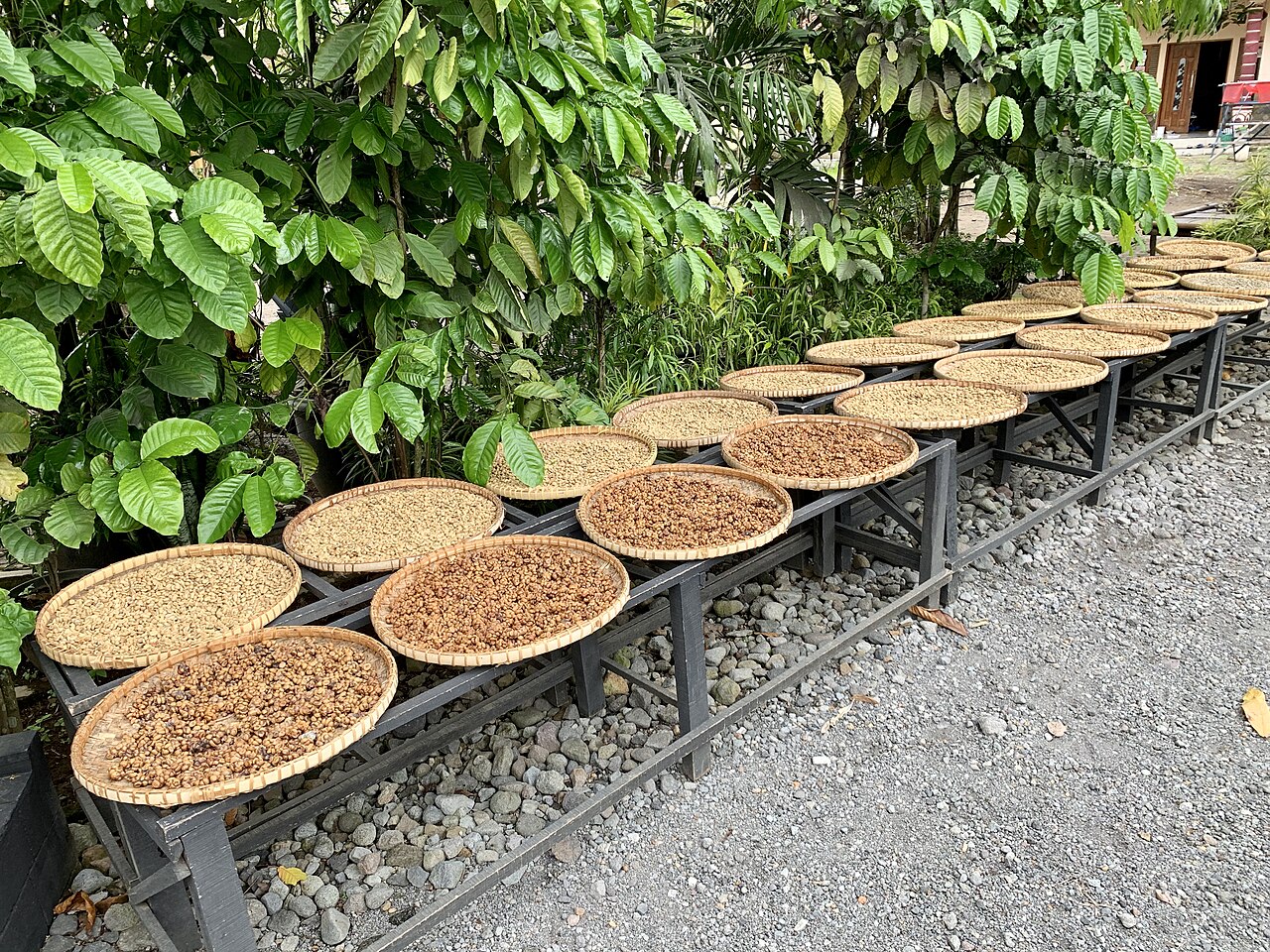
One of the most expensive coffees in the world, made from coffee cherries that have been eaten and passed by the Asian palm civet, a small wild animal. Once the beans were gathered from the droppings of wild civets. Today most kopi luwak comes from civets kept in small cages and force-fed coffee cherries, which raises serious animal welfare concerns. Investigations have also found coffee from caged animals sold as 'wild', so many visitors now choose to skip it and drink ordinary Indonesian coffee instead.
Kopi means coffee and luwak is the Indonesian name for the civet.
Table manners
Use your right hand to eat, pass food and hand over money; the left hand is traditionally used for washing and is considered unclean.
Most meals are eaten with a spoon in the right hand and a fork in the left, used to push food onto the spoon. Knives are not normally used at the table.
When eating with your hand, as many people do in Padang restaurants and at home, use only your right hand; a bowl of water with lime is provided for washing your fingers.
Take food from the shared dishes with the serving spoon, not your own hand or spoon.
Many Indonesians are Muslim and do not eat pork or drink alcohol. During the fasting month of Ramadan, try not to eat or drink in front of people who are fasting during the day.
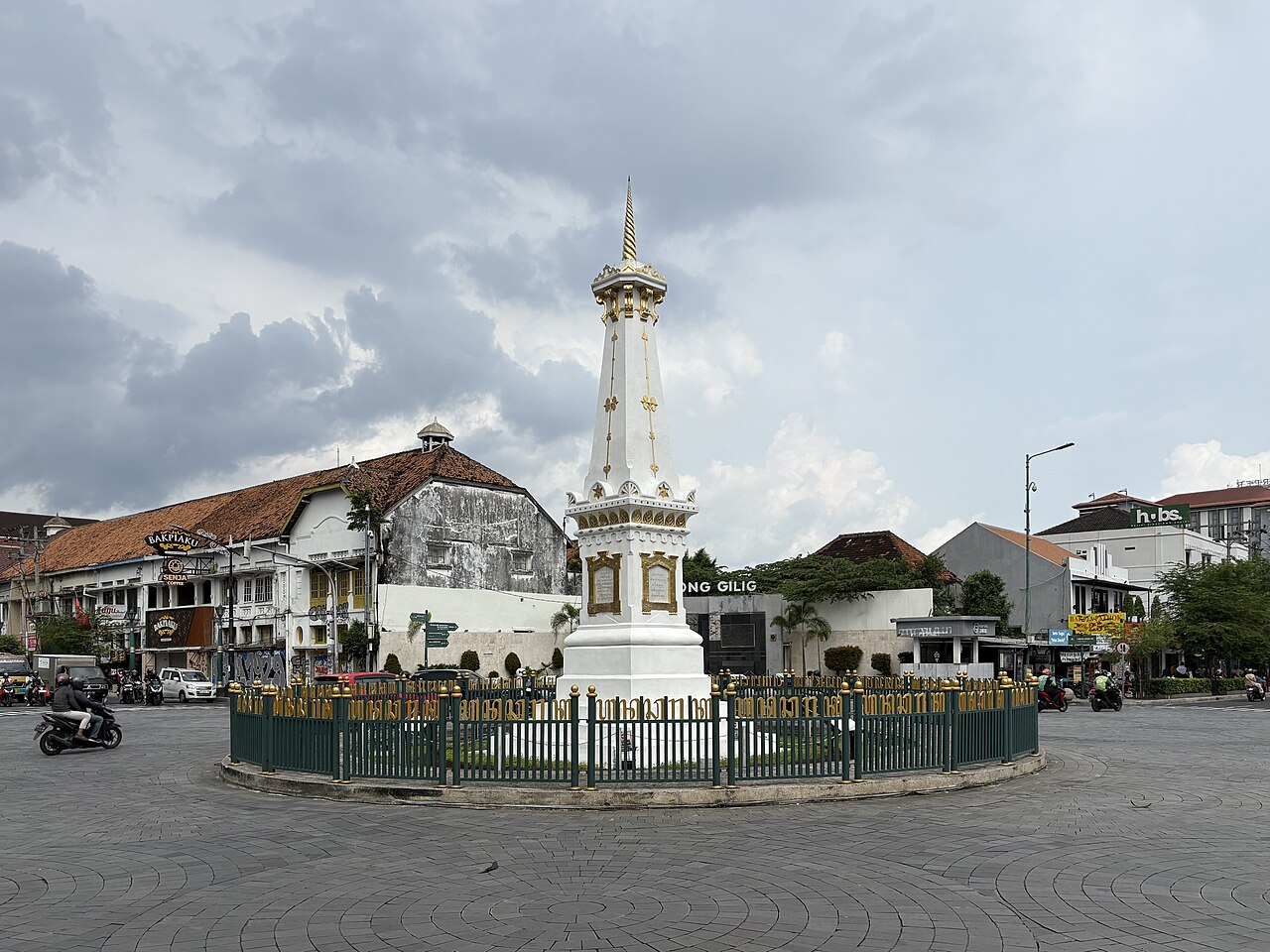
More than half of all Indonesians live on Java, where Jakarta, Bandung, Yogyakarta, Surabaya and Malang lie. Sumatra, to the west, has Medan, Palembang and the highland town of Bukittinggi. To the east are Hindu Bali with Denpasar, the port of Labuan Bajo on Flores, and Makassar and Manado on the island of Sulawesi. The new capital, Nusantara, is still being built on Borneo, so it is not on this map yet.
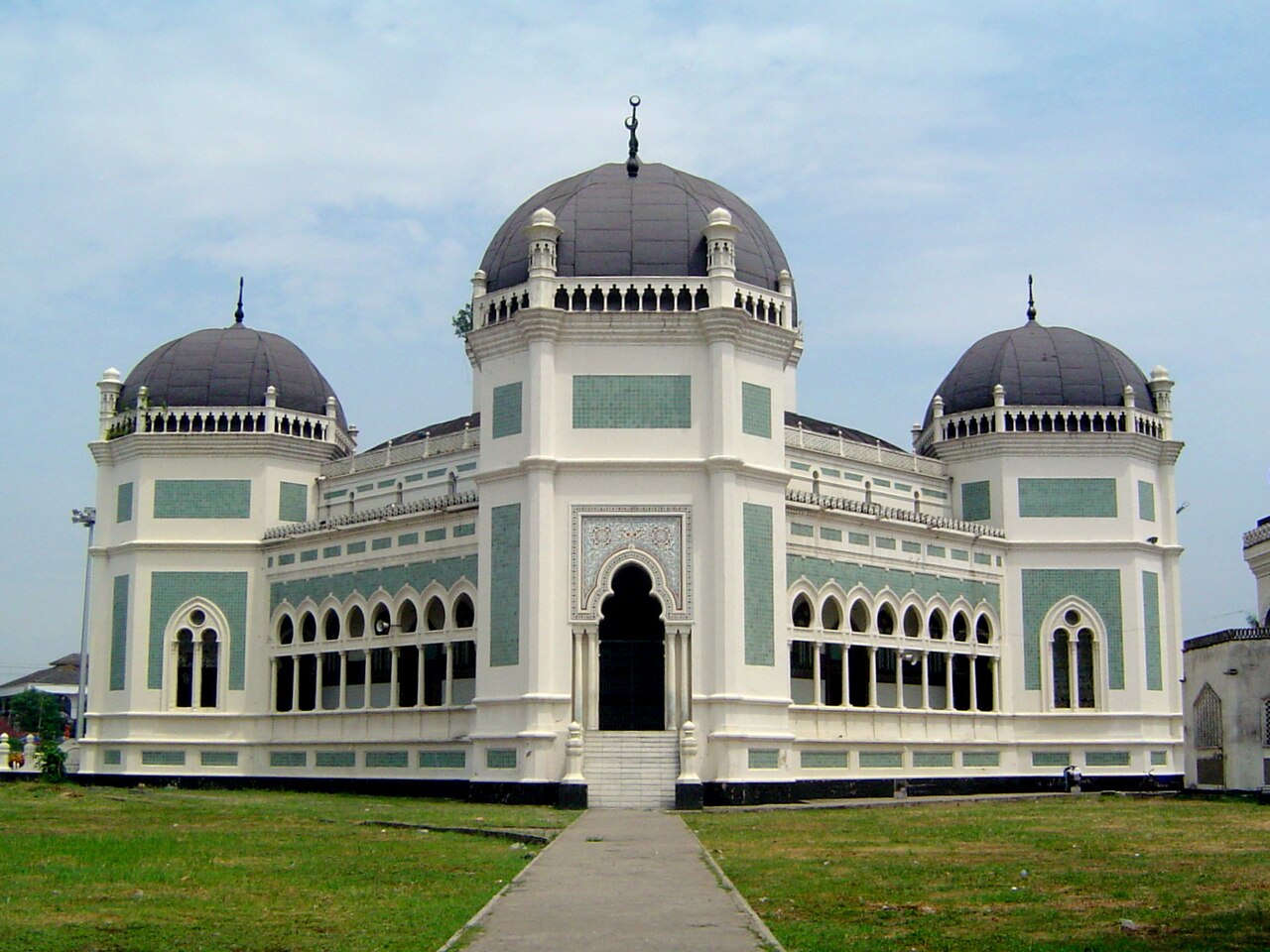
The largest city in Indonesia outside Java, with about 2.5 million people, and the capital of North Sumatra. It is a busy, multicultural trading city that grew rich from tobacco, rubber and palm oil plantations, and the main gateway to Lake Toba.
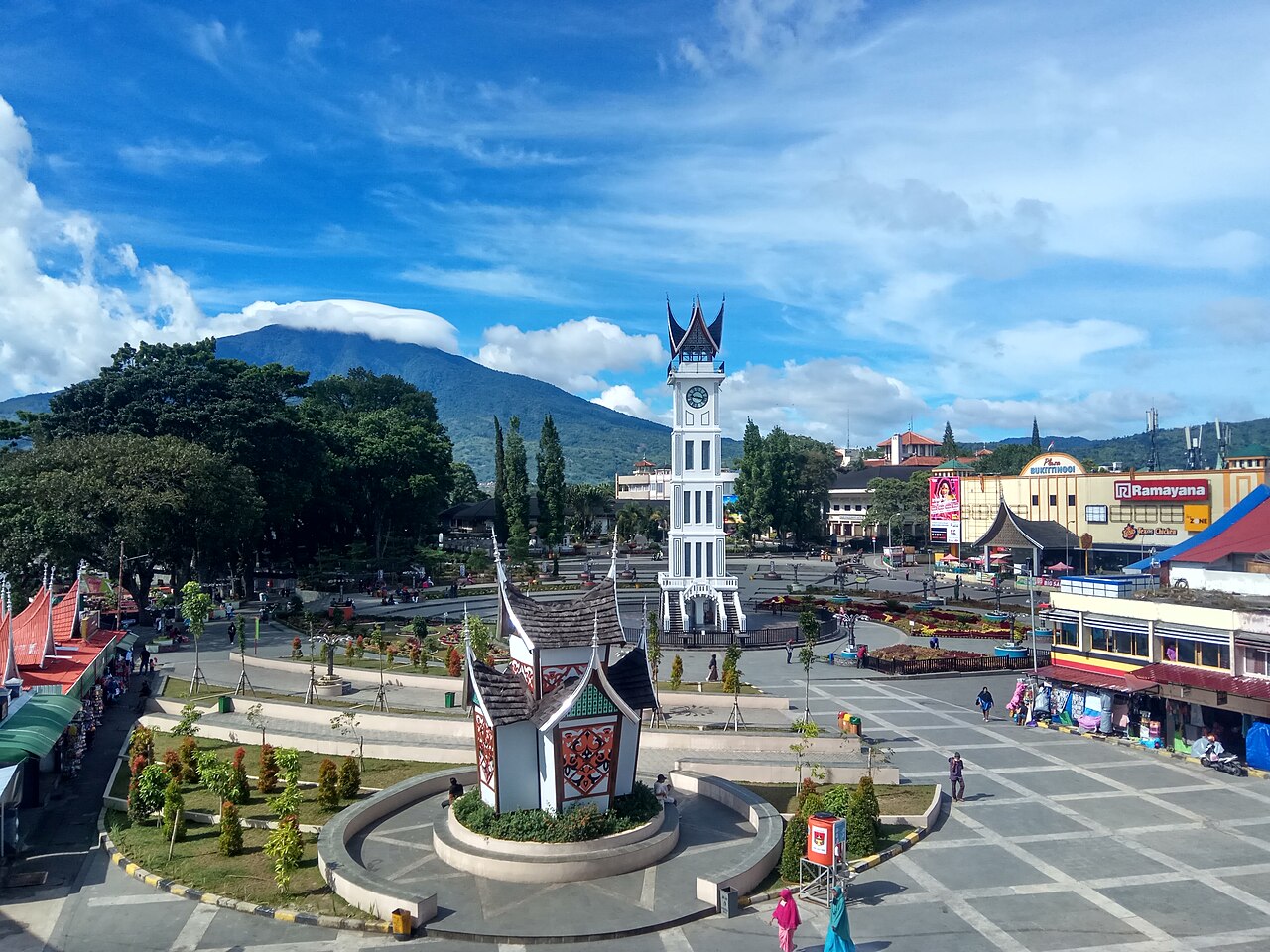
A cool highland town about 930 m above sea level in the heart of Minangkabau country, surrounded by volcanoes. The Dutch called it Fort de Kock. It was the birthplace of Mohammad Hatta, who proclaimed independence with Sukarno.
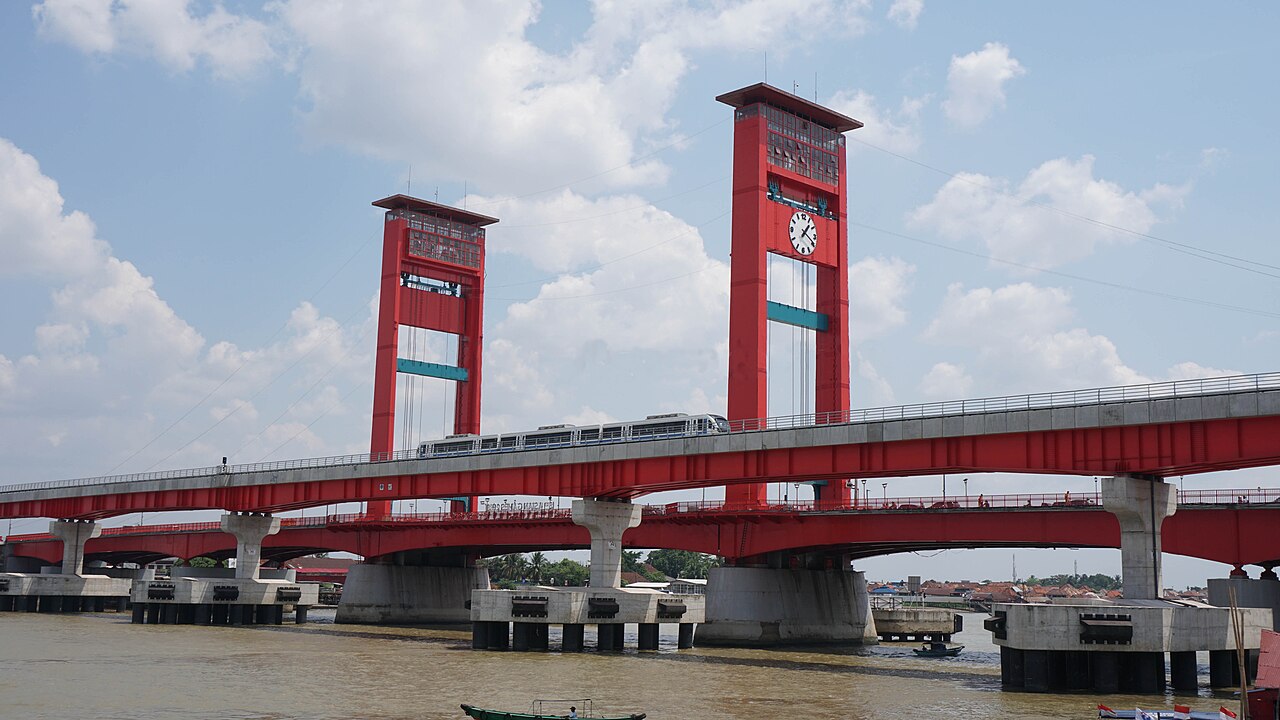
A large city on both banks of the Musi River, with about 1.8 million people. It is one of the oldest cities in the country: it was the capital of the Buddhist kingdom of Srivijaya more than 1,300 years ago.
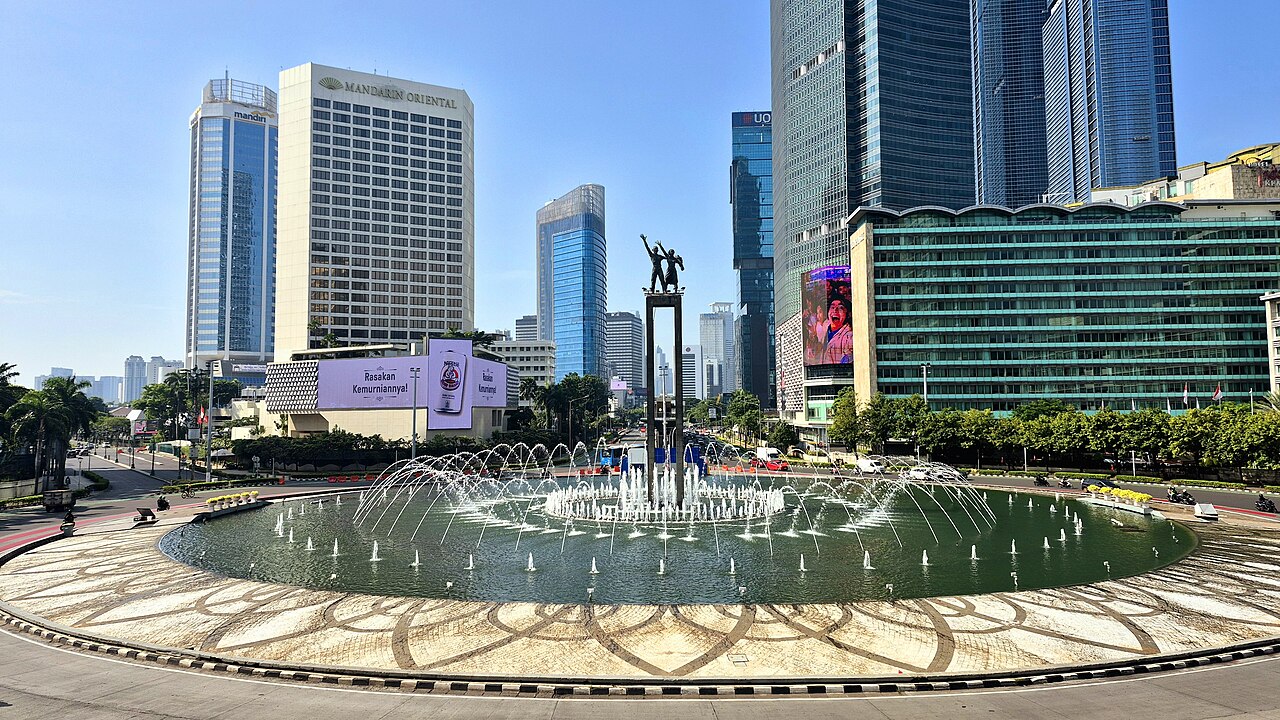
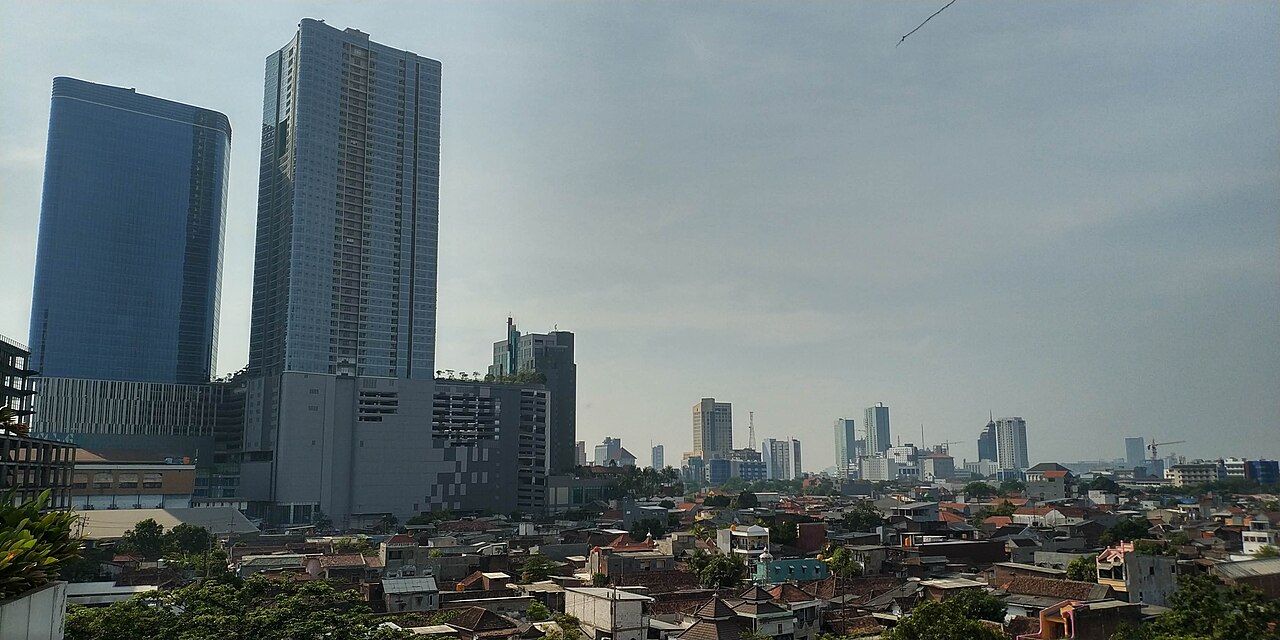
The capital and largest city, with about 11 million registered residents and more than 40 million in the greater urban area, by some counts the most populous urban area in the world. The Dutch built it as Batavia in 1619. The government is slowly moving to the new capital, Nusantara, but as of September 2026 Jakarta is still the capital.
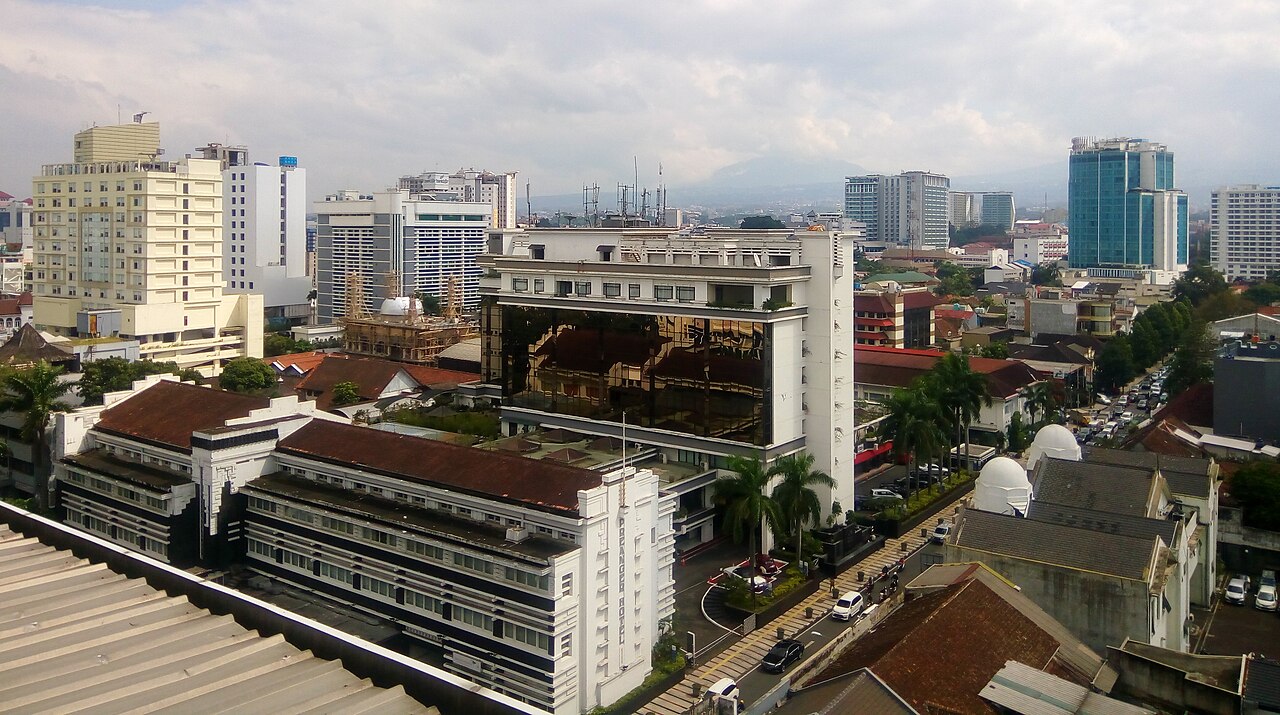
The capital of West Java, about 700 m above sea level in a basin ringed by volcanoes, so it is cooler than most Indonesian cities. Its Dutch-era buildings and shops earned it the nickname 'Paris of Java', and it hosted the Asian-African Conference of 1955.
The capital of the only Indonesian province whose governor is a hereditary sultan, and a centre of Javanese culture, batik, gamelan music and shadow puppetry. It was the capital of the young republic during the struggle for independence, from 1946. Borobudur and Prambanan are both close by.
Indonesia's second-largest city, with about 3 million people, and one of its oldest ports. In November 1945 it saw one of the fiercest battles of the independence struggle, which is why it is known as the City of Heroes.
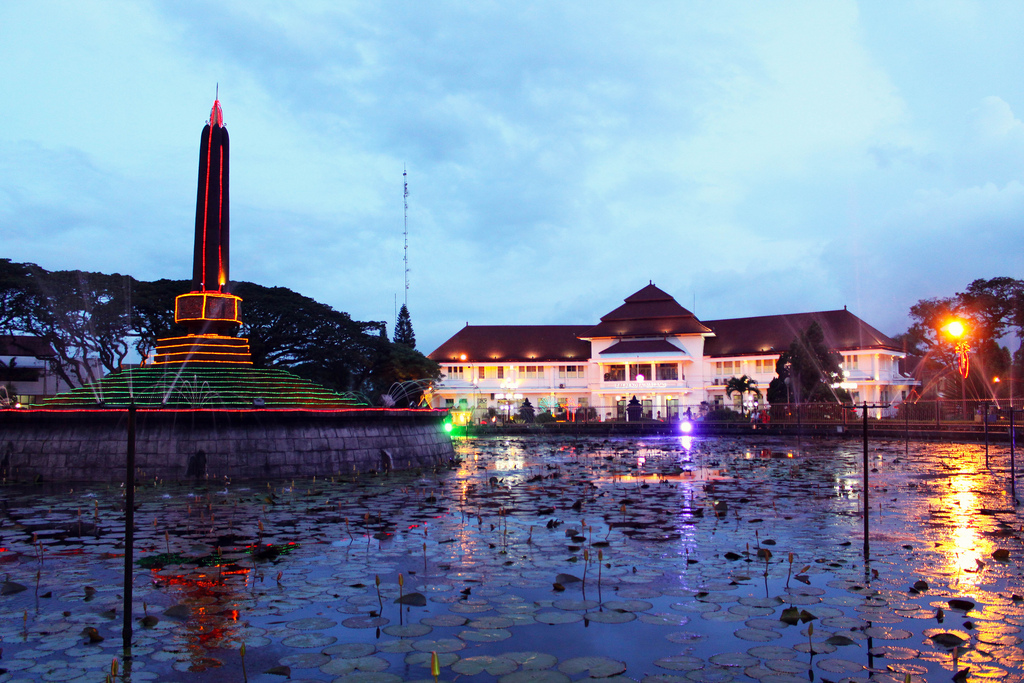
A highland city with a mild climate that was popular with Dutch residents, and it still has old colonial buildings and churches. The active volcano Mount Bromo is about 40 km to the east.
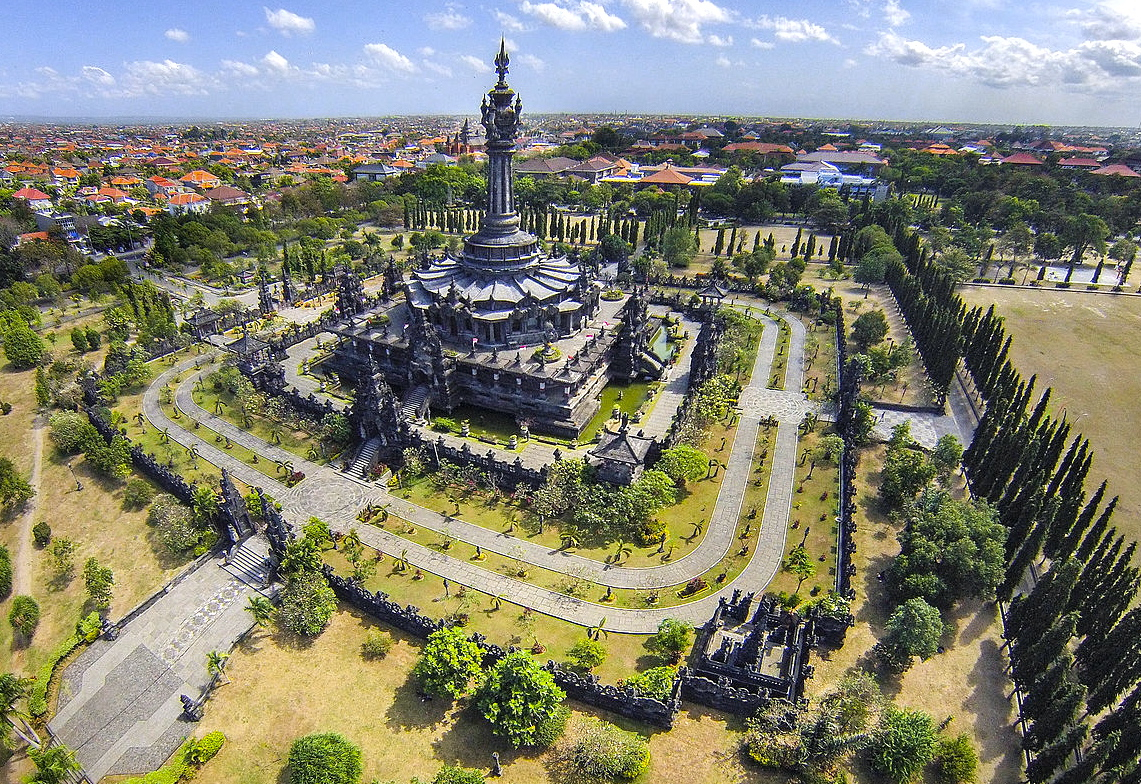
The capital and largest city of Bali, with about 670,000 people. Most visitors pass through on their way to the beaches, rice terraces and temples of this mostly Hindu island.
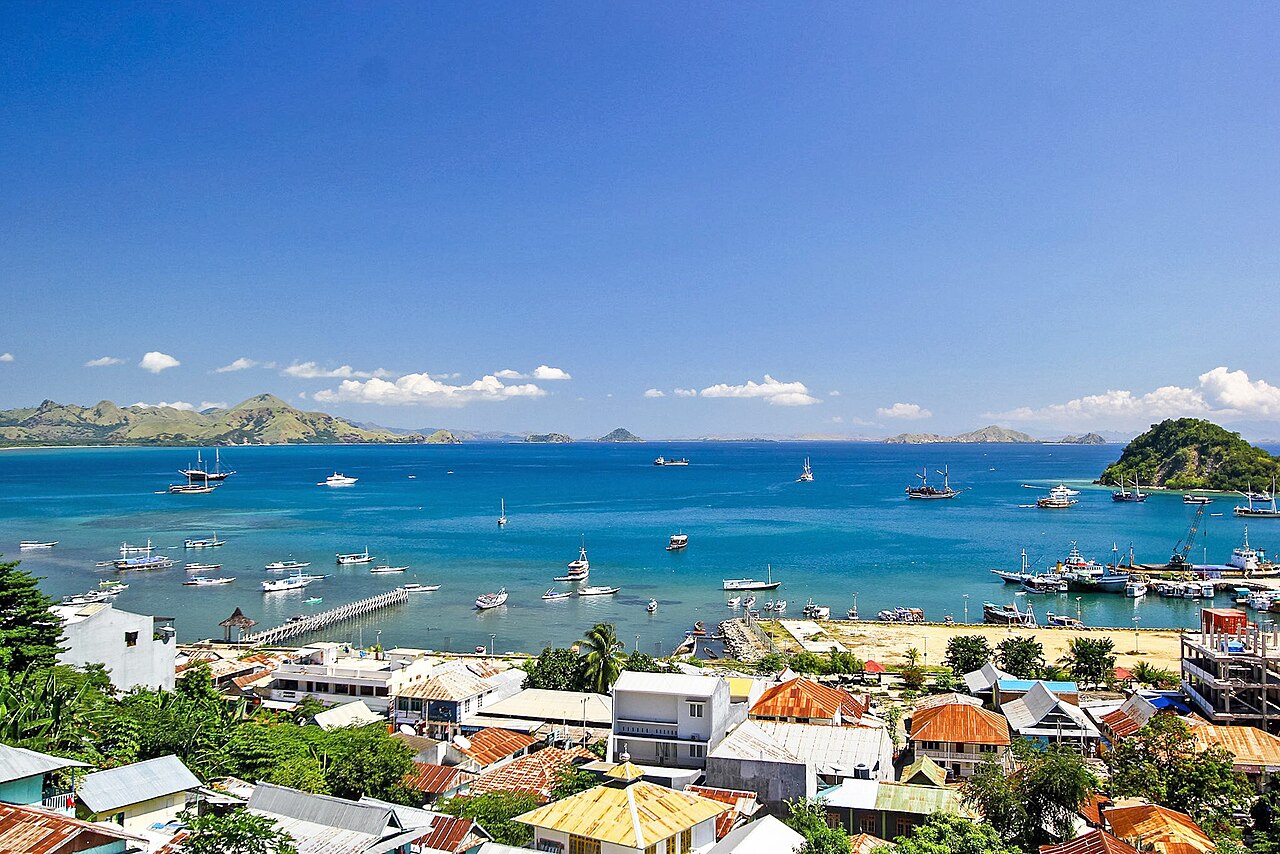
A small fishing town at the western tip of the island of Flores that has become the gateway to Komodo National Park. Boats leave from its harbour for Komodo, Rinca and Padar islands.
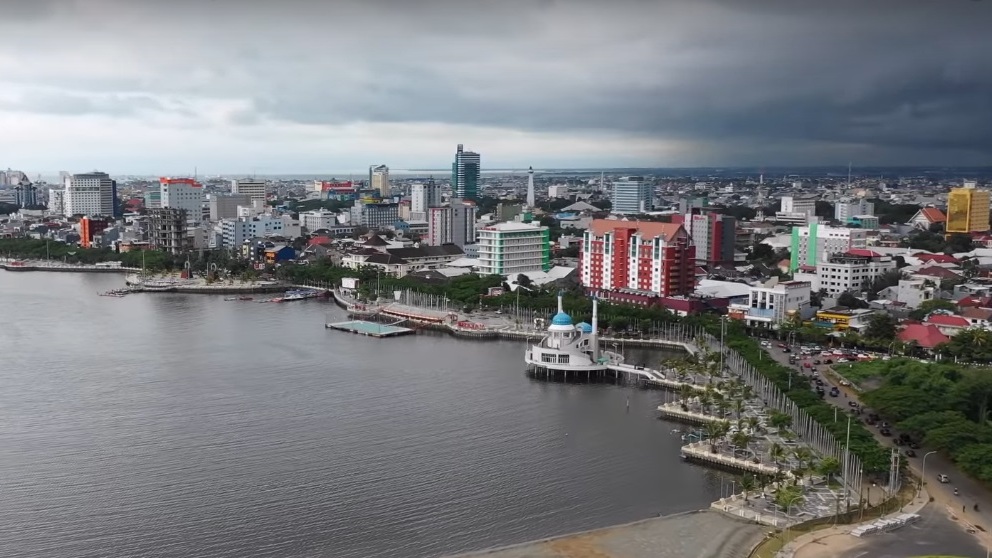
The largest city in eastern Indonesia, on the southwest coast of Sulawesi. It has been a great trading port for centuries, once the centre of the Sultanate of Gowa. Prince Diponegoro spent his last years in exile at its Fort Rotterdam.
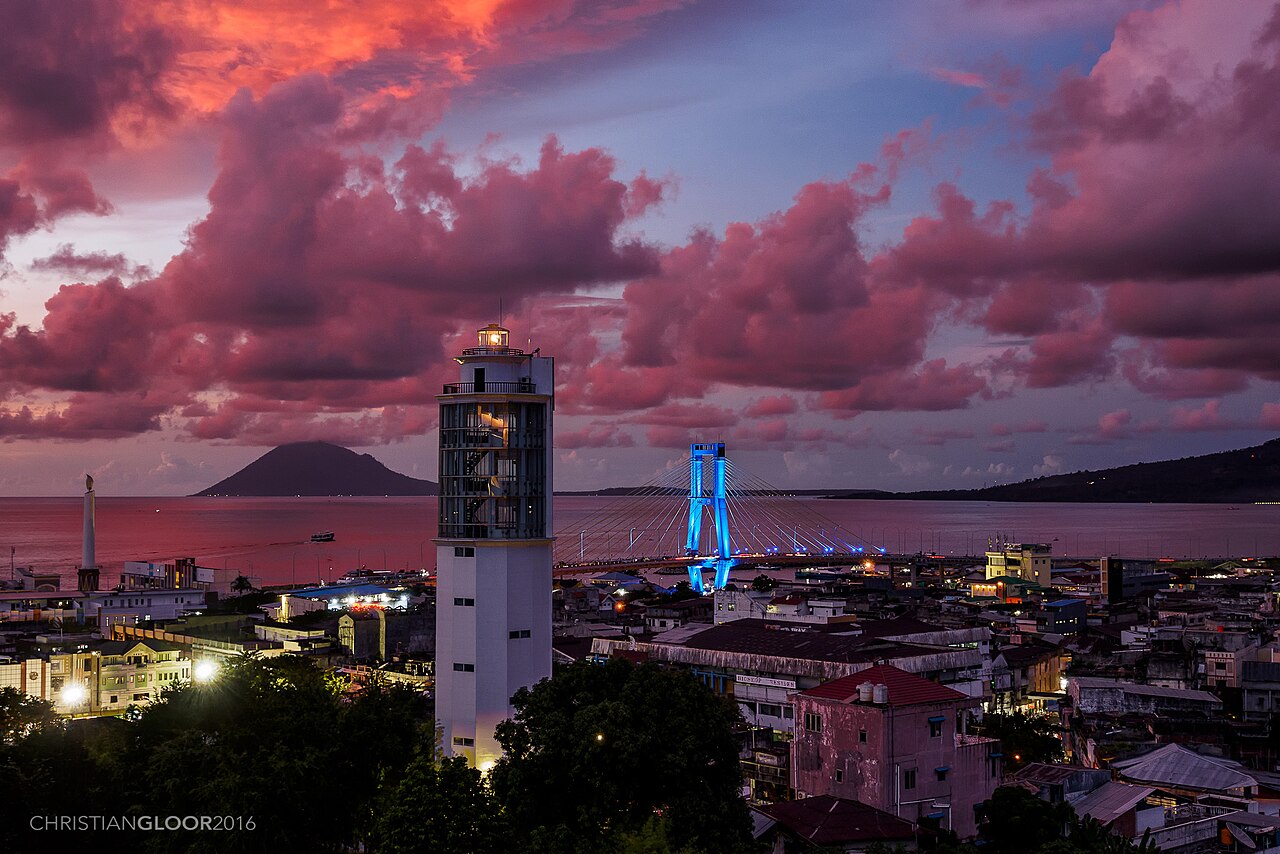
A hilly coastal city at the northern tip of Sulawesi with a mostly Christian population, known for its big Christmas celebrations. Divers come for the coral reefs of Bunaken National Park just offshore.
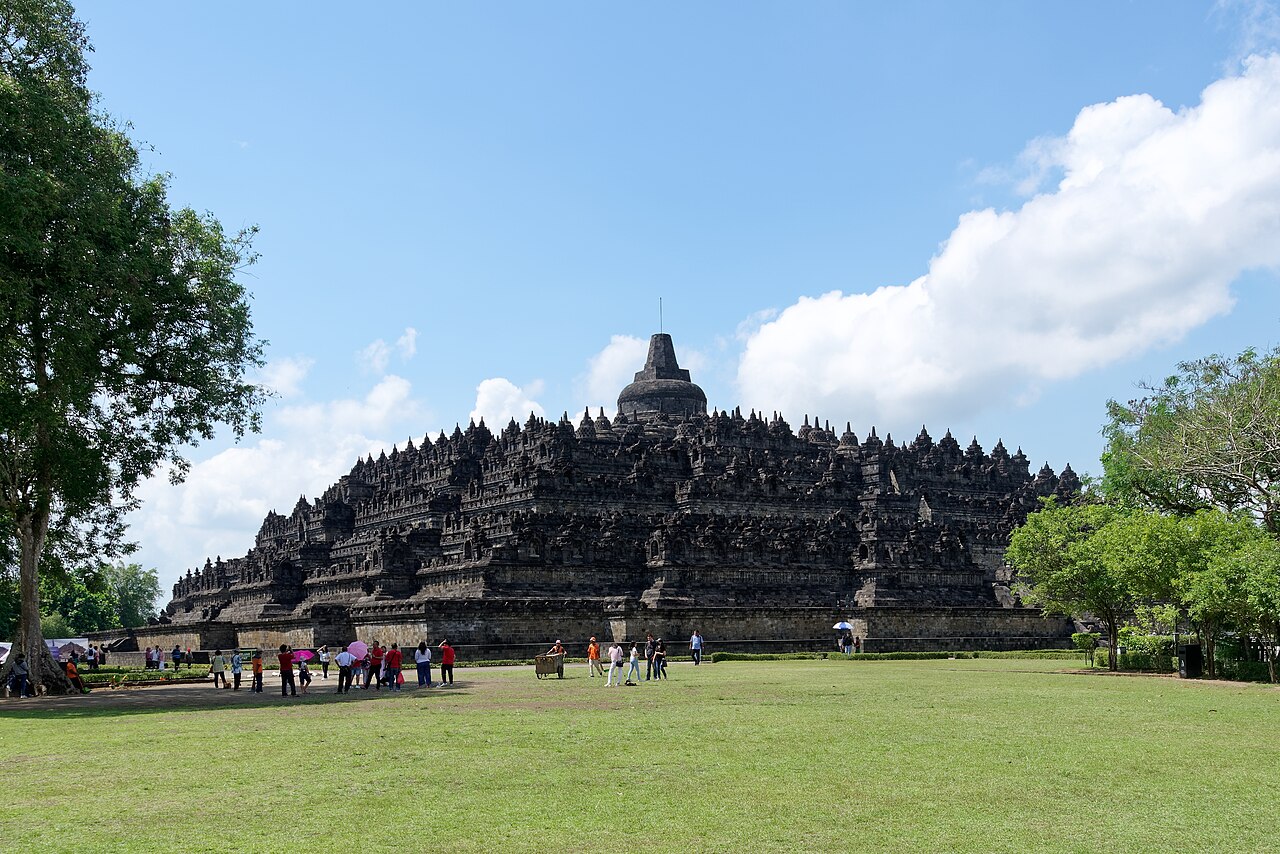
The largest Buddhist temple in the world, built in the 9th century about 40 km northwest of Yogyakarta. Nine stacked platforms rise to a central dome, surrounded by 72 Buddha statues sitting inside stone stupas. Pilgrims walk upwards past 2,672 carved panels. It was listed by UNESCO in 1991.
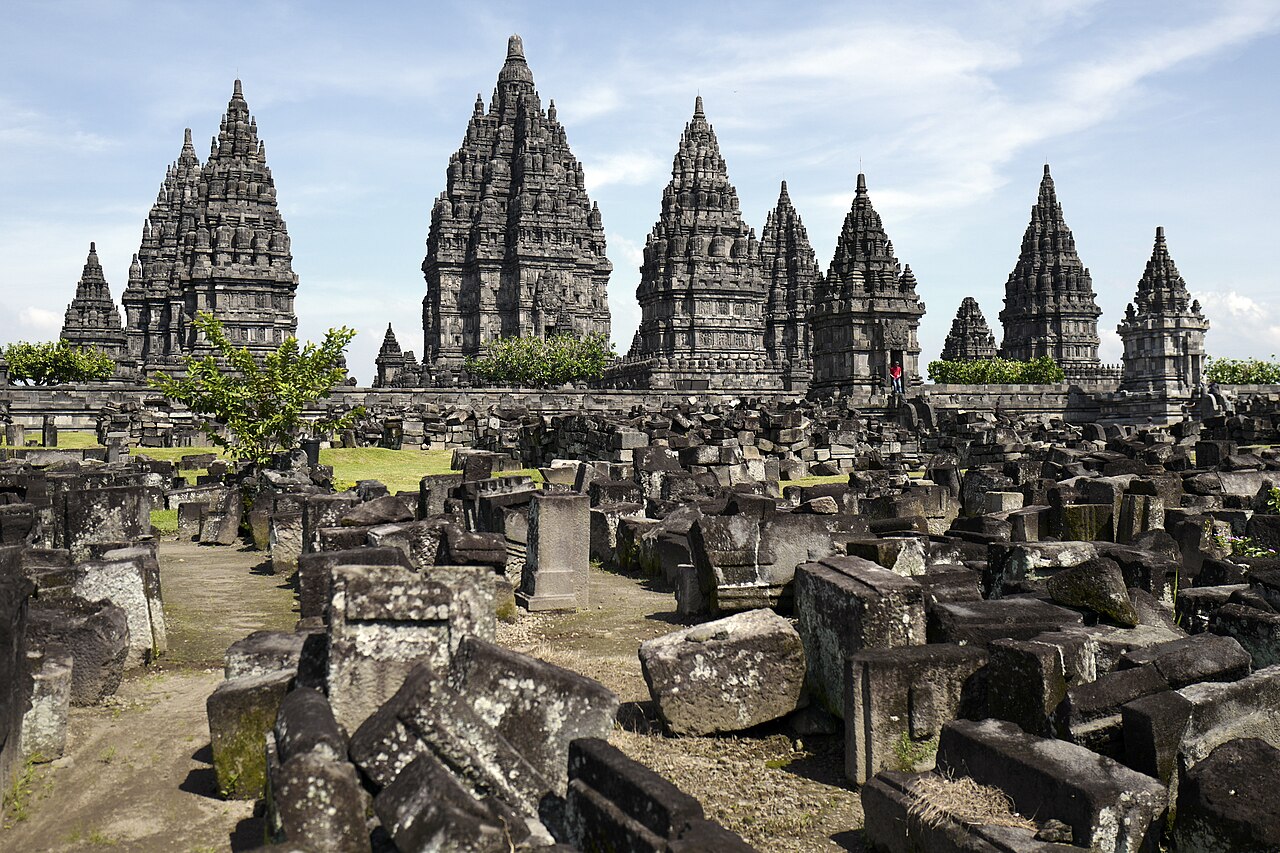
The largest Hindu temple site in Indonesia, about 17 km northeast of Yogyakarta, dedicated in 856 to Shiva, Brahma and Vishnu. The tall, pointed central tower is 47 m high, and on many evenings the Ramayana ballet is performed on an open-air stage nearby. It was listed by UNESCO in 1991.
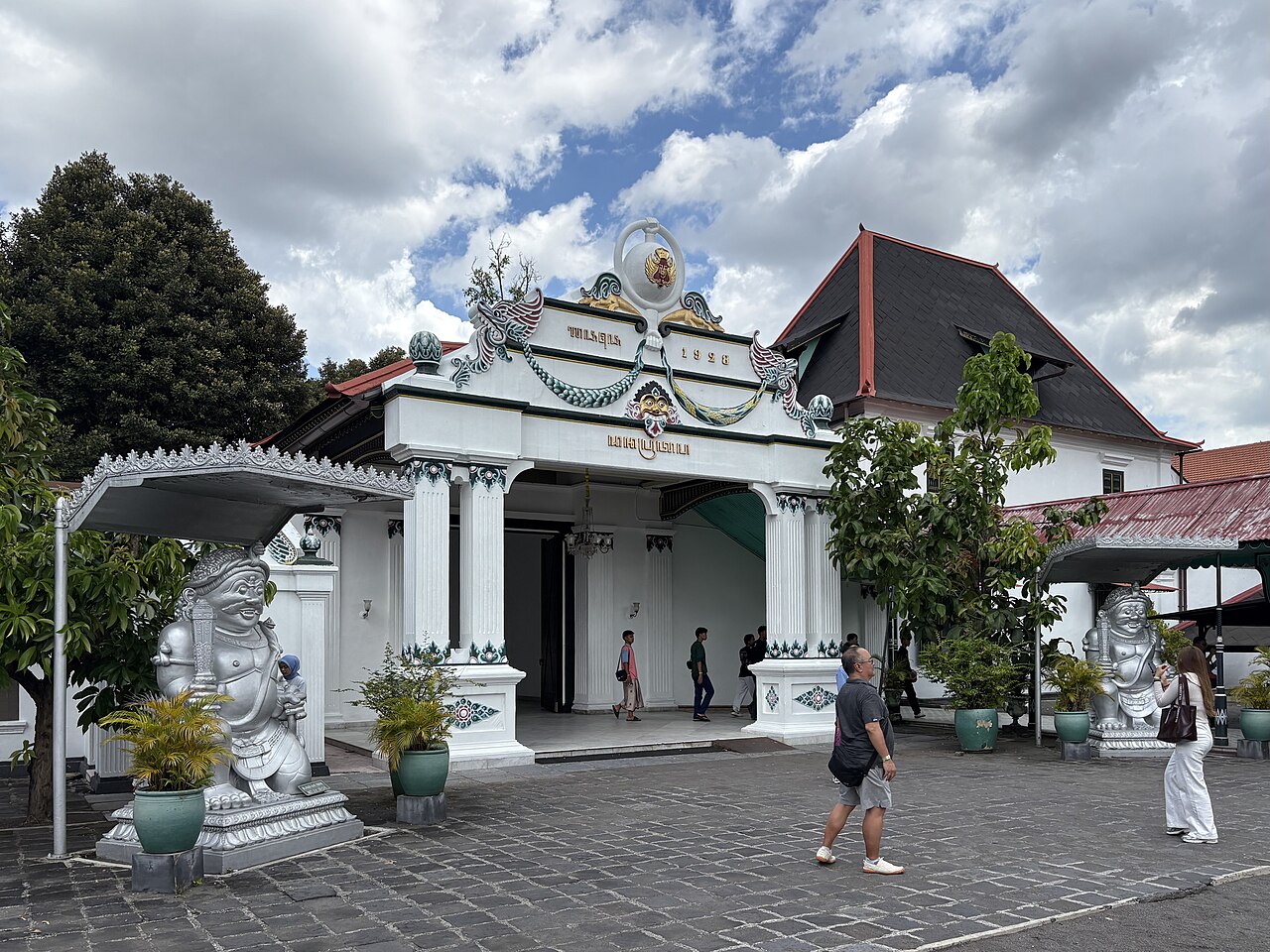
The palace of the Sultans of Yogyakarta, built in 1755 to 1756 for the first sultan, Hamengkubuwono I. The reigning sultan still lives here, and parts of the palace are a museum of royal treasures, with gamelan and dance performances. It is part of the UNESCO site 'The Cosmological Axis of Yogyakarta', listed in 2023.
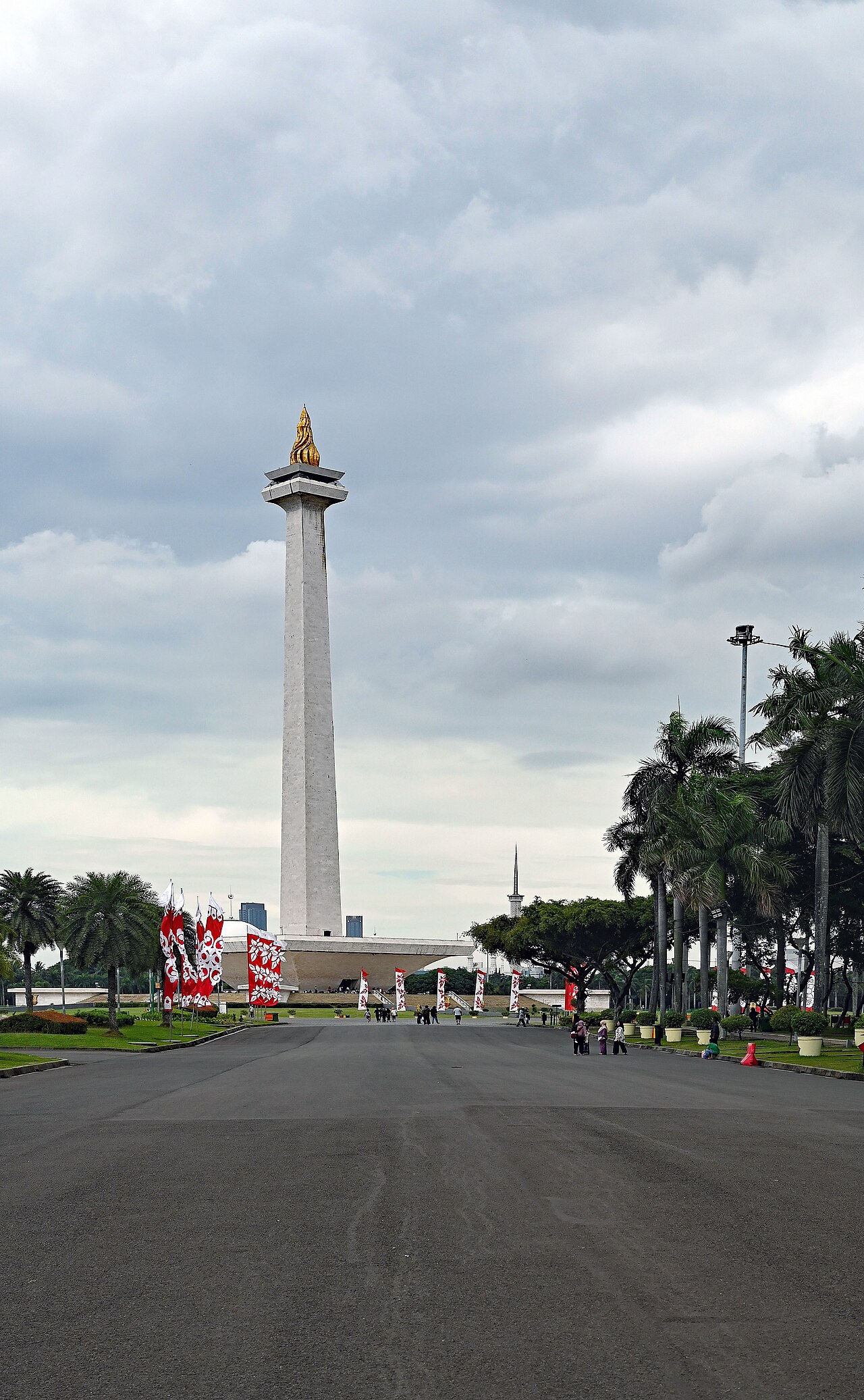
A 132 m tall obelisk in the middle of Merdeka (Freedom) Square, built to remember the struggle for independence. It is topped by a flame covered in gold leaf, and a lift takes visitors up to a viewing platform. Work began under President Sukarno in 1961, and it opened in 1975.
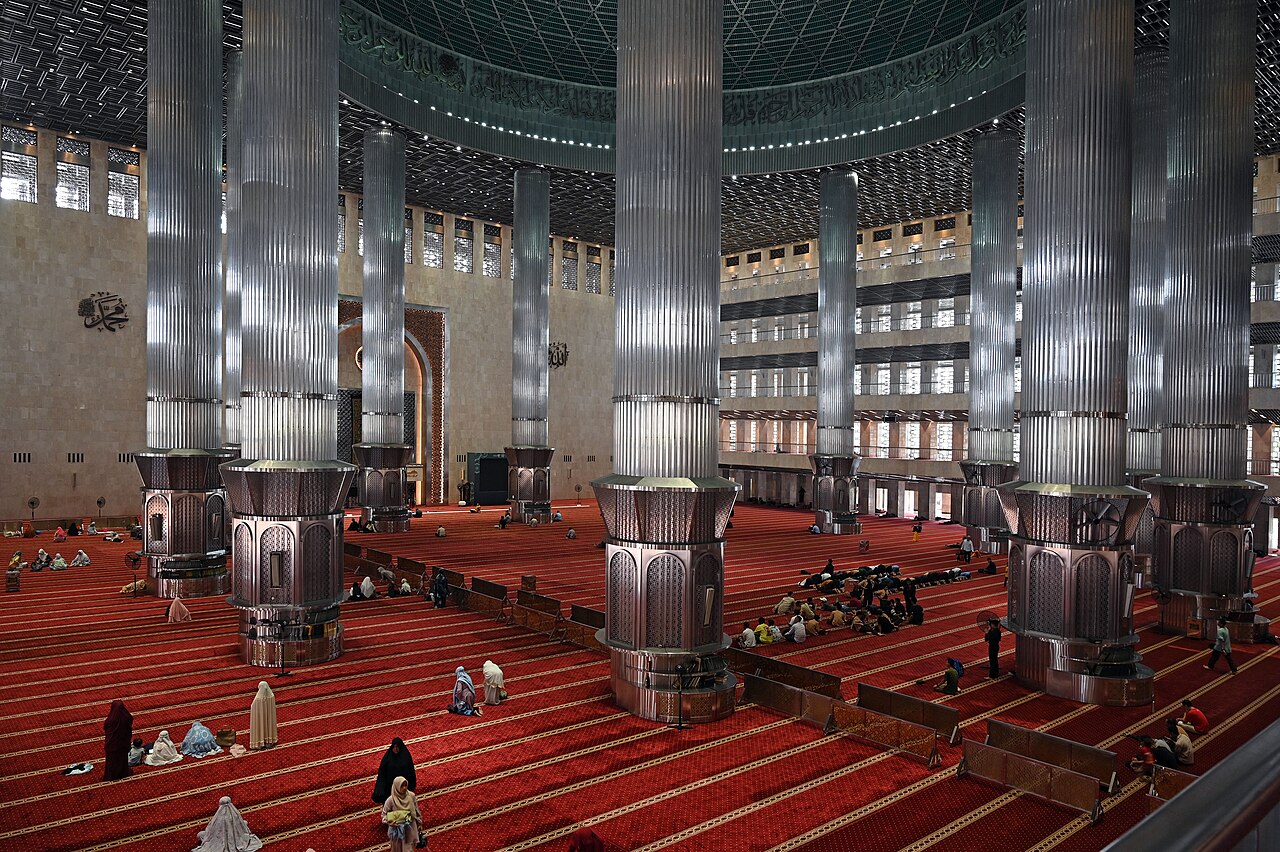
The national mosque of Indonesia and the largest in Southeast Asia, opened in 1978. Istiqlal is Arabic for 'independence'. It stands across the road from Jakarta's Catholic cathedral, and its architect, Friedrich Silaban, was a Christian, the son of a Lutheran pastor.
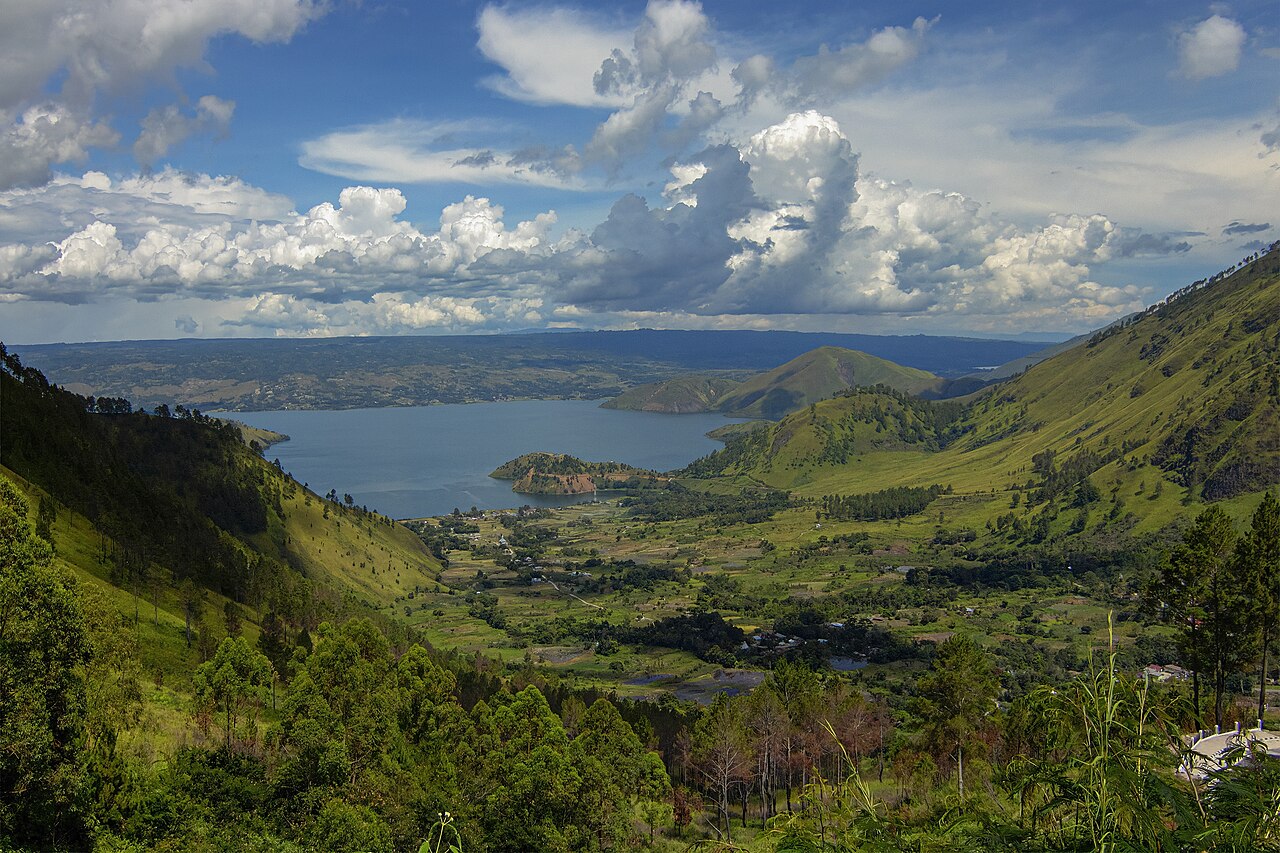
The largest lake in Indonesia and the largest volcanic lake in the world, about 100 km long, filling the crater of a supervolcano that erupted about 74,000 years ago. In the middle lies Samosir Island, home to Batak villages with boat-shaped roofs. The pin marks Medan, the nearest big city, about 170 km to the north by road (four to five hours).
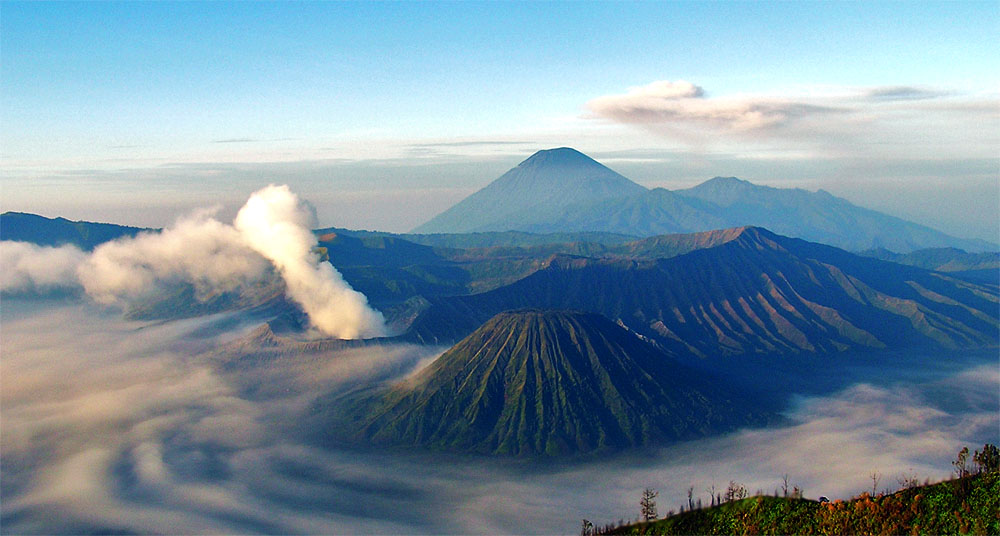
An active volcano, 2,329 m high, rising from a wide plain of volcanic sand called the Sea of Sand. Many visitors come before dawn to watch the sunrise from the nearby viewpoint of Mount Penanjakan. Its name comes from Brahma, the Hindu god of creation, and it is a Hindu pilgrimage site, with a statue of Ganesha at the crater's edge.
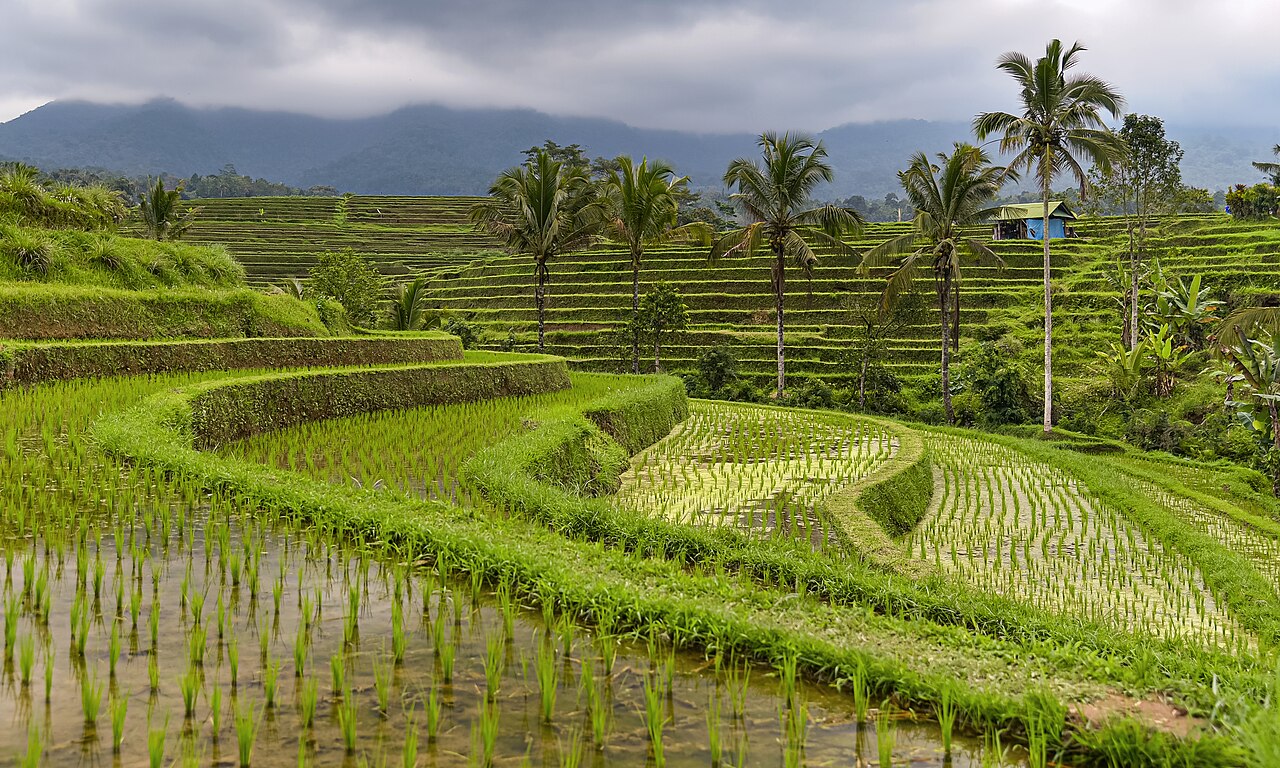
Green rice terraces on the slopes of Mount Batukaru in central Bali, watered by subak, a system of canals and water temples run by farmers together since about the 9th century. They are part of the UNESCO site 'Cultural Landscape of Bali Province: the Subak System', listed in 2012.
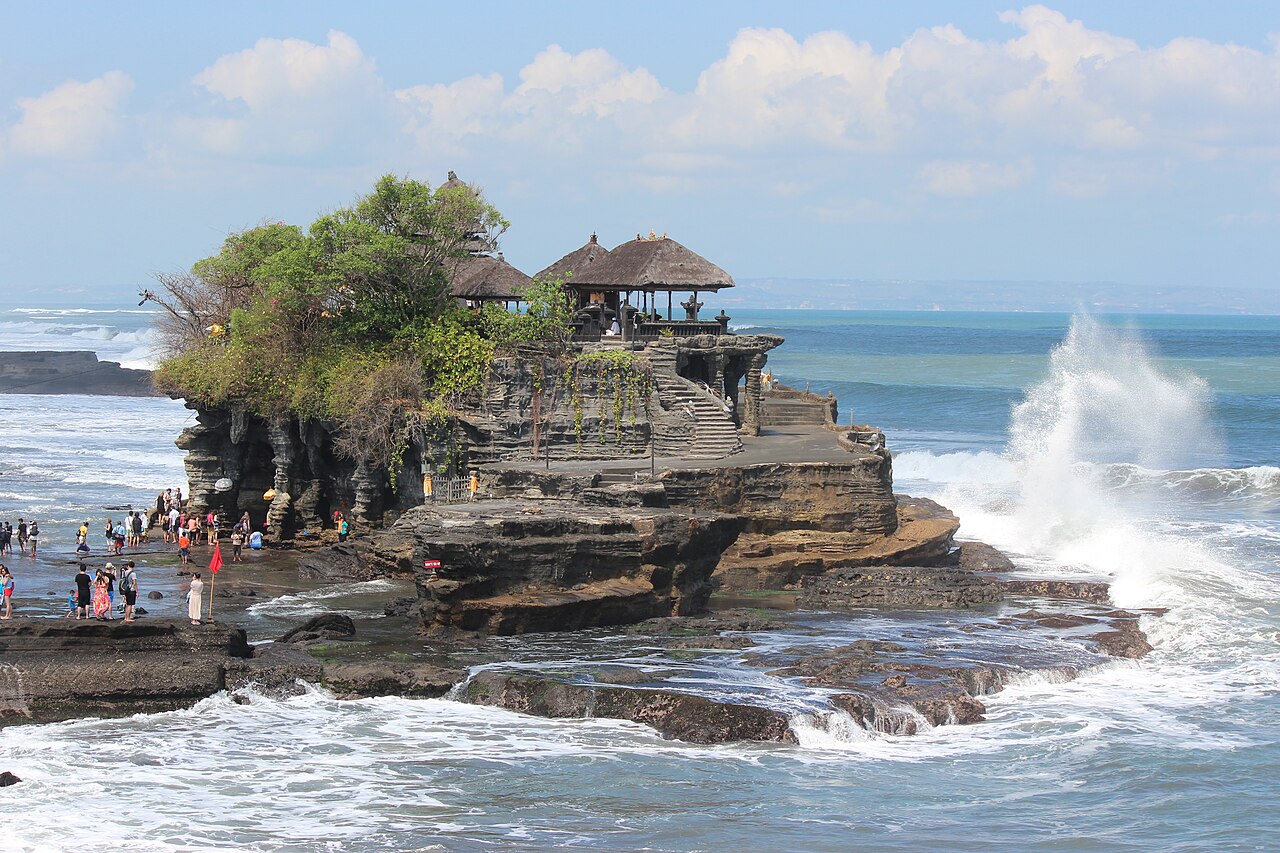
A Hindu sea temple on a rock just off the southwest coast of Bali, about 20 km northwest of Denpasar. You can walk to the rock only at low tide. The name means 'land in the sea', and it is one of the most visited places in Indonesia.
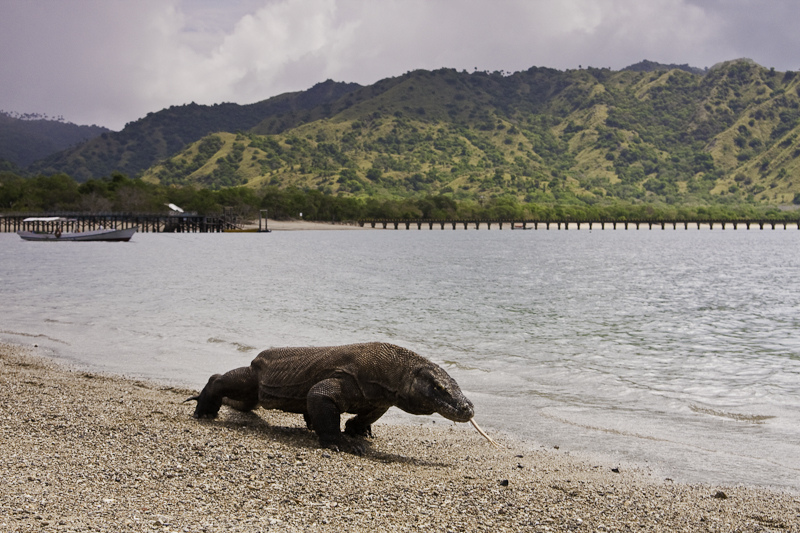
A group of dry, hilly islands, including Komodo, Rinca and Padar, and the seas around them, protected since 1980 for the Komodo dragon, the world's largest lizard. The waters are rich in coral and manta rays. It was listed by UNESCO in 1991.
Indonesia's official count found 17,380 named islands in 2024, up from 17,374 in 2023, as surveyors keep finding and naming more. The usual round figure is about 17,000.
02
Java is the most populous island in the world. As of the latest estimates it is home to about 159 million people, more than half of all Indonesians, on only 7 percent of the country's land.
03
More than 700 languages are spoken in Indonesia, about a tenth of all the languages in the world. The one most people speak at home is Javanese, but everyone learns Indonesian at school.
04
The Komodo dragon, found only on a few Indonesian islands, is the largest living lizard. Males can grow to about 3 m long, and wild adults usually weigh around 70 kg.
05
Rafflesia, which grows in the rainforests of Sumatra and Borneo, has some of the largest single flowers on Earth, often about 1 m across. It smells of rotting meat, which is why it is also called the corpse flower.
06
The national motto, Bhinneka Tunggal Ika, means 'unity in diversity'. It comes from a poem written in Old Javanese in the 14th century, in the time of Majapahit.
07
In 1815 Mount Tambora, on the island of Sumbawa, erupted in the largest eruption in recorded history. Its ash cooled the whole planet, and 1816 became known in Europe and North America as the 'Year Without a Summer'.
08
The third blast of Krakatoa, on 27 August 1883, is thought to be the loudest sound in recorded history. It was heard on the island of Rodrigues near Mauritius, about 4,800 km away.
09
Indonesia has more Muslims than any other country. About 87 percent of Indonesians are Muslim, but Bali is mostly Hindu, and there are large Christian communities in places such as North Sulawesi.
10
Wild orangutans live only on two islands: Sumatra, and Borneo, which Indonesia shares with Malaysia and Brunei.
11
Indonesia is the country that straddles the greatest length of the equator, counting both land and sea.
12
UNESCO recognised Indonesian batik, the art of dyeing cloth with wax patterns, in October 2009. Since then Indonesia has celebrated National Batik Day every year on 2 October.
13
Borobudur's carvings of farmers show that rice has been grown on Java for well over a thousand years. Rice is still the heart of almost every meal: 'nasi' means cooked rice.
Give and receive money, food and gifts with your right hand, and eat with it too. The left hand is traditionally used for washing and is seen as unclean.
Dress modestly at mosques and temples
Cover your shoulders and knees at mosques and temples and take off your shoes before going in. At Balinese temples visitors wear a sarong and a sash around the waist; they can usually be borrowed or rented at the entrance.
Count the zeros
Prices in rupiah have many zeros, and the largest banknote is 100,000 rupiah. Check each note carefully when you pay, and keep small notes for taxis, markets and street food.
Drink bottled water
Tap water is generally not safe to drink. Drink bottled or boiled water, and be careful with ice from street stalls. Many hotels give guests free bottled water.
Plan around Ramadan and Nyepi
During the fasting month of Ramadan many restaurants close in daytime, and at its end, around the Lebaran holiday, millions travel home and trains, flights and roads are packed. In Bali, on Nyepi, the Hindu Day of Silence in March or April, the whole island shuts down for a day: even the airport closes, and visitors must stay in their hotels.
Pay Bali's tourist levy
Since 14 February 2024, foreign visitors to Bali have had to pay a tourist levy of 150,000 rupiah (as of 2026). Pay it online before your trip on the official Love Bali website or app.
Tipping and bargaining
Tipping is not required in Indonesia, though small tips are welcome in tourist areas of Java and Bali. Many restaurants add government tax and a service charge, marked '++' on the menu. In markets and small shops without price tags, friendly bargaining is normal.
Know the emergency numbers
In Indonesia, dial 110 for the police, 118 or 119 for an ambulance and 113 for the fire brigade. From a mobile phone you can also dial 112. Operators may not speak English, so ask hotel staff to help if you can.

 Timor-Leste
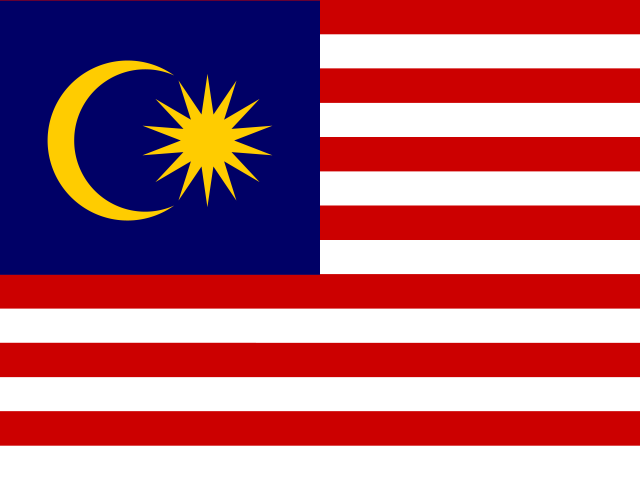 Malaysia
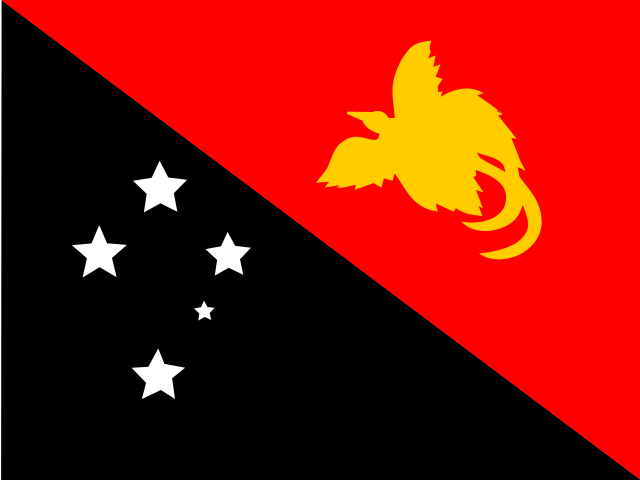 Papua New Guinea