Cuba trivia: 47 questions and answers
History
In which year did Christopher Columbus first reach Cuba?
- A. 1492
- B. 1511
- C. 1519
- D. 1588
Show the answer
1492. Columbus sighted Cuba on 27 October 1492, during his first voyage, and landed the next day. Baracoa was founded in 1511 and Havana moved to its present site in 1519.
Which town, founded in 1511, was the first Spanish settlement in Cuba?
- A. Baracoa
- B. Havana
- C. Trinidad
- D. Cienfuegos
Show the answer
Baracoa. Baracoa, near the eastern tip of the island, was founded by Diego Velázquez de Cuéllar in 1511 and was Cuba's first capital. Trinidad followed in 1514, Havana moved to its bay in 1519 and Cienfuegos was founded in 1819.
Which poet and writer, killed in battle in 1895, is honoured as Cuba's national hero?
- A. José Martí
- B. Carlos Manuel de Céspedes
- C. Ignacio Agramonte
- D. Fulgencio Batista
Show the answer
José Martí. José Martí organised the 1895 war of independence from exile and was killed at Dos Ríos on 19 May 1895. Céspedes and Agramonte were leaders of the earlier Ten Years' War, and Batista was the president overthrown in 1959.
The Cuban Missile Crisis of October 1962 was a stand-off between the United States and which other power?
- A. The Soviet Union
- B. China
- C. The United Kingdom
- D. Spain
Show the answer
The Soviet Union. The Soviet Union had placed nuclear missiles in Cuba. After 13 tense days, it agreed to remove them in exchange for a US promise not to invade Cuba.
The American warship USS Maine exploded and sank in Havana harbour in February 1898.
True or false?
Show the answer
True. True. The Maine sank on 15 February 1898. The cause is still debated, but the event helped lead to the Spanish–American War that April.
Cuba became an independent republic in 1868.
True or false?
Show the answer
False. False. In 1868 Carlos Manuel de Céspedes proclaimed independence and began the Ten Years' War, but Spain kept Cuba. The Republic of Cuba was founded on 20 May 1902.
The Bay of Pigs invasion by Cuban exiles in April 1961 was defeated within a few days.
True or false?
Show the answer
True. True. About 1,400 exiles, trained and funded by the US government, landed on 17 April 1961. Cuban troops and militias defeated them by 19 April.
Food and drink
What does the name of the Cuban dish 'ropa vieja' mean?
- A. Old clothes
- B. Fried cow
- C. Moors and Christians
- D. Rice with chicken
Show the answer
Old clothes. Ropa vieja means 'old clothes', perhaps because the shredded beef looks like rags. Fried cow is vaca frita, Moors and Christians is moros y cristianos, and rice with chicken is arroz con pollo.
In the dish moros y cristianos, what do the 'moros' (Moors) stand for?
- A. Black beans
- B. White rice
- C. Roast pork
- D. Fried plantains
Show the answer
Black beans. The Moors are the black beans and the Christians are the white rice, cooked together in one pot.
Tostones, a favourite Cuban side dish, are made from which ingredient?
- A. Green plantains
- B. Ripe mangoes
- C. Sweet potatoes
- D. Corn dough
Show the answer
Green plantains. Tostones are slices of green plantains, fried, flattened and fried again until crisp. In Cuba they are also called chatinos or tachinos.
Which cocktail shares its name with a beach and an old iron mine near Santiago de Cuba?
- A. Daiquiri
- B. Mojito
- C. Cuba libre
- D. Piña colada
Show the answer
Daiquiri. Daiquirí is a beach and former iron mine near Santiago de Cuba. The daiquiri is usually credited to an American mining engineer who worked there around 1898.
Which herb goes into a mojito, along with rum, lime and sugar?
- A. Mint
- B. Basil
- C. Coriander
- D. Oregano
Show the answer
Mint. A mojito is made with mint. In Cuba it is usually a local kind called yerba buena, with a light, citrus-like scent.
In a traditional Cuban meal, the dishes come to the table together rather than in separate courses.
True or false?
Show the answer
True. True. A traditional Cuban meal is not served in courses: rice, beans, meat and plantains arrive at the same time.
Havana is considered the birthplace of the mojito.
True or false?
Show the answer
True. True. Havana is the mojito's home city, although exactly how the drink was invented is still debated.
Cities
Which Cuban city is nicknamed the 'Pearl of the South'?
- A. Cienfuegos
- B. Matanzas
- C. Varadero
- D. Pinar del Río
Show the answer
Cienfuegos. Cienfuegos, a port on the south coast founded in 1819, is called La Perla del Sur, the Pearl of the South. Matanzas, Varadero and Pinar del Río are in the north and west.
Which city is called the 'City of Bridges' and the 'Athens of Cuba'?
- A. Matanzas
- B. Camagüey
- C. Santa Clara
- D. Baracoa
Show the answer
Matanzas. Matanzas has seventeen bridges over three rivers, and its poets earned it the name Athens of Cuba.
What is Cuba's second-largest city?
- A. Santiago de Cuba
- B. Camagüey
- C. Santa Clara
- D. Trinidad
Show the answer
Santiago de Cuba. Santiago de Cuba is the second-largest city after Havana. Camagüey is third, Santa Clara fifth, and Trinidad is a small colonial town.
Camagüey was rebuilt with winding, maze-like streets to make it hard for attackers to find their way.
True or false?
Show the answer
True. True. After the pirate Henry Morgan burned the city in the 1600s, it was redesigned like a maze. Its old town has been a UNESCO World Heritage Site since 2008.
Landmarks
Which fortress guards the entrance to Havana harbour?
- A. Castillo de los Tres Reyes del Morro
- B. Castillo de San Pedro de la Roca
- C. Basilica of El Cobre
- D. Che Guevara Mausoleum
Show the answer
Castillo de los Tres Reyes del Morro. The Castillo de los Tres Reyes del Morro, begun in 1589, stands across the harbour mouth from Old Havana. San Pedro de la Roca guards Santiago Bay, El Cobre is a church and the mausoleum is in Santa Clara.
UNESCO listed the Viñales Valley partly for its traditional way of growing which crop?
- A. Tobacco
- B. Coffee
- C. Rice
- D. Bananas
Show the answer
Tobacco. Farmers in the Viñales Valley still grow tobacco by hand using methods centuries old, and UNESCO listed it as a cultural landscape in 1999.
What are the steep limestone hills that rise from the floor of the Viñales Valley called?
- A. Mogotes
- B. Cenotes
- C. Tepuis
- D. Mesas
Show the answer
Mogotes. The rounded limestone hills are called mogotes and can be up to 300 m tall. Cenotes are water-filled sinkholes, tepuis are table mountains in South America, and mesas are flat-topped hills.
Alejandro de Humboldt National Park is named after a scientist from which country?
- A. Germany
- B. France
- C. Spain
- D. Sweden
Show the answer
Germany. Germany. The park is named after the German scientist Alexander von Humboldt, who visited Cuba in 1800 and 1801.
As of 2026, how many places in Cuba are on UNESCO's World Heritage List?
- A. 9
- B. 5
- C. 13
- D. 17
Show the answer
9. As of 2026 Cuba has 9 World Heritage Sites, including Old Havana, Trinidad and the Valle de los Ingenios, the Viñales Valley and Alejandro de Humboldt National Park.
The Malecón is a seawall and seafront road that runs for about 8 km along the coast of Havana.
True or false?
Show the answer
True. True. The Malecón runs for 8 km from the harbour mouth to the Almendares River. Building began in 1901.
The Valle de los Ingenios near Trinidad was a centre of coffee growing.
True or false?
Show the answer
False. False. The name means 'Valley of the Sugar Mills'. In the 1700s and 1800s it had over fifty sugar mills, worked by enslaved people.
Fun facts
The bee hummingbird, native to Cuba, holds which record?
- A. It is the smallest known bird
- B. It is the fastest-flying bird
- C. It is the longest-living bird
- D. It is the loudest bird
Show the answer
It is the smallest known bird. It is the smallest known bird: the bee hummingbird, or zunzuncito, is only about 5 to 6 cm long.
Which bird, whose feathers match the colours of the flag, is Cuba's national bird?
- A. The Cuban trogon (tocororo)
- B. The bee hummingbird
- C. The American flamingo
- D. The brown pelican
Show the answer
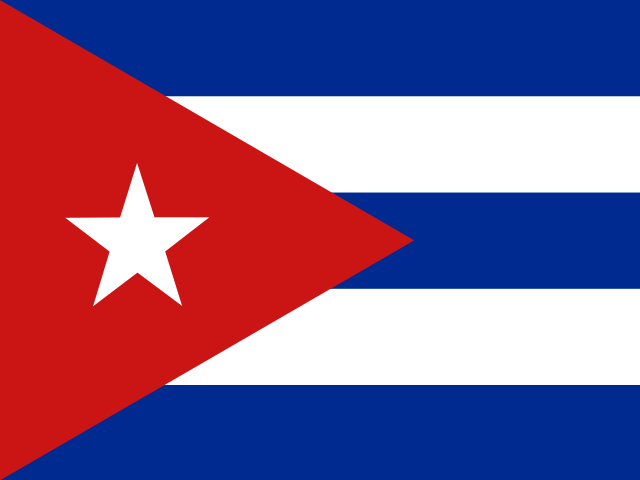
The Cuban trogon (tocororo). The Cuban trogon (tocororo), found only in Cuba, is the national bird. Its red, white and blue feathers match the Cuban flag.
Which sport is the most popular in Cuba?
- A. Baseball
- B. Football (soccer)
- C. Boxing
- D. Basketball
Show the answer
Baseball. Baseball is Cuba's most popular sport, followed by football. It has been the most played sport on the island since the 1870s.
Isla de la Juventud, Cuba's second-largest island, was known until 1978 by which name?
- A. Isle of Pines
- B. Hispaniola
- C. Isla Mujeres
- D. Cayman Brac
Show the answer
Isle of Pines. It was called the Isle of Pines (Isla de Pinos) until 1978. Hispaniola, Isla Mujeres and Cayman Brac are islands belonging to other countries.
In 2015 the World Health Organization confirmed that Cuba had eliminated mother-to-child transmission of HIV and which other disease?
- A. Syphilis
- B. Malaria
- C. Measles
- D. Polio
Show the answer
Syphilis. In 2015 Cuba became the first country validated by the WHO for eliminating mother-to-child transmission of both HIV and syphilis.
Snow has been officially recorded on Pico Turquino, the highest mountain in Cuba.
True or false?
Show the answer
True. True. Pico Turquino is the only place in Cuba where snowfall has been officially recorded. It last fell in February 1900.
The writer Ernest Hemingway lived for years at Finca Vigía, a farm near Havana.
True or false?
Show the answer
True. True. Hemingway lived at Finca Vigía, about 24 km from Havana, for much of the 1940s and 1950s.
Cuba's main island is one of the smallest islands in the Caribbean.
True or false?
Show the answer
False. False. The main island, about 1,250 km long, is the largest island in the Caribbean and the 17th-largest in the world.
Words
In Cuba, what is a 'guagua'?
- A. A bus
- B. A bicycle
- C. A cigar
- D. A market stall
Show the answer
A bus. In Cuba a guagua is a bus. The word came from the Canary Islands and is said to imitate the sound of a horn.
In Cuba, what is a 'paladar'?
- A. A privately run restaurant
- B. A sugar mill
- C. A seaside road
- D. A bus station
Show the answer
A privately run restaurant. A paladar is a privately run restaurant, often run by a family. They were first allowed in the 1990s and became much more common after 2010.
What does the Cuban word 'chévere' mean?
- A. Great, wonderful
- B. Expensive
- C. Tomorrow
- D. Very spicy
Show the answer
Great, wonderful. Chévere means great, wonderful. It is one of several Cuban words of African origin.
In informal Cuban Spanish, 'asere' means 'friend'.
True or false?
Show the answer
True. True. Asere is an informal word for friend or mate, of African origin.
Phrases
How do you say 'Good afternoon' in Spanish?
- A. Buenas tardes
- B. Buenos días
- C. Buenas noches
- D. Mucho gusto
Show the answer
Buenas tardes. Buenas tardes is used from about noon until dark. Buenos días is good morning, buenas noches is good evening, and mucho gusto means pleased to meet you.
What does '¿Cuánto cuesta?' mean?
- A. How much does it cost?
- B. Where is it?
- C. Do you speak English?
- D. Is it far?
Show the answer
How much does it cost?. ¿Cuánto cuesta? means How much does it cost? It is useful at markets and stalls.
Which phrase do you use to ask for the bill at the end of a meal?
- A. La cuenta, por favor
- B. Con permiso
- C. ¡Buen provecho!
- D. Mucho gusto
Show the answer
La cuenta, por favor. La cuenta, por favor means The bill, please. ¡Buen provecho! wishes someone a good meal, and con permiso is used to squeeze past people.
Many Cubans soften or drop the 's' at the end of a syllable, so 'estar' can sound like 'etar'.
True or false?
Show the answer
True. True. Like other Caribbean Spanish speakers, many Cubans turn a final 's' into a soft 'h' sound or drop it, which is why Cuban Spanish can sound fast to learners.
Local customs and tips
According to UK travel advice as of September 2026, where may visitors legally exchange money in Cuba?
- A. At official Cadeca exchange houses
- B. With private individuals in the street
- C. With taxi drivers
- D. At the market stalls
Show the answer
At official Cadeca exchange houses. Money may be exchanged only at official Cadeca exchange houses. Exchanging it anywhere else is illegal and can lead to a fine or prison.
What is the official emergency number for the police in Cuba?
- A. 106
- B. 104
- C. 105
Show the answer
106. The police number is 106. In Cuba 104 is for an ambulance and 105 for the fire service.
How soon before arriving must travellers fill in Cuba's online D'Viajeros arrival form?
- A. Within 72 hours
- B. Within 30 days
- C. Within 6 months
- D. After landing, at passport control
Show the answer
Within 72 hours. The D'Viajeros form must be completed within 72 hours before you enter Cuba. It gives you a QR code to show on arrival.
As of September 2026, UK travel advice says international cards such as Visa and Mastercard are no longer accepted in Cuba.
True or false?
Show the answer
True. True. Since 6 June 2026 international cards are no longer accepted, so visitors are advised to bring enough cash, such as US dollars or euros, for their whole stay.
UK travel advice says you can buy Cuban pesos at banks at home before you travel.
True or false?
Show the answer
False. False. The Cuban peso cannot be exchanged outside Cuba. Visitors bring US dollars or euros and change them at Cadeca exchange houses.
The hurricane season in Cuba runs from June to November.
True or false?
Show the answer
True. True. Hurricanes can strike from June to November, bringing floods and cutting power, water and flights.
Answer key
History
- A. 1492
- A. Baracoa
- A. José Martí
- A. The Soviet Union
- True
- False
- True
Food and drink
- A. Old clothes
- A. Black beans
- A. Green plantains
- A. Daiquiri
- A. Mint
- True
- True
Cities
- A. Cienfuegos
- A. Matanzas
- A. Santiago de Cuba
- True
Landmarks
- A. Castillo de los Tres Reyes del Morro
- A. Tobacco
- A. Mogotes
- A. Germany
- A. 9
- True
- False
Fun facts
- A. It is the smallest known bird
- A. The Cuban trogon (tocororo)
- A. Baseball
- A. Isle of Pines
- A. Syphilis
- True
- True
- False
Words
- A. A bus
- A. A privately run restaurant
- A. Great, wonderful
- True
Phrases
- A. Buenas tardes
- A. How much does it cost?
- A. La cuenta, por favor
- True
Local customs and tips
- A. At official Cadeca exchange houses
- A. 106
- A. Within 72 hours
- True
- False
- True
More about Cuba
- The trip to CubaMap, story, food, phrases and a friendly quiz.
- Cuba word searchCities and dishes in large print.
- Cuban words crosswordLearn a few words while you solve it.
- Colour the flag of CubaPrint it or colour it in on the screen.
- Cuban rootsA family guide: history, recipes and words for the grandchildren.
- Before you goPhrases, customs and tips for travellers.
- Printable packLarge print, with a quiz and answers.