World Stroll
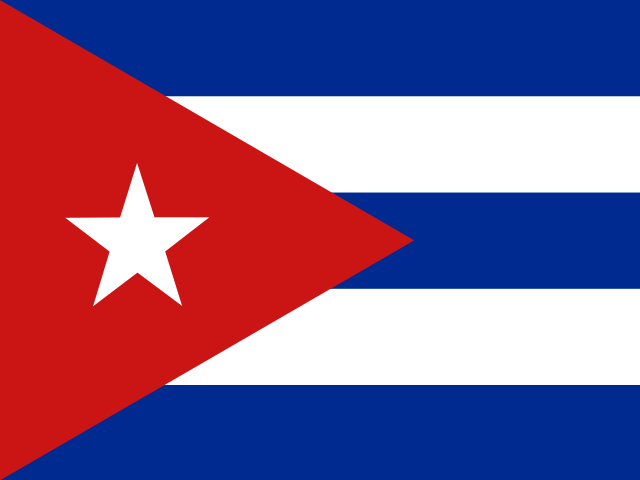
Flag of Cuba
Travel guide

Learn Cuba before you go

Colonial squares, old sea forts, tobacco valleys, rumba and son, and the largest island in the Caribbean.
Take the full trip
CapitalHavana
CurrencyCuban peso (CUP). The Cuban convertible peso (CUC) was withdrawn in 2021
Official languageSpanish
Drives on theRight
Calling code+53

10 phrases to learn

In Spanish (Cuban). Capital letters show the stressed part. Tap the heart to practise a phrase later.

Buenos días
BWEH-nohs DEE-ahs
Good morning, hello
Greeting someone in the morning, until about noon
Buenas tardes
BWEH-nahs TAR-dehs
Good afternoon
Greeting someone from about noon until it gets dark
Buenas noches
BWEH-nahs NOH-chehs
Good evening, good night
Greeting someone after dark, or saying goodnight
¿Cómo está?
KOH-moh ehs-TAH (in Cuba often KOH-moh eh-TAH)
How are you? (polite)
Asking an older person or a stranger how they are
Mucho gusto
MOO-choh GOOS-toh
Pleased to meet you
When you are introduced to someone
Por favor
por fah-VOR
Please
Whenever you ask for something
Muchas gracias
MOO-chahs GRAH-syahs
Thank you very much
Thanking someone warmly
Con permiso
kohn per-MEE-soh
Excuse me, may I pass?
Squeezing past people or leaving the table
Disculpe
dees-KOOL-peh
Excuse me, sorry
Getting someone's attention or apologising
¿Habla inglés?
AH-blah een-GLEHS
Do you speak English?
Before asking for help

At the table

  • A traditional meal is not served in courses: rice, beans, meat and plantains all come to the table at the same time.
  • Rice and black beans are part of almost every lunch and dinner, either cooked together as moros or served side by side.
  • Private family-run restaurants are called paladares. They were first allowed in the 1990s, grew in number after reforms in 2010, and are popular with visitors.
  • Sharing a small, very sweet coffee is an everyday social ritual. For breakfast, café con leche comes with buttered toasted bread.
  • Food is rationed and many ingredients are scarce, so a dish on the menu may not be available. Be patient and understanding if a restaurant has run out.

Local tips

Check the travel advice first

As of September 2026, the UK government advises against all but essential travel to Cuba. Fuel shortages have caused repeated failures of the power grid, cancelled flights and cuts to transport, medical care and communications. Check your own government's advice and your insurance before you book.

Bring enough cash for the whole trip

Since 6 June 2026, international cards such as Visa and Mastercard are no longer accepted in Cuba, and cash machines will probably not work with a foreign card. Bring enough US dollars or euros in cash for your whole stay and for emergencies, keep it safe, and ask your hotel how to pay in advance.

Change money only at a Cadeca

The Cuban peso cannot be bought outside Cuba. Change money only at official Cadeca exchange houses: exchanging money anywhere else, including with people in the street, is illegal and can lead to a fine or prison. Declare foreign cash worth more than 5,000 US dollars when you arrive.

Sort out your visa and arrival form

Tourists need a tourist card or an electronic visa before travelling. Within 72 hours before you arrive, fill in the online D'Viajeros form, then print or download the QR code, as wifi may not be available on arrival. Your passport must be valid for at least 6 months after the date you arrive and 3 months after you leave.

Pack all your medicines

There are severe shortages of basic medicines in Cuba, and many pharmacy items are not available. Bring everything you need for the whole trip, with a letter from your doctor, and make sure your insurance covers treatment and medical evacuation. Treatment must be paid for in foreign currency before it is given.

Protect yourself from mosquitoes

Dengue, chikungunya and Oropouche fever are spread by mosquitoes in Cuba. Use insect repellent and cover your arms and legs, during the day as well as at dusk.

Use official yellow taxis

At the airport and in Old Havana, some people pose as taxi drivers or guides. Use registered yellow taxis or your tour operator's transport, and avoid the three-wheeled coco-taxis, which may be unsafe. In an emergency, call 104 for an ambulance, 105 for the fire service and 106 for the police.

Watch the hurricane season

The hurricane season runs from June to November. Storms can cause floods and cut power, water and flights. As of 2026, parts of eastern Cuba are still recovering from Hurricane Melissa of October 2025.

Dishes to try

  • Ropa vieja: Beef slow-cooked until it falls apart into strands, then simmered with tomato, onion, peppers and garlic. It is one of Cuba's national dishes and is usually served with rice, black beans and fried plantains.
  • Moros y cristianos (Moros): White rice and black beans cooked together in one pot with a base of onion, garlic and peppers, seasoned with cumin, oregano and bay leaf. In the east of the island, a similar dish made with red beans is called congrí.
  • Picadillo: Minced beef cooked with onion, peppers, garlic, cumin, oregano and tomato sauce, with green olives, capers and often raisins. It is served over white rice, or used to fill pastries and stuffed potato balls called papas rellenas.
  • Vaca frita: Flank or skirt steak that is slow-cooked, shredded, then fried until crisp at the edges and topped with soft onions and a squeeze of lime. It is served with rice and black beans.
  • Arroz con pollo: Chicken and rice cooked together in one pot with onion, peppers, garlic and tomato, coloured yellow with saffron or annatto.
  • Tostones (Chatinos or tachinos): Thick slices of green, unripe plantain fried once, flattened, then fried again until crisp and golden. They are salted and eaten like crisps, often dipped in mojo, a garlic and citrus sauce.
  • Frijoles negros: Black beans slowly cooked with onion, garlic, cumin, oregano and a dash of vinegar until thick and velvety. They are served over white rice, or made thinner as black bean soup.
  • Pastelitos de guayaba: Crisp, flaky puff pastries filled with sweet guava paste, sometimes with cream cheese too, and brushed with a sugary glaze. Savoury versions are filled with seasoned minced beef. They are eaten at any time of day, often with a small coffee.

Cities to see

  • Havana (capital): Old Havana and its fortresses, The Malecón seafront, El Capitolio, inspired by the US Capitol.
  • Santiago de Cuba: Castillo de San Pedro de la Roca, The Moncada Barracks, The Basilica of El Cobre nearby.
  • Camagüey: Maze-like old streets, Large clay water jars called tinajones, The Ignacio Agramonte monument.
  • Santa Clara: The Che Guevara Mausoleum, The Armoured Train monument, Its central park.
  • Trinidad: Cobbled streets and the Plaza Mayor, The Valle de los Ingenios, Mansions from the sugar era.
  • Cienfuegos: Its historic centre, The bay and seafront promenade, The Pearl of the South nickname.

Landmarks and the city map are on the Cuba trip