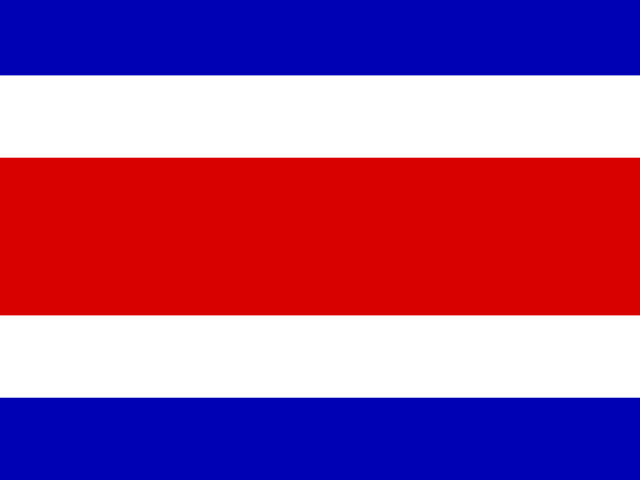
Costa Rica trivia: 47 questions and answers
The country at a glance
What does the Spanish name 'Costa Rica' mean in English?
- A. Rich coast
- B. Green coast
- C. Pure life
- D. Fine harbour
Show the answer
Rich coast. Costa Rica means rich coast. By some accounts the name comes from the gold jewellery Columbus saw local people wearing in 1502. 'Pure life' is 'pura vida', the country's favourite phrase.
Which two countries border Costa Rica by land?
- A. Nicaragua and Panama
- B. Honduras and Panama
- C. Nicaragua and Colombia
- D. Guatemala and Belize
Show the answer
Nicaragua and Panama. Nicaragua and Panama are Costa Rica's only land neighbours: Nicaragua to the north and Panama to the southeast.
History
Which explorer reached Costa Rica's Caribbean coast in 1502, on his fourth voyage?
- A. Christopher Columbus
- B. Hernán Cortés
- C. Francisco Pizarro
- D. Ferdinand Magellan
Show the answer
Christopher Columbus. Christopher Columbus anchored near today's Limón in September 1502, on his fourth and last voyage. Cortés conquered Mexico, Pizarro conquered Peru, and Magellan's expedition sailed around the world.
Which city was Costa Rica's colonial capital before the capital moved to San José in 1823?
- A. Cartago
- B. Alajuela
- C. Heredia
- D. Liberia
Show the answer
Cartago. Cartago, founded in 1563, was the capital until 1823, when the republicans of San José and Alajuela won the Battle of Ochomogo and the capital moved to San José.
Costa Rica won its independence after a long war against Spanish troops.
True or false?
Show the answer
False. False. Costa Rica never had to fight Spain. On 15 September 1821, the authorities in Guatemala declared the independence of all of Central America, and Costa Rica still celebrates that day.
Which young drummer, who died at the Battle of Rivas in 1856, is Costa Rica's national hero?
- A. Juan Santamaría
- B. José Figueres
- C. Juan Vázquez de Coronado
- D. Óscar Arias
Show the answer
Juan Santamaría. Juan Santamaría died on 11 April 1856 setting fire to the stronghold of William Walker's men at Rivas. The country's main airport is named after him.
Costa Rica abolished its army in 1948, after a short civil war.
True or false?
Show the answer
True. True. José Figueres abolished the army on 1 December 1948, and Article 12 of the 1949 constitution abolished it as a permanent institution.
What did President Óscar Arias receive in 1987?
- A. The Nobel Peace Prize
- B. The Nobel Prize in Literature
- C. An Olympic gold medal
- D. An Oscar for a film
Show the answer
The Nobel Peace Prize. Óscar Arias received the Nobel Peace Prize in 1987 for his plan to end the wars in Central America through negotiation.
How was the building of the National Theatre in San José paid for?
- A. With a tax on coffee
- B. With gold from Spanish mines
- C. With a gift from the King of Spain
- D. With money from the Panama Canal
Show the answer
With a tax on coffee. The theatre was paid for with a tax on coffee, the country's main export at the time. It opened on 21 October 1897.
Food and drink
What does 'gallo pinto', the name of Costa Rica's national dish, mean?
- A. Spotted rooster
- B. Married man
- C. Black soup
- D. Little pot
Show the answer
Spotted rooster. Gallo pinto means spotted rooster, from the speckled look of rice and beans fried together. 'Married man' is casado, the lunch plate.
A casado is the classic Costa Rican meal for which time of day?
- A. Lunch
- B. Breakfast
- C. A late-night snack
- D. Christmas Eve only
Show the answer
Lunch. The casado is the traditional lunch: rice and beans side by side with meat or fish, salad and often fried plantain. Gallo pinto is the usual breakfast.
In a casado, the rice and beans are fried together in one pan before serving.
True or false?
Show the answer
False. False. In a casado the rice and beans sit side by side on the plate. Frying them together makes gallo pinto.
The bar snack chifrijo takes its name from which two ingredients?
- A. Chicharrón and frijoles
- B. Chile and fried plantain
- C. Chicken and rice
- D. Cheese and tortillas
Show the answer
Chicharrón and frijoles. Chifrijo takes its name from chicharrón and frijoles: crispy fried pork and beans. It also has rice, a fresh tomato salsa and fried tortilla chips.
The 'rice and beans' of Limón and the Caribbean coast is cooked in what?
- A. Coconut milk
- B. Beer
- C. Black coffee
- D. Orange juice
Show the answer
Coconut milk. Caribbean rice and beans is cooked in coconut milk, usually with red beans, and served with fish and fried plantain.
In Costa Rica, what is a chorreador?
- A. A cloth coffee filter on a wooden stand
- B. A sweet corn pancake
- C. A painted oxcart
- D. A sugar cane spirit
Show the answer
A cloth coffee filter on a wooden stand. A chorreador is a cloth coffee filter on a wooden stand: hot water is poured over the grounds in a small cloth bag and drips into the cup. Be careful: a chorreada, with an a, is a sweet corn pancake.
Which tangy brown sauce, created by a Costa Rican company in 1920, often goes into gallo pinto?
- A. Salsa Lizano
- B. Tabasco
- C. Sriracha
- D. Soy sauce
Show the answer
Salsa Lizano. Salsa Lizano was created in Costa Rica in 1920 and is used in gallo pinto, tamales and much more. Tabasco is from the United States, Sriracha from Thailand, and soy sauce from East Asia.
The lime juice in ceviche cooks the fish completely, so ceviche is as safe as a cooked dish for pregnant women.
True or false?
Show the answer
False. False. Lime changes the taste and texture of the fish, but it is still raw fish. Pregnant women, older people and anyone with a weak immune system should choose a cooked dish.
Cities
Which Costa Rican city is nicknamed 'the white city'?
- A. Liberia
- B. Cartago
- C. Heredia
- D. Puntarenas
Show the answer
Liberia. Liberia is called 'la ciudad blanca', the white city, after the white gravel once used on its roads and its whitewashed colonial houses.
In which city was the national hero Juan Santamaría born?
- A. Alajuela
- B. Heredia
- C. Cartago
- D. Limón
Show the answer
Alajuela. Juan Santamaría was born in Alajuela in 1831. A bronze statue of him stands in the city, and the nearby international airport carries his name.
Landmarks
Which of these places is part of a UNESCO World Heritage Site?
- A. Santa Rosa National Park
- B. Manuel Antonio National Park
- C. Poás Volcano
- D. The National Theatre
Show the answer
Santa Rosa National Park. Santa Rosa National Park is part of the Area de Conservación Guanacaste, a UNESCO World Heritage Site since 1999. Manuel Antonio, Poás and the National Theatre are not on the list.
Which volcano erupted without warning in 1968, destroying the small town of Tabacón?
- A. Arenal
- B. Poás
- C. Irazú
- D. Chirripó
Show the answer
Arenal. Arenal erupted in 1968 and stayed active until 2010. Chirripó is the highest mountain, not an active volcano.
The National Theatre in San José opened in 1897 with a performance of which work?
- A. Faust
- B. Aida
- C. Hamlet
- D. Carmen
Show the answer
Faust. The theatre opened on 21 October 1897 with a performance of Faust.
Laguna Caliente, the lake in the crater of Poás Volcano, is one of the most acidic lakes in the world.
True or false?
Show the answer
True. True. Its pH can fall almost to zero, and only specially adapted bacteria can live in it.
Which is the highest active volcano in Costa Rica, with a road up to its summit craters?
- A. Irazú
- B. Arenal
- C. Poás
- D. Rincón de la Vieja
Show the answer
Irazú. Irazú, at about 3,432 m near Cartago, is the highest active volcano in Costa Rica. On a rare clear day you can see both oceans from the top.
Manuel Antonio is the largest national park in Costa Rica by land area.
True or false?
Show the answer
False. False. Manuel Antonio is one of the smaller parks by land area, but it is one of the most visited national parks in the country.
Fun facts
Costa Rica covers only about 0.03 percent of the world's land. About what share of the world's species live there?
- A. About 5 percent
- B. About 0.5 percent
- C. About 25 percent
- D. About 50 percent
Show the answer
About 5 percent. About 5 percent of the world's biodiversity lives in Costa Rica, a huge share for such a small country.
What is Costa Rica's national bird?
- A. The clay-colored thrush
- B. The resplendent quetzal
- C. The scarlet macaw
- D. The keel-billed toucan
Show the answer
The clay-colored thrush. The national bird is the clay-colored thrush, the plain brown yigüirro. Its song is said to announce the start of the rainy season.
In 2019, Costa Rica made more than 99 percent of its electricity from renewable sources.
True or false?
Show the answer
True. True. In 2019 the figure was 99.62 percent, mostly from water power, and the country ran only on renewable electricity for 300 days in a row.
Costa Rica's painted oxcarts traditionally carried which crop from the highlands to the Pacific port?
- A. Coffee
- B. Gold
- C. Silver
- D. Oil
Show the answer
Coffee. The oxcarts carried coffee from the highlands down to the port on the Pacific. Costa Rica was known in colonial times for its lack of gold and silver. In 2005 UNESCO recognised its oxherding and oxcart traditions.
Roughly how far out in the Pacific is Costa Rica's Cocos Island?
- A. About 550 km
- B. About 5 km
- C. About 50 km
- D. About 5,500 km
Show the answer
About 550 km. Cocos Island lies about 550 km southwest of the mainland, a boat trip of 36 to 48 hours.
The famous stone spheres of southern Costa Rica were carved by Spanish settlers in the 1600s.
True or false?
Show the answer
False. False. The stone spheres were made by pre-Columbian peoples of the Diquís region, long before the Spanish colony. Their settlements became a UNESCO World Heritage Site in 2014.
Which part of Costa Rica was named a 'Blue Zone', where people often live to a great age?
- A. Nicoya
- B. Limón
- C. Monteverde
- D. Cartago
Show the answer
Nicoya. In 2006 researchers named the Nicoya area a Blue Zone, although later studies have questioned how special it really is.
Words
In Costa Rica, what is a 'soda'?
- A. A small, simple local restaurant
- B. A bus station
- C. A coffee farm
- D. A beach hotel
Show the answer
A small, simple local restaurant. A soda is a small, simple local restaurant or snack shop, the best place for a cheap casado. Bottled soft drinks are called refrescos.
What is a 'tico'?
- A. A Costa Rican person
- B. A small monkey
- C. A cup of coffee
- D. A type of volcano
Show the answer
A Costa Rican person. Tico (tica for a woman) is a Costa Rican person. The name comes from the Costa Rican habit of making words small with the ending -ico, as in momentico.
Costa Ricans call the dry season from December to April 'verano'. What does verano literally mean?
- A. Summer
- B. Winter
- C. Spring
- D. Autumn
Show the answer
Summer. Verano literally means summer. The rainy season from May to November is called invierno, winter, even though it is warm.
What is a 'carreta'?
- A. An oxcart
- B. A car
- C. A corn pancake
- D. A coffee filter
Show the answer
An oxcart. A carreta is an oxcart. Brightly painted carretas are a national symbol, and the town of Sarchí is famous for making them.
Costa Ricans use the polite word 'usted' for 'you' very widely, even with friends.
True or false?
Show the answer
True. True. Usted is the most common word for 'you' in Costa Rica, even between close friends, and Costa Ricans tend to use it with foreigners.
Phrases
Which Costa Rican phrase, meaning 'pure life', is used as hello, goodbye, thanks and 'all good'?
- A. Pura vida
- B. Mucho gusto
- C. Buenas tardes
- D. Con permiso
Show the answer
Pura vida. Pura vida means pure life. Costa Ricans use it as a greeting, a goodbye, a thank-you and as the answer to 'How are you?'
You are introduced to someone new. What do you say?
- A. Mucho gusto
- B. Con permiso
- C. La cuenta, por favor
- D. No entiendo
Show the answer
Mucho gusto. Mucho gusto means pleased to meet you. Con permiso is for squeezing past someone, and La cuenta, por favor asks for the bill.
In Costa Rica, '¡Pura vida!' can be used both as a greeting and as an answer to 'How are you?'
True or false?
Show the answer
True. True. Pura vida works as a hello, and as an answer to 'How are you?' it means that all is very well.
In a restaurant you ask for 'agua con gas'. What will you get?
- A. Sparkling water
- B. Hot water
- C. Tap water
- D. Coconut water
Show the answer
Sparkling water. Agua con gas, literally water with gas, is sparkling water. Coconut water from a green coconut is called agua de pipa.
Local customs and tips
What is the official emergency number for ambulance, fire and police in Costa Rica?
- A. 911
- B. 999
- C. 000
- D. 111
Show the answer
911. The emergency number in Costa Rica is 911, for ambulance, fire and police. 999 is used in the UK, 000 in Australia and 111 in New Zealand.
In Costa Rican restaurants, a 10 percent service charge is usually already included in the price.
True or false?
Show the answer
True. True. Restaurant and hotel prices usually include 13 percent tax and a 10 percent service charge, so there is no need for a large extra tip.
What colour are official taxis in Costa Rican towns?
- A. Red
- B. Yellow
- C. Black
- D. Green
Show the answer
Red. Official taxis are red, with a triangular sticker and a plastic box on the roof. At the airport, the official taxis are orange.
When is the rainy season in most of Costa Rica?
- A. May to November
- B. December to April
- C. June to August only
- D. January to March
Show the answer
May to November. The rainy season, called invierno, runs from May to November. The dry season, verano, runs from December to April.
The Caribbean side of Costa Rica has a long, well-defined dry season from December to April, just like the Pacific side.
True or false?
Show the answer
False. False. The Caribbean side has no well-defined dry season: rain falls there in every month, with only short, slightly drier spells.
According to UK travel advice, which danger is very common at Costa Rican beaches, where there are often no lifeguards?
- A. Rip currents
- B. Shark attacks
- C. Floating ice
- D. Tsunamis every summer
Show the answer
Rip currents. Rip currents are very common, and many beaches have no lifeguards. Dozens of people drown each year, about a third of them tourists, so ask locals about conditions before you swim.
Answer key
The country at a glance
- A. Rich coast
- A. Nicaragua and Panama
History
- A. Christopher Columbus
- A. Cartago
- False
- A. Juan Santamaría
- True
- A. The Nobel Peace Prize
- A. With a tax on coffee
Food and drink
- A. Spotted rooster
- A. Lunch
- False
- A. Chicharrón and frijoles
- A. Coconut milk
- A. A cloth coffee filter on a wooden stand
- A. Salsa Lizano
- False
Cities
- A. Liberia
- A. Alajuela
Landmarks
- A. Santa Rosa National Park
- A. Arenal
- A. Faust
- True
- A. Irazú
- False
Fun facts
- A. About 5 percent
- A. The clay-colored thrush
- True
- A. Coffee
- A. About 550 km
- False
- A. Nicoya
Words
- A. A small, simple local restaurant
- A. A Costa Rican person
- A. Summer
- A. An oxcart
- True
Phrases
- A. Pura vida
- A. Mucho gusto
- True
- A. Sparkling water
Local customs and tips
- A. 911
- True
- A. Red
- A. May to November
- False
- A. Rip currents
More about Costa Rica
- The trip to Costa RicaMap, story, food, phrases and a friendly quiz.
- Costa Rica word searchCities and dishes in large print.
- Costa Rican words crosswordLearn a few words while you solve it.
- Colour the flag of Costa RicaPrint it or colour it in on the screen.
- Costa Rican rootsA family guide: history, recipes and words for the grandchildren.
- Before you goPhrases, customs and tips for travellers.
- Printable packLarge print, with a quiz and answers.