Volcanoes, cloud forests, two coastlines, sloths in the trees and a country that gave up its army.
Costa Rica is a small country in Central America, between Nicaragua to the north and Panama to the southeast. It has the Caribbean Sea on one side and the Pacific Ocean on the other. A chain of volcanic mountains runs down the middle, and most people live in the cool Central Valley, where the capital, San José, stands.
The name means 'rich coast' in Spanish. Christopher Columbus sailed along its Caribbean shore in 1502, and Spain ruled it for about two and a half centuries as a poor and faraway province. It became independent with the rest of Central America in 1821. Coffee made it prosperous in the 1800s, and bananas followed.
Questions to ask the older generation
Memories fade faster than photos. Ask these over a meal or a phone call, and write the answers down.
Which town or region of Costa Rica did our family come from? Was it near Cartago, Alajuela, Heredia?
Who was the first in the family to leave Costa Rica, when, and why?
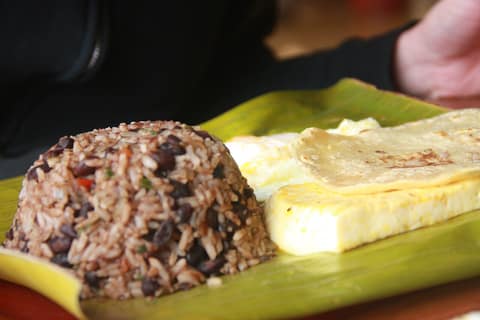
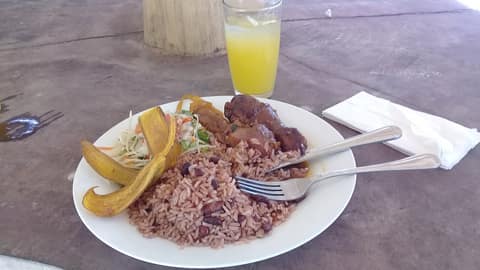
Which dishes from Costa Rica were cooked at home? Did anyone make Gallo pinto or Casado?
Does anyone in the family still speak Spanish, or use a few words of it?
Were there songs, prayers, games or holidays from Costa Rica that the family kept?
Are there old photos, letters or documents from Costa Rica? Who has them?
If you could visit Costa Rica together, where would you go first?
A short history of Costa Rica
Costa Rica was home to many Indigenous peoples long before the Spanish came. It spent about two and a half quiet centuries as a poor corner of the Spanish Empire, became independent in 1821, grew rich on coffee, fought off an American adventurer in 1856 and, after a short civil war in 1948, became the peaceful democracy without an army that it is today.
1000 BC
People settle at Guayabo
From about 1000 BC, people lived at Guayabo, on the slopes of the Turrialba Volcano. At its height it may have had about 10,000 residents, with stone roads, mounds and aqueducts. It was abandoned around AD 1400, a century before the Spanish arrived, and nobody knows why.
1563
Juan Vázquez de Coronado founds Cartago
The Spanish conquistador Juan Vázquez de Coronado founded Cartago, the first lasting Spanish town in Costa Rica. It served as the colonial capital for more than two and a half centuries.
1821
Central America declares independence
On 15 September 1821, the authorities in Guatemala declared the independence of all of Central America from Spain. Costa Rica never had to fight for it, and 15 September is still its Independence Day.
1856
Juan Santamaría dies at Rivas
In 1856 the American adventurer William Walker, who had seized power in Nicaragua, threatened Costa Rica. Costa Rican troops beat his men at Santa Rosa and then at Rivas, in Nicaragua, where the young drummer Juan Santamaría died setting fire to the enemy's stronghold on 11 April. He is the national hero, and the main airport bears his name.
1897
The National Theatre opens
Paid for with a tax on coffee, the grand National Theatre in San José opened on 21 October 1897 with a performance of Faust. It is still the finest historic building in the capital.
1949
The present constitution is approved
On 7 November 1949, an elected assembly approved the constitution that is still in force. It gave the vote to all adults, guaranteed free schooling and social rights, and its Article 12 abolished the army as a permanent institution.
1987
Óscar Arias wins the Nobel Peace Prize
President Óscar Arias received the Nobel Peace Prize in 1987 for his plan to end the wars in Central America through negotiation. He served as president twice, from 1986 to 1990 and from 2006 to 2010.
2026
A second woman is elected president
In the election of 1 February 2026, Costa Ricans chose a woman as president for the second time, sixteen years after Laura Chinchilla. As of September 2026 she is in office; she was sworn in on 8 May 2026.