Lions on the savanna, snow on the equator, an old Swahili coast on the Indian Ocean and a hot cup of chai, in the land that gave the world the word safari.
Kenya lies in East Africa, right across the equator, with a warm coastline on the Indian Ocean. From the coast, dry plains rise to cool, green highlands, cut in two by the Great Rift Valley with its chain of lakes. Mount Kenya, the second highest mountain in Africa, still carries small glaciers, and the country is named after it.
People have lived here for a very long time: some of the oldest fossils of early humans were found around Lake Turkana. For centuries Swahili towns such as Mombasa, Malindi and Lamu traded across the Indian Ocean. Britain ruled the country from the 1890s, and after years of struggle, including the Mau Mau uprising, Kenya became independent on 12 December 1963.
Questions to ask the older generation
Memories fade faster than photos. Ask these over a meal or a phone call, and write the answers down.
Which town or region of Kenya did our family come from? Was it near Mombasa, Kisumu, Nakuru?
Who was the first in the family to leave Kenya, when, and why?
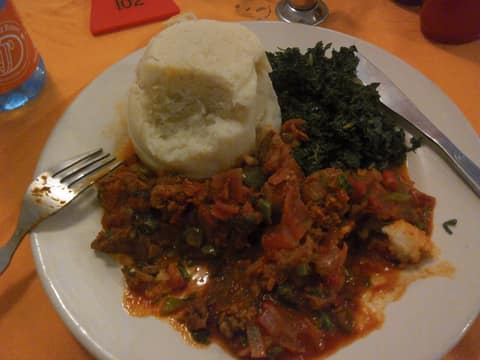
Which dishes from Kenya were cooked at home? Did anyone make Ugali or Nyama choma?
Does anyone in the family still speak Swahili, or use a few words of it?
Were there songs, prayers, games or holidays from Kenya that the family kept?
Are there old photos, letters or documents from Kenya? Who has them?
If you could visit Kenya together, where would you go first?
A short history of Kenya
Early humans lived around Lake Turkana more than a million years ago. Much later, Cushitic, Nilotic and Bantu-speaking peoples settled the land, and Swahili trading towns grew up along the coast. The Portuguese came in 1498, followed by the Omani Arabs, and in the 1890s Britain took control and built a railway from the coast to Lake Victoria. After the Mau Mau uprising of the 1950s, Kenya won its independence in 1963.
1498
Vasco da Gama reaches Malindi
In April 1498 the Portuguese explorer Vasco da Gama was turned away at Mombasa but welcomed at Malindi, a rival Swahili town. There he hired a pilot who guided his ships across the Indian Ocean to India, opening the first sea route from Europe to India.
1698
Omani Arabs take Fort Jesus
After a siege that lasted from 1696 to 1698, almost three years, Omani Arab forces captured Fort Jesus in December 1698. This ended most Portuguese power on the coast, and Oman, and later the Sultan of Zanzibar, became the main power along the Kenyan coast.
1895
Britain declares a protectorate
After the Imperial British East Africa Company ran into money troubles, the British government took over and declared the East Africa Protectorate in 1895. Its capital was Mombasa.
1899
The railway reaches Nairobi
On 30 May 1899 the railway reached a swampy spot the Maasai called Enkare Nyirobi, the place of cool waters. A railway depot was built there, and the town of Nairobi grew so quickly around it that within a few years it replaced Mombasa as the capital.
1952
A state of emergency is declared
In October 1952 the colonial government declared a state of emergency against the Mau Mau uprising, a rebellion mainly of Kikuyu, Embu and Meru fighters against colonial rule and the loss of their land. At least 11,000 people died, most of them Mau Mau fighters, and some estimates are much higher. By official figures about 80,000 people were held in detention camps without trial, where many were mistreated, and more than a million were moved into guarded villages.
1964
Kenya becomes a republic
Exactly one year after independence, on 12 December 1964, Kenya became a republic and Jomo Kenyatta its first president. He led the country until his death in 1978.
2004
Wangari Maathai wins the Nobel Peace Prize
Wangari Maathai, who founded the Green Belt Movement to plant trees and support women, became the first African woman to win the Nobel Peace Prize.
2013
Britain settles Mau Mau claims
In June 2013 the British government agreed a settlement worth 19.9 million pounds, including legal costs, for 5,228 elderly Kenyans who had been mistreated in detention during the emergency, and paid for a memorial in Nairobi, which was unveiled in 2015.