World Stroll
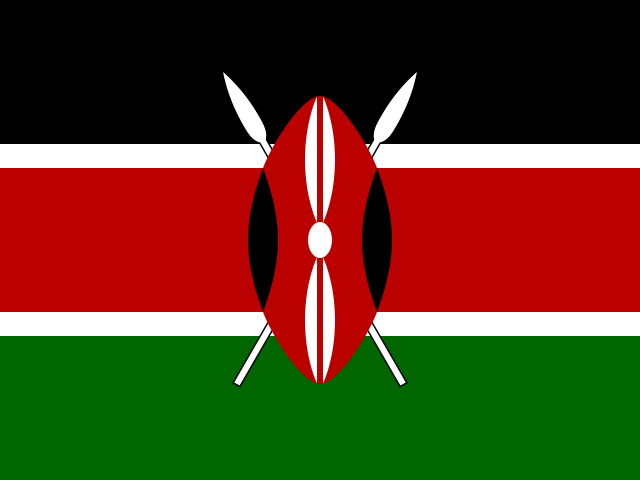
Flag of Kenya
Travel guide

Learn Kenya before you go

Lions on the savanna, snow on the equator, an old Swahili coast on the Indian Ocean and a hot cup of chai, in the land that gave the world the word safari.
Take the full trip
CapitalNairobi
CurrencyKenyan shilling (KES)
Official languageSwahili (Kiswahili) and English. Most people also speak the language of their own community
Drives on theLeft
Calling code+254

10 phrases to learn

In Swahili (Kiswahili). Capital letters show the stressed part. Tap the heart to practise a phrase later.

Hujambo? Sijambo.
hoo-JAHM-boh? see-JAHM-boh
How are you? (reply) I'm fine.
A simple greeting and its reply
Habari yako?
hah-BAH-ree YAH-koh
How are you? (literally 'What is your news?')
Greeting someone, before any other business
Nzuri, asante.
n-ZOO-ree, ah-SAHN-teh
Fine, thank you.
Answering 'Habari?'
Asante sana.
ah-SAHN-teh SAH-nah
Thank you very much.
Thanking someone warmly
Karibu!
kah-REE-boo
Welcome! / You're welcome.
Welcoming a guest, or answering 'thank you'
Jina langu ni ...
JEE-nah LAHN-goo nee
My name is ...
Introducing yourself
Jina lako nani?
JEE-nah LAH-koh NAH-nee
What is your name?
Asking someone's name
Samahani.
sah-mah-HAH-nee
Excuse me / I'm sorry.
Getting attention or apologising
Pole.
POH-leh
I'm sorry (for your trouble).
Showing sympathy when someone is tired, hurt or has bad news
Hakuna matata.
hah-KOO-nah mah-TAH-tah
No worries, no problem.
Telling someone that everything is fine

At the table

  • Wash your hands before and after the meal. In many homes a bowl of water and a towel are brought to the table.
  • Eat with your right hand, and if you are given a spoon or fork, hold it in your right hand too.
  • To eat ugali, pull off a small piece, roll it into a ball, press a dent in it with your thumb and use it to scoop up stew or greens.
  • In traditional homes the guest of honour and the elders are served first. Wait until the eldest person has started before you begin to eat.
  • Accept a cup of tea when it is offered, even if you only take a few sips; tea is a sign of welcome.
  • On the mainly Muslim coast, in Mombasa and Lamu, pork and alcohol may not be served at the table, and during Ramadan it is polite not to eat in public in the daytime.

Local tips

Stay in the vehicle on safari

In national parks and reserves, stay inside your vehicle except at marked picnic sites, viewpoints and camps. As of 2025 the Kenya Wildlife Service asks visitors to keep at least 20 m from animals, never to feed them, not to drive off the tracks, and to keep below 40 km/h.

Respect wild animals on foot too

Never walk up to wild animals, even ones that look calm; buffaloes, elephants and hippos can be very dangerous. In safari camps, let a guard walk you to your tent after dark, take a guide on hikes, and do not swim in lakes or rivers in the parks.

Leave plastic bags at home

Since August 2017 Kenya has banned plastic carrier bags, and parks are plastic-free zones. Travellers may be asked to leave duty-free plastic bags on the plane or at the airport, so pack a cloth bag instead.

Greet people before anything else

Kenyans value a proper greeting. Say 'Jambo' or 'Habari?' and ask how someone is before you ask for directions or a price. Older people are treated with great respect; in traditional settings, especially on the coast, a younger person greets them with 'Shikamoo'. It is heard far more often in Tanzania.

Ask before taking photos

Ask before photographing people; some Maasai and other villagers may ask for a small fee. It is illegal to photograph government buildings, embassies or airports.

Dress modestly on the coast

Most people on the coast, in towns such as Lamu and Mombasa's Old Town, are Muslim. Away from the beach, cover your shoulders and knees, and keep swimwear for the beach and the pool.

Carry cash and know about M-Pesa

Many Kenyans pay for almost everything by mobile phone with M-Pesa, and visitors can use it with a local SIM card. Carry some Kenyan shillings in small notes for tips, markets and places that do not take cards.

Paperwork and emergencies

As of 2026 visitors from outside Africa, including the UK, Europe and North America, must apply online for an electronic travel authorisation (eTA) before they travel. Always carry ID; a copy of your passport is usually accepted, but police may ask to see the original. In an emergency, dial 999.

Dishes to try

  • Ugali: Maize flour cooked in boiling water until it becomes a firm, smooth dough. It is served in a round mound, and pieces are pulled off with the right hand, rolled into a ball and used to scoop up stew or greens.
  • Nyama choma: Goat meat or beef slow-grilled over charcoal or wood, cut into bite-sized pieces and eaten with the hands, usually with ugali and a fresh kachumbari salad. Grilling it is a social event, and many people consider it the national dish.
  • Sukuma wiki: Collard greens, or kale, chopped finely and fried with onions and tomatoes. It is cheap, grows all year round and is eaten with ugali in homes across the country.
  • Githeri (Gĩtheri): Maize kernels and beans boiled together until soft, often fried afterwards with onions, tomatoes and sometimes potatoes, greens or a little meat.
  • Mukimo: Potatoes mashed with green vegetables such as pumpkin leaves, peas or spinach, and often maize and beans, giving it a bright green colour. It is served with stew or nyama choma.
  • Chapati: A soft, layered flatbread made from wheat flour and fried in a little oil on a flat pan. In Kenya it is richer and flakier than the Indian original, and it is a favourite for breakfast, with tea, or at celebrations.
  • Pilau: Rice cooked in a meat broth with a spice mix of cumin, cardamom, cinnamon, cloves and black pepper, which turns it a warm brown colour. It is made with beef, chicken or fish, or without meat, and served at weddings and festivals with kachumbari.
  • Kachumbari: A fresh, uncooked salad of chopped tomatoes, onions and chilli, with lemon or lime juice, coriander and salt. It is served with nyama choma, pilau and ugali to add freshness.

Cities to see

  • Nairobi (capital): Nairobi National Park, with the city skyline behind the animals, The Karen Blixen Museum, The Nairobi National Museum.
  • Mombasa: Fort Jesus, The narrow streets of the Old Town, Beaches to the north and south.
  • Kisumu: Lake Victoria sunsets, Fresh fried fish at the lakeside, Benga music.
  • Nakuru: Lake Nakuru and its flamingos, Rhinos in the national park, Farming in the Rift Valley.
  • Eldoret: Distance runners and high-altitude training, The Kipchoge Keino Stadium, Maize and wheat farms.
  • Malindi: The Vasco da Gama Pillar, Coral reefs and marine parks, The nearby ruins of Gedi.

Landmarks and the city map are on the Kenya trip