Portuguese sailors reach the Gold Coast
Portuguese ships reached this coast in 1471 and found people trading gold, which the Akan states inland had long sold northwards across the Sahara. Europeans soon called the land the Gold Coast.
Ghana lies in West Africa on the Gulf of Guinea, a few degrees north of the equator, between Ivory Coast, Burkina Faso and Togo. Low coastal plains with sandy beaches and fishing villages rise to forested hills in the centre and dry savanna in the north. The Volta River and its tributaries drain most of the country into Lake Volta, the huge reservoir behind the Akosombo Dam, and the Prime Meridian passes through the port city of Tema, near Accra.
Powerful kingdoms grew here long before Europeans arrived: Bonoman in the forest, Dagbon in the north and later the Asante Empire, ruled from Kumasi. Portuguese ships came in 1471 looking for gold, and Europeans named the land the Gold Coast. Over the next four centuries more than 30 forts and castles were built along the shore, first for the gold trade and then for the Atlantic slave trade. Britain made the coast a colony in 1874. On 6 March 1957, led by Kwame Nkrumah, the Gold Coast became independent as Ghana, one of the first countries in sub-Saharan Africa to win independence from colonial rule, and took its name from the ancient Ghana Empire.
Memories fade faster than photos. Ask these over a meal or a phone call, and write the answers down.
The kingdoms of Bonoman and Dagbon grew up in the forest and the savanna centuries ago, and in 1701 the Asante formed a union that became one of the strongest states in West Africa. From 1471 Portuguese, then Dutch, English, Danish, Swedish and German traders built forts along the coast, first for gold and then for the Atlantic slave trade. Britain took control in the 19th century after long wars with the Asante. In 1957 the Gold Coast became independent Ghana, and after years of coups it has been a stable multiparty democracy since 1992.
Portuguese ships reached this coast in 1471 and found people trading gold, which the Akan states inland had long sold northwards across the Sahara. Europeans soon called the land the Gold Coast.
The Dutch West India Company seized Elmina Castle from the Portuguese in 1637 and took the rest of the Portuguese Gold Coast in 1642. English, Danish, Swedish and German traders followed, and more than 30 forts and castles rose along the shore, trading first in gold and then in enslaved people.
Worried by Asante attacks, Fante chiefs on the coast signed the Bond of 1844, which let British officials try serious crimes such as murder and robbery. More than a century later, Ghana's independence day was set on its 113th anniversary.
In 1900 the British governor demanded to sit on the Golden Stool, the sacred symbol of the Asante nation. Yaa Asantewaa, the Queen Mother of Ejisu, led an uprising. The British won and made Asante part of the colony in 1902, but the stool itself was never handed over.
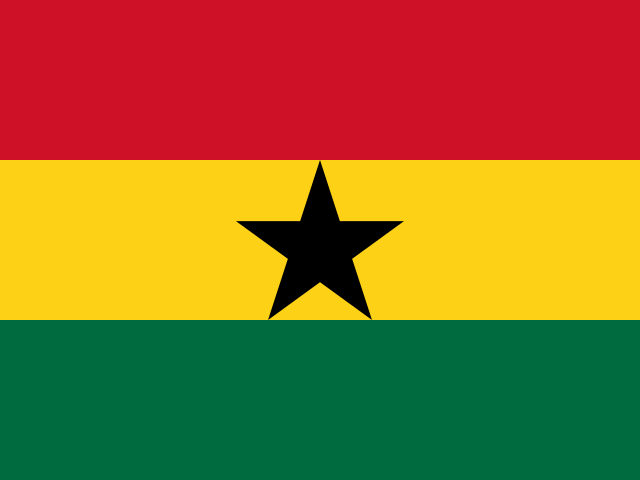
At midnight on 6 March 1957 the Gold Coast, Ashanti, the Northern Territories and British Togoland became one independent country named Ghana, with Kwame Nkrumah as prime minister. The new red, gold and green flag carried a black star.
The dam across the Volta River at Akosombo was completed in 1965 to power an aluminium smelter and the country. Its reservoir, Lake Volta, flooded 740 villages, and about 78,000 people had to move to new towns.
On 28 April 1992 voters approved a new constitution in a referendum, bringing back multiparty elections. The Fourth Republic began on 7 January 1993, and since then presidents have been elected for four-year terms, with a limit of two terms.
Ghana invited people of African descent around the world to visit in 2019, 400 years after the first enslaved Africans landed in the English colony of Virginia in 1619. Many visitors came to the castles of Cape Coast and Elmina.
Cook one of the recipes, print the large-print pack about Ghana, and finish with the big-screen quiz or the words crossword. Grandchildren can colour the flag.