World Stroll
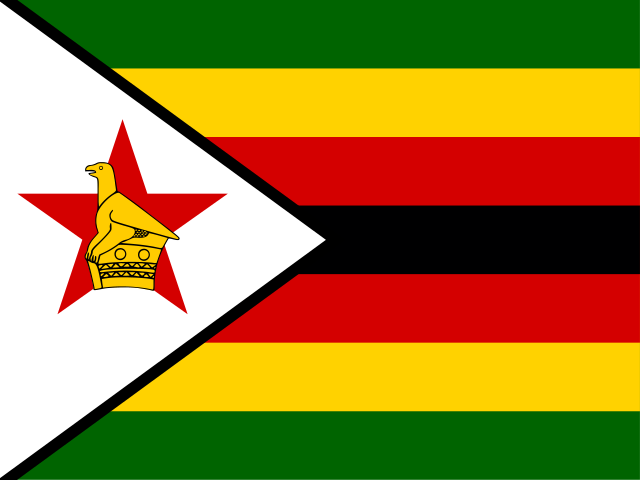
Flag of Zimbabwe
Travel guide

Learn Zimbabwe before you go

The smoke that thunders at Victoria Falls, the stone walls of Great Zimbabwe and some of Africa's finest wildlife parks, all on a high, sunny plateau between two great rivers.
Take the full trip
CapitalHarare
CurrencyZimbabwe Gold (ZiG, code ZWG), introduced in April 2024. As of September 2026 the United States dollar is also legal tender and is used for most everyday payments
Official languageSixteen under the 2013 Constitution: Chewa, Chibarwe, English, Kalanga, Koisan, Nambya, Ndau, Ndebele, Shangani, Shona, sign language, Sotho, Tonga, Tswana, Venda and Xhosa. Shona, Ndebele and English are the most widely used
Drives on theLeft
Calling code+263

10 phrases to learn

In Shona and Ndebele (isiNdebele). Capital letters show the stressed part. Tap the heart to practise a phrase later.

Mhoro (Shona)
MHOH-roh
Hello (to one person)
An everyday greeting to one person
Mhoroi (Shona)
mhoh-ROH-ee
Hello (to several people, or politely to an elder)
Greeting a group, or an older person with respect
Mangwanani (Shona)
mahn-gwah-NAH-nee
Good morning
Greeting someone in the morning
Masikati (Shona)
mah-see-KAH-tee
Good afternoon
Greeting someone in the afternoon
Manheru (Shona)
mah-NHEH-roo
Good evening
Greeting someone in the evening
Makadini zvenyu? (Shona)
mah-kah-DEE-nee ZVEH-nyoo
How are you? (polite)
Asking after someone after the greeting
Ndiripo (Shona)
ndee-REE-poh
I am fine (literally 'I am here')
Answering 'How are you?'
Maita zvenyu (Shona)
mah-EE-tah ZVEH-nyoo
Thank you (polite)
Thanking anyone, especially an elder or a host
Pamusoroi (Shona)
pah-moo-soh-ROH-ee
Excuse me
Getting someone's attention politely
Chinoita marii? (Shona)
chee-noh-EE-tah mah-REE-ee
How much is this?
Asking the price at a market

At the table

  • Before a meal a bowl of water is brought round so that everyone can wash their hands, and it is brought again afterwards.
  • Sadza is eaten with the right hand: roll a small ball, press a hollow into it with your thumb and use it to scoop up the relish.
  • The host usually serves each person individually.
  • Pass and receive plates and other things with both hands. Clapping twice, softly, is a polite way of saying thank you.
  • It is polite not to talk with food in your mouth, and to accept food and drink when they are offered.

Local tips

Bring small US dollar notes

As of September 2026 Zimbabwe uses both its own currency, the ZiG, and the US dollar, and most prices are given in US dollars. Physical dollar cash is often short, cash machines may not work with foreign cards, and some businesses do not take cards, so bring enough small notes in good condition.

Drive on the left, and not at night

Traffic keeps to the left. Roads can have deep potholes, stray cattle and goats, pedestrians and vehicles without lights, so avoid driving outside the main towns after dark.

Know the emergency numbers

As of 2026 the government lists 999 for all emergencies, 995 for the police and 993 for the fire brigade. Emergency services outside the big cities are limited, so good travel insurance with medical evacuation is important.

Protect yourself against malaria

Harare and Bulawayo have very little malaria, but the risk is high below about 1,200 m from November to June, and all year in the Zambezi valley, which includes Kariba and Mana Pools. See a travel clinic before you go and use repellent in the evenings.

Choose your season at the falls

Victoria Falls carries the most water from February to May, peaking in April, when the spray is so thick you may get soaked and see less. From September to January the flow is low and up to half of the rock face can be dry.

Be careful with your camera

It is illegal to photograph government offices, airports and military sites without permission. Ask before you photograph people.

Expect power cuts

Long power cuts are common because of electricity shortages. Carry a torch and a power bank, and remember that traffic lights may not work during a cut.

Greet first, and use both hands

Always greet people before asking a question or starting business. Stand up to greet someone who comes into the room, and give and receive things with both hands.

Dishes to try

  • Sadza (sadza (Shona), isitshwala (Ndebele)): The heart of almost every meal: a stiff porridge of finely ground white maize meal cooked with water until it holds its shape. It is served in smooth mounds with a relish of stew, greens or beans. People pinch off a piece with the right hand, roll it into a ball, press a hollow into it with the thumb and use it to scoop up the relish.
  • Nyama (meat stew) (nyama): Nyama simply means 'meat' in Shona, and on the plate it usually means a stew of beef or chicken simmered with onion, tomato and a little curry powder or paprika until the sauce is thick. It is the favourite relish for sadza, especially on Sundays and at family gatherings.
  • Muriwo une dovi (muriwo unedovi): Leafy greens cooked with onion, tomato and peanut butter, which melts into a creamy, nutty sauce. Spinach, rape, covo or pumpkin leaves are all used. It is one of the most common relishes for sadza, and a good way to make a meal of vegetables alone.
  • Kapenta (matemba): Tiny freshwater sardines, sold sun-dried and salty. At home they are soaked, then fried with onion and tomato, sometimes with ground peanuts, and eaten with sadza. Most of Zimbabwe's kapenta is caught at night on Lake Kariba from boats that lure the fish with lights.
  • Madora (mopane worms) (madora (Shona), amacimbi (Ndebele)): The large caterpillars of the mopane emperor moth, picked by hand from mopane trees, squeezed clean and dried in the sun. They are eaten crunchy as a snack or soaked and fried with onion, tomato and chilli and served with sadza. They are rich in protein.
  • Maputi (roasted maize) (maputi): Dried maize kernels roasted in a heavy pan over the fire until golden and crunchy. They are often roasted together with peanuts, a mix called maputi anenzungu, and handed round while people sit and talk by the fire.
  • Nhopi (pumpkin mash) (nhopi, inhopi): Pumpkin or butternut boiled until soft and mashed, sometimes with a little maize meal, and usually with a spoonful of peanut butter. It is naturally sweet and filling.
  • Umxhanxa: A seasonal Ndebele dish, cooked in winter after the harvest. A yellow-fleshed melon, called ijodo, is peeled, seeded and boiled, then mixed with sun-dried maize kernels that have been boiled for hours until soft, and sweetened with a little sugar.

Cities to see

  • Harare (capital): Jacaranda trees that turn the streets purple in spring, The National Gallery of Zimbabwe and its stone sculpture, Mbare, the district that was called Harari before 1982.
  • Bulawayo: The Natural History Museum of Zimbabwe, The headquarters of National Railways of Zimbabwe and a railway museum, Wide streets laid out for ox wagons to turn.
  • Mutare: The Bvumba mountains, southeast of the city, The road and railway to the port of Beira, Timber and paper industries.
  • Gweru: Midlands State University, Beef cattle ranching, Antelope Park, a wildlife park near the city.
  • Kwekwe: The National Mining Museum, Gold mining, Steel and ferrochrome works.
  • Masvingo: Great Zimbabwe nearby, Lake Mutirikwi, which supplies the city's water, The Old Fort in the town centre.

Landmarks and the city map are on the Zimbabwe trip