World Stroll
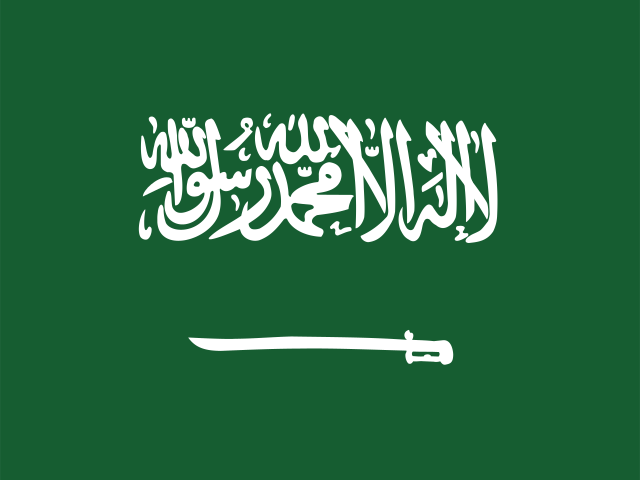
Flag of Saudi Arabia
Travel guide

Learn Saudi Arabia before you go

Red sand dunes, carved Nabataean tombs, cool green mountains and a small cup of cardamom coffee, in the country that holds Islam's two holiest cities.
Take the full trip
CapitalRiyadh
CurrencySaudi riyal (SAR), divided into 100 halalas. It is fixed at 3.75 riyals to one US dollar
Official languageArabic. People speak regional dialects such as Najdi, Hejazi and Gulf Arabic, and English is widely used in business and for visitors
Drives on theRight
Calling code+966

10 phrases to learn

In Arabic. Capital letters show the stressed part. Tap the heart to practise a phrase later.

As-salamu alaykum (السلام عليكم)
as-sah-LAH-moo ah-LAY-koom
Peace be upon you (hello)
The polite greeting for anyone, at any time of day
Wa alaykum as-salam (وعليكم السلام)
wah ah-LAY-koom as-sah-LAHM
And upon you be peace (the reply)
Answering someone who greets you with as-salamu alaykum
Ahlan wa sahlan (أهلاً وسهلاً)
AH-lan wah SAH-lan
Welcome
What your host says when you arrive; you can reply 'ahlan bik'
Sabah al-khayr (صباح الخير)
sah-BAAH al-KHAYR
Good morning
In the morning; the reply is 'sabah an-nur', morning of light
Kayf al-hal? (كيف الحال؟)
KAYF al-HAAL
How are you?
After the greeting, to anyone
Al-hamdu lillah (الحمد لله)
al-HAM-doo lil-LAH
Praise be to God (I am fine)
The usual answer to 'how are you?'
Shukran jazilan (شكراً جزيلاً)
SHOOK-ran ja-ZEE-lan
Thank you very much
To thank someone warmly
Afwan (عفواً)
AF-wan
You're welcome; also excuse me
Replying to thanks, or to get past someone politely
Min fadlak / min fadlik (من فضلك)
min FAD-lak / min FAD-lik
Please (to a man / to a woman)
When asking for something
Law samaht (لو سمحت)
law sa-MAHT
Excuse me, if you would allow
To get attention in a shop or restaurant (to a woman: law samahti)

At the table

  • Wash your hands before and after the meal. Eat, and pass food, with your right hand.
  • Many families eat from a large shared platter, sitting on a carpet or cushions. Take food from the part of the dish directly in front of you.
  • Your host will keep offering more. It is polite to accept and to praise the food, and to leave a little on your plate when you have had enough.
  • Arabic coffee is poured into small cups, a little at a time. Hold the cup in your right hand; when you have had enough, gently shake the cup from side to side before handing it back.
  • Do not ask for alcohol or pork: both are forbidden by law.
  • During Ramadan, if you are invited to break the fast (iftar), it usually begins with dates, water and coffee at sunset, followed by a larger meal.

Local tips

Check the official travel advice

Read your government's travel advice before you go. As of September 2026, the UK government advises against all travel within 10 km of the border with Yemen, and against all but essential travel between 10 and 80 km from that border and to the cities of Abha and Khamis Mushait in Asir. Advice can change quickly with the situation in the region.

Apply for the eVisa online

Since 2019 visitors from many countries can get a tourist eVisa online or on arrival at the main airports. As of September 2026 it is valid for a year for several visits, up to 90 days in total, and includes health insurance. Your passport must be valid for at least 6 months after you arrive. Pilgrims going for Hajj need a separate Hajj visa.

Mecca is only for Muslims

Under Saudi law, non-Muslims may not enter Mecca, and signs and checkpoints on the main roads mark the boundary of the sacred area that they may not cross. Medina is different: non-Muslims may visit the city, but the Prophet's Mosque is for Muslims, and the rules for the area around it have changed in recent years, so check locally.

Dress modestly

As of September 2026, the UK government says that men and women must wear loose clothing that covers the elbows and reaches below the knees. Women visitors do not have to wear the abaya (the traditional long robe) or cover their hair.

No alcohol, and zero tolerance for drugs

Do not bring alcohol into the country: drinking alcohol is illegal, and so is being drunk in public. Drug offences are punished very severely. Pork is also not allowed.

Be thoughtful during Ramadan

During Ramadan, do not eat, drink, smoke or chew gum in public in the daytime, including in your car. Many shops and restaurants open late into the night, and the evenings are festive.

Ask before you take photos

Ask people before photographing them. It is illegal to photograph government buildings, military sites, embassies and palaces. Public displays of affection, swearing and loud music can also cause offence.

Respect the heat

In summer, temperatures in Riyadh and the desert often pass 40 °C, and the coast is hot and humid. The most pleasant months to visit are from November to March. Drink plenty of water, and plan desert trips with an experienced guide.

Dishes to try

  • Kabsa (كبسة): The best-known Saudi dish: long-grain rice cooked in one pot with chicken, lamb or camel, tomatoes, onions and a mix of spices such as cardamom, cloves, cinnamon, black pepper and dried black lime. It is piled on a large platter with the meat on top and often scattered with raisins and fried almonds.
  • Jareesh (جريش): Crushed wheat cooked slowly with meat or chicken, onions and spices, often with yoghurt or laban, until soft and creamy. It is served in a wide dish topped with crisp fried onions and a spoonful of ghee.
  • Mandi (مندي): Chicken or lamb seasoned with spices and cooked in a deep oven in the ground, called a tannour, hung above a pot of rice so that the juices drip into the rice below. The meat comes out very tender, with a light smoky taste.
  • Ruz Bukhari (رز بخاري): A golden rice dish cooked with meat or chicken, onions, tomato, black pepper, cumin and grated carrots. It is as widespread as kabsa, but milder and a little sweeter.
  • Saleeg (سليق): Short, creamy rice cooked slowly in chicken or lamb broth with milk, cardamom and a little mastic, then topped with the roasted meat and a pool of ghee. It is often compared to an Italian risotto.
  • Harees (هريس): Whole wheat grains cooked for hours with meat and then beaten until smooth, like a thick savoury porridge. It is served with melted ghee, and sometimes cinnamon or sugar, on top.
  • Mutabbaq (مطبق): Paper-thin dough folded around minced meat, beaten egg, leeks and spring onions, then fried on a flat griddle until crisp and cut into squares. It is eaten hot with lemon and green chillies.
  • Dakkous (دقوس): A simple spicy tomato sauce with garlic, chilli and cumin, spooned over kabsa, saleeg and other rice dishes.

Cities to see

  • Riyadh (capital): The Masmak fort in the old centre, Skyscrapers such as the Kingdom Centre, The historic At-Turaif district in nearby Diriyah.
  • Jeddah: Historic Jeddah, a World Heritage Site, A long corniche on the Red Sea, Diving and snorkelling in the Red Sea.
  • Mecca: The Great Mosque and the Kaaba, The Hajj pilgrimage, The Cave of Hira on Jabal al-Nour.
  • Medina: The Prophet's Mosque with its green dome, Ajwa dates, The end of the old Hejaz Railway.
  • Dammam: The first commercial oil well, Dammam No. 7, The Gulf seafront, The King Fahd Causeway to Bahrain nearby.
  • Taif: Fields of fragrant Taif roses and rose oil, Grapes, pomegranates and honey, Saleeg, the Hejazi rice dish.

Landmarks and the city map are on the Saudi Arabia trip