Uganda trivia: 45 questions and answers
The country at a glance
What is the capital of Uganda?
- A. Kampala
- B. Entebbe
- C. Jinja
- D. Gulu
Show the answer
Kampala. Kampala is the capital and largest city. Entebbe, on Lake Victoria, was the seat of the British government until independence in 1962 and is home to the main airport.
Uganda has a coastline on the Indian Ocean.
True or false?
Show the answer
False. False. Uganda is landlocked. It has no coast, but it shares Lake Victoria, Africa's largest lake, with Kenya and Tanzania.
Uganda takes its name from which old kingdom?
- A. Buganda
- B. Bunyoro
- C. Ankole
- D. Toro
Show the answer
Buganda. Uganda is named after Buganda, the largest of the old kingdoms, whose kings ruled from the hills where Kampala now stands.
Which two languages are official in Uganda?
- A. English and Swahili
- B. English and Luganda
- C. French and Swahili
- D. Luganda and Swahili
Show the answer
English and Swahili. English and Swahili are official; Swahili was added by a change to the constitution in 2005. Luganda is the most widely spoken local language, but it is not official.
History
On what date did Uganda become independent from Britain?
- A. 9 October 1962
- B. 12 December 1963
- C. 1 July 1960
- D. 25 January 1971
Show the answer
9 October 1962. Uganda became independent on 9 October 1962, and the day is celebrated as Independence Day. 25 January 1971 is the date of Idi Amin's coup.
The explorer John Hanning Speke reached the place where the Nile leaves Lake Victoria in 1862.
True or false?
Show the answer
True. True. In July 1862 Speke saw the Nile flowing out of Lake Victoria over the Ripon Falls, near today's Jinja.
What happened to the Ripon Falls that Speke saw in 1862?
- A. They were covered by water behind a dam
- B. They dried up during a long drought
- C. They were turned into a canal for boats
- D. They were moved by an earthquake
Show the answer
They were covered by water behind a dam. They were covered by water behind a dam: the Owen Falls Dam, finished in 1954, raised the water at the outlet of Lake Victoria and submerged the falls.
In 1972 Idi Amin ordered Uganda's Asian minority to leave the country within 90 days.
True or false?
Show the answer
True. True. In August 1972 Amin gave Uganda's Asians, most of them of Indian origin, 90 days to leave. Many settled in Britain, and some families returned years later.
Which country's army, together with Ugandan exiles, took Kampala in April 1979 and ended Idi Amin's rule?
- A. Tanzania
- B. Kenya
- C. Rwanda
- D. Zambia
Show the answer
Tanzania. Tanzania. After Ugandan troops invaded northern Tanzania in late 1978, the Tanzanian army and Ugandan exiles fought their way north and took Kampala on 11 April 1979.
On which day each year do pilgrims gather at Namugongo to remember the Uganda Martyrs?
- A. 3 June
- B. 9 October
- C. 25 December
- D. 1 May
Show the answer
3 June. 3 June is Uganda Martyrs Day, a public holiday. On 3 June 1886 many of the young Christian martyrs were burned to death at Namugongo.
Food and drink
What is matooke, often called a national dish of Uganda?
- A. Green cooking bananas, steamed and mashed
- B. Maize flour cooked into a stiff dough
- C. Fried bush crickets
- D. Bread made from millet flour
Show the answer
Green cooking bananas, steamed and mashed. Matooke is green cooking bananas, steamed and mashed, usually wrapped in banana leaves. Maize dough is posho, and millet bread is kalo.
Where does the name of the rolex, Uganda's favourite street snack, come from?
- A. 'Rolled eggs', said quickly
- B. A prize of a watch for the best cook
- C. The name of the cook who invented it
- D. A town on Lake Victoria
Show the answer
'Rolled eggs', said quickly. The name comes from 'rolled eggs', said quickly: an omelette rolled up in a chapati.
Luwombo, a dish once served to the kings of Buganda, is steamed in what?
- A. Parcels of smoked banana leaves
- B. A clay pot buried in hot ashes
- C. Hollowed-out pumpkins
- D. Bamboo tubes
Show the answer
Parcels of smoked banana leaves. Luwombo is steamed in parcels of smoked banana leaves, which give the chicken, meat, fish or groundnuts a gentle smoky taste.
Eshabwe, a white sauce from Ankole, is made mainly from what?
- A. Ghee from cow's milk
- B. Ground peanuts
- C. Mashed beans
- D. Sesame paste
Show the answer
Ghee from cow's milk. Eshabwe is made from ghee from cow's milk, washed and whipped with salted water until it turns white.
Malewa, a dish from the slopes of Mount Elgon, is made from smoked and dried bamboo shoots.
True or false?
Show the answer
True. True. Malewa is smoked, dried bamboo shoots from Bugisu, cooked into a sauce with peanut or sesame paste.
Nsenene are a kind of fish from Lake Victoria.
True or false?
Show the answer
False. False. Nsenene are bush crickets, insects related to grasshoppers, caught in the rainy seasons and fried as a crunchy snack.
Posho is made from maize flour and is the same dish that Kenyans call ugali.
True or false?
Show the answer
True. True. Posho is white maize flour stirred into boiling water until firm; in Kenya and Tanzania it is called ugali.
Kikomando is chapati cut into pieces and served with what?
- A. Fried beans
- B. Fried bush crickets
- C. Smoked fish
- D. Mashed matooke
Show the answer
Fried beans. Kikomando is chopped chapati with fried beans, a cheap and filling favourite of students and workers.
Cities
Which town on Lake Victoria is home to Uganda's main international airport?
- A. Entebbe
- B. Jinja
- C. Mbarara
- D. Gulu
Show the answer
Entebbe. Entebbe, on a peninsula in Lake Victoria about 35 km from Kampala, has the main international airport.
Kampala's name comes from Luganda words meaning what?
- A. Hill of the impala
- B. Place of cool waters
- C. City of seven kings
- D. Shore of the great lake
Show the answer
Hill of the impala. Kampala means hill of the impala, after the antelopes that once grazed on the hill where the British built their first fort.
Fort Portal is the historic seat of the Tooro kingdom.
True or false?
Show the answer
True. True. Fort Portal, in the green highlands of western Uganda, is the historic seat of the Tooro kingdom.
Landmarks
Which national park protects almost half of the world's mountain gorillas?
- A. Bwindi Impenetrable National Park
- B. Murchison Falls National Park
- C. Lake Mburo National Park
- D. Queen Elizabeth National Park
Show the answer
Bwindi Impenetrable National Park. Bwindi Impenetrable National Park: as of the 2018 count about 459 mountain gorillas lived there, almost half of all mountain gorillas in the world.
At Murchison Falls, the whole Nile squeezes through a gap in the rocks about how wide?
- A. About 7 metres
- B. About 70 metres
- C. About 700 metres
- D. About 7 kilometres
Show the answer
About 7 metres. About 7 metres. The river is forced through the narrow gap and falls 43 m into the pool below.
The snowy Rwenzori Mountains are often linked with which legendary mountains?
- A. The Mountains of the Moon
- B. The Mountains of the Sun
- C. The Mountains of the Stars
- D. The Mountains of Gold
Show the answer
The Mountains of the Moon. The Mountains of the Moon, which the ancient geographer Ptolemy named as the source of the Nile.
After being rebuilt following a fire, the Kasubi Tombs were removed from the UNESCO List of World Heritage in Danger in 2023.
True or false?
Show the answer
True. True. A fire destroyed the main tomb house in 2010; after it was rebuilt with traditional skills, UNESCO removed the site from the danger list in 2023.
Which of these is a UNESCO World Heritage Site?
- A. The Kasubi Tombs
- B. Murchison Falls
- C. Lake Bunyonyi
- D. Sipi Falls
Show the answer
The Kasubi Tombs. The Kasubi Tombs, inscribed in 2001. Uganda's other World Heritage Sites are Bwindi and the Rwenzori Mountains national parks.
Lake Mburo National Park is famous for its mountain gorillas.
True or false?
Show the answer
False. False. Lake Mburo is a park of lakes and grassland known for zebras, impalas and elands. Uganda's mountain gorillas live in Bwindi and Mgahinga in the far south-west.
Fun facts
On the road from Kampala to Masaka, which town has a monument marking the equator?
- A. Kayabwe
- B. Jinja
- C. Entebbe
- D. Gulu
Show the answer
Kayabwe. Kayabwe sits right on the equator, and visitors stop at the monument to stand with one foot in each hemisphere.
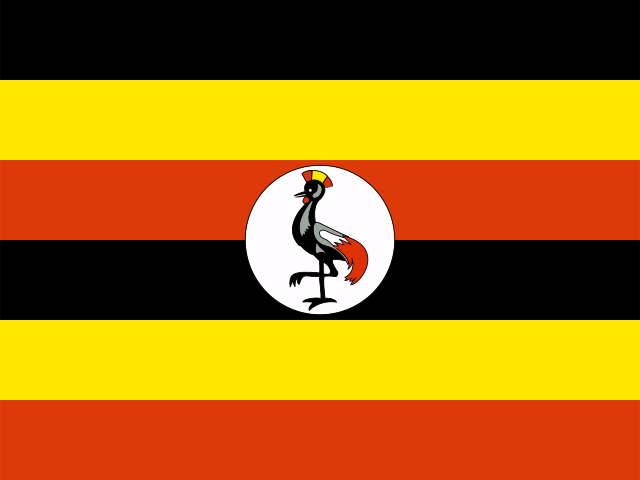
Which bird is in the middle of Uganda's flag?
- A. Grey crowned crane
- B. Shoebill
- C. African fish eagle
- D. Marabou stork
Show the answer
Grey crowned crane. The grey crowned crane, the national bird, stands in a white circle in the middle of the black, yellow and red stripes.
In which event did John Akii-Bua win Uganda's first Olympic gold medal in 1972?
- A. 400 metres hurdles
- B. Marathon
- C. Boxing
- D. 10,000 metres
Show the answer
400 metres hurdles. He won the 400 metres hurdles in Munich in a world record time of 47.82 seconds.
Most of Lake Victoria lies in Kenya.
True or false?
Show the answer
False. False. Tanzania has about 49 per cent of the lake, Uganda about 45 per cent and Kenya only about 6 per cent.
At the 2024 census, about half of Uganda's people were under 18.
True or false?
Show the answer
True. True. About 49.6 per cent of Ugandans were under 18 at the 2024 census, which makes Uganda one of the youngest countries in the world.
Traditional Ugandan barkcloth, recognised by UNESCO, is made from the inner bark of which kind of tree?
- A. A fig tree
- B. A baobab
- C. A mahogany tree
- D. A eucalyptus
Show the answer
A fig tree. A fig tree (Ficus natalensis). Its inner bark is soaked and beaten into soft sheets of cloth.
Words
What does 'webale' mean in Luganda?
- A. Thank you
- B. Goodbye
- C. Please
- D. Water
Show the answer
Thank you. 'Webale' means thank you, and 'webale nnyo' means thank you very much.
Which Luganda word means 'water'?
- A. amazzi
- B. emmere
- C. kaawa
- D. ekibuga
Show the answer
amazzi. 'Amazzi' is water. 'Emmere' is food, 'kaawa' is coffee and 'ekibuga' is city.
In Luganda, 'kaawa' means tea.
True or false?
Show the answer
False. False. 'Kaawa' means coffee; tea is 'caayi'.
Phrases
How do you greet one person with 'How are you?' in Luganda?
- A. Oli otya?
- B. Webale nnyo.
- C. Weeraba.
- D. Mmeka?
Show the answer
Oli otya?. 'Oli otya?' is the everyday greeting. 'Webale nnyo' means thank you very much, 'weeraba' goodbye and 'mmeka?' how much?
The morning greeting 'Wasuze otya?' literally asks what?
- A. How did you sleep?
- B. Where are you going?
- C. Have you eaten?
- D. What is your name?
Show the answer
How did you sleep?. 'Wasuze otya?' means how did you sleep, and it is used as good morning.
'Mmeka?' is how you ask 'How much?' at a market.
True or false?
Show the answer
True. True. 'Mmeka?' means how much?, a useful word for markets and taxis.
Someone says 'Oli otya?' to you. Which reply means 'Fine'?
- A. Bulungi
- B. Weeraba
- C. Nnyamba
- D. Owange
Show the answer
Bulungi. 'Bulungi' means fine or well. 'Weeraba' is goodbye, 'nnyamba' is help me and 'owange' is excuse me.
Local customs and tips
As of September 2026, which vaccination certificate do travellers need to enter Uganda?
- A. Yellow fever
- B. Rabies
- C. Cholera
- D. Chickenpox
Show the answer
Yellow fever. A yellow fever vaccination certificate is required, and officials may ask to see it on arrival.
As of September 2026, which number calls the police in an emergency in Uganda?
- A. 999
- B. 000
- C. 17
- D. 190
Show the answer
999. 999 is the number for police, fire and ambulance in Uganda.
In Uganda it is fine to photograph military sites and the Owen Falls Dam at Jinja.
True or false?
Show the answer
False. False. Photographing military, official and diplomatic sites is forbidden, including the Owen Falls Dam at Jinja. Always ask people before taking their photo, too.
What is a boda boda in Uganda?
- A. A motorbike taxi
- B. A kind of fried bread
- C. A market stall
- D. A long wooden canoe
Show the answer
A motorbike taxi. A boda boda is a motorbike taxi. They have many accidents, so official travel advice is to avoid them, or at least to wear a helmet.
Many lakes and slow rivers in Uganda can carry bilharzia, so it is wise not to swim unless you know the water is safe.
True or false?
Show the answer
True. True. Bilharzia is a parasite found in many African lakes; ask locally before swimming.
Answer key
The country at a glance
- A. Kampala
- False
- A. Buganda
- A. English and Swahili
History
- A. 9 October 1962
- True
- A. They were covered by water behind a dam
- True
- A. Tanzania
- A. 3 June
Food and drink
- A. Green cooking bananas, steamed and mashed
- A. 'Rolled eggs', said quickly
- A. Parcels of smoked banana leaves
- A. Ghee from cow's milk
- True
- False
- True
- A. Fried beans
Cities
- A. Entebbe
- A. Hill of the impala
- True
Landmarks
- A. Bwindi Impenetrable National Park
- A. About 7 metres
- A. The Mountains of the Moon
- True
- A. The Kasubi Tombs
- False
Fun facts
- A. Kayabwe
- A. Grey crowned crane
- A. 400 metres hurdles
- False
- True
- A. A fig tree
Words
- A. Thank you
- A. amazzi
- False
Phrases
- A. Oli otya?
- A. How did you sleep?
- True
- A. Bulungi
Local customs and tips
- A. Yellow fever
- A. 999
- False
- A. A motorbike taxi
- True
More about Uganda
- The trip to UgandaMap, story, food, phrases and a friendly quiz.
- Uganda word searchCities and dishes in large print.
- Ugandan words crosswordLearn a few words while you solve it.
- Colour the flag of UgandaPrint it or colour it in on the screen.
- Ugandan rootsA family guide: history, recipes and words for the grandchildren.
- Before you goPhrases, customs and tips for travellers.
- Printable packLarge print, with a quiz and answers.