Mexico trivia: 46 questions and answers
History
The Aztec capital Tenochtitlan was built on an island in which lake?
- A. Lake Chapala
- B. Lake Texcoco
- C. Lake Pátzcuaro
- D. Lake Titicaca
Show the answer
Lake Texcoco. Tenochtitlan stood on an island in Lake Texcoco, in the Valley of Mexico. Mexico City now covers the old lake bed. Chapala and Pátzcuaro are lakes in western Mexico, and Titicaca is in the Andes.
On which date do Mexicans celebrate their Independence Day?
- A. 5 May
- B. 16 September
- C. 20 November
- D. 12 December
Show the answer
16 September. Independence Day is 16 September, the day in 1810 when Miguel Hidalgo gave the Cry of Dolores. 5 May recalls the Battle of Puebla, 20 November the start of the Revolution, and 12 December is the feast of the Virgin of Guadalupe.
Cinco de Mayo marks the day Mexico became independent from Spain.
True or false?
Show the answer
False. False. Cinco de Mayo remembers the Mexican victory over French troops at the Battle of Puebla on 5 May 1862. Independence Day is 16 September.
Maximilian, who reigned as Emperor of Mexico from 1864 to 1867, belonged to which European royal family?
- A. The Bourbons
- B. The Bonapartes
- C. The Habsburgs
- D. The Tudors
Show the answer
The Habsburgs. Maximilian belonged to the Habsburgs, the ruling family of Austria: he was an archduke and the younger brother of Emperor Franz Joseph. France's Napoleon III helped put him on the throne, but Maximilian was not a Bonaparte.
In 2000, Vicente Fox won the presidential election, the first time in 71 years that the Institutional Revolutionary Party (PRI) lost the presidency.
True or false?
Show the answer
True. True. Vicente Fox of the National Action Party won in July 2000, ending 71 years in which the PRI had won every presidential election.
Food and drink
Chiles en nogada, topped with walnut sauce and pomegranate seeds, are traditionally eaten in which months?
- A. December and January
- B. March and April
- C. May and June
- D. August and September
Show the answer
August and September. Chiles en nogada are eaten in August and September, when pomegranates are in season and Mexico celebrates its independence.
Mole poblano takes its name from which city?
- A. Puebla
- B. Oaxaca
- C. Guadalajara
- D. Mérida
Show the answer
Puebla. Poblano means 'from Puebla'. Mole poblano, a dark sauce of chillies, spices, nuts and a little chocolate, is the city's most famous dish.
The word guacamole comes from the Aztec language Nahuatl. What did the original word mean?
- A. Green gold
- B. Avocado sauce
- C. Mashed fruit
- D. Lime and salt
Show the answer
Avocado sauce. Guacamole comes from the Nahuatl āhuacamōlli, which means avocado sauce: āhuacatl is avocado and mōlli is sauce.
Tequila is distilled from which plant?
- A. Sugar cane
- B. Corn
- C. Blue agave
- D. Prickly pear cactus
Show the answer
Blue agave. By law, tequila is made from blue agave grown in a protected area centred on the state of Jalisco. Agave is a succulent, not a cactus.
To make masa, the dough for tortillas and tamales, corn is soaked and cooked with what?
- A. Vinegar
- B. Lime (calcium hydroxide)
- C. Sea water
- D. Milk
Show the answer
Lime (calcium hydroxide). Corn is cooked with lime (calcium hydroxide, not the fruit), a process called nixtamalisation. It softens the grain and makes it more nutritious.
In Mexico, tacos are normally eaten with a knife and fork.
True or false?
Show the answer
False. False. Tacos are eaten with your hands. Tilt your head, not the taco, so the filling stays inside.
In Mexico, la comida, the main meal of the day, is usually eaten in the early afternoon.
True or false?
Show the answer
True. True. La comida is the biggest meal of the day and is eaten in the early afternoon. Supper in the evening is usually light.
Pan de muerto, a sweet bun decorated with dough 'bones', is baked for which celebration?
- A. Christmas
- B. Easter
- C. The Day of the Dead
- D. Independence Day
Show the answer
The Day of the Dead. Pan de muerto is baked in the weeks before the Day of the Dead, on 1 and 2 November, and placed on family altars called ofrendas.
Cities
Which port on the Gulf of Mexico was founded by Hernán Cortés in 1519?
- A. Acapulco
- B. Veracruz
- C. Mazatlán
- D. Cancún
Show the answer
Veracruz. Cortés founded Villa Rica de la Vera Cruz in 1519. Veracruz became Mexico's oldest and most important port. Acapulco and Mazatlán are on the Pacific, and Cancún is a modern Caribbean resort.
Which former silver-mining city has main streets that run through underground tunnels?
- A. Cancún
- B. Tijuana
- C. Guanajuato
- D. Mérida
Show the answer
Guanajuato. In Guanajuato, old flood tunnels and the former course of the river were turned into underground roads.
Landmarks
Which civilisation built Chichén Itzá?
- A. The Aztecs
- B. The Maya
- C. The Olmecs
- D. The Incas
Show the answer
The Maya. Chichén Itzá was built by The Maya, on the Yucatán Peninsula. The Aztecs lived in central Mexico, the Olmecs much earlier on the Gulf Coast, and the Incas in South America.
At Teotihuacan, the Avenue of the Dead runs between the Pyramid of the Moon and which other great pyramid?
- A. The Pyramid of the Sun
- B. El Castillo
- C. The Temple of the Inscriptions
- D. The Pyramid of the Magician
Show the answer
The Pyramid of the Sun. The Pyramid of the Sun and the Pyramid of the Moon are Teotihuacan's great pyramids. El Castillo is at Chichén Itzá, the Temple of the Inscriptions at Palenque and the Pyramid of the Magician at Uxmal.
Teotihuacan was built by the Aztecs.
True or false?
Show the answer
False. False. Teotihuacan was built and abandoned centuries before the Aztecs. They found its ruins and gave it the Nahuatl name we use today.
What makes the Great Pyramid of Cholula, near Puebla, special?
- A. It is the tallest pyramid in the world
- B. It is the largest pyramid in the world by volume
- C. It is the oldest pyramid in the world
- D. It is built of solid granite
Show the answer
It is the largest pyramid in the world by volume. It is the largest pyramid in the world by volume, but only about 25 m high, much lower than the Great Pyramid of Giza. It was built of adobe bricks and now looks like a hill with a church on top.
The Blue House in Coyoacán, Mexico City, where she was born and died, is now a museum to which painter?
- A. Frida Kahlo
- B. Octavio Paz
- C. Pancho Villa
- D. Benito Juárez
Show the answer
Frida Kahlo. The Blue House was Frida Kahlo's home. It became a museum in 1958. Octavio Paz was a poet, Pancho Villa a revolutionary general and Benito Juárez a president.
Which famous Aztec treasure can you see in the National Museum of Anthropology in Mexico City?
- A. The Rosetta Stone
- B. The Sun Stone
- C. The Terracotta Army
- D. The Mask of Agamemnon
Show the answer
The Sun Stone. The Sun Stone, often called the Aztec calendar, is the museum's most famous piece. The Rosetta Stone is in London, the Terracotta Army in China and the Mask of Agamemnon in Athens.
The murals in the chapel of the Hospicio Cabañas in Guadalajara were painted by Diego Rivera.
True or false?
Show the answer
False. False. They were painted by José Clemente Orozco in the late 1930s, including his famous Man of Fire.
Fun facts
In which city was the Caesar salad invented?
- A. Rome
- B. New York
- C. Tijuana
- D. Madrid
Show the answer
Tijuana. The Caesar salad is credited to Caesar Cardini, an Italian-born restaurateur, who created it at his restaurant in Tijuana in 1924.
The asteroid that wiped out the dinosaurs struck near which Mexican peninsula?
- A. Baja California
- B. The Yucatán Peninsula
- C. The Florida peninsula
- D. The Iberian Peninsula
Show the answer
The Yucatán Peninsula. The Chicxulub crater, about 200 km across, lies buried under the Yucatán Peninsula. The impact happened about 66 million years ago. Florida and Iberia are not in Mexico.
Parts of Mexico City have sunk by several metres since the early 1900s.
True or false?
Show the answer
True. True. The city stands on the soft clay of an old lake bed, and pumping water from underground has made some areas sink as much as 9 m.
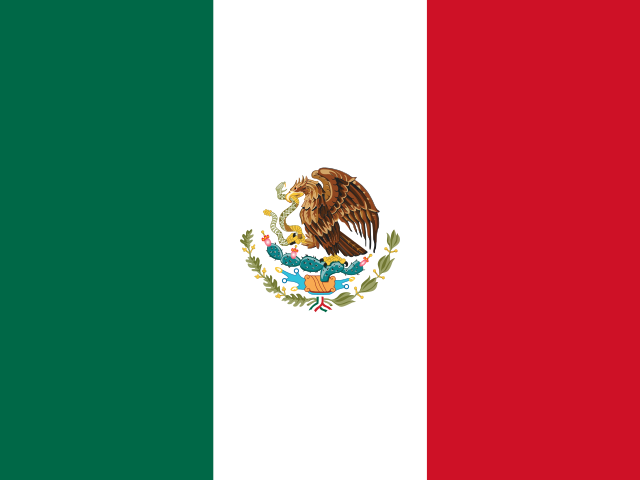
The eagle on the Mexican flag stands on a cactus and holds what in its beak?
- A. An olive branch
- B. A fish
- C. A snake
- D. A corn cob
Show the answer
A snake. The eagle is eating a snake. It recalls the Aztec legend of the sign that showed them where to build Tenochtitlan.
The tiny Chihuahua dog shares its name with what?
- A. Mexico's largest state
- B. Mexico's highest volcano
- C. An Aztec emperor
- D. A Maya city
Show the answer
Mexico's largest state. The dog shares its name with Mexico's largest state, Chihuahua, in the north on the US border. Mexico's highest volcano is Pico de Orizaba.
Which insects gather in their millions every winter in the fir forests of Michoacán and the State of Mexico?
- A. Honey bees
- B. Monarch butterflies
- C. Locusts
- D. Fireflies
Show the answer
Monarch butterflies. Millions of migrating monarch butterflies spend the winter in these forests. Their reserve became a UNESCO World Heritage Site in 2008.
Corn (maize) was first domesticated in what is now Mexico.
True or false?
Show the answer
True. True. Indigenous peoples in southern Mexico domesticated maize from a wild grass called teosinte about 9,000 years ago.
As of 2026, Spain has more Spanish speakers than Mexico.
True or false?
Show the answer
False. False. Mexico, with about 134 million people, has the largest Spanish-speaking population in the world. Spain has about 50 million people.
Words
In Mexico, a 'camión' can be a truck, but what else does the word often mean?
- A. A bicycle
- B. A bus
- C. A boat
- D. An aeroplane
Show the answer
A bus. In Mexico, camión is the everyday word for a bus as well as a truck. In Spain it only means a truck.
In a Mexican restaurant, what is a 'propina'?
- A. A tip
- B. A receipt
- C. A menu
- D. A napkin
Show the answer
A tip. La propina is a tip. About 10 to 15 percent is normal for good service.
In Mexico, what is a tortilla?
- A. A potato omelette
- B. A thin, flat round bread of corn or wheat
- C. A sweet pastry
- D. A spicy soup
Show the answer
A thin, flat round bread of corn or wheat. A Mexican tortilla is a thin, flat round bread of corn or wheat. In Spain, the same word means a potato omelette.
In many Mexican towns, what is the 'zócalo'?
- A. The main square
- B. The bus station
- C. The cemetery
- D. The covered market
Show the answer
The main square. The zócalo is the main square.
In everyday Mexican Spanish, 'ahorita' can mean 'right now' but also 'in a little while'.
True or false?
Show the answer
True. True. Ahorita literally means 'right now', but Mexicans often use it for 'soon' or 'in a moment', so do not be surprised if you wait a little.
Phrases
In Mexico, why do people often say '¿Mande?'
- A. To say goodbye
- B. To ask you to repeat what you said
- C. To order food
- D. To say thank you
Show the answer
To ask you to repeat what you said. People say ¿Mande? to ask you to repeat what you said: it is a very Mexican, polite way to say 'Pardon?'.
You pass a table of people eating. Which phrase wishes them an enjoyable meal?
- A. ¡Salud!
- B. Mucho gusto
- C. ¡Provecho!
- D. ¿Mande?
Show the answer
¡Provecho!. ¡Provecho! means 'enjoy your meal'. ¡Salud! is 'cheers', mucho gusto is 'nice to meet you' and ¿mande? is 'pardon?'.
What are you asking if you point at a salsa and say '¿Pica?'
- A. Is it fresh?
- B. Is it free?
- C. Is it spicy?
- D. Is it sweet?
Show the answer
Is it spicy?. ¿Pica? means 'Is it spicy?'. A very useful question in Mexico.
'Buenas noches' is the usual greeting when you meet someone at 10 in the morning.
True or false?
Show the answer
False. False. In the morning you say 'Buenos días'. 'Buenas noches' is for after dark or for saying goodnight.
In Mexico, '¡Qué padre!' is a way of saying 'How cool!' or 'How great!'.
True or false?
Show the answer
True. True. Padre means father, but in everyday Mexican Spanish it also means great or cool, so '¡Qué padre!' is 'How great!'.
Local customs and tips
What does official travel advice recommend you drink in Mexico?
- A. Tap water
- B. Bottled or boiled water
- C. Water from public fountains
- D. Unfiltered well water
Show the answer
Bottled or boiled water. Travel advice says to drink only bottled or boiled water in Mexico and to be careful with ice in drinks.
About how high above sea level is Mexico City?
- A. About 240 m
- B. About 2,240 m
- C. About 4,240 m
- D. About 6,240 m
Show the answer
About 2,240 m. Mexico City is about 2,240 m above sea level, so take it easy on your first day or two.
For good service in a Mexican restaurant, what is a normal tip?
- A. About 1 percent
- B. About 10 to 15 percent
- C. About 30 to 40 percent
- D. About half the bill
Show the answer
About 10 to 15 percent. About 10 to 15 percent is normal. Check the bill first in case the tip has already been added.
The National Museum of Anthropology in Mexico City is closed on Mondays.
True or false?
Show the answer
True. True. It opens Tuesday to Sunday. The Frida Kahlo Museum is also closed on Mondays.
At Mexican airports, travel advice recommends waving down any passing taxi outside the terminal.
True or false?
Show the answer
False. False. Use the authorised, prepaid airport taxis, bought at the official desk. In town, take taxis from an official rank or ask your hotel to call one.
In Mexican shops, prices written with the dollar sign are usually in US dollars.
True or false?
Show the answer
False. False. The Mexican peso uses the same sign as the US dollar, so prices in Mexico are normally in pesos.
Answer key
History
- B. Lake Texcoco
- B. 16 September
- False
- C. The Habsburgs
- True
Food and drink
- D. August and September
- A. Puebla
- B. Avocado sauce
- C. Blue agave
- B. Lime (calcium hydroxide)
- False
- True
- C. The Day of the Dead
Cities
- B. Veracruz
- C. Guanajuato
Landmarks
- B. The Maya
- A. The Pyramid of the Sun
- False
- B. It is the largest pyramid in the world by volume
- A. Frida Kahlo
- B. The Sun Stone
- False
Fun facts
- C. Tijuana
- B. The Yucatán Peninsula
- True
- C. A snake
- A. Mexico's largest state
- B. Monarch butterflies
- True
- False
Words
- B. A bus
- A. A tip
- B. A thin, flat round bread of corn or wheat
- A. The main square
- True
Phrases
- B. To ask you to repeat what you said
- C. ¡Provecho!
- C. Is it spicy?
- False
- True
Local customs and tips
- B. Bottled or boiled water
- B. About 2,240 m
- B. About 10 to 15 percent
- True
- False
- False
More about Mexico
- The trip to MexicoMap, story, food, phrases and a friendly quiz.
- Mexico word searchCities and dishes in large print.
- Mexican words crosswordLearn a few words while you solve it.
- Colour the flag of MexicoPrint it or colour it in on the screen.
- Mexican rootsA family guide: history, recipes and words for the grandchildren.
- Before you goPhrases, customs and tips for travellers.
- Printable packLarge print, with a quiz and answers.