Ancient pyramids, colourful colonial towns, Caribbean beaches and one of the world's great kitchens.
Mexico lies in the south of North America, between the Pacific Ocean on one side and the Gulf of Mexico and the Caribbean Sea on the other. Two long mountain ranges, the Sierra Madre Occidental and the Sierra Madre Oriental, frame a high central plateau. Mexico City, the capital, sits in a high valley at about 2,240 m, surrounded by volcanoes.
Long before Europeans arrived, the land was home to great civilisations: the Olmecs, the Maya, the builders of Teotihuacan, the Zapotecs and the Aztecs, who built their capital Tenochtitlan on an island in a lake. Spain conquered the Aztec capital in 1521 and ruled New Spain for three centuries. Mexico won its independence in 1821.
Questions to ask the older generation
Memories fade faster than photos. Ask these over a meal or a phone call, and write the answers down.
Which town or region of Mexico did our family come from? Was it near Guadalajara, Monterrey, Tijuana?
Who was the first in the family to leave Mexico, when, and why?
Which dishes from Mexico were cooked at home? Did anyone make Tacos al pastor or Mole poblano?
Does anyone in the family still speak Spanish, or use a few words of it?
Were there songs, prayers, games or holidays from Mexico that the family kept?
Are there old photos, letters or documents from Mexico? Who has them?
If you could visit Mexico together, where would you go first?
A short history of Mexico
Mexico's story begins thousands of years before the Spanish arrived, with cities, pyramids and calendars built by the Olmecs, Maya, Zapotecs and Aztecs. After three centuries as the Spanish colony of New Spain, Mexico fought for independence, lost about half of its territory to the United States, survived a French invasion and a long revolution, and became the modern republic it is today.
1200 BC
The Olmecs flourish on the Gulf Coast
By about 1200 BC the Olmecs, often called the 'mother culture' of Mesoamerica, were building ceremonial centres such as San Lorenzo in today's Veracruz. They are famous for giant stone heads, the largest about 3.4 m tall.
1325
The Aztecs found Tenochtitlan
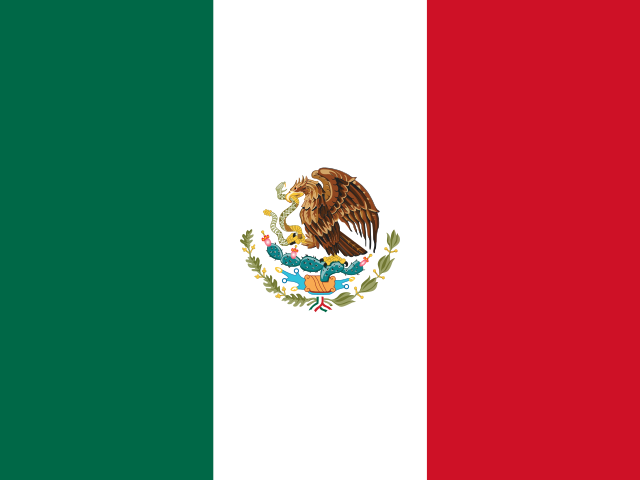
According to tradition, the Mexica (Aztecs) founded their capital Tenochtitlan in 1325 on an island in Lake Texcoco, where they saw an eagle perched on a cactus. The city grew into one of the largest in the world, and Mexico City now stands on its ruins.
1521
Tenochtitlan falls to the Spanish
After a long siege, helped by thousands of Indigenous allies, above all the Tlaxcalans, Cortés captured Tenochtitlan on 13 August 1521. Spain built Mexico City on the ruins and ruled the colony of New Spain for three centuries.
1821
Mexico wins independence
After eleven years of war, the Treaty of Córdoba was signed in August 1821, and on 27 September the Army of the Three Guarantees marched into Mexico City, ending Spanish rule.
1867
Emperor Maximilian is executed
France had installed the Austrian archduke Maximilian as Emperor of Mexico in 1864. When the French withdrew, the forces of President Benito Juárez captured him, and he was executed at Querétaro on 19 June 1867.
1917
A new constitution is signed
The constitution approved in Querétaro on 5 February 1917 laid the foundations for land reform, workers' rights and free, secular education. With many changes, it is still in force today.
1968
Mexico City hosts the Olympic Games
In October 1968 Mexico City held the first Olympic Games ever staged in Latin America and in a Spanish-speaking country. Just days before, soldiers had killed protesting students at Tlatelolco, a tragedy Mexicans still remember.
2024
Claudia Sheinbaum becomes the first woman president
On 1 October 2024 Claudia Sheinbaum, a scientist and former head of government of Mexico City, was sworn in as the first woman president of Mexico.