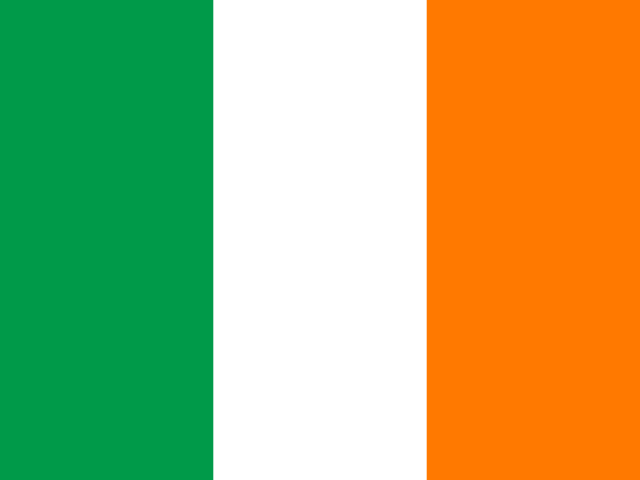
Ireland trivia: 45 questions and answers
The country at a glance
What is the capital of Ireland?
- A. Dublin
- B. Cork
- C. Galway
- D. Belfast
Show the answer
Dublin. Dublin, on the River Liffey, is the capital and largest city. Belfast is the capital of Northern Ireland, which is part of the United Kingdom.
What is the longest river in Ireland?
- A. The Shannon
- B. The Liffey
- C. The Boyne
- D. The Lee
Show the answer
The Shannon. The Shannon, about 360 km long including its estuary, is the longest river in Ireland and in Britain and Ireland.
Under the Constitution, Irish is the first official language of Ireland and English is the second.
True or false?
Show the answer
True. True. Irish (Gaeilge) is the national and first official language, and English is the second official language, although most people speak English every day.
History
Which ancient tomb in the Boyne Valley was built around 3100 BC, about 500 years before the Great Pyramid of Giza?
- A. Newgrange
- B. Skellig Michael
- C. The Rock of Cashel
- D. Glendalough
Show the answer
Newgrange. Newgrange was built by Stone Age farmers around 3100 BC. Skellig Michael, Cashel and Glendalough are early Christian and medieval sites, thousands of years younger.
Who built the settlement, around 841, that grew into the town of Dublin?
- A. The Vikings
- B. The Normans
- C. The Romans
- D. The Spanish
Show the answer
The Vikings. The Vikings built a fortified base beside the 'Dubh Linn', the black pool, around 841. The Normans only arrived in 1169, and the Romans never ruled Ireland.
Which High King of Ireland won the Battle of Clontarf in 1014 but was killed during the battle?
- A. Brian Boru
- B. Hugh O'Neill
- C. Diarmait Mac Murchada
- D. Strongbow
Show the answer
Brian Boru. Brian Boru's side won at Clontarf in 1014, but he was killed. Hugh O'Neill left Ireland in 1607, and Diarmait Mac Murchada invited the Normans, led later by Strongbow, in 1169.
Saint Patrick, the patron saint of Ireland, was born in Ireland.
True or false?
Show the answer
False. False. Patrick was born in Britain. At 16 he was captured by Irish raiders and kept as a slave in Ireland, and he later returned as a missionary.
What destroyed the potato crop and caused the Great Famine of 1845 to 1852?
- A. Potato blight, a plant disease
- B. A long drought
- C. A plague of locusts
- D. A great earthquake
Show the answer
Potato blight, a plant disease. Potato blight, a plant disease, rotted the potato crop year after year. About one million people died and more than a million emigrated.
Ireland joined the European Economic Community on the same day as the United Kingdom, 1 January 1973.
True or false?
Show the answer
True. True. Ireland, the United Kingdom and Denmark all joined on 1 January 1973.
Food and drink
What makes Irish soda bread rise, instead of yeast?
- A. Bread soda and buttermilk
- B. Beer
- C. Whisked egg whites
- D. A sourdough starter
Show the answer
Bread soda and buttermilk. Bread soda and buttermilk react together and make the dough rise, so soda bread needs no yeast and no waiting.
Which meat is traditionally used in Irish stew?
- A. Lamb or mutton
- B. Pork
- C. Chicken
- D. Fish
Show the answer
Lamb or mutton. Irish stew is traditionally made with lamb or mutton, simmered with potatoes, onions and parsley. Beef is also common today.
Colcannon is mashed potato mixed with what?
- A. Cabbage or kale
- B. Cheese and ham
- C. Apples
- D. Seaweed
Show the answer
Cabbage or kale. Colcannon is mashed potato mixed with cabbage or kale, spring onions and plenty of butter.
Which dish of sausages, rashers, potatoes and onions is especially associated with Dublin?
- A. Coddle
- B. Boxty
- C. Blaa
- D. Barmbrack
Show the answer
Coddle. Coddle is Dublin's dish. Boxty is a potato pancake from the north midlands, the blaa is a Waterford bread roll and barmbrack is a fruit bread.
White pudding, part of a full Irish breakfast, is made with blood.
True or false?
Show the answer
False. False. Black pudding contains blood. White pudding is made in a similar way with oatmeal and pork, but without blood.
In 1759 Arthur Guinness signed a lease on the St James's Gate brewery in Dublin. How long was it for?
- A. 99 years
- B. 999 years
- C. 9,000 years
- D. 90 years
Show the answer
9,000 years. The lease was for 9,000 years, at 45 pounds a year.
In an Irish pub, friends often take turns to buy a round of drinks for the whole group.
True or false?
Show the answer
True. True. Buying rounds is a pub custom. If someone buys you a drink, you are expected to buy the next round.
Cities
Which city on the River Suir was founded by Vikings in 914 and is famous for its crystal?
- A. Waterford
- B. Galway
- C. Kilkenny
- D. Sligo
Show the answer
Waterford. Waterford was founded by Vikings in 914, and crystal was first made there in 1783. The modern Waterford Crystal company was founded there in 1947.
Which city is nicknamed 'the City of the Tribes', after fourteen merchant families?
- A. Galway
- B. Limerick
- C. Cork
- D. Kilkenny
Show the answer
Galway. Galway was long ruled by fourteen merchant families, the Tribes of Galway.
Cork is the second-largest city in the Republic of Ireland.
True or false?
Show the answer
True. True. Cork, on the River Lee, is the second-largest city after Dublin.
Landmarks
As of 2026, how many UNESCO World Heritage Sites does Ireland have?
- A. 2
- B. 5
- C. 8
- D. 12
Show the answer
2. Ireland has 2 World Heritage Sites: Brú na Bóinne, with Newgrange, and Skellig Michael.
The Cliffs of Moher are a UNESCO World Heritage Site.
True or false?
Show the answer
False. False. The cliffs are part of a UNESCO Global Geopark, but they are not a World Heritage Site. Ireland's two World Heritage Sites are Brú na Bóinne and Skellig Michael.
Which famous illuminated manuscript can you see at Trinity College Dublin?
- A. The Book of Kells
- B. The Domesday Book
- C. The Dead Sea Scrolls
- D. The Magna Carta
Show the answer
The Book of Kells. The Book of Kells, a decorated book of the Gospels made around 800, has been at Trinity College since 1661.
What happens at Newgrange at dawn around the winter solstice?
- A. Sunlight shines down the passage into the inner chamber
- B. The tomb floods with sea water
- C. Bonfires are lit on its roof
- D. The stones ring like bells
Show the answer
Sunlight shines down the passage into the inner chamber. Sunlight shines down the passage into the inner chamber for about 17 minutes, as its builders planned more than 5,000 years ago.
What are people who kiss the Blarney Stone said to receive?
- A. The gift of the gab
- B. Seven years of good luck
- C. A happy marriage
- D. Good health for a year
Show the answer
The gift of the gab. The gift of the gab, a talent for charming talk, is said to come to those who kiss the stone at the top of Blarney Castle.
Scenes from Star Wars films were filmed on Skellig Michael.
True or false?
Show the answer
True. True. The island appears as the planet Ahch-To in 'The Force Awakens' and 'The Last Jedi'.
Fun facts
Ireland has native wild snakes.
True or false?
Show the answer
False. False. Legend says Saint Patrick drove the snakes out, but scientists say snakes never reached Ireland after the last Ice Age.
Which emblem of the Irish state appears on Irish euro coins and passports?
- A. A harp
- B. A red hand
- C. A lion
- D. A crown
Show the answer
A harp. A harp is the emblem of the Irish state, based on a medieval harp kept at Trinity College Dublin.
Before pumpkins, what did people in Ireland carve into Halloween lanterns?
- A. Turnips
- B. Pineapples
- C. Coconuts
- D. Watermelons
Show the answer
Turnips. Turnips were hollowed out and carved. Irish and Scottish emigrants took the custom to America, where pumpkins were easier to find.
In 2004 Ireland became the first country in the world to ban smoking in enclosed workplaces nationwide, including pubs.
True or false?
Show the answer
True. True. The ban began on 29 March 2004 and covers enclosed workplaces such as pubs, restaurants and offices.
What was the Titanic's last port of call before it crossed the Atlantic in April 1912?
- A. Cobh (then Queenstown)
- B. Galway
- C. Dún Laoghaire
- D. Waterford
Show the answer
Cobh (then Queenstown). Cobh (then Queenstown), in Cork Harbour, was the last stop on 11 April 1912. 123 passengers boarded there.
Ireland won the Eurovision Song Contest three years in a row. Which years?
- A. 1992, 1993 and 1994
- B. 1970, 1971 and 1972
- C. 1985, 1986 and 1987
- D. 2000, 2001 and 2002
Show the answer
1992, 1993 and 1994. Ireland won in 1992, 1993 and 1994, and as of 2026 it has won seven times in all.
If the Irish and English texts of the Irish Constitution disagree, the English text wins.
True or false?
Show the answer
False. False. The Constitution says that in such a case the Irish text prevails.
Words
What does the word 'craic' mean, as in 'What's the craic?'
- A. Fun, news and good company
- B. A crack in a wall
- C. A loaf of bread
- D. A fishing boat
Show the answer
Fun, news and good company. Craic means fun, news and good company. 'What's the craic?' means 'What's new?' or 'How are things?'
People say 'Sláinte!' when they raise a glass. What does the word mean?
- A. Health
- B. Goodbye
- C. Welcome
- D. Water
Show the answer
Health. Sláinte means health, so it is like saying 'to your health'.
Many Irish place names begin with 'Bally', from the Irish word 'baile'. What does 'baile' mean?
- A. Town or home
- B. Mountain
- C. Lake
- D. Island
Show the answer
Town or home. Baile means town or home. Mountain is 'sliabh' (Slieve), lake is 'loch' (Lough) and island is 'oileán'.
What are the police called in Ireland?
- A. The Gardaí
- B. The Taoiseach
- C. The Fáilte
- D. The Ceol
Show the answer
The Gardaí. The Gardaí are the police, and one officer is a Garda. The Taoiseach is the head of government.
Phrases
How do you say 'thank you' in Irish?
- A. Go raibh maith agat
- B. Dia duit
- C. Slán go fóill
- D. Le do thoil
Show the answer
Go raibh maith agat. Go raibh maith agat means thank you. Dia duit is hello, slán go fóill is goodbye for now and le do thoil is please.
What does 'Céad míle fáilte' mean?
- A. A hundred thousand welcomes
- B. Happy Christmas
- C. Good luck
- D. Where is the toilet?
Show the answer
A hundred thousand welcomes. Céad míle fáilte means a hundred thousand welcomes, the famous Irish greeting.
The usual reply to 'Dia duit' is 'Dia is Muire duit'.
True or false?
Show the answer
True. True. 'Dia duit' means 'God be with you', and the reply 'Dia is Muire duit' means 'God and Mary be with you'.
'Nollaig shona duit' means 'Happy St Patrick's Day'.
True or false?
Show the answer
False. False. 'Nollaig shona duit' means 'Happy Christmas'. For St Patrick's Day you say 'Lá fhéile Pádraig sona duit'.
Local customs and tips
On which side of the road do people drive on the island of Ireland?
- A. On the left
- B. On the right
- C. Left in the Republic, right in Northern Ireland
Show the answer
On the left. On the left, both in the Republic and in Northern Ireland.
Northern Ireland uses the euro, like the Republic of Ireland.
True or false?
Show the answer
False. False. Northern Ireland is part of the United Kingdom and uses the pound sterling. The Republic uses the euro.
In the Republic of Ireland, road speed limits are given in which units?
- A. Kilometres per hour
- B. Miles per hour
- C. Knots
Show the answer
Kilometres per hour. Kilometres per hour, up to 120 km/h on motorways. In Northern Ireland they are in miles per hour.
What are the official emergency numbers in Ireland?
- A. 112 and 999
- B. 911 and 000
- C. 100 and 101
- D. 118 and 119
Show the answer
112 and 999. In Ireland the official emergency numbers are 112 and 999. Both are free and work from any phone.
In an Irish pub it is expected that you tip the bartender for each drink you order at the bar.
True or false?
Show the answer
False. False. You do not tip for each drink ordered at the bar. In restaurants, about 10 to 15 percent is usual for good service.
Answer key
The country at a glance
- A. Dublin
- A. The Shannon
- True
History
- A. Newgrange
- A. The Vikings
- A. Brian Boru
- False
- A. Potato blight, a plant disease
- True
Food and drink
- A. Bread soda and buttermilk
- A. Lamb or mutton
- A. Cabbage or kale
- A. Coddle
- False
- C. 9,000 years
- True
Cities
- A. Waterford
- A. Galway
- True
Landmarks
- A. 2
- False
- A. The Book of Kells
- A. Sunlight shines down the passage into the inner chamber
- A. The gift of the gab
- True
Fun facts
- False
- A. A harp
- A. Turnips
- True
- A. Cobh (then Queenstown)
- A. 1992, 1993 and 1994
- False
Words
- A. Fun, news and good company
- A. Health
- A. Town or home
- A. The Gardaí
Phrases
- A. Go raibh maith agat
- A. A hundred thousand welcomes
- True
- False
Local customs and tips
- A. On the left
- False
- A. Kilometres per hour
- A. 112 and 999
- False
More about Ireland
- The trip to IrelandMap, story, food, phrases and a friendly quiz.
- Ireland word searchCities and dishes in large print.
- Irish words crosswordLearn a few words while you solve it.
- Colour the flag of IrelandPrint it or colour it in on the screen.
- Irish rootsA family guide: history, recipes and words for the grandchildren.
- Before you goPhrases, customs and tips for travellers.
- Printable packLarge print, with a quiz and answers.