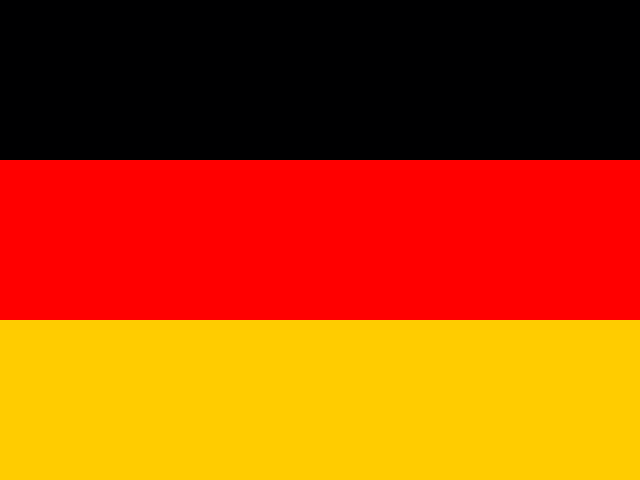
Germany trivia: 47 questions and answers
The country at a glance
What is the capital of Germany today?
- A. Berlin
- B. Bonn
- C. Munich
- D. Frankfurt
Show the answer
Berlin. Berlin has been the capital of reunified Germany since 1990. Bonn was the capital of West Germany from 1949 to 1990.
After reunification in 1990, the German parliament and government stayed in Bonn until 1999.
True or false?
Show the answer
True. True. Berlin became the capital in 1990, but Bonn remained the seat of parliament and government until 1999. It is still a 'Federal City' with several ministries.
How many countries share a land border with Germany?
- A. 6
- B. 7
- C. 9
- D. 12
Show the answer
9. Germany has 9 neighbours: Denmark, Poland, the Czech Republic, Austria, Switzerland, France, Luxembourg, Belgium and the Netherlands.
What is the highest mountain in Germany?
- A. Zugspitze
- B. Brocken
- C. Feldberg
- D. Watzmann
Show the answer
Zugspitze. The Zugspitze, 2,962 m, is in the Bavarian Alps on the border with Austria. The Watzmann and the Feldberg are lower, and the Brocken is in the Harz hills in the north.
History
In the year 9, Germanic warriors led by Arminius destroyed three legions of which empire in the Teutoburg Forest?
- A. The Roman Empire
- B. The Persian Empire
- C. The Ottoman Empire
- D. The Byzantine Empire
Show the answer
The Roman Empire. The Roman Empire lost three legions under Varus. Afterwards the Rhine became Rome's frontier.
In which city did Johannes Gutenberg print his famous Bible in the 1450s?
- A. Mainz
- B. Wittenberg
- C. Leipzig
- D. Hamburg
Show the answer
Mainz. Gutenberg printed his Bible with movable metal type in Mainz, and the first copies were ready by 1455.
Who wrote the Ninety-five Theses in Wittenberg in 1517, starting the Protestant Reformation?
- A. Martin Luther
- B. Johannes Gutenberg
- C. Otto von Bismarck
- D. Charlemagne
Show the answer
Martin Luther. Martin Luther, a monk and professor in Wittenberg, wrote the theses against the sale of indulgences in 1517.
The Holy Roman Empire came to an end in 1806, after Napoleon's victories.
True or false?
Show the answer
True. True. Emperor Francis II gave up the imperial crown on 6 August 1806, and the empire, which had lasted since 962, ended.
In 1949, the German Democratic Republic (East Germany) was founded before the Federal Republic of Germany (West Germany).
True or false?
Show the answer
False. False. The Federal Republic was founded first, with its Basic Law of 23 May 1949. The German Democratic Republic followed on 7 October 1949.
Why did the East German government begin building the Berlin Wall in 1961?
- A. To stop its citizens leaving for the West
- B. To keep out an invading army
- C. To protect the city from floods
- D. To mark a new tax border
Show the answer
To stop its citizens leaving for the West. It was built to stop its citizens leaving for the West: about 3.5 million people had already left East Germany.
On which date is the Day of German Unity, marking reunification in 1990, celebrated?
- A. 3 October
- B. 9 November
- C. 1 May
- D. 23 May
Show the answer
3 October. 3 October is the day in 1990 when the two German states became one. The Wall had opened on 9 November 1989.
Women in Germany voted in a national election for the first time in 1919.
True or false?
Show the answer
True. True. In the January 1919 election for the assembly that wrote the Weimar constitution, women could vote for the first time.
In the Holocaust, Nazi Germany and its collaborators murdered about how many Jews?
- A. About six million
- B. About six hundred thousand
- C. About sixty thousand
Show the answer
About six million. About six million Jews were murdered, around two thirds of the Jews of Europe. Many others were also persecuted and killed.
Food and drink
In which city was currywurst, sliced sausage in curry-spiced tomato sauce, first sold in 1949?
- A. Berlin
- B. Munich
- C. Hamburg
- D. Cologne
Show the answer
Berlin. Herta Heuwer is said to have created currywurst at her stall in Berlin in 1949.
By Bavarian tradition, Weisswurst is eaten before noon.
True or false?
Show the answer
True. True. An old saying goes that a Weisswurst should not hear the church bells ring noon, because it was made fresh each morning without preserving.
Maultaschen, large meat-filled pasta parcels, come from which region?
- A. Swabia
- B. Saxony
- C. Schleswig-Holstein
- D. Thuringia
Show the answer
Swabia. Maultaschen come from Swabia, in Baden-Württemberg. Legend says monks at Maulbronn Abbey hid meat inside the pasta during Lent.
The classic Swabian potato salad is dressed with mayonnaise.
True or false?
Show the answer
False. False. Swabian and other southern potato salads are dressed with hot broth, vinegar, onion and oil. Mayonnaise is more usual in the north.
How many fresh herbs go into Frankfurt green sauce?
- A. 3
- B. 5
- C. 7
- D. 10
Show the answer
7. 7 herbs: parsley, chives, chervil, borage, sorrel, garden cress and salad burnet.
Which spirit is used to soak the sponge of a Black Forest cake?
- A. Kirsch (cherry brandy)
- B. Rum
- C. Gin
- D. Whisky
Show the answer
Kirsch (cherry brandy). Kirsch (cherry brandy) soaks the chocolate sponge, which is layered with cream and sour cherries.
Early Dresden stollen was plain because butter was not allowed during the Advent fast, until a papal letter of 1490 permitted it.
True or false?
Show the answer
True. True. The 'Butter Letter' of Pope Innocent VIII in 1490 allowed butter, and stollen became the rich bread we know today.
Cities
In which city was Johann Sebastian Bach cantor of St Thomas Church from 1723 until his death?
- A. Leipzig
- B. Bonn
- C. Stuttgart
- D. Heidelberg
Show the answer
Leipzig. Bach worked in Leipzig from 1723 until he died in 1750. Bonn is Beethoven's birthplace.
Hamburg is the second-largest city in Germany.
True or false?
Show the answer
True. True. Hamburg, with about 1.9 million people, is second after Berlin. Munich is third and Cologne fourth.
Landmarks
As of 2026, how many UNESCO World Heritage Sites does Germany have?
- A. 25
- B. 40
- C. 55
- D. 70
Show the answer
55. Germany has 55 World Heritage Sites, including Cologne Cathedral, Museum Island in Berlin and, since 2025, the palaces of King Ludwig II.
Cologne Cathedral was begun in 1248. In which year was it finally completed?
- A. 1880
- B. 1348
- C. 1648
- D. 1948
Show the answer
1880. It was completed in 1880, 632 years after it was begun. Work stopped in the 1500s and restarted only in 1842.
In 1806, who took the Quadriga, the horse-drawn chariot on top of the Brandenburg Gate, to Paris?
- A. Napoleon
- B. Charlemagne
- C. Louis XIV
- D. Bismarck
Show the answer
Napoleon. Napoleon took it to Paris in 1806, and it was brought back to Berlin in 1814.
Since 2025, Neuschwanstein Castle has been part of a UNESCO World Heritage Site.
True or false?
Show the answer
True. True. In 2025 UNESCO added the palaces of King Ludwig II of Bavaria, Neuschwanstein, Linderhof, Schachen and Herrenchiemsee, to the World Heritage List.
The ruins of Dresden's Frauenkirche were left as a memorial for about 50 years, and the rebuilt church was consecrated in 2005.
True or false?
Show the answer
True. True. The church collapsed after the bombing of February 1945. It was rebuilt from 1994 and consecrated again on 30 October 2005.
Fun facts
Which three ingredients did the Bavarian beer purity law of 1516 allow?
- A. Barley, hops and water
- B. Wheat, sugar and water
- C. Barley, honey and yeast
- D. Rye, hops and malt vinegar
Show the answer
Barley, hops and water. Barley, hops and water. Yeast was added to the rule later, once its role in brewing was understood.
When it was issued in 1516, the beer purity law applied to the whole of Germany.
True or false?
Show the answer
False. False. It was a Bavarian law. It was applied across all of Germany only in 1906.
What did the first Oktoberfest in Munich, in 1810, celebrate?
- A. A royal wedding
- B. The end of a war
- C. A good harvest of hops
- D. A new king's coronation
Show the answer
A royal wedding. It celebrated a royal wedding: Crown Prince Ludwig of Bavaria married Princess Therese on 12 October 1810. The Theresienwiese is named after her.
The sweet company Haribo, maker of gummy bears, takes its name from its founder and which city?
- A. Bonn
- B. Hamburg
- C. Berlin
- D. Bochum
Show the answer
Bonn. Haribo stands for HAns RIegel BOnn. The first gummy bears were made in Bonn in 1922.
The word 'kindergarten' comes from German and means 'garden of children'.
True or false?
Show the answer
True. True. Friedrich Fröbel gave the name to his school for young children in 1840.
The Striezelmarkt, first held in 1434 and one of the oldest Christmas markets, is in which city?
- A. Dresden
- B. Cologne
- C. Stuttgart
- D. Bremen
Show the answer
Dresden. The Striezelmarkt is in Dresden, the home of Dresden stollen.
Which of these stories was published by the Brothers Grimm in their fairy tale collection?
- A. Hansel and Gretel
- B. The Little Mermaid
- C. Pinocchio
- D. Alice in Wonderland
Show the answer
Hansel and Gretel. Hansel and Gretel is one of the Grimms' tales, first published in 1812, along with Snow White and Rapunzel. The Little Mermaid is by the Dane Hans Christian Andersen.
Words
What does the German word 'Brot' mean?
- A. Bread
- B. Soup
- C. Beer
- D. Cake
Show the answer
Bread. Brot means bread. Germany bakes around 3,000 kinds of it.
In German spelling, ordinary nouns such as 'Brot' and 'Stadt' are written with a capital letter.
True or false?
Show the answer
True. True. German capitalises nouns, not only names, which is why you see 'Brot', 'Stadt' and 'Kirche'.
What does 'Feierabend' mean?
- A. The end of the working day
- B. A birthday party
- C. A public holiday
- D. An evening church service
Show the answer
The end of the working day. Feierabend is the end of the working day, and the free evening after it.
In German, a 'Burg' is usually a fortress built for defence, while a 'Schloss' is usually a grand residence or palace.
True or false?
Show the answer
True. True. Both are often translated as 'castle', but a Burg is a fortress and a Schloss is usually a palace or stately home.
Phrases
How do you say 'thank you very much' in German?
- A. Vielen Dank
- B. Guten Tag
- C. Entschuldigung
- D. Prost
Show the answer
Vielen Dank. Vielen Dank means thank you very much. Guten Tag is hello, Entschuldigung is excuse me and Prost is cheers.
'Gute Nacht' is the usual greeting when you arrive at a friend's house in the evening.
True or false?
Show the answer
False. False. When you arrive in the evening you say 'Guten Abend', good evening. 'Gute Nacht' is said when leaving late or going to bed.
What do Germans say when they raise a glass of beer together?
- A. Prost!
- B. Tschüss!
- C. Bitte!
- D. Hallo!
Show the answer
Prost!. Prost! means cheers. With wine people also often say 'Zum Wohl'.
Which phrase politely asks 'Do you speak English?'
- A. Sprechen Sie Englisch?
- B. Wie viel kostet das?
- C. Wie geht es Ihnen?
- D. Ich heiße ...
Show the answer
Sprechen Sie Englisch?. Sprechen Sie Englisch? asks if someone speaks English. Wie viel kostet das? asks the price, wie geht es Ihnen? is how are you, and ich heiße ... means my name is ...
Local customs and tips
Most shops in Germany, including supermarkets, are closed on Sundays.
True or false?
Show the answer
True. True. Sunday opening is restricted by law. Bakeries and shops in large stations and airports are among the exceptions.
How much is the deposit (Pfand) on a single-use plastic bottle or can in Germany?
- A. 25 cents
- B. 5 cents
- C. 1 euro
- D. There is no deposit
Show the answer
25 cents. 25 cents. Return the bottle or can to a machine in a supermarket and you get a voucher for the till.
As of 2026, which of these is NOT covered by the Deutschlandticket?
- A. ICE high-speed trains
- B. Regional trains
- C. City buses and trams
- D. The U-Bahn
Show the answer
ICE high-speed trains. ICE high-speed trains are not included. The ticket covers local and regional transport: buses, trams, U-Bahn, S-Bahn and regional trains.
What is the usual way to tip in a German restaurant?
- A. Round up and tell the server the total you want to pay
- B. Leave 20 percent on the table
- C. Tipping is forbidden
- D. Pay an automatic 15 percent service charge
Show the answer
Round up and tell the server the total you want to pay. Round up and tell the server the total you want to pay, adding about 5 to 10 percent, or say 'Stimmt so', keep the change.
What is the official emergency number for an ambulance or the fire brigade in Germany?
- A. 112
- B. 110
- C. 115
- D. 118
Show the answer
112. 112 is the official number for an ambulance or the fire brigade, free from any phone. 110 is the police, and 115 is a general government information line.
Answer key
The country at a glance
- A. Berlin
- True
- C. 9
- A. Zugspitze
History
- A. The Roman Empire
- A. Mainz
- A. Martin Luther
- True
- False
- A. To stop its citizens leaving for the West
- A. 3 October
- True
- A. About six million
Food and drink
- A. Berlin
- True
- A. Swabia
- False
- C. 7
- A. Kirsch (cherry brandy)
- True
Cities
- A. Leipzig
- True
Landmarks
- C. 55
- A. 1880
- A. Napoleon
- True
- True
Fun facts
- A. Barley, hops and water
- False
- A. A royal wedding
- A. Bonn
- True
- A. Dresden
- A. Hansel and Gretel
Words
- A. Bread
- True
- A. The end of the working day
- True
Phrases
- A. Vielen Dank
- False
- A. Prost!
- A. Sprechen Sie Englisch?
Local customs and tips
- True
- A. 25 cents
- A. ICE high-speed trains
- A. Round up and tell the server the total you want to pay
- A. 112
More about Germany
- The trip to GermanyMap, story, food, phrases and a friendly quiz.
- Germany word searchCities and dishes in large print.
- German words crosswordLearn a few words while you solve it.
- Colour the flag of GermanyPrint it or colour it in on the screen.
- German rootsA family guide: history, recipes and words for the grandchildren.
- Before you goPhrases, customs and tips for travellers.
- Printable packLarge print, with a quiz and answers.