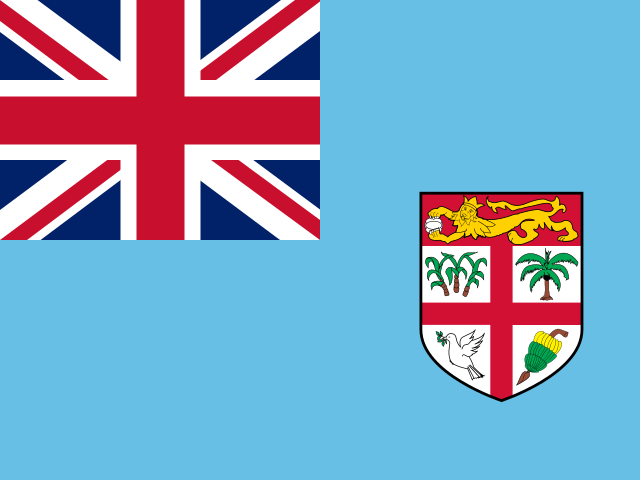
Fiji trivia: 47 questions and answers
The country at a glance
What is the capital of Fiji?
- A. Suva
- B. Nadi
- C. Lautoka
- D. Labasa
Show the answer
Suva. Suva, on the southeast coast of Viti Levu, is the capital, the largest city and the main port.
What is Fiji's official currency?
- A. Fijian dollar
- B. Indian rupee
- C. New Zealand dollar
- D. Pound sterling
Show the answer
Fijian dollar. The Fijian dollar (FJD) replaced the Fijian pound in 1969.
About how many islands make up Fiji, not counting the hundreds of tiny islets?
- A. More than 330
- B. About 30
- C. About 80
- D. More than 3,000
Show the answer
More than 330. Fiji has more than 330 islands, and about 110 of them are lived on all year. Most people live on Viti Levu and Vanua Levu.
Fiji shares a land border with Vanuatu.
True or false?
Show the answer
False. False. Fiji is made up entirely of islands and has no land borders. Vanuatu is its neighbour across the sea to the west.
Mount Tomanivi, Fiji's highest mountain, is more than 2,000 m high.
True or false?
Show the answer
False. False. Mount Tomanivi, an extinct volcano on Viti Levu, is 1,324 m high.
History
Fiji became independent from Britain on 10 October 1970.
True or false?
Show the answer
True. True. The British flag came down in Suva at sunset on 9 October 1970 and Fiji became independent at midnight. 10 October is Fiji Day.
Who was the first known European to sight the Fiji islands, in 1643?
- A. Abel Tasman
- B. James Cook
- C. William Bligh
- D. Ferdinand Magellan
Show the answer
Abel Tasman. The Dutch explorer Abel Tasman sighted Vanua Levu and the islands north of Taveuni in 1643. Cook came in 1774 and Bligh in 1789.
Which chief was crowned King of Fiji at Levuka in 1871?
- A. Seru Epenisa Cakobau
- B. Enele Ma'afu
- C. John Bates Thurston
- D. William Bligh
Show the answer
Seru Epenisa Cakobau. Seru Epenisa Cakobau, chief of Bau, was crowned king in 1871. Three years later he signed the Deed of Cession that made Fiji a British colony.
Why is the ship Leonidas remembered in Fiji?
- A. It brought the first indentured workers from India, in 1879
- B. It carried the Deed of Cession to London, in 1874
- C. It brought Abel Tasman to Fiji, in 1643
- D. It was the first steamship to reach Fiji, in 1882
Show the answer
It brought the first indentured workers from India, in 1879. It brought the first indentured workers from India, in 1879: 463 people who came to work in the sugarcane fields. About 60,000 came in all before the scheme ended in 1916.
Which town on the island of Ovalau was Fiji's capital before Suva?
- A. Levuka
- B. Lautoka
- C. Savusavu
- D. Sigatoka
Show the answer
Levuka. Levuka was the capital until the government moved to Suva, a move decided in 1877 and completed in 1882. There was no room for it to grow between the sea and the hills.
A measles epidemic in 1875 and 1876 killed about a third of Fiji's indigenous people.
True or false?
Show the answer
True. True. More than 40,000 Fijians died after a ship bringing Cakobau back from Sydney, where he had caught measles, was not quarantined.
Fiji became a republic on the day it became independent, in 1970.
True or false?
Show the answer
False. False. Fiji became independent in 1970 as a Commonwealth realm with the British monarch as head of state. It was declared a republic in 1987, after two coups.
Food and drink
What is kokoda?
- A. Raw fish marinated in lime juice and mixed with coconut milk
- B. Pork cooked for hours in an earth oven
- C. A flatbread cooked on a hot iron plate
- D. A soup of yellow split peas
Show the answer
Raw fish marinated in lime juice and mixed with coconut milk. Kokoda is raw fish marinated in lime juice and mixed with coconut milk, with tomato, onion and chilli. It is served cold.
What is a Fijian lovo?
- A. A feast cooked for hours on hot stones in a pit in the ground
- B. A wooden bowl for serving kava
- C. A sweet steamed pudding made with cassava
- D. A fish market held on Saturday mornings
Show the answer
A feast cooked for hours on hot stones in a pit in the ground. A lovo is a feast cooked for hours on hot stones in a pit in the ground. Meat, fish and root crops are wrapped in leaves and covered with earth.
Yaqona, Fiji's national drink, is made from the root of which plant?
- A. Kava
- B. Sugarcane
- C. Coconut palm
- D. Taro
Show the answer
Kava. Yaqona is made from the dried and powdered root of kava, a relative of pepper, mixed with water in a wooden bowl called a tanoa.
When you are handed a cup of yaqona, it is customary to clap once and drink it in one go.
True or false?
Show the answer
True. True. You clap once, take the cup, drink the yaqona in a single draught and hand the cup back.
Which thin flatbread, brought to Fiji by Indian families, is used to scoop up curry and dhal?
- A. Roti
- B. Madrai
- C. Damper
- D. Tortilla
Show the answer
Roti. Roti is cooked on a hot iron plate and torn by hand to scoop up curry and dhal. Many Fijian families eat roti and curry for breakfast or lunch.
Duruka, sometimes called Fijian asparagus, is what part of a plant?
- A. The unopened flower head of a close relative of sugarcane
- B. The young shoot of a coconut palm
- C. The leaf of the taro plant
- D. The root of the kava plant
Show the answer
The unopened flower head of a close relative of sugarcane. Duruka is the unopened flower head of a close relative of sugarcane. It is sold in bundles at markets and eaten raw or cooked.
Cassava, called tavioka, has overtaken yams to become Fiji's most widely grown staple crop.
True or false?
Show the answer
True. True. Cassava has replaced yams and is now the most cultivated and eaten staple in Fiji. It is usually boiled and eaten with stews and curries.
Shark meat is a favourite dish at Fijian village feasts.
True or false?
Show the answer
False. False. In many communities sharks are linked to the sea god Dakuwaqa and are taboo, and eating one is believed to bring misfortune.
Cities
Which city on the west coast of Viti Levu is known as the Sugar City?
- A. Lautoka
- B. Suva
- C. Levuka
- D. Nausori
Show the answer
Lautoka. Lautoka, Fiji's second city, lies in the heart of the sugarcane country and has a large sugar mill.
Near which town is Fiji's main international airport, where most visitors arrive?
- A. Nadi
- B. Labasa
- C. Levuka
- D. Savusavu
Show the answer
Nadi. Nadi International Airport, on the west coast of Viti Levu, is the main gateway to Fiji.
Savusavu is known for hot springs along its shore.
True or false?
Show the answer
True. True. At low tide steam rises all along the shore of Savusavu, on Vanua Levu, and villagers have cooked taro and breadfruit in the hottest pools for centuries.
Landmarks
As of 2026, which place is Fiji's UNESCO World Heritage Site?
- A. Levuka Historical Port Town
- B. Sigatoka Sand Dunes National Park
- C. Navala Village
- D. Colo-i-Suva Forest Park
Show the answer
Levuka Historical Port Town. Levuka Historical Port Town, Fiji's first colonial capital, was inscribed in 2013. As of 2026 it is Fiji's only World Heritage Site.
Which actor, famous as television's Perry Mason, started the Garden of the Sleeping Giant near Nadi in 1977?
- A. Raymond Burr
- B. Marlon Brando
- C. Gregory Peck
- D. Humphrey Bogart
Show the answer
Raymond Burr. Raymond Burr started the garden for his own collection of orchids. Today it shows more than a thousand kinds of orchids.
What is Navala, in the Ba Highlands, known for?
- A. More than 200 traditional thatched houses
- B. Fiji's largest sugar mill
- C. A Hindu temple painted in bright colours
- D. White sand dunes up to 60 m high
Show the answer
More than 200 traditional thatched houses. Navala has more than 200 traditional thatched houses called bure, and is one of the few villages in Fiji that is still fully traditional in its architecture.
The Fiji Museum in Suva displays the rudder of HMS Bounty.
True or false?
Show the answer
True. True. Along with the rudder of the Bounty, the museum's centrepiece is a 13 m double-hulled canoe, the Ratu Finau.
The Sigatoka Sand Dunes lie at the mouth of which river?
- A. Sigatoka River
- B. Rewa River
- C. Ba River
- D. Navua River
Show the answer
Sigatoka River. The dunes lie at the mouth of the Sigatoka River on the south coast of Viti Levu. Pottery more than 2,600 years old has been found there.
Fun facts
Which line of longitude runs across the Fijian island of Taveuni?
- A. The 180th meridian
- B. The Prime Meridian
- C. The 90th meridian east
- D. The 150th meridian west
Show the answer
The 180th meridian. The 180th meridian crosses Taveuni, but the International Date Line bends around Fiji so the whole country shares one date.
Where does the English name Fiji come from?
- A. The Tongan way of saying Viti
- B. A Dutch word for 'green island'
- C. The name of a British ship
- D. The Hindi word for 'sugar'
Show the answer
The Tongan way of saying Viti. Fijians call their islands Viti. The Tongans said 'Fisi', and James Cook wrote the name down from them. So Fiji is the Tongan way of saying Viti.
In which sport did Fiji win its first Olympic medal, a gold, in 2016?
- A. Rugby sevens
- B. Boxing
- C. Sailing
- D. Weightlifting
Show the answer
Rugby sevens. Fiji's rugby sevens team beat Great Britain 43 to 7 in the Rio final, and won gold again at the Tokyo Games.
As of 2026, Cyclone Winston, which struck Fiji in February 2016, is the most intense tropical cyclone on record in the Southern Hemisphere.
True or false?
Show the answer
True. True. A wind gust of 306 km/h, a national record, was measured on Vanua Balavu as the storm crossed Fiji.
The Sawau people, famous for walking on white-hot stones, come from which island?
- A. Beqa
- B. Ovalau
- C. Kadavu
- D. Rotuma
Show the answer
Beqa. The firewalkers of Beqa, an island off the south coast of Viti Levu, say an ancestor was given the power by a spirit god.
As of 2026, new Fijian banknotes show a portrait of the British monarch.
True or false?
Show the answer
False. False. Queen Elizabeth II stayed on Fiji's money until 2013, when the new series replaced her with Fiji's own plants and animals.
Words
The everyday Fijian greeting bula literally means what?
- A. Life
- B. Sun
- C. Friend
- D. Welcome home
Show the answer
Life. Bula means life, so saying 'Bula!' is like wishing someone good health and life.
In written Fijian, how is the letter c pronounced, as in moce (goodbye)?
- A. Like 'th' in 'that'
- B. Like 'k' in 'kite'
- C. Like 's' in 'sun'
- D. Like 'ch' in 'chair'
Show the answer
Like 'th' in 'that'. Like 'th' in 'that'. So moce sounds like MOH-theh, and Cakobau like Thah-kom-BAU.
The Fijian word tabu means 'forbidden'.
True or false?
Show the answer
True. True. You may see TABU on signs, and English borrowed the same Pacific word as 'taboo'.
What is madrai?
- A. Bread
- B. Milk
- C. Chicken
- D. Money
Show the answer
Bread. Madrai means bread. Milk is sucu, chicken is toa and money is ilavo.
Phrases
How do you say 'thank you very much' in Fijian?
- A. Vinaka vakalevu
- B. Ni sa moce
- C. Sota tale
- D. Vosoti au
Show the answer
Vinaka vakalevu. Vinaka vakalevu means thank you very much. Ni sa moce is goodbye, sota tale is see you again, and vosoti au is I'm sorry.
At a market stall, 'E vica?' means 'Where is it?'.
True or false?
Show the answer
False. False. E vica? means how much?, the question to ask about prices.
What does 'Sega na lega' mean?
- A. No worries
- B. Good morning
- C. I don't know
- D. Help!
Show the answer
No worries. Sega na lega means no worries. Good morning is ni sa yadra, I don't know is au sega ni kila, and help is kere veivuke.
Which phrase do you use to say goodbye or good night politely?
- A. Ni sa moce
- B. Ni sa bula
- C. Ni sa yadra
- D. O cei na yacamu?
Show the answer
Ni sa moce. Ni sa moce means goodbye or good night. Ni sa bula is hello, ni sa yadra is good morning, and o cei na yacamu? asks someone's name.
Local customs and tips
What is the traditional gift, called sevusevu, to bring when you visit a Fijian village?
- A. A bundle of kava roots
- B. A bottle of rum
- C. A basket of pineapples
- D. A bouquet of cut flowers
Show the answer
A bundle of kava roots. A bundle of kava roots is the usual sevusevu. You can buy one at any town market, and it is presented to the chief or head of the family.
In Fijian villages, visitors are expected to cover their shoulders and knees.
True or false?
Show the answer
True. True. This applies to men and women. A sulu, a wrap-around cloth, is perfect, and villagers are often happy to lend one.
In which months can tropical cyclones strike Fiji?
- A. November to April
- B. May to October
- C. June to August
- D. July to September
Show the answer
November to April. The cyclone season runs from November to April, the warm and wet months of the Southern Hemisphere summer.
In Fiji, a tip of 15 percent is expected in restaurants.
True or false?
Show the answer
False. False. Tipping is not part of Fijian culture. Some resorts keep a staff 'Christmas box' for those who want to give something.
On which side of the road does traffic drive in Fiji?
- A. On the left
- B. On the right
- C. It depends on the island
Show the answer
On the left. Traffic in Fiji drives on the left, as in Australia and New Zealand.
Answer key
The country at a glance
- A. Suva
- A. Fijian dollar
- A. More than 330
- False
- False
History
- True
- A. Abel Tasman
- A. Seru Epenisa Cakobau
- A. It brought the first indentured workers from India, in 1879
- A. Levuka
- True
- False
Food and drink
- A. Raw fish marinated in lime juice and mixed with coconut milk
- A. A feast cooked for hours on hot stones in a pit in the ground
- A. Kava
- True
- A. Roti
- A. The unopened flower head of a close relative of sugarcane
- True
- False
Cities
- A. Lautoka
- A. Nadi
- True
Landmarks
- A. Levuka Historical Port Town
- A. Raymond Burr
- A. More than 200 traditional thatched houses
- True
- A. Sigatoka River
Fun facts
- A. The 180th meridian
- A. The Tongan way of saying Viti
- A. Rugby sevens
- True
- A. Beqa
- False
Words
- A. Life
- A. Like 'th' in 'that'
- True
- A. Bread
Phrases
- A. Vinaka vakalevu
- False
- A. No worries
- A. Ni sa moce
Local customs and tips
- A. A bundle of kava roots
- True
- A. November to April
- False
- A. On the left
More about Fiji
- The trip to FijiMap, story, food, phrases and a friendly quiz.
- Fiji word searchCities and dishes in large print.
- Fijian words crosswordLearn a few words while you solve it.
- Colour the flag of FijiPrint it or colour it in on the screen.
- Fijian rootsA family guide: history, recipes and words for the grandchildren.
- Before you goPhrases, customs and tips for travellers.
- Printable packLarge print, with a quiz and answers.