Dominican Republic trivia: 48 questions and answers
The country at a glance
Which country shares the island of Hispaniola with the Dominican Republic?
- A. Haiti
- B. Cuba
- C. Jamaica
- D. Puerto Rico
Show the answer
Haiti. Haiti occupies the western part of Hispaniola, and the Dominican Republic the eastern five-eighths.
What is the capital of the Dominican Republic?
- A. Santo Domingo
- B. Santiago de los Caballeros
- C. Punta Cana
- D. Puerto Plata
Show the answer
Santo Domingo. Santo Domingo, on the Caribbean coast, is the capital and by far the largest city.
What is the currency of the Dominican Republic?
- A. Dominican peso
- B. Dominican dollar
- C. Dominican colón
- D. Dominican real
Show the answer
Dominican peso. The currency is the Dominican peso (DOP). Prices are often written RD with the dollar sign.
Spanish is the official language of the Dominican Republic.
True or false?
Show the answer
True. True. Spanish is the official language; the local variety is called Dominican Spanish.
History
On 27 February 1844, Dominicans declared independence from which country?
- A. Haiti
- B. Spain
- C. France
- D. The United States
Show the answer
Haiti. In 1844 the country declared independence from Haiti, which had ruled the whole island since 1822.
The Dominican Republic celebrates its Independence Day on 27 February.
True or false?
Show the answer
True. True. Independence was declared on 27 February 1844, and the day is also the high point of carnival season.
From 1936 to 1961, what was Santo Domingo officially called?
- A. Ciudad Trujillo
- B. Ciudad Duarte
- C. Ciudad Colón
- D. Ciudad Balaguer
Show the answer
Ciudad Trujillo. The dictator Rafael Trujillo named the capital Ciudad Trujillo after himself in 1936; it got its old name back after his death in 1961.
The United States occupied the Dominican Republic from 1916 to 1934.
True or false?
Show the answer
False. False. The US occupation lasted from 1916 to 1924.
Food and drink
What is the everyday Dominican lunch of white rice, red beans and stewed meat called?
- A. La bandera
- B. Los tres golpes
- C. El concón
- D. La yaroa
Show the answer
La bandera. La bandera, 'the flag', is the most popular lunch in the country: white rice, red beans and stewed meat.
Mangú, the national breakfast dish, is made from which mashed ingredient?
- A. Green plantains
- B. Potatoes
- C. Pumpkin
- D. Chickpeas
Show the answer
Green plantains. Mangú is boiled green plantains mashed until smooth, topped with red onions softened in vinegar.
What are "los tres golpes", the three hits, served with mangú?
- A. Fried cheese, fried salami and fried eggs
- B. Rice, beans and stewed meat
- C. Avocado, tomato and onion
- D. Rum, coffee and orange juice
Show the answer
Fried cheese, fried salami and fried eggs. Fried cheese, fried salami and fried eggs are the three hits; together with mangú they make the classic Dominican breakfast.
The festive stew sancocho de siete carnes is made with how many kinds of meat?
- A. 7
- B. 3
- C. 5
- D. 12
Show the answer
7. 7: siete carnes means seven meats, such as chicken, beef, pork, goat and sausage, cooked with root vegetables and plantain.
Habichuelas con dulce, a sweet dessert popular at Easter, is made mainly from what?
- A. Red beans
- B. Rice
- C. Corn
- D. Chickpeas
Show the answer
Red beans. It is made from red beans blended and cooked with coconut milk, evaporated milk, sugar, spices, raisins and sweet potato.
Casabe, the crisp flatbread the Taíno ate long before the Spanish arrived, is made from which root?
- A. Cassava
- B. Potato
- C. Ginger
- D. Carrot
Show the answer
Cassava. Casabe is made from grated cassava (yuca). UNESCO listed the tradition of cassava bread in 2024.
Tostones are made from ripe, sweet yellow plantains.
True or false?
Show the answer
False. False. Tostones are made from green, unripe plantains, fried, flattened and fried a second time.
Mamajuana is made by soaking tree bark and herbs in rum, red wine and honey.
True or false?
Show the answer
True. True. The mix is left to soak for weeks and becomes a deep red drink that tastes a little like port.
Cities
Which is the second largest city of the Dominican Republic?
- A. Santiago de los Caballeros
- B. La Romana
- C. Puerto Plata
- D. Barahona
Show the answer
Santiago de los Caballeros. Santiago de los Caballeros, in the Cibao valley, had about 770,000 people in the 2022 census.
Which city is famous for one of the country's biggest carnivals, with masked devils called diablos cojuelos?
- A. La Vega
- B. Monte Cristi
- C. Jarabacoa
- D. Samaná
Show the answer
La Vega. La Vega's carnival in February is one of the biggest in the country, and the diablo cojuelo is its best-known character.
From January to March, humpback whales come to Samaná Bay to give birth.
True or false?
Show the answer
True. True. Thousands of North Atlantic humpback whales arrive every winter, and Samaná is the centre for whale watching.
San Pedro de Macorís is famous for producing an unusually large number of professional players of which sport?
- A. Baseball
- B. Volleyball
- C. Tennis
- D. Golf
Show the answer
Baseball. Baseball: Cuban immigrants brought the game to San Pedro de Macorís in the late 1800s, and the city has produced many major league players.
Landmarks
As of 2026, how many UNESCO World Heritage Sites does the Dominican Republic have?
- A. 1
- B. 3
- C. 5
- D. 7
Show the answer
1. It has 1: the Colonial City of Santo Domingo, listed in 1990.
The huge cross-shaped Faro a Colón in Santo Domingo is a monument to whom?
- A. Christopher Columbus
- B. Juan Pablo Duarte
- C. Francis Drake
- D. Saint Dominic
Show the answer
Christopher Columbus. The Faro a Colón, the Columbus Lighthouse, honours Christopher Columbus and opened in 1992, 500 years after his first voyage.
Altos de Chavón is a village built by Spanish settlers in the 1500s.
True or false?
Show the answer
False. False. It looks old, but it was built from 1976 as a recreation of a 16th-century Mediterranean village.
Pico Duarte, the highest mountain in the Caribbean, is about how high?
- A. About 3,100 m
- B. About 1,500 m
- C. About 2,200 m
- D. About 4,800 m
Show the answer
About 3,100 m. It is about 3,100 m high; measurements range from about 3,087 to 3,101 m.
What makes Lake Enriquillo special?
- A. Its surface lies below sea level, the lowest point in the Caribbean
- B. It is a crater lake at the top of a volcano
- C. It freezes over every winter
- D. It is the source of the Yaque del Norte
Show the answer
Its surface lies below sea level, the lowest point in the Caribbean. Its surface lies below sea level, the lowest point in the Caribbean: about 45 m below. It is also the largest lake in the Caribbean and home to American crocodiles.
The Cathedral of Santo Domingo stands inside the Colonial City, a UNESCO World Heritage Site.
True or false?
Show the answer
True. True. The cathedral, on Parque Colón, is part of the Colonial City of Santo Domingo, listed by UNESCO in 1990.
Fun facts
Larimar, a blue stone found only in the Dominican Republic, comes from the area around which city?
- A. Barahona
- B. Punta Cana
- C. Samaná
- D. Monte Cristi
Show the answer
Barahona. Larimar is found only in the mountains near Barahona, in the southwest.
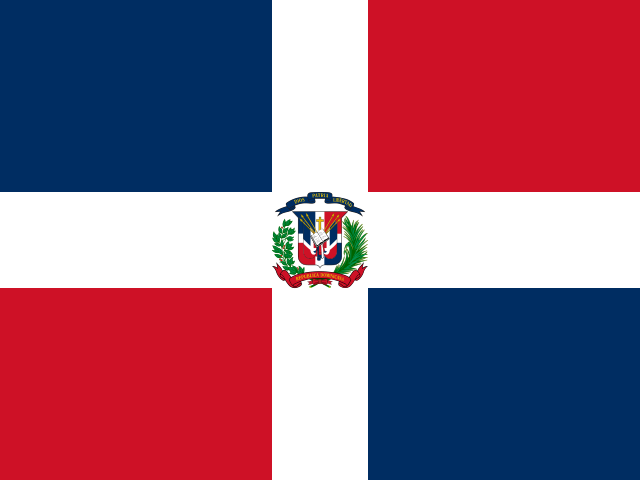
As of 2026, what does the Dominican flag show that no other national flag shows?
- A. A Bible
- B. An eagle
- C. A ship
- D. A star
Show the answer
A Bible. A Bible lies open in the coat of arms at the centre of the white cross, and no other national flag shows one.
Which three instruments make up a traditional merengue band?
- A. Accordion, tambora drum and güira
- B. Steel drums, bass and trumpet
- C. Violin, piano and flute
- D. Bagpipes, drum and whistle
Show the answer
Accordion, tambora drum and güira. Accordion, tambora drum and güira: they are said to stand for the country's European, African and Taíno roots.
Bachata used to be called "amargue", meaning bitterness, because so many songs are about heartbreak.
True or false?
Show the answer
True. True. Amargue was its original name. Bachata was added to UNESCO's Intangible Cultural Heritage list in 2019.
Hispaniola and which other Caribbean island are each shared by two countries?
- A. Saint Martin
- B. Trinidad
- C. Jamaica
- D. Puerto Rico
Show the answer
Saint Martin. Saint Martin is divided between France and the Netherlands; Hispaniola between the Dominican Republic and Haiti.
Which UN international day is held on 25 November, the anniversary of the Mirabal sisters' murder?
- A. The International Day for the Elimination of Violence against Women
- B. International Women's Day
- C. World Human Rights Day
- D. International Day of Peace
Show the answer
The International Day for the Elimination of Violence against Women. In 1999 the UN chose 25 November as the International Day for the Elimination of Violence against Women, in memory of the Mirabal sisters.
The beach town of Sosúa was settled by Jewish refugees from Germany and Austria in the early 1940s.
True or false?
Show the answer
True. True. About 800 Jewish refugees received Dominican visas between 1940 and 1945 and settled in Sosúa.
Words
In the Dominican Republic, what is a "guagua"?
- A. A bus
- B. A market
- C. A drink
- D. A hat
Show the answer
A bus. A guagua is a bus, very often a crowded minibus.
What is a "colmado"?
- A. A neighbourhood corner shop
- B. A motorbike taxi
- C. A rice dish
- D. A storm
Show the answer
A neighbourhood corner shop. A colmado is a neighbourhood corner shop, and often a place where people meet and chat.
If a Dominican asks for "un chin", how much do they want?
- A. A little bit
- B. A lot
- C. Exactly half
- D. Nothing at all
Show the answer
A little bit. Un chin means a little bit, as in "un chin de azúcar", a little sugar.
"Yipeta" is the Dominican word for a bicycle.
True or false?
Show the answer
False. False. A yipeta is an SUV, a four-wheel-drive car; the word comes from "jeep".
The Spanish word "huracán", which gave English the word "hurricane", was borrowed from the Taíno language.
True or false?
Show the answer
True. True. The Spanish took the word from the Taíno of the Caribbean in the early 1500s.
Phrases
How do you ask for the bill in a restaurant?
- A. La cuenta, por favor
- B. ¡Buen provecho!
- C. Permiso
- D. Mucho gusto
Show the answer
La cuenta, por favor. "La cuenta, por favor" means "The bill, please".
What does the very Dominican greeting "¿Qué lo qué?" mean?
- A. What's up?
- B. Goodbye!
- C. How much is it?
- D. Thank you!
Show the answer
What's up?. "¿Qué lo qué?" means "What's up?", a casual greeting among friends.
What does "¡Buen provecho!" mean?
- A. Enjoy your meal!
- B. Cheers!
- C. Excuse me!
- D. Good night!
Show the answer
Enjoy your meal!. "¡Buen provecho!" means "Enjoy your meal!" and is said before eating or to people who are eating.
In everyday Dominican Spanish, an "s" at the end of a syllable is often dropped or softened to a breathy "h".
True or false?
Show the answer
True. True. "Las mesas" often sounds like "lah mesah", so "gracias" may sound like "gracia".
Local customs and tips
When is the hurricane season in the Caribbean?
- A. June to November
- B. December to March
- C. March to May
- D. Only in January
Show the answer
June to November. The hurricane season normally runs from June to November, when the sea can also be rough.
Tap water in the Dominican Republic is safe to drink.
True or false?
Show the answer
False. False. Tap water is not drinkable; use bottled water, and be careful with ice.
What must every traveller fill in online before flying into or out of the Dominican Republic?
- A. An entry and exit form, often called the e-Ticket
- B. A driving permit application
- C. A hotel registration card
- D. A currency declaration for any amount of cash
Show the answer
An entry and exit form, often called the e-Ticket. An entry and exit form, often called the e-Ticket, gives you a QR code; you can fill it in up to 7 days before arrival.
What do most restaurant bills in the Dominican Republic already include?
- A. 18 percent tax and a 10 percent service charge
- B. No tax and no service charge
- C. A 5 percent tourist fee only
- D. A fixed charge for bread
Show the answer
18 percent tax and a 10 percent service charge. Bills usually add 18 percent tax and a 10 percent service charge; many people leave about 10 percent more for very good service.
As of September 2026, British visitors can stay up to 30 days for tourism without a visa.
True or false?
Show the answer
True. True. As of September 2026, British tourists can stay 30 days without a visa and can pay to extend their stay.
What is the national emergency number in the Dominican Republic?
- A. 911
- B. 999
- C. 000
- D. 066
Show the answer
911. 911 is the national emergency number, although it does not yet cover the whole country; outside Santo Domingo you can also call the tourist police, Politur.
Answer key
The country at a glance
- A. Haiti
- A. Santo Domingo
- A. Dominican peso
- True
History
- A. Haiti
- True
- A. Ciudad Trujillo
- False
Food and drink
- A. La bandera
- A. Green plantains
- A. Fried cheese, fried salami and fried eggs
- A. 7
- A. Red beans
- A. Cassava
- False
- True
Cities
- A. Santiago de los Caballeros
- A. La Vega
- True
- A. Baseball
Landmarks
- A. 1
- A. Christopher Columbus
- False
- A. About 3,100 m
- A. Its surface lies below sea level, the lowest point in the Caribbean
- True
Fun facts
- A. Barahona
- A. A Bible
- A. Accordion, tambora drum and güira
- True
- A. Saint Martin
- A. The International Day for the Elimination of Violence against Women
- True
Words
- A. A bus
- A. A neighbourhood corner shop
- A. A little bit
- False
- True
Phrases
- A. La cuenta, por favor
- A. What's up?
- A. Enjoy your meal!
- True
Local customs and tips
- A. June to November
- False
- A. An entry and exit form, often called the e-Ticket
- A. 18 percent tax and a 10 percent service charge
- True
- A. 911
More about the Dominican Republic
- The trip to the Dominican RepublicMap, story, food, phrases and a friendly quiz.
- Dominican Republic word searchCities and dishes in large print.
- Dominican words crosswordLearn a few words while you solve it.
- Colour the flag of the Dominican RepublicPrint it or colour it in on the screen.
- Dominican rootsA family guide: history, recipes and words for the grandchildren.
- Before you goPhrases, customs and tips for travellers.
- Printable packLarge print, with a quiz and answers.