The Hafit period begins
Around 3200 BC people began building beehive-shaped stone tombs on the slopes of Jebel Hafeet near today's Al Ain. The period is named after the mountain, and the tombs are part of a World Heritage Site.
The United Arab Emirates sits at the eastern end of the Arabian Peninsula. Most of the country faces the Persian Gulf, while a short stretch of coast in the east looks out on the Gulf of Oman. Inland, sand dunes roll south into the Empty Quarter, and in the north and east the bare, rocky Hajar Mountains rise along the border with Oman.
It is a federation of seven emirates: Abu Dhabi, Dubai, Sharjah, Ajman, Umm Al Quwain, Ras Al Khaimah and Fujairah. Each has its own hereditary ruler, and together the seven rulers form the Federal Supreme Council, which elects the country's president. Abu Dhabi, by far the largest emirate, holds the capital, while Dubai is the biggest city.
Memories fade faster than photos. Ask these over a meal or a phone call, and write the answers down.
People have lived along this coast and in its oases for thousands of years, trading copper with Mesopotamia and the Indus Valley and farming dates with the help of underground water channels called falaj. Islam arrived in the 7th century. From the 1820s the coastal sheikhdoms signed a series of treaties with Britain and became known as the Trucial States. After Britain decided to leave the Gulf, six of them formed the United Arab Emirates in December 1971, and Ras Al Khaimah joined on 10 February 1972.
Around 3200 BC people began building beehive-shaped stone tombs on the slopes of Jebel Hafeet near today's Al Ain. The period is named after the mountain, and the tombs are part of a World Heritage Site.
Islam is thought to have reached the region after the Prophet Muhammad sent a letter to the rulers of Oman in 630. Within a few years the peoples of the coast and the oases had become Muslim.
The ruling family of the Bani Yas tribe moved their residence from the Liwa Oasis in the desert to Abu Dhabi island on the coast, where pearling and fishing offered a living.
Members of the Al Bu Falasah tribe left Abu Dhabi and settled on the creek at Dubai, led by Maktoum bin Butti and Obeid bin Saeed. The Al Maktoum family has ruled Dubai ever since.
In January 1968 the British government announced that it would end its treaties with the Gulf sheikhdoms and withdraw its forces by the end of 1971. The rulers began talks about forming a union.
Ras Al Khaimah, the northernmost emirate, joined the federation on 10 February 1972, making it the seven emirates of today.
The Burj Khalifa in Dubai opened on 4 January 2010. At 828 m it became the tallest building in the world, a title it still held as of September 2026.
UNESCO added the Faya Palaeolandscape in the emirate of Sharjah to its World Heritage List. Stone tools found at Jebel Faya are some of the earliest evidence of modern humans outside Africa.
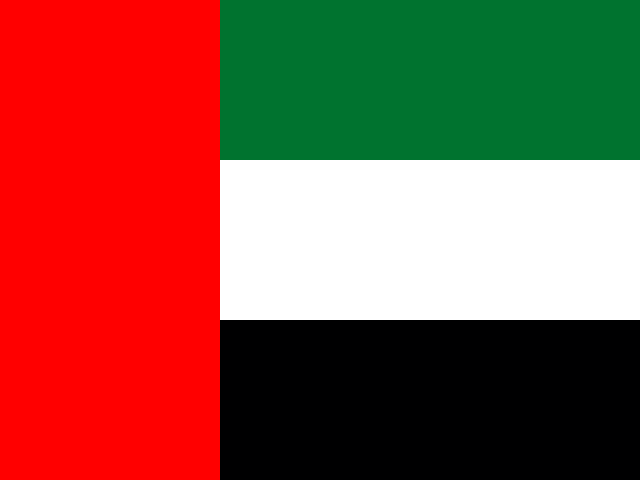
Cook one of the recipes, print the large-print pack about the United Arab Emirates, and finish with the big-screen quiz or the words crossword. Grandchildren can colour the flag.