The Romans at Trenčín
During the Marcomannic Wars, Roman soldiers of the Second Legion carved an inscription on the rock below today's Trenčín Castle, naming the place Laugaricio. It is still there.
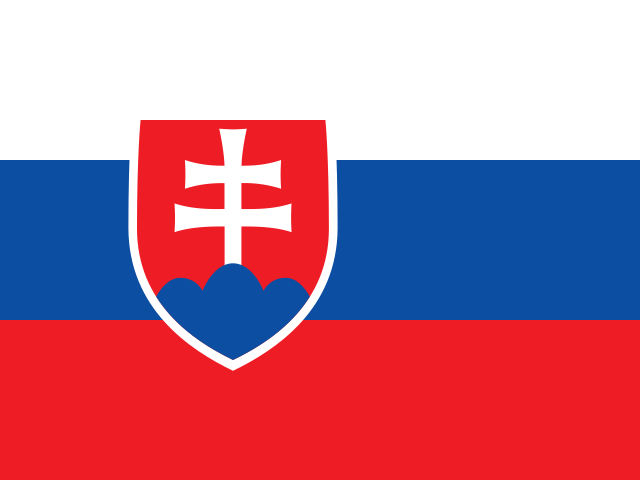
Slovakia is a landlocked country in Central Europe, bordered by Poland to the north, Ukraine to the east, Hungary to the south, Austria to the west and the Czech Republic to the north-west. The Carpathian Mountains fill most of its northern half, rising to the High Tatras, while the warm, flat Danubian Lowland in the south-west is farming and wine country. Forests cover more than 40% of the land.
Slavs settled here in the 5th and 6th centuries, and in the 9th century the land was part of Great Moravia, where the missionaries Cyril and Methodius taught in a Slavic language. For about nine centuries after that it belonged to the Kingdom of Hungary, and Bratislava, then called Pressburg, was the coronation city of Hungarian kings. In 1918 Slovaks and Czechs formed Czechoslovakia, which split peacefully into two countries on 1 January 1993.
Memories fade faster than photos. Ask these over a meal or a phone call, and write the answers down.
Slovakia is a young state with a long past. Romans, Slavs, Great Moravia, the Kingdom of Hungary, the Habsburgs and Czechoslovakia all shaped the land before it became independent in 1993.
During the Marcomannic Wars, Roman soldiers of the Second Legion carved an inscription on the rock below today's Trenčín Castle, naming the place Laugaricio. It is still there.
Prince Pribina of Nitra had a church built and consecrated around 828. It is the first Christian church known from written sources in present-day Slovakia.
Hungarian armies defeated the Bavarians near today's Bratislava. Great Moravia broke up, and over the next two centuries the land was gradually absorbed into the Kingdom of Hungary, where it stayed until 1918.
Maximilian II was crowned King of Hungary in St Martin's Cathedral. Coronations were held there until 1830, including that of Maria Theresa.
Under pressure from Nazi Germany, Slovakia broke away from Czecho-Slovakia and became a one-party state allied with Hitler, led by Jozef Tiso. In 1942 the regime itself deported about 57,000 Jews to Nazi camps in occupied Poland, and in all most of Slovakia's Jews were murdered.
The Slovak Alexander Dubček led Czechoslovakia's communist party and promised 'socialism with a human face'. In August, Warsaw Pact armies invaded and ended the reforms.
On 1 January 1993, Czechoslovakia split peacefully into the Czech Republic and Slovakia, a separation often called the Velvet Divorce.
On 1 January 2009 Slovakia replaced the koruna with the euro, becoming the 16th member of the eurozone.
Cook one of the recipes, print the large-print pack about Slovakia, and finish with the big-screen quiz or the words crossword. Grandchildren can colour the flag.