Mud-brick forts below bare mountains, green palm oases, golden dunes, misty monsoon hills and a long coast of fishing towns, in a land ruled by the same family since 1744.
Oman lies in the southeast corner of the Arabian Peninsula, with a long coastline on the Gulf of Oman and the Arabian Sea. The rugged Hajar Mountains run across the north, a wide gravel desert and the sand dunes of the Sharqiya fill the middle, and in the far south the Dhofar hills turn green each summer under the monsoon mist. Oman also has two pieces of land cut off from the rest of the country: the Musandam Peninsula on the Strait of Hormuz and the tiny Madha, both surrounded on land by the United Arab Emirates.
For thousands of years Omanis lived from the sea, from copper and from frankincense. Sumerian texts call the land Magan, a source of copper. Omani sailors traded as far as India, China and East Africa, and in the 17th century Oman drove out the Portuguese and built an empire that reached Zanzibar and Mombasa. The Al Bu Said family, which still rules, came to power in 1744. From 1970 oil money paid for roads, schools and hospitals in a country that had very few before.
Questions to ask the older generation
Memories fade faster than photos. Ask these over a meal or a phone call, and write the answers down.
Which town or region of Oman did our family come from? Was it near Sohar, Buraimi, Rustaq?
Who was the first in the family to leave Oman, when, and why?
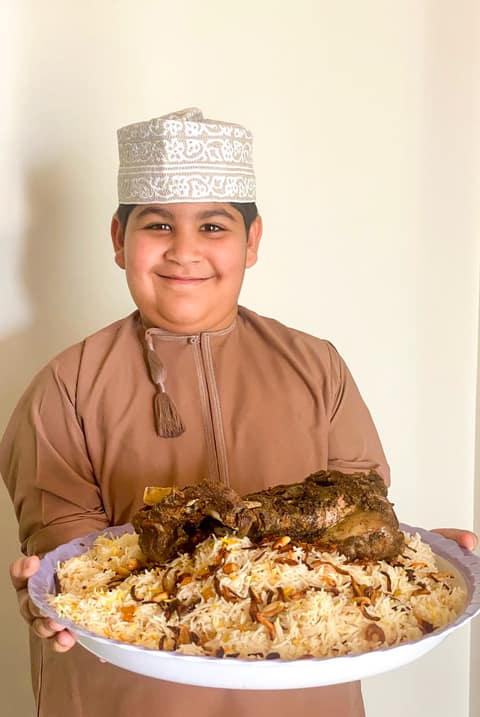
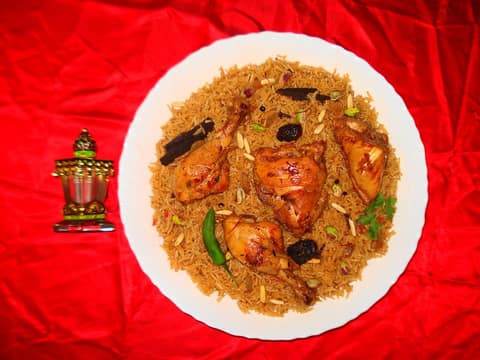
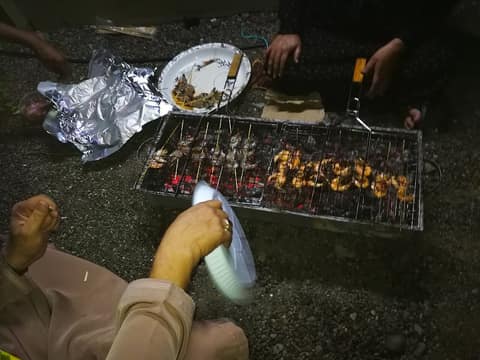
Which dishes from Oman were cooked at home? Did anyone make Shuwa or Maqbous (majboos)?
Does anyone in the family still speak Omani Arabic, or use a few words of it?
Were there songs, prayers, games or holidays from Oman that the family kept?
Are there old photos, letters or documents from Oman? Who has them?
If you could visit Oman together, where would you go first?
A short history of Oman
Oman looks out to the Indian Ocean, so its history is one of sailors, merchants and sea empires, with a tribal interior ruled for centuries by elected religious leaders called imams. Early dates are approximate. Copper and frankincense made the land rich in ancient times, the Portuguese held its coast for more than a century, and Omani imams and sultans later ruled lands as far away as Zanzibar and Gwadar. Modern Oman took shape after 1970.
2300 BC
Sumerian texts name Magan
Around 2300 BC clay tablets from Mesopotamia mention Magan, a land that sent copper and hard stone up the Gulf by boat. Magan is now identified with Oman and the nearby United Arab Emirates, where ancient copper mines and smelting sites have been found. The beehive-shaped stone tombs at Bat date from this Bronze Age world.
AD 751
The first Ibadi imam is elected
According to many historians, al-Julanda bin Masud was elected the first Ibadi imam of Oman around 751. Ibadism, a branch of Islam that chooses its leader by the agreement of scholars and tribes, became the leading faith of the interior, and elected imams ruled the interior on and off for more than 1,000 years.
1507
The Portuguese capture Muscat
In 1507 a Portuguese fleet under Afonso de Albuquerque attacked the Omani coast and took Muscat. The Portuguese fortified the harbour and held a chain of coastal towns to control trade at the mouth of the Gulf. The two forts that still guard Muscat harbour, Al Jalali and Al Mirani, were built in their time.
1650
The Portuguese are driven out of Muscat
In January 1650, after a surprise attack at dawn by the imam's troops, the Portuguese garrison of Muscat surrendered. Only a small Portuguese post at Khasab in Musandam held out a few years longer. Around the same time the Yaruba imams built the great round tower of Nizwa Fort.
1856
Said bin Sultan dies and the empire splits
Said bin Sultan ruled from 1804 to 1856 and moved his court to Zanzibar, which grew rich from cloves and, sadly, from the slave trade. When he died in 1856 his sons quarrelled, and in 1861 British arbitration confirmed the split into two sultanates, Muscat and Oman in Arabia and Zanzibar in Africa.
1958
Oman sells Gwadar to Pakistan
For almost two centuries the port of Gwadar, on the coast of today's Pakistan, belonged to the rulers of Muscat. On 8 September 1958 Pakistan bought it from Oman, and many families in both countries still have links across the Arabian Sea.
1970
Sultan Qaboos comes to power
On 23 July 1970 Qaboos bin Said replaced his father in a palace coup in Salalah. At that time Oman had only about 10 km of paved road and very few schools or hospitals. He renamed the country the Sultanate of Oman, abolished slavery and began a rapid programme of building that Omanis call the Renaissance.
2020
Sultan Qaboos dies
Sultan Qaboos died on 10 January 2020, after almost 50 years in power, at that time the longest-serving ruler in the Arab world. A cousin from the same family succeeded him the next day, following the rules of the Basic Statute, Oman's constitution of 1996.