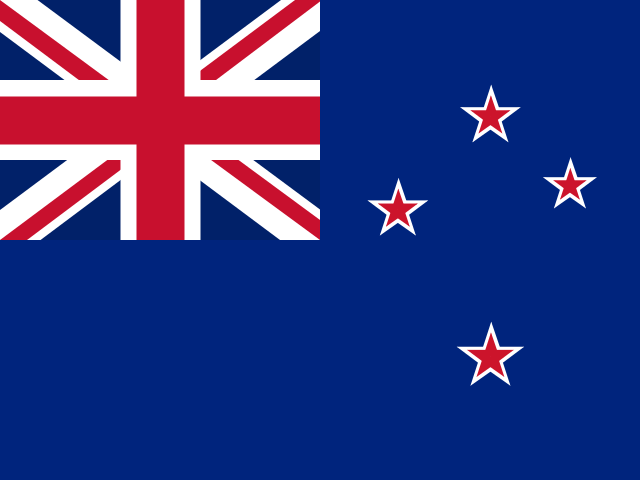
Two long green islands at the bottom of the Pacific, with snowy peaks, fiords, geysers and beaches, and a culture shaped by Māori and by settlers from far away.
New Zealand is an island country in the south-western Pacific Ocean, made up of two main islands, the North Island and the South Island, and more than 700 smaller ones. It lies more than 1,500 km east of Australia across the Tasman Sea. The Southern Alps run down the length of the South Island, with glaciers, lakes and deep fiords, while the North Island has volcanoes, hot springs and geysers. Sheep farms, rainforest and long empty beaches are never far away.
The islands were the last large habitable land on Earth to be settled by people. Polynesian voyagers arrived in canoes called waka between about 1280 and 1350, and their descendants became the Māori people. The Māori name Aotearoa, often translated as 'land of the long white cloud', is widely used today alongside New Zealand. Dutch explorer Abel Tasman sighted the islands in 1642, and in 1840 the British Crown and Māori chiefs signed the Treaty of Waitangi, the founding document of the country.
Questions to ask the older generation
Memories fade faster than photos. Ask these over a meal or a phone call, and write the answers down.
Which town or region of New Zealand did our family come from? Was it near Auckland, Christchurch, Hamilton?
Who was the first in the family to leave New Zealand, when, and why?
Which dishes from New Zealand were cooked at home? Did anyone make Hāngī or Boil-up?
Does anyone in the family still speak Te reo Māori, or use a few words of it?
Were there songs, prayers, games or holidays from New Zealand that the family kept?
Are there old photos, letters or documents from New Zealand? Who has them?
If you could visit New Zealand together, where would you go first?
A short history of New Zealand
New Zealand's human story is short compared with most countries, but full of change. Polynesian settlers arrived only about 700 years ago and built the Māori world of tribes (iwi), carved meeting houses and great canoe traditions. Europeans came first as explorers, then as whalers, traders and missionaries, and from 1840 as settlers under British rule. Wars over land followed, and much Māori land was taken. The young colony became a pioneer of votes for women, a dominion and finally a fully independent country, which today continues to work through the promises of the Treaty of Waitangi.
1300
Polynesian voyagers settle the islands
Between about 1280 and 1350, Polynesians from the islands of eastern Polynesia sailed thousands of kilometres in ocean-going canoes (waka) and settled New Zealand. Māori traditions tell of the explorer Kupe and of canoes setting out from Hawaiki. Many Māori today trace their ancestry back to the crews of particular waka.
1769
Captain Cook maps the coast
The British explorer James Cook reached New Zealand on 6 October 1769 in the Endeavour and landed at Poverty Bay (Tūranganui-a-Kiwa) the next day, where several Māori were killed in the first meetings. The Tahitian navigator Tupaia, who could understand Māori, helped as an interpreter. Over six months Cook mapped almost the entire coastline.
1840
The Treaty of Waitangi is signed
On 6 February 1840 William Hobson, for the British Crown, and about forty Māori chiefs signed the Treaty of Waitangi at Waitangi. Copies travelled around the country, and in the end about 530 to 540 Māori, at least 13 of them women, signed the Māori text. The English and Māori texts differ, especially about sovereignty, and this led to long disagreement. 6 February is now Waitangi Day, the national day.
1865
Wellington becomes the capital
Auckland had been the capital since 1841, but settlers in the South Island wanted a more central seat of government. Wellington, at the southern tip of the North Island, was chosen, and in 1865 Parliament began meeting there as the capital.
1915
The Anzacs land at Gallipoli
On 25 April 1915, during the First World War, soldiers of the Australian and New Zealand Army Corps (ANZAC) landed on the Gallipoli Peninsula in Turkey. The campaign failed, with heavy losses, and 25 April became Anzac Day, when New Zealanders and Australians remember those who served and died in war.
1947
The Statute of Westminster is adopted
New Zealand adopted the Statute of Westminster with an act that received royal assent on 25 November 1947. From then on the British Parliament could no longer make laws for New Zealand without its consent, which gave the country full independence in law. The British monarch remained head of state.
1975
The Waitangi Tribunal is set up
The Treaty of Waitangi Act 1975 set up the Waitangi Tribunal, a permanent commission that hears Māori claims that the Crown broke the promises of the Treaty. From 1985 it could also look at grievances going back to 1840, and since the 1990s many tribes have reached settlements with the government.
2011
The Christchurch earthquake
At 12:51 pm on 22 February 2011 a shallow magnitude 6.2 earthquake struck close to the centre of Christchurch, killing 185 people and destroying much of the city centre, including the spire of ChristChurch Cathedral. The rebuilding of the city took many years.