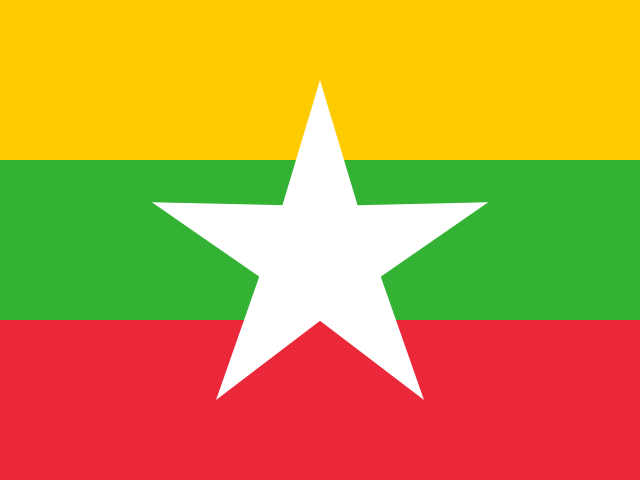
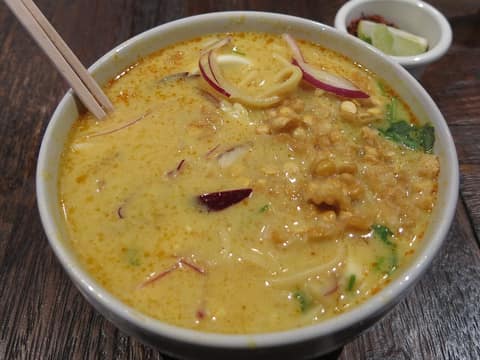
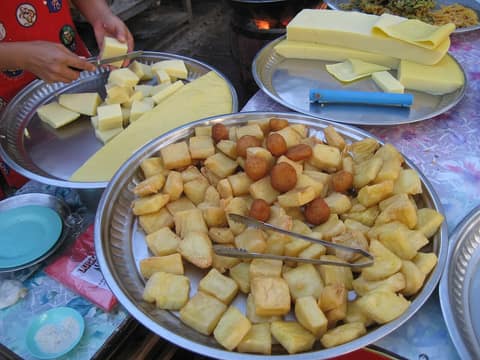
Golden pagodas, a plain of 2,000 temples, noodle soup for breakfast and a great river running through the middle, in the country once called Burma.
Myanmar is the largest country by area in mainland Southeast Asia. A horseshoe of mountains, rising in the far north to Hkakabo Razi near the Himalayas, surrounds the long valley of the Irrawaddy River, where most people live. To the south and west lies a coastline of almost 2,000 km on the Bay of Bengal and the Andaman Sea.
The Pyu built the first cities here more than 2,000 years ago, and the Bamar kings of Bagan later united the Irrawaddy valley and spread Theravada Buddhism. After three wars in the 1800s the country became a British colony, and in 1948 it became independent as the Union of Burma. Both names, Burma and Myanmar, come from the same Burmese word for the country and its main people. The military government changed the official English name to Myanmar in 1989. The United Nations uses Myanmar, while some governments and many people still say Burma.
Questions to ask the older generation
Memories fade faster than photos. Ask these over a meal or a phone call, and write the answers down.
Which town or region of Myanmar did our family come from? Was it near Yangon, Mandalay, Bagan?
Who was the first in the family to leave Myanmar, when, and why?
Which dishes from Myanmar were cooked at home? Did anyone make Mohinga or Tea leaf salad (lahpet thoke)?
Does anyone in the family still speak Burmese, or use a few words of it?
Were there songs, prayers, games or holidays from Myanmar that the family kept?
Are there old photos, letters or documents from Myanmar? Who has them?
If you could visit Myanmar together, where would you go first?
A short history of Myanmar
The Irrawaddy valley has been home to rice farmers for thousands of years. Pyu city-states came first, then the Bamar kingdom of Bagan, and later great empires ruled from Taungoo, Ava and Mandalay. Britain took the country in three wars in the 1800s. Since independence in 1948 Myanmar has lived through long periods of military rule, a short opening in the 2010s, and a new coup and civil war from 2021.
200 BC
The first Pyu cities rise
Around the 2nd century BC the Pyu people, who spoke a Tibeto-Burman language, began building walled cities in the dry zone of central Myanmar. For about a thousand years cities such as Halin, Beikthano and Sri Ksetra traded with India and China and took up Buddhism.
1287
Pagan falls after the Mongol invasions
Repeated Mongol invasions in the late 1200s brought down the Pagan Kingdom in 1287. About 250 years of division followed, with Shan states, the kingdoms of Ava and Hanthawaddy, and Arakan on the western coast competing for power.
1752
The Konbaung dynasty is founded
Alaungpaya, the chief of a small village, founded the Konbaung dynasty in 1752 and reunited the country within a few years. He enlarged the town of Dagon and named it Yangon. The Konbaung kings were the last royal dynasty of Burma.
1885
The last king is deposed
After wars with Britain in 1824 to 1826 and in 1852, a third war in November 1885 ended with British troops entering Mandalay Palace. King Thibaw was sent into exile in India, and on 1 January 1886 all of Burma was annexed to British India. Rangoon, today's Yangon, became the capital.
1988
The 8888 Uprising
Nationwide protests for democracy peaked on 8 August 1988, the date that gave the uprising its name. Security forces killed thousands of demonstrators and a new military council took power. Aung San Suu Kyi, the daughter of Aung San, became the leader of the democracy movement.
2005
Naypyidaw becomes the capital
On 6 November 2005 government offices began moving from Yangon to a new city built near the town of Pyinmana, in the centre of the country. Its name, Naypyidaw, meaning 'royal capital', was announced on 27 March 2006.
2017
The Rohingya flee to Bangladesh
From August 2017 military operations in northern Rakhine State drove more than 700,000 Rohingya, a mostly Muslim minority, across the border into Bangladesh, according to UN reports. In 2019 The Gambia brought a case against Myanmar at the International Court of Justice under the Genocide Convention. The court heard the case in January 2026 and, as of September 2026, has not yet given its judgment.
2025
The Mandalay earthquake
On 28 March 2025 an earthquake of magnitude 7.7 to 7.9 struck near Mandalay, the strongest in the country since 1912. It killed thousands of people, damaged Naypyidaw and Mandalay Palace, and destroyed more than 8,000 monasteries, nunneries and pagodas.