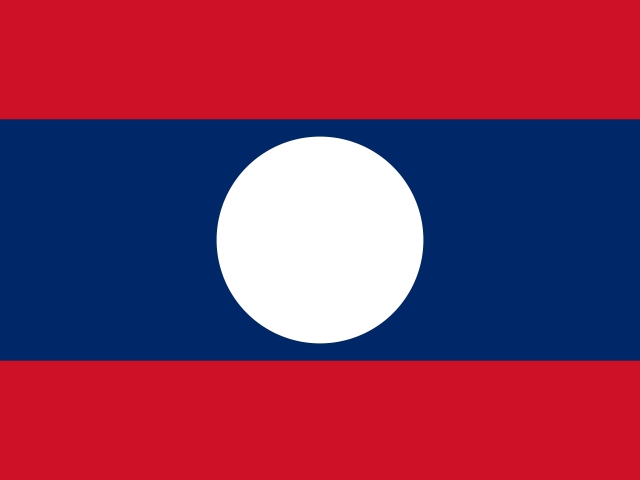
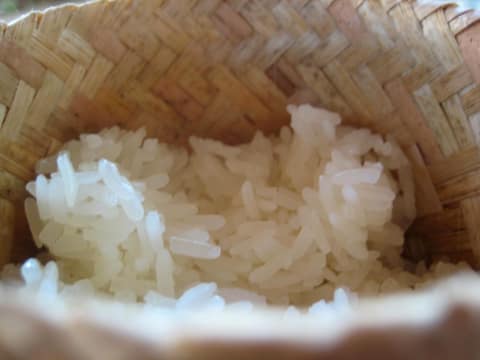
Golden temples, a slow brown Mekong, misty green mountains and baskets of sticky rice, in the only landlocked country of Southeast Asia.
Laos is the only country in Southeast Asia without a coastline. It is wrapped around by China, Myanmar, Thailand, Cambodia and Vietnam, and most of it is forested mountains and high plateaus. The Mekong River runs the length of the country and forms much of its long border with Thailand, and the capital, Vientiane, and most larger towns lie along its banks.
From 1353 the kingdom of Lan Xang, 'a million elephants', ruled these lands and made Theravada Buddhism the heart of Lao life. After Lan Xang broke apart in the early 1700s, its pieces fell under Siamese control, and in 1893 France took the lands east of the Mekong into French Indochina. Laos became fully independent in 1953, and after a long war that drew in its neighbours and the United States, the monarchy ended in 1975.
Questions to ask the older generation
Memories fade faster than photos. Ask these over a meal or a phone call, and write the answers down.
Which town or region of Laos did our family come from? Was it near Luang Prabang, Savannakhet, Pakse?
Who was the first in the family to leave Laos, when, and why?
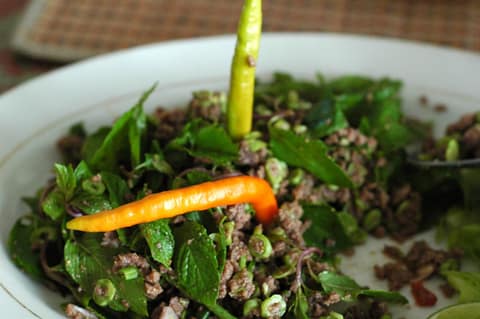
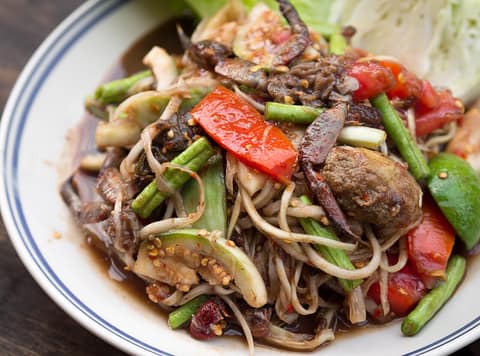
Which dishes from Laos were cooked at home? Did anyone make Larb or Tam mak hoong (green papaya salad)?
Does anyone in the family still speak Lao, or use a few words of it?
Were there songs, prayers, games or holidays from Laos that the family kept?
Are there old photos, letters or documents from Laos? Who has them?
If you could visit Laos together, where would you go first?
A short history of Laos
People have lived in the mountains of Laos for tens of thousands of years: a human skull found in Tam Pa Ling cave is at least 46,000 years old, and the great stone jars of the Xiangkhoang Plateau were set in place well over two thousand years ago. Tai-speaking peoples, the ancestors of the Lao, moved south along the rivers from what is now southern China from about the 8th century. In 1353 their principalities were united as the kingdom of Lan Xang, the foundation of Lao identity to this day.
1353
Fa Ngum founds Lan Xang
Prince Fa Ngum, raised in exile at the Khmer court of Angkor, returned with an army, took the towns along the Mekong and was crowned at Xieng Dong Xieng Thong, today's Luang Prabang. He named his kingdom Lan Xang, 'a million elephants', and, by tradition, made Theravada Buddhism the state religion.
1566
Pha That Luang is built
Setthathirath ordered the building of Pha That Luang, the great golden stupa of Vientiane, on a site where, by tradition, a relic of the Buddha had long been kept. Rebuilt several times since, it is now the national symbol of Laos.
1707
Lan Xang breaks apart
After Sourigna Vongsa died in 1694 with no grown son to succeed him, a struggle over the throne split Lan Xang. Rival kingdoms formed at Luang Prabang and Vientiane, and by 1713 a third at Champasak in the south. Divided, they were soon drawn into the wars between Burma and Siam.
1827
Anouvong's revolt fails
King Anouvong of Vientiane rose against Siam and marched towards Bangkok, but his armies were driven back. Siamese forces took Vientiane and in 1828 burned much of it; Wat Si Saket was one of the few temples left standing. Anouvong died a captive in Bangkok and is honoured in Laos as a national hero.
1945
Free Laos declares independence
After Japan's surrender at the end of the Second World War, Lao nationalists led by Prince Phetsarath formed the Lao Issara, 'Free Laos', government in October 1945 and declared the country independent. French troops returned in 1946 and the Lao Issara leaders went into exile in Thailand.
1964
The American bombing begins
As the war in Vietnam widened, North Vietnamese supply routes, the Ho Chi Minh Trail, ran through eastern Laos. From 1964 to 1973 the United States carried out a long, officially secret air campaign over Laos, dropping more than 2 million tons of bombs, while a ground war was fought in the north.
1994
The first Friendship Bridge opens
The First Thai-Lao Friendship Bridge, built with aid from Australia, opened across the Mekong between Nong Khai in Thailand and the outskirts of Vientiane. It was the first bridge across the lower Mekong.
2021
The Laos-China Railway opens
On 3 December 2021 a new electric railway, about 422 km long, opened between Vientiane and Boten on the Chinese border, through Vang Vieng and Luang Prabang. A trip from the capital to Luang Prabang that took most of a day by road now takes a few hours.