A rose-red city carved into rock, a desert of red sand and granite, and a salt lake at the lowest land on Earth, in a small country famous for its welcome.
Jordan lies in the Middle East, east of the Jordan River, from which it takes its name. Most of the country is desert and dry plateau, but the northwest has green hills with olive groves and pine woods. In the west the land drops steeply into the Jordan Rift Valley, where the Dead Sea lies far below sea level, and in the far south the country has a short coast on the Red Sea at Aqaba.
People have lived here for hundreds of thousands of years. In ancient times the land held the kingdoms of Ammon, Moab and Edom, then the Nabataeans, who carved their capital Petra out of pink sandstone. Romans, Byzantines, the early Islamic caliphates, Crusaders and Ottomans followed. The modern state began as the Emirate of Transjordan in 1921 and became the independent Hashemite Kingdom of Jordan in 1946.
Questions to ask the older generation
Memories fade faster than photos. Ask these over a meal or a phone call, and write the answers down.
Which town or region of Jordan did our family come from? Was it near Zarqa, Irbid, As-Salt?
Who was the first in the family to leave Jordan, when, and why?
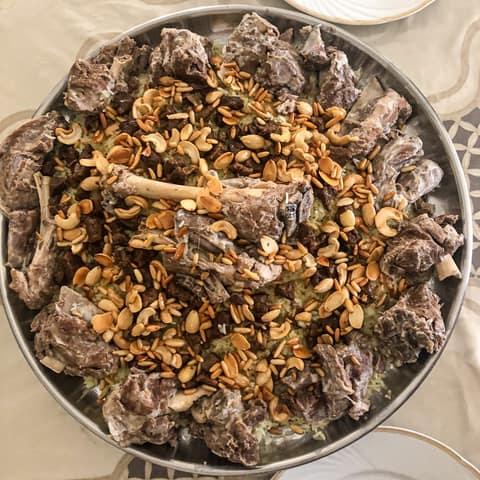
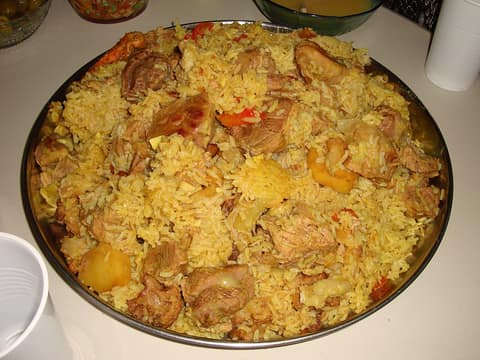
Which dishes from Jordan were cooked at home? Did anyone make Mansaf or Maqluba?
Does anyone in the family still speak Jordanian Arabic, or use a few words of it?
Were there songs, prayers, games or holidays from Jordan that the family kept?
Are there old photos, letters or documents from Jordan? Who has them?
If you could visit Jordan together, where would you go first?
A short history of Jordan
Jordan sits on old crossroads between Arabia, Egypt, Syria and Mesopotamia, so traders, pilgrims and armies have passed through for thousands of years. Early dates are approximate. The Nabataeans grew rich from the incense trade and built Petra, Rome turned the region into a province, and later Muslim dynasties, Crusaders, Mamluks and Ottomans ruled it. The modern country took shape after the Arab Revolt of 1916 and became independent in 1946.
7200 BC
The Ain Ghazal statues are made
About 9,000 years ago, farmers at Ain Ghazal, in today's Amman, made large statues and busts of people from lime plaster over reed frames, with wide-open eyes outlined in bitumen. Found in 1983 and 1985, they are among the earliest large statues of people ever found. Even earlier, more than 14,000 years ago, hunter-gatherers in Jordan's Black Desert baked the oldest bread known as of 2026.
AD 106
Rome annexes the Nabataean kingdom
The Nabataeans, Arab traders who had grown rich on the incense routes, ruled from Petra for centuries. In 106, after the death of their last king, the Roman emperor Trajan annexed their kingdom and made it the province of Arabia Petraea.
AD 363
An earthquake strikes Petra
In 363 a strong earthquake destroyed many buildings in Petra and damaged its clever water system. Trade had already moved to sea routes, and the city slowly declined until it was left to a few nomads.
1142
Kerak Castle is begun
Crusader lords started building a huge castle at Karak, high above the Dead Sea, in the 1140s. It controlled the trade and pilgrim routes between Damascus, Egypt and Mecca, and Saladin besieged it in 1183 and 1184 before it fell to his forces in 1188.
1908
The Hejaz Railway reaches Medina
The Ottoman Empire built the Hejaz Railway from Damascus through Jordan to carry Muslim pilgrims towards Mecca. It reached Medina on 1 September 1908, and towns along the line, including Amman and Zarqa, grew around its stations.
1921
The Emirate of Transjordan is founded
On 11 April 1921 the Emirate of Transjordan was set up with Abdullah, a son of Sharif Hussein, as emir, under a British mandate. Amman became its capital.
1967
The Six-Day War
In June 1967 war broke out between Israel and Egypt, Syria and Jordan. Jordan lost control of the West Bank and East Jerusalem, which it had held since 1948, and many more refugees crossed the river into Jordan. In 1988 Jordan gave up its claims to the West Bank.
2024
Umm el-Jimal joins the World Heritage List
In July 2024 UNESCO added Umm el-Jimal, a town of black basalt houses, churches and reservoirs in the northern desert, to the World Heritage List. In 2026 the Aqaba Marine Reserve followed, bringing Jordan's total to eight sites.