World Stroll
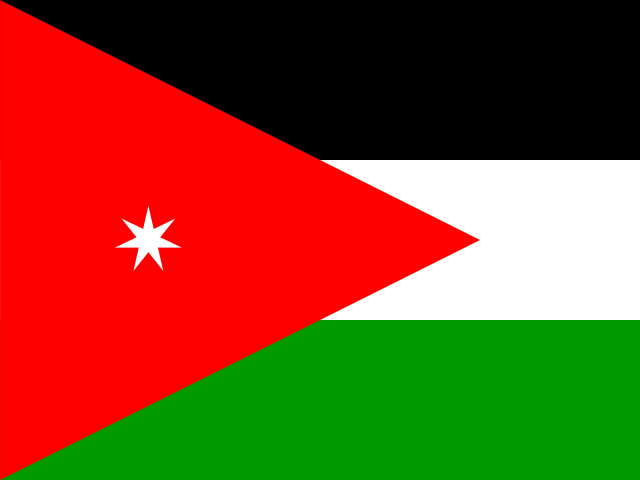
Flag of Jordan
Travel guide

Learn Jordan before you go

A rose-red city carved into rock, a desert of red sand and granite, and a salt lake at the lowest land on Earth, in a small country famous for its welcome.
Take the full trip
CapitalAmman
CurrencyJordanian dinar (JOD, often written JD), divided into 100 qirsh (piastres) or 1,000 fils
Official languageArabic. People speak Jordanian Arabic in daily life, and English is widely used in business and universities
Drives on theRight
Calling code+962

10 phrases to learn

In Jordanian Arabic. Capital letters show the stressed part. Tap the heart to practise a phrase later.

As-salamu alaykum (السلام عليكم)
as-sa-LAA-moo a-LAY-koom
Peace be upon you (hello)
The polite greeting when you walk into a shop or meet someone
Wa alaykum as-salam (وعليكم السلام)
wa a-LAY-koom as-sa-LAAM
And upon you be peace (the reply)
Answering 'as-salamu alaykum'
Sabah el-khair (صباح الخير)
sa-BAAH el-KHAIR
Good morning
Greeting someone in the morning
Masa' el-khair (مساء الخير)
ma-SAA el-KHAIR
Good evening
Greeting someone in the evening
Keef halak? / Keef halik? (كيف حالك)
KEEF HAA-lak / KEEF HAA-lik
How are you? (to a man / to a woman)
Asking after someone
Al-hamdu lillah (الحمد لله)
al-HAM-doo lil-LAAH
Praise be to God (I'm fine, thank you)
The usual answer to 'how are you?'
Ahlan wa sahlan (أهلا وسهلا)
AH-lan wa SAH-lan
Welcome!
You will hear it everywhere, from shopkeepers to hosts
Shu ismak? / Shu ismik? (شو اسمك)
shoo IS-mak / shoo IS-mik
What is your name? (to a man / to a woman)
Getting to know someone
Ismi... (اسمي)
IS-mee
My name is...
Introducing yourself
Tsharrafna (تشرفنا)
tshar-RAF-na
Nice to meet you (literally 'we are honoured')
After being introduced

At the table

  • Hospitality is a point of honour. A guest is offered coffee or tea straight away, and it is polite to accept at least one cup.
  • A 'Jordanian invitation' means you are expected to bring nothing and eat everything.
  • Mansaf is traditionally eaten standing around the shared tray, using only the right hand, with the left hand behind the back.
  • When drinking Arabic coffee, gently shake the small empty cup from side to side to show you do not want any more.
  • During Ramadan, families break the fast together at sunset, and sweets such as qatayef follow the evening meal.

Local tips

Buy the Jordan Pass before you fly

As of September 2026 the Jordan Pass costs 70 to 80 JD, depending on whether it includes one, two or three days in Petra, and gives entry to more than 40 sites. If you buy it before you arrive and stay the minimum number of nights, it also covers the usual tourist visa fee. The official site says two nights and British government advice says three, so check the rule before you book.

Check the official travel advice

Jordan is generally calm and welcoming, but it sits in a region where conflicts can flare up. Before and during your trip, check your own government's official travel advice for Jordan and its border areas.

Dress modestly

Clothes that cover the shoulders and knees are the most comfortable choice in towns, markets, religious and historical sites; Amman and the resorts are more relaxed. Women visiting a mosque should also cover their hair.

Be thoughtful during Ramadan

During the holy month of Ramadan most Muslims fast from dawn to sunset. Visitors should avoid eating, drinking or smoking in public in the daytime. Many restaurants outside tourist areas open only at sunset, and evenings are lively.

Ask before taking photos of people

Landscapes and monuments are fine, but ask before photographing people, especially women, and do not photograph police, soldiers or military sites.

Float carefully in the Dead Sea

Float on your back and keep your face out of the water: the very salty water stings badly in the eyes and must not be swallowed. Rinse off afterwards in the fresh-water showers on the beach.

Watch for flash floods

From about November to March, heavy rain can send sudden floods through dry valleys such as those around Petra and the Dead Sea. Follow local warnings and your guide's advice on hiking in canyons.

Drink bottled water and carry small notes

Most people drink bottled water rather than tap water. Carry small dinar notes and coins for taxis, snacks and tips; many small shops do not take cards. Alcohol is sold in bars, hotels and some shops, but drinking it in the street is illegal.

Dishes to try

  • Mansaf (منسف): Jordan's national dish: lamb cooked slowly in a sauce of jameed, a hard dried yogurt made from sheep's or goat's milk, then served on a huge tray over thin shrak bread and rice, topped with toasted almonds and pine nuts and more hot yogurt sauce. It is made for weddings, births, Eid, Christmas and to honour a guest.
  • Maqluba (مقلوبة): Layers of fried vegetables, usually aubergine and cauliflower, with chicken or lamb and spiced rice, cooked in one deep pot. At the table the pot is turned upside down onto a big platter and lifted away, leaving a tall, golden cake of rice.
  • Musakhan (مسخن): Roast chicken baked on thick taboon bread with a great deal of onion slowly cooked in olive oil and dark red sumac, then scattered with fried pine nuts. It is eaten with the hands, tearing off pieces of the soaked, tangy bread.
  • Zarb (زرب): A Bedouin feast of meat, usually chicken or lamb, with vegetables, placed on metal trays and lowered into a pit oven in the sand, then covered with a lid, hot coals and sand and left to cook for a few hours. Visitors to the desert camps of Wadi Rum often watch it being dug out for dinner.
  • Galayet bandora (قلاية بندورة): Tomatoes fried in olive oil with onion, garlic and hot green chilli until soft and jammy, eaten straight from the pan with bread. It is one of the simplest and most loved meals in Jordan, cooked at home and over campfires alike.
  • Hummus (حمص): A smooth dip of chickpeas blended with tahini (sesame paste), lemon juice and garlic, spread in a shallow bowl and finished with olive oil. In Jordan it is a classic breakfast, eaten with falafel, pickles, onions and warm bread.
  • Falafel (فلافل): Crisp fried balls of ground chickpeas mixed with parsley, onion, garlic and spices, green and soft inside. They are eaten hot for breakfast with hummus or stuffed into bread with salad, pickles and tahini sauce.
  • Mutabbal (متبل): Aubergines charred over a flame until the skin is black and the flesh is soft and smoky, then mashed with tahini, lemon and garlic and served with olive oil and pomegranate seeds.

Cities to see

  • Amman (capital): The Citadel and the Roman Theatre, The Jordan Museum and its Ain Ghazal statues, Rainbow Street and the downtown souks.
  • Zarqa: Industry and trade, A stop on the old Hejaz Railway, Its Chechen founding families.
  • Irbid: Yarmouk University, Nearby Umm Qais, ancient Gadara, Olive groves and farms.
  • As-Salt: Yellow limestone mansions, A UNESCO World Heritage Site since 2021, Mansaf, which people from Salt say is the best.
  • Jerash: Hadrian's Arch and the Oval Plaza, Roman chariot shows in the hippodrome, The Jerash Festival of Culture and Arts.
  • Ajloun: Ajloun Castle, Forest walks in the Ajloun reserve, Olive oil and fruit orchards.

Landmarks and the city map are on the Jordan trip