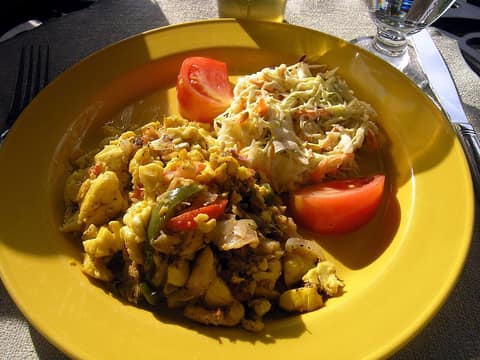
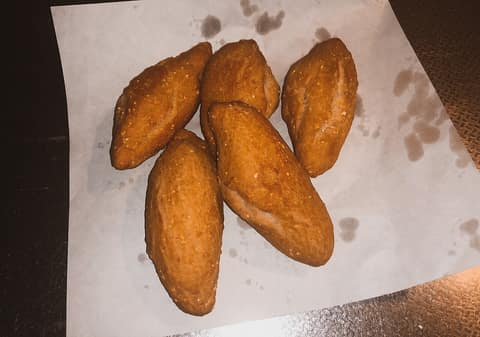
Misty blue mountains, waterfalls that run into the sea, the beat of reggae, and a plate of ackee and saltfish for breakfast.
Jamaica is an island in the Caribbean Sea, about 145 km south of Cuba. It is the third-largest island in the Greater Antilles, after Cuba and Hispaniola, and is about 235 km long. Mountains fill the middle of the island: the Blue Mountains in the east rise to 2,256 m at Blue Mountain Peak, where it can be cool and misty while the coast below is hot. A narrow plain with beaches, bays and mangroves runs around the edge.
The Taíno called the island Xaymaca, usually explained as the 'land of wood and water' or 'land of springs'. Spain ruled it from 1509, and England took it in 1655. Under British rule Jamaica became a great sugar producer, worked by hundreds of thousands of enslaved Africans, until slavery ended in the 1830s. Later, workers came from India and China. The national motto, 'Out of Many, One People', reflects this mix.
Questions to ask the older generation
Memories fade faster than photos. Ask these over a meal or a phone call, and write the answers down.
Which town or region of Jamaica did our family come from? Was it near Spanish Town, Montego Bay, May Pen?
Who was the first in the family to leave Jamaica, when, and why?
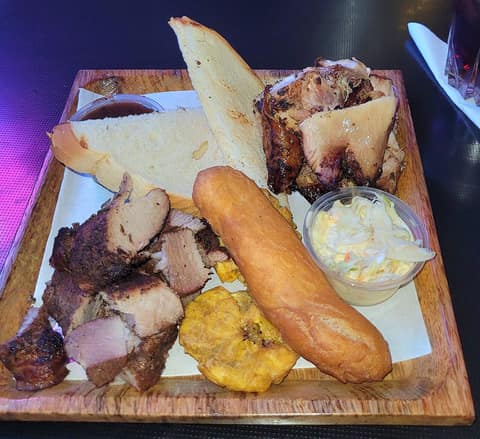
Which dishes from Jamaica were cooked at home? Did anyone make Ackee and saltfish or Jerk chicken and pork?
Does anyone in the family still speak Jamaican Patois, or use a few words of it?
Were there songs, prayers, games or holidays from Jamaica that the family kept?
Are there old photos, letters or documents from Jamaica? Who has them?
If you could visit Jamaica together, where would you go first?
A short history of Jamaica
Jamaica's story runs from the Taíno villages, through 146 years of Spanish rule and three centuries of British rule built on sugar and slavery, to independence in 1962. Much of it is a story of resistance: the Maroons who kept their freedom in the mountains, the great slave rebellions, and the march on Morant Bay. It is also a story of earthquakes and hurricanes, and of an island that keeps rebuilding.
AD 800
The Taíno settle the island
People first reached Jamaica around 500 to 600 CE. The Taíno, who most likely came from South America, arrived around 800. They fished and farmed cassava and maize, and at their height about 60,000 of them lived in some 200 villages, each led by a chief called a cacique.
1509
The Spanish found Sevilla
Juan de Esquivel founded the first Spanish settlement, Sevilla, near St Ann's Bay on the north coast in 1509. Because the site was thought unhealthy, it was moved to higher ground in 1518, and in 1534 most of its people moved to the new capital on the south coast. The Taíno died in great numbers from new diseases and forced labour, and the Spanish began to bring enslaved Africans to the island.
1655
The English capture Jamaica
In May 1655 an English force under Admiral William Penn and General Robert Venables, sent by Oliver Cromwell, took the island after failing to capture Santo Domingo. Many enslaved Africans escaped into the mountains during the fighting and joined the free communities known as Maroons. Spain formally gave Jamaica to England in the Treaty of Madrid in 1670.
1739
The Maroons win a peace treaty
After years of guerrilla war in the mountains, the British signed a treaty with the Leeward Maroons, led by Cudjoe, in 1739, and with the Windward Maroons, whose leaders included Queen Nanny, soon after. The treaties gave the Maroons their freedom and land. Nanny of the Maroons is now one of Jamaica's National Heroes.
1838
Full freedom from slavery
Britain's law ending slavery took effect on 1 August 1834, but most formerly enslaved people had to keep working for their old masters as 'apprentices'. Full freedom came on 1 August 1838. The date is still celebrated as Emancipation Day, a public holiday. Many freed people left the plantations to farm their own small plots.
1872
The capital moves to Kingston
In 1872 the seat of government moved from Spanish Town to Kingston, the island's largest city and port. Its great natural harbour, sheltered by the long sand spit of the Palisadoes, made it the natural choice.
1944
All adults win the vote
After the labour unrest of the late 1930s, a new constitution in 1944 created a House of Representatives elected by all adults. The two main parties of modern Jamaica grew out of this period: the Jamaica Labour Party of Alexander Bustamante and the People's National Party of Norman Manley.
2025
Hurricane Melissa strikes
On 28 October 2025 Hurricane Melissa came ashore near New Hope in Westmoreland as a Category 5 storm, the strongest hurricane on record to hit Jamaica. The western and southwestern parishes suffered the worst damage, and at least 45 people died in Jamaica. As of September 2026 many communities in the west are still rebuilding.
unnuOO-nooyou (when talking to more than one person), you all
pickneyPIK-neechild
higglerHIG-lahstreet vendor, market trader
Everyday life
yaadYAADhome, house
likkleLIK-llittle, small; a little
tekTEKto take
cyaanKYAANcan't, cannot
fiFEEfor; to
enuhih-NUHyou know (added at the end of a sentence)
labrishLAB-rishgossip, idle chat
Food
nyamNYAHMto eat; food
Towns and regions
Kingston, Kingston and St Andrew: The Bob Marley Museum and Devon House, National Heroes Park and the National Gallery.
Spanish Town, St Catherine: The old square with the Rodney Memorial and the facade of the Old King's House, An early cast-iron bridge from 1801 over the Rio Cobre.
Montego Bay, St James: Sam Sharpe Square, named after the leader of the 1831 rebellion, Beaches, resorts and the 'Hip Strip'.
May Pen, Clarendon: The Denbigh agricultural show, held around Independence Day, Citrus packing, including the ugli fruit.
Mandeville, Manchester: The courthouse of 1820 with its horseshoe staircase, Manchester Golf Club, founded in 1868.
Ocho Rios, St Ann: Dunn's River Falls, Fern Gully, a road through a gorge full of ferns.
Port Antonio, Portland: The Blue Lagoon, about 60 m deep, Frenchman's Cove, a secluded beach.
Negril, Westmoreland and Hanover: Seven Mile Beach, The cliffs and lighthouse of the West End.
Falmouth, Trelawny: Georgian houses and public buildings, Piped water earlier than New York City.
Morant Bay, St Thomas: The site of the 1865 rebellion, The memory of the National Hero Paul Bogle.