Greeks settle on Hvar
Greek colonists from the island of Paros founded Pharos, today's Stari Grad on Hvar. They divided the nearby plain into fields with stone walls that are still farmed today.
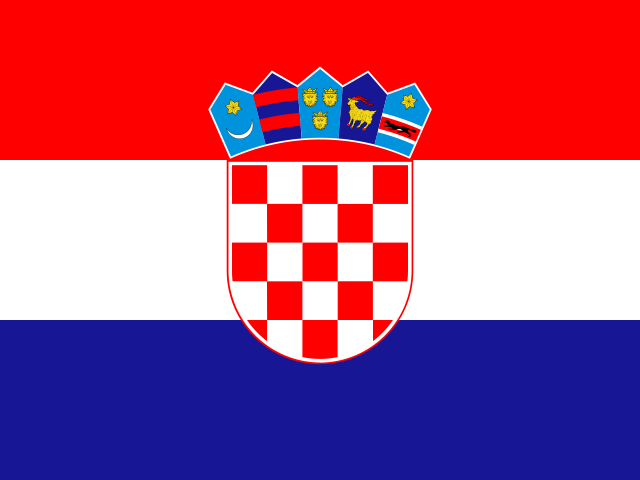
Croatia curves like a boomerang around the eastern shore of the Adriatic Sea. In the north and east it reaches into the flat farmland of the Pannonian plain along the Sava, Drava and Danube rivers; in the south it runs as a narrow strip of rocky coast backed by the Dinaric mountains. Offshore lie more than a thousand islands, islets and rocks, 48 of them inhabited.
People have lived here since prehistoric times. Greek colonists planted vineyards on the islands, the Roman emperor Diocletian built his retirement palace in Split, and Tomislav was recognised as the first Croatian king by 925. Over the centuries the land was joined with Hungary and the Habsburgs, while Venice ruled much of the coast, and in the 20th century it was part of Yugoslavia. Croatia declared independence in 1991.
Memories fade faster than photos. Ask these over a meal or a phone call, and write the answers down.
Croatia's story runs from Greek farmers on the islands and a Roman emperor's palace, through a medieval kingdom and the rich city republic of Dubrovnik, to centuries within larger states and independence in 1991.
Greek colonists from the island of Paros founded Pharos, today's Stari Grad on Hvar. They divided the nearby plain into fields with stone walls that are still farmed today.
Tomislav, who had ruled as duke, is called king of the Croats in a letter from Pope John X in 925. He is remembered as the first king of Croatia.
Venice gave up its claims to Dalmatia, and Dubrovnik, then called Ragusa, began its long life as a self-governing republic. It grew rich from trade and skilled diplomacy.
Croatian and Habsburg troops defeated an Ottoman army at Sisak, south of Zagreb. The battle started a long war, after which the Ottoman advance into Croatia was largely stopped.
On 29 October 1918, as Austria-Hungary collapsed, the Croatian parliament cut its ties with it and joined a new state of Slovenes, Croats and Serbs. In December this state united with Serbia in the kingdom later called Yugoslavia.
On 25 June 1991 the Croatian parliament declared independence from Yugoslavia. Fighting soon broke out, and the war that followed is known in Croatia as the Homeland War.
Most of the fighting ended in August 1995. The last area in the east was returned peacefully under a United Nations mission that ended in January 1998. Around 20,000 people died in the war, and many more lost their homes.
On 1 January 2023 the euro replaced the kuna, and Croatia joined the Schengen area, so checks at its land and sea borders with other Schengen countries ended.
Cook one of the recipes, print the large-print pack about Croatia, and finish with the big-screen quiz or the words crossword. Grandchildren can colour the flag.