Rome conquers the Illyrians
Local Illyrian tribes rose up against Rome in AD 6. After four years of hard fighting, one of Rome's most difficult wars, the revolt was put down in AD 9 and the land became part of the Roman Empire.
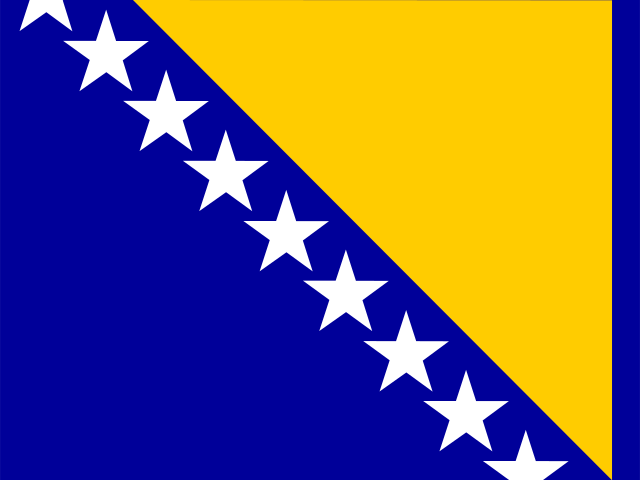
Bosnia and Herzegovina lies in the western Balkans. It is mostly mountains and forest, crossed by the Dinaric Alps and by rivers such as the Sava, Drina, Bosna, Vrbas, Una and Neretva. Bosnia is the larger, northern part of the country, with cold, snowy winters; Herzegovina in the south is drier, with a Mediterranean climate and a single short stretch of coast around the town of Neum.
Its history is layered. A medieval Bosnian kingdom was followed by about four centuries of Ottoman rule, which brought Islam, bazaars, mosques and graceful stone bridges. Austria-Hungary took over in 1878, and in the 20th century the country was part of Yugoslavia. It declared independence in 1992, and the war that followed lasted until the end of 1995.
Memories fade faster than photos. Ask these over a meal or a phone call, and write the answers down.
Bosnia and Herzegovina's story runs from Illyrian tribes and Roman soldiers, through a medieval kingdom and four centuries of Ottoman rule, to Austria-Hungary, Yugoslavia, a painful war in the 1990s and a peace that still shapes the country today.
Local Illyrian tribes rose up against Rome in AD 6. After four years of hard fighting, one of Rome's most difficult wars, the revolt was put down in AD 9 and the land became part of the Roman Empire.
Ban Tvrtko Kotromanić had himself crowned king, and Bosnia became a kingdom. By the 14th century it was the most powerful state in the western Balkans.
The Ottoman Empire conquered the Kingdom of Bosnia. Over the next four centuries Islam spread, and towns such as Sarajevo and Mostar grew into centres of trade with mosques, markets and bridges.
At the Congress of Berlin, Austria-Hungary won the right to occupy and run Bosnia and Herzegovina, which stayed formally Ottoman. It annexed the country outright in 1908, and brought new laws, institutions and industries.
During the Second World War, in which more than 300,000 people from Bosnia and Herzegovina died, Tito's Partisan movement held councils in Mrkonjić Grad and Jajce in November 1943. They restored Bosnia and Herzegovina as a republic within a future Yugoslav federation, which it became after the war.
After a referendum that most Bosnian Serbs boycotted, Bosnia and Herzegovina declared independence on 3 March 1992 and was recognised internationally on 6 April. War followed. Bosnian Serb forces, supported by Serbia, took control of much of the country, and from late 1992 to early 1994 Bosnian Croat and government forces also fought each other. Sarajevo was besieged for almost four years. More than 100,000 people were killed and over 2 million had to leave their homes.
Peace talks at an air force base near Dayton, Ohio, ended the war in November 1995, and the agreement was formally signed in Paris on 14 December. It kept one state made up of two entities, the Federation of Bosnia and Herzegovina and Republika Srpska, with an international High Representative overseeing the peace.
On 15 December 2022 the European Union made Bosnia and Herzegovina an official candidate for membership. In March 2024 EU leaders agreed in principle to open membership talks once further conditions are met.
Cook one of the recipes, print the large-print pack about Bosnia and Herzegovina, and finish with the big-screen quiz or the words crossword. Grandchildren can colour the flag.