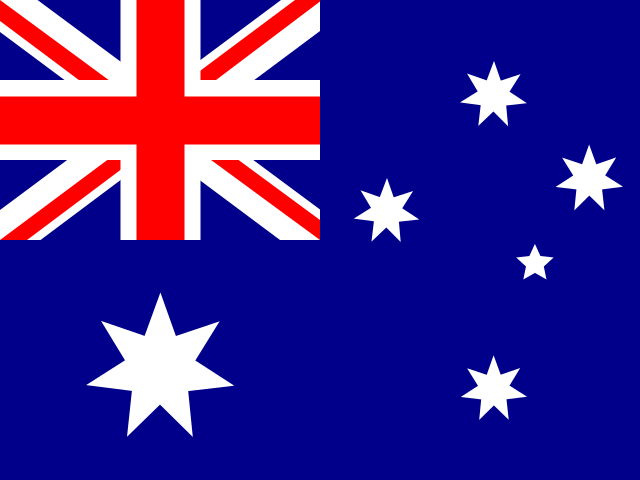
Red desert and coral reef, koalas and kangaroos, beaches and big cities: a whole island continent, home to one of the oldest living cultures on Earth.
Australia is a country made up of the mainland of the Australian continent, the island of Tasmania and many smaller islands, between the Indian and Pacific oceans. By total area it is the sixth-largest country in the world. Most of the interior is dry outback and desert, while the east coast has green hills, rainforests and long sandy beaches, and the Great Barrier Reef runs along the coast of Queensland. Most Australians live in cities near the coast, especially in the south-east.
Aboriginal and Torres Strait Islander peoples are the Indigenous peoples of Australia. Their ancestors arrived at least 50,000 years ago, and dating at the Madjedbebe rock shelter in Arnhem Land suggests it may have been about 65,000 years ago. When the British arrived, Aboriginal people spoke more than 250 languages, and theirs is one of the oldest continuous cultures in the world. Dutch sailors mapped much of the coast in the 1600s, and British colonisation began in 1788 with a penal colony at Sydney Cove.
Questions to ask the older generation
Memories fade faster than photos. Ask these over a meal or a phone call, and write the answers down.
Which town or region of Australia did our family come from? Was it near Sydney, Melbourne, Brisbane?
Who was the first in the family to leave Australia, when, and why?
Which dishes from Australia were cooked at home? Did anyone make Meat pie or Pie floater?
Does anyone in the family still speak Australian English, or use a few words of it?
Were there songs, prayers, games or holidays from Australia that the family kept?
Are there old photos, letters or documents from Australia? Who has them?
If you could visit Australia together, where would you go first?
A short history of Australia
For tens of thousands of years before Europeans arrived, Aboriginal and Torres Strait Islander peoples lived across the whole continent and its islands, with hundreds of languages and deep knowledge of the land. Dutch sailors charted the coasts in the 1600s, and James Cook claimed the east coast for Britain in 1770. British settlement from 1788 took land from Aboriginal people without treaty, and conflict and disease caused great suffering. The colonies grew with free settlers and gold, united in 1901, and the country has since worked, not always easily, to face the harder parts of its past.
1606
The Duyfken reaches Cape York
In 1606 the small Dutch ship Duyfken, captained by Willem Janszoon, sailed from Java and charted part of the Cape York Peninsula, landing near the Pennefather River in the Gulf of Carpentaria. It is the first recorded European landing in Australia. The Dutch later called the land New Holland.
1770
Captain Cook charts the east coast
In April 1770 James Cook's ship Endeavour reached the east coast of Australia and landed at Botany Bay, where two Gweagal men opposed the landing. Cook sailed north, charting the coast, and on Possession Island near Cape York he claimed the whole east coast for Britain.
1851
The gold rush begins
In May 1851 Edward Hargraves announced that he had found gold near Orange in New South Wales, and within months even richer goldfields were found in Victoria, at Ballarat and Bendigo. People came from around the world, and Australia's population grew from about 430,000 in 1851 to 1.7 million in 1871.
1901
Federation
On 1 January 1901 the six British colonies of New South Wales, Victoria, Queensland, South Australia, Western Australia and Tasmania united to form the Commonwealth of Australia. The first federal Parliament opened in Melbourne on 9 May 1901, in the Royal Exhibition Building.
1932
The Sydney Harbour Bridge opens
The steel arch bridge across Sydney Harbour, nicknamed 'the Coathanger', was formally opened on 19 March 1932. Its arch spans 504 m, and its top is 134 m above the water. Before it opened, it was tested by loading its rail tracks with up to 96 steam locomotives.
1973
The Sydney Opera House opens
Queen Elizabeth II formally opened the Sydney Opera House on 20 October 1973. The Danish architect Jørn Utzon had won the design competition in 1957, but he left the project in 1966, and an Australian team led by Peter Hall completed the building. It became a World Heritage Site in 2007.
1999
The republic referendum
On 6 November 1999 Australians voted on whether to become a republic with a president chosen by Parliament. The proposal did not pass: 54.87 percent voted No, and no state had a Yes majority. Australia remains a constitutional monarchy.
2023
The Voice referendum
On 14 October 2023 Australians voted on a proposal to recognise Aboriginal and Torres Strait Islander peoples in the Constitution through an advisory body called the Aboriginal and Torres Strait Islander Voice. The proposal was not approved: about 60 percent of voters and a majority in every state voted No.