Greeks found Epidamnos
Greek colonists from Corinth and Corcyra (Corfu), working with the local Illyrian Taulantii, founded the port of Epidamnos. It later became Roman Dyrrachium and is today's Durrës.
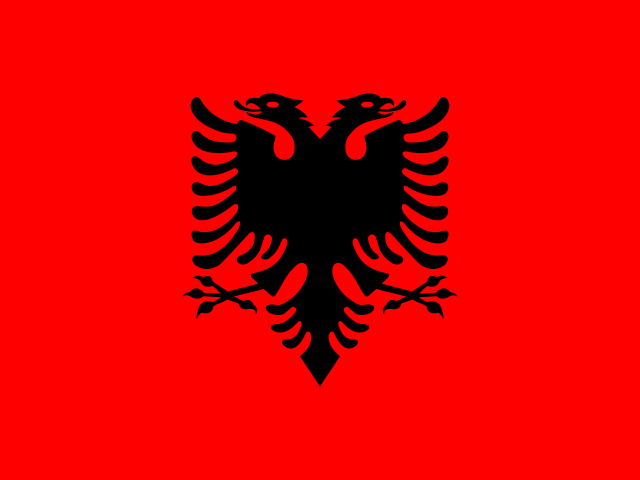
Albania lies in the south-west of the Balkan Peninsula, facing Italy across the Adriatic and Ionian seas. It is only about 148 km wide from east to west and around 340 km long from north to south, yet it packs in the snowy Albanian Alps, deep river valleys, the great lakes of Shkodër, Ohrid and Prespa, flat coastal plains and the rocky Albanian Riviera in the south-west.
Illyrian tribes lived here in ancient times, Greek colonists founded ports such as Epidamnos, today's Durrës, and Apollonia, and the land later became part of the Roman and Byzantine empires. In the 15th century Skanderbeg led a long resistance against the Ottoman Empire, which then ruled Albania for more than four centuries. Albania declared independence in Vlorë on 28 November 1912.
Memories fade faster than photos. Ask these over a meal or a phone call, and write the answers down.
Albania's story runs from Illyrian kingdoms and Greek colonies on the coast, through Rome, Byzantium and the hero Skanderbeg, to four centuries of Ottoman rule, independence in 1912 and a hard road from communism to democracy.
Greek colonists from Corinth and Corcyra (Corfu), working with the local Illyrian Taulantii, founded the port of Epidamnos. It later became Roman Dyrrachium and is today's Durrës.
Progon of Kruja founded the Principality of Arbanon, with its centre at Krujë. It is seen as the first sketch of an Albanian state, and lasted into the 13th century.
Skanderbeg died on 17 January 1468 after about 25 years of resistance. Krujë fell to the Ottomans ten years later, and Albania remained under Ottoman rule until 1912.
Albanian scholars meeting in Manastir, today's Bitola in North Macedonia, agreed on a Latin alphabet for Albanian. It became the basis of the 36-letter alphabet used today.
Ahmet Zogu, who had been prime minister and then president, turned Albania into a monarchy in 1928 and took the title King Zog I.
In 1944 partisan forces led by communists drove out the German army, which had replaced the Italians in 1943. Enver Hoxha led Albania from 1944 until his death in 1985.
After student protests and the fall of communism across Eastern Europe, Albania held its first multi-party elections on 31 March 1991. The Republic of Albania was proclaimed on 29 April 1991.
Albania became a full member of NATO on 1 April 2009 and applied to join the European Union later the same month. It became an official EU candidate in 2014.
Cook one of the recipes, print the large-print pack about Albania, and finish with the big-screen quiz or the words crossword. Grandchildren can colour the flag.