World Stroll
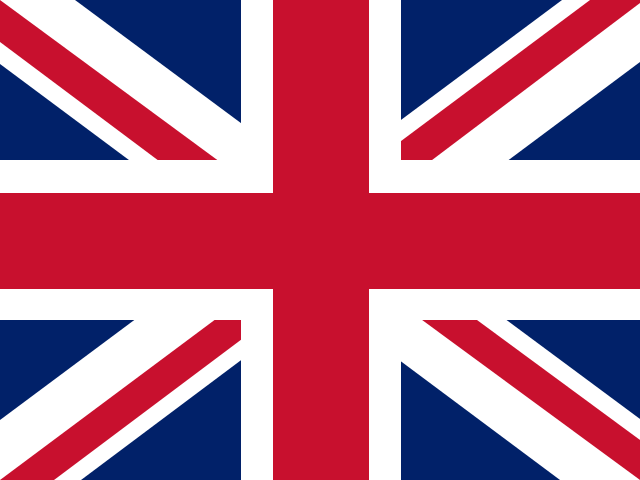
Flag of United Kingdom
Travel guide

Learn the United Kingdom before you go

Four nations, one crown: castles and cathedrals, green countryside, great cities and a proper cup of tea.
Take the full trip
CapitalLondon
CurrencyPound sterling (£), also called the British pound, divided into 100 pence
Official languageNo law names an official language for the whole UK; English is the de facto official language. Welsh is official in Wales, Gaelic (since 2005) and Scots (since 2025) have official status in Scotland, and Irish and Ulster Scots are recognised in law in Northern Ireland
Drives on theLeft
Calling code+44

10 phrases to learn

Capital letters show the stressed part. Tap the heart to practise a phrase later.

Cheers!
CHEERZ
Thanks, goodbye, or 'to your health' when raising a glass
Thanking someone casually, saying goodbye, or making a toast
You alright?
yoo awl-RYTE
Hello, how are you? (a friendly greeting, not a worried question)
Greeting someone casually; reply 'Yes, fine thanks, you?'
Fancy a cuppa?
FAN-see uh KUP-uh
Would you like a cup of tea?
Offering tea to a guest or a friend
Mind the gap
MYND thuh GAP
Watch out for the gap between the train and the platform
You will hear it on the London Underground
Mind your head
MYND yor HED
Watch out, the ceiling or doorway is low
Signs in old pubs, cottages and castles
Sorry!
SOR-ee
Excuse me, or pardon me
Squeezing past someone, bumping into someone, or asking them to repeat something
Could I have the bill, please?
kud eye hav thuh BILL, pleez
Could I have the check, please?
At the end of a meal in a restaurant
Where's the loo, please?
WAIRZ thuh LOO, pleez
Where is the restroom, please?
Asking for the toilet politely
A return to Edinburgh, please
uh rih-TURN tuh ED-in-bruh, pleez
A round-trip ticket to Edinburgh, please
Buying a train or bus ticket
Is this the queue?
iz this thuh KYOO
Is this the line?
Checking where a line starts, so you do not push in by mistake

At the table

  • Hold the fork in your left hand and the knife in your right, and keep them there while you eat, rather than swapping hands.
  • In most pubs you order and pay at the bar. Friends often take turns to buy a 'round' of drinks for the whole group, and if someone buys you one, it is polite to buy the next.
  • Check the restaurant bill before tipping: many restaurants add a service charge of about 10 to 12.5 percent. If there is none, 10 to 15 percent is usual for good service. You do not need to tip for drinks at the bar.
  • Tea is usually drunk with milk. If you visit someone at home, you will almost certainly be asked if you would like a cup, and it is friendly to say yes.
  • When raising a glass, say 'Cheers'. In Wales you may hear 'Iechyd da' (YEH-chid DAH), which means 'good health'.

Local tips

Drive on the left, in miles

Traffic drives on the left, and road signs show distances in miles and speeds in miles per hour. The usual limits for cars are 30 mph (about 48 km/h) in towns, 60 mph on ordinary country roads and 70 mph (about 112 km/h) on dual carriageways and motorways. In Wales the default in built-up areas is 20 mph.

Check if you need an ETA

As of 2026, most visitors who do not need a visa, including travellers from the United States and the European Union, must get an Electronic Travel Authorisation (ETA) before they travel. It costs £20 (as of 2026) and lets you visit for up to 6 months at a time. Apply on the official GOV.UK website, as other websites may charge more. Irish citizens do not need one.

Money: pounds and pence

The currency is the pound sterling (£), divided into 100 pence. Cards and contactless payment are accepted almost everywhere. Banks in Scotland and Northern Ireland print their own notes: they work well there, but some shops in England may hesitate to take them, so spend them before you leave.

Bring the right plug

The UK uses the Type G plug, with three large rectangular pins. Plugs from mainland Europe and North America do not fit, so pack an adapter.

Emergency number

For police, ambulance, fire or coastguard, call 999. The European emergency number 112 also works and reaches the same service. Both are free.

Tipping without worry

Look at the bill first: many restaurants add a service charge of 10 to 12.5 percent, and then no extra tip is needed. Otherwise 10 to 15 percent is usual for good table service. In pubs you order at the bar and do not need to tip, and for taxis people often just round up.

Many great museums are free

Entry to the permanent collections of the big national museums, such as the British Museum in London, is free. A donation box at the door is welcome, and special exhibitions usually charge a fee.

Dishes to try

  • Full English breakfast: A big cooked breakfast of bacon, sausages, eggs, grilled tomatoes, mushrooms, baked beans and toast or fried bread, often with black pudding. Scotland, Wales and Northern Ireland each have their own version.
  • Fish and chips: White fish, usually cod or haddock, fried in crisp batter and served with thick-cut chips, salt and malt vinegar. Mushy peas and tartare sauce are popular sides, and seaside towns are famous for it.
  • Sunday roast: Roast beef, lamb, pork or chicken with roast potatoes, vegetables and gravy, traditionally eaten at Sunday lunchtime. Each meat has its partner: Yorkshire pudding and horseradish with beef, mint sauce with lamb, apple sauce with pork.
  • Yorkshire pudding: A simple batter of eggs, flour and milk poured into smoking hot fat, which puffs up into a golden, crisp cup. It is served with roast beef and gravy.
  • Shepherd's pie: Minced lamb cooked with onions, carrots and gravy, topped with mashed potato and baked until golden. Made with beef, it is usually called cottage pie.
  • Lancashire hotpot: Lamb or mutton and onions, covered with overlapping slices of potato and cooked slowly in a lidded pot until the top is crisp and brown. It is traditionally served with pickled red cabbage.
  • Haggis: Scotland's national dish: sheep's heart, liver and lungs minced with onion, oatmeal, suet and spices, traditionally cooked in a sheep's stomach. It is served with 'neeps and tatties', mashed swede and potatoes.
  • Cullen skink: A thick, creamy soup of smoked haddock, potatoes and onions, made with milk. It comes from the fishing town of Cullen on the Moray coast.

Cities to see

  • London (capital): Buckingham Palace and the Changing of the Guard, The Tower of London and Tower Bridge, The British Museum, free to enter.
  • Edinburgh: Edinburgh Castle and the Royal Mile, The Festival Fringe every August, The Palace of Holyroodhouse and the Scottish Parliament.
  • Cardiff: Cardiff Castle, The Principality Stadium and rugby, Cardiff Bay and the Senedd.
  • Belfast: Titanic Belfast museum, Stormont, the Parliament Buildings, City Hall.
  • Manchester: Two famous football clubs, Manchester United and Manchester City, Industrial heritage and red-brick warehouses, The world's first intercity passenger railway, to Liverpool, in 1830.
  • Liverpool: The Beatles and the Cavern Club, The Royal Albert Dock, The 'Three Graces' on the waterfront.

Landmarks and the city map are on the United Kingdom trip