World Stroll
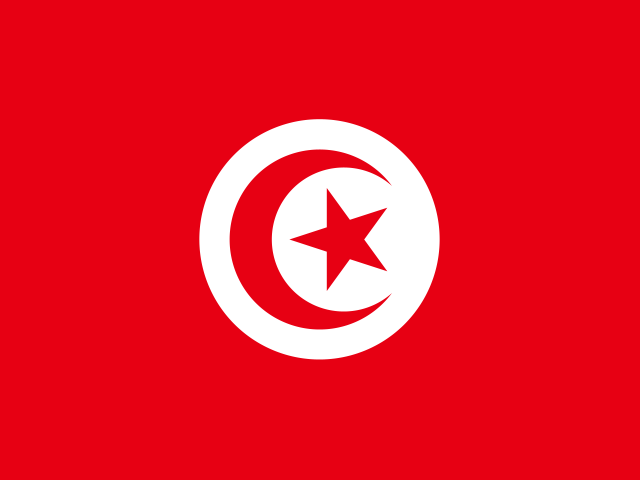
Flag of Tunisia
Travel guide

Learn Tunisia before you go

Ancient Carthage, Roman amphitheatres, blue and white villages above the sea and the edge of the Sahara, all in the northernmost country of Africa.
Take the full trip
CapitalTunis
CurrencyTunisian dinar (TND), divided into 1,000 millimes
Official languageArabic. Most people speak Tunisian Arabic (Derja), and French is widely used in business and education but has no official status
Drives on theRight
Calling code+216

10 phrases to learn

In Tunisian Arabic (Derja). Capital letters show the stressed part. Tap the heart to practise a phrase later.

Shnahwalek? (شنحوالك)
shnah-WEH-lek
How are you?
After saying hello to someone you know, or to be friendly
Labes, yaishek (لاباس، يعيشك)
leh-BEHS, yah-EESH-ek
Fine, thank you
Answering 'How are you?'
Sbah il-khir (صباح الخير)
SBAH el-KHEER
Good morning
Greeting someone in the morning
Msa il-khir (مسا الخير)
MSAH el-KHEER
Good evening
Greeting someone in the afternoon or evening
Liltek zina (ليلتك زينة)
LEEL-tek ZEE-na
Have a good night
Saying goodbye in the evening
Shnowa ismek? (شنوة إسمك)
SHNOO-wa ISM-ek
What is your name?
Getting to know someone
Ismi ... (إسمي)
IS-mee
My name is ...
Introducing yourself
Tsharrafna (تشرفنا)
tshar-RAF-na
Nice to meet you
After being introduced
Samahni (سامحني)
SAH-mah-nee
Excuse me, sorry
Getting someone's attention, or apologising
Ma fhimtish (ما فهمتش)
ma FHIM-teesh
I don't understand
When someone speaks too fast for you

At the table

  • Bread, olive oil and harissa are put on the table at the start of almost every meal: tear off a piece of bread, dip it in the oil and then, carefully, in the harissa.
  • Couscous is served in one large shared dish at family meals, weddings and other gatherings. Eat from the part of the dish in front of you.
  • Eat a brik with your fingers, holding it by the corners, and bite carefully: the egg yolk inside is often runny.
  • Tea is usually drunk after a meal, sweet and in small glasses, sometimes with pine nuts floating on top.
  • Most Tunisians are Muslim and do not eat pork, and alcohol is served only in licensed restaurants, bars and hotels.
  • During Ramadan, families break the day's fast together at sunset, and cafés and streets fill up after the meal.

Local tips

Keep your exchange receipts

The Tunisian dinar is a closed currency: you may not take dinars into or out of the country. Change money in Tunisia, keep the official receipts, and use them to change leftover dinars back before you leave. Declare larger amounts of foreign cash on arrival. ATMs are common in towns.

Be thoughtful during Ramadan

During the holy month of Ramadan (as of September 2026, the next one begins in February 2027) most Tunisians fast from dawn to sunset. Eating, drinking or smoking in public in the daytime may cause offence, many cafés close by day, and the evenings after the sunset meal are lively.

Dress modestly away from the beach

Beachwear is fine in resorts, but cover shoulders and knees when visiting religious sites, medinas and villages, especially in the more traditional south.

Know where alcohol is sold

Alcohol is served in licensed restaurants, bars and hotels. Supermarkets do not sell it on Fridays. During Ramadan, shops stop selling alcohol and only a few restaurants and bars serve it, although these rules do not apply in holiday resorts.

Do not photograph official buildings

Do not take photographs of or near government buildings or military sites. Ask before photographing people, and never take antiquities out of the country without permission.

Agree taxi fares first

In Tunis and other large towns, city taxis have meters: check that it is switched on. For longer trips, agree the price before you set off.

Emergency numbers

As of 2026, the numbers in Tunisia are 190 for an ambulance, 197 for the police in towns, 193 for the National Guard in rural areas, and 198 for fire and road accidents.

French helps

Most road signs are in Arabic and French, and French is widely spoken in shops, hotels and offices. English is mostly heard in tourist areas, so a few words of French or Derja go a long way.

Dishes to try

  • Fish couscous (كسكسي (kosksi)): Couscous, called kosksi in Tunisia, is steamed over a pot of stew in a double pot called a couscoussier. On the coast it is often served with whole fish, such as sea bream or grouper, and vegetables in a hot, red, harissa-spiced sauce. Inland, lamb, chicken or beef are more common.
  • Brik with egg (بريك (brik)): A sheet of paper-thin malsouka pastry folded around a whole egg, often with tuna, capers, parsley and onion, then fried for a few minutes until crisp and golden. The yolk usually stays runny inside.
  • Lablabi (لبلابي): A garlicky chickpea soup with cumin, poured over torn pieces of stale bread and topped with harissa, olive oil, often a soft-cooked egg, and sometimes tuna, capers and olives. It is cheap, filling and warming.
  • Slata mechouia (grilled salad) (سلاطة مشوية): Peppers, tomatoes, onions and garlic are grilled until blackened, peeled and chopped or pounded together with olive oil, caraway and coriander seed. It is usually served cold with tuna, olives and hard-boiled eggs, and eaten with bread.
  • Harissa (هريسة): A hot red paste of sun-dried chilli peppers pounded with garlic, caraway, coriander seed and salt, and covered with olive oil. It goes into stews, soups and couscous, and is served on its own with bread and olive oil at the start of almost any meal.
  • Ojja with merguez (عجة): A quick dish of eggs cooked in a spicy sauce of tomatoes, peppers, garlic, caraway and harissa, often with slices of merguez, a small spicy sausage, or with shrimp. It is eaten straight from the pan with bread.
  • Tunisian tajine (طاجين): Nothing like the Moroccan stew of the same name: a Tunisian tajine is a thick baked omelette, somewhat like an Italian frittata, made with eggs, grated cheese, parsley, potatoes and chicken, minced meat or tuna. It is cut into squares and served warm or cold.
  • Mloukhia (ملوخية): A slow-cooked beef or lamb stew in a thick, almost black-green sauce made from the dried and powdered leaves of the jute plant, simmered for hours in olive oil with garlic and bay leaves. It is eaten with bread.

Cities to see

  • Tunis (capital): The Medina and the Zitouna Mosque, The Bardo National Museum, Avenue Habib Bourguiba.
  • Sfax: Its walled medina, Olive oil and fishing, Fine pastries for weddings.
  • Sousse: The Ribat and the medina, Beaches and hotels, Olive oil and textiles.
  • Kairouan: The Great Mosque of Kairouan, Makroudh, date-filled pastries, Hand-knotted carpets.
  • Bizerte: Its old harbour, Cape Angela, Africa's northernmost point, Lablabi sandwiches.
  • Gabès: A coastal palm oasis, Hrous, a spicy onion and chilli paste, Henna.

Landmarks and the city map are on the Tunisia trip