World Stroll
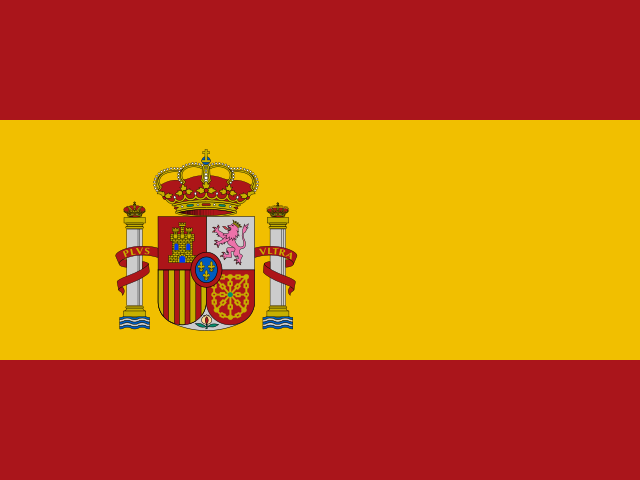
Flag of Spain
Travel guide

Learn Spain before you go

Sunny plazas, Moorish palaces, Gaudí's dreamlike buildings and long, late dinners with friends.
Take the full trip
CapitalMadrid
CurrencyEuro (€)
Official languageSpanish (Castilian), with Catalan, Galician, Basque and others co-official in their regions
Drives on theRight
Calling code+34

10 phrases to learn

In Spanish (Castilian). Capital letters show the stressed part. Tap the heart to practise a phrase later.

Buenos días
BWEH-nohs DEE-ahs
Good morning, hello
Greeting someone in the morning, until lunchtime
Buenas tardes
BWEH-nahs TAR-dehs
Good afternoon, good evening
Greeting someone after lunch and into the early evening
Buenas noches
BWEH-nahs NOH-chehs
Good evening, good night
Greeting someone late in the evening, or saying goodnight
Adiós
ah-DYOHS
Goodbye
Saying goodbye
Hasta luego
AHS-tah LWEH-goh
See you later
A friendly goodbye, even to people you may not see again
Por favor
por fah-BOR
Please
Asking for anything
Perdone
pehr-DOH-neh
Excuse me
Getting someone's attention politely
Encantado / Encantada
en-kahn-TAH-doh / en-kahn-TAH-dah
Nice to meet you (said by a man / by a woman)
Meeting someone for the first time
¿Qué tal?
keh TAHL
How are you? How is it going?
A friendly greeting after hello
¿Habla inglés?
AH-blah een-GLEHS
Do you speak English?
Before asking for help

At the table

  • Meals are late by northern European standards: lunch usually starts around 2 pm and dinner is often after 9 pm.
  • Tapas are for sharing. Order a few plates for the table and everyone picks from them.
  • Bread is served with most meals and is used to push food onto the fork and to mop up sauces.
  • Waiters do not bring the bill until you ask for it. Lingering at the table after a meal to talk is so normal that it has a name: la sobremesa.
  • At lunch many restaurants offer a menú del día, a fixed-price meal of a first course, a second course and dessert, often with bread and a drink.

Local tips

Eat on Spanish time

Restaurants usually serve lunch from about 1 pm to 4 pm and dinner from about 8 pm to 11:30 pm. Arrive at 7 pm and you may find the kitchen closed.

Look for the menú del día

On weekdays many restaurants offer a fixed-price lunch of three courses, often with bread and a drink. It is usually the best value meal of the day.

Shops close on Sundays

Most shops open from about 10 am to 9 pm, but Sunday is the normal day for shops and businesses to close. Some smaller shops also close for a few hours in the afternoon, especially in summer.

Tipping is modest

Tips are not obligatory in Spain. Leaving some small change, or about 5 to 10 percent for good service in a restaurant, is appreciated.

Two kisses

Friends and family usually greet each other with a light kiss on each cheek, first leaning to your left so that right cheeks touch. When you first meet someone in a formal setting, a handshake is fine.

Take the high-speed train

The AVE high-speed trains link the big cities fast: Madrid to Barcelona takes about two and a half hours, and Madrid to Valencia less than two hours.

Book famous sights ahead

Popular places such as the Alhambra in Granada and the Sagrada Família in Barcelona sell timed tickets that often run out days or weeks ahead, especially in spring and summer.

Respect the summer heat

Inland Andalusia, around Seville and Córdoba, can be extremely hot in July and August. Sightsee in the morning, rest in the afternoon like the locals, and carry water.

Dishes to try

  • Paella valenciana: Rice cooked in a wide, shallow pan with olive oil, chicken, rabbit, green beans, large white beans and saffron. The original Valencian recipe has no seafood and no chorizo.
  • Gazpacho (Gazpacho andaluz): A cold, refreshing soup of raw tomatoes, pepper, cucumber, garlic, olive oil and vinegar, blended until smooth. In summer it is often drunk from a glass.
  • Salmorejo: A thicker, creamier cousin of gazpacho, made mainly of tomatoes, bread, garlic and olive oil, served cold and topped with chopped hard-boiled egg and cured ham.
  • Spanish omelette (Tortilla de patatas): A thick, round omelette of eggs and potatoes slowly fried in olive oil, often with onion. It is eaten warm or cold, as a tapa, a sandwich filling or a light supper.
  • Bread with tomato (Pa amb tomàquet (Catalan), pan con tomate (Spanish)): Toasted or fresh country bread rubbed with ripe tomato, drizzled with olive oil and sprinkled with salt. In Catalonia it goes with almost every meal.
  • Garlic prawns (Gambas al ajillo): Prawns cooked in plenty of olive oil with sliced garlic and a little dried chilli, served sizzling in a small clay dish with bread to mop up the oil.
  • Galician-style octopus (Pulpo a la gallega (pulpo á feira in Galician)): Tender boiled octopus cut into slices, sprinkled with coarse salt and paprika and drizzled with olive oil, traditionally served on a round wooden plate.
  • Fabada asturiana: A rich, warming stew of large white beans (fabes) slowly cooked with chorizo, morcilla (blood sausage) and pork.

Cities to see

  • Madrid (capital): The Prado Museum, The Royal Palace, Puerta del Sol and Plaza Mayor.
  • Barcelona: The Sagrada Família, Park Güell, La Rambla and the Gothic Quarter.
  • Valencia: Paella, The City of Arts and Sciences, The Fallas festival in March.
  • Seville: The cathedral and the Giralda, The Royal Alcázar, Flamenco.
  • Bilbao: The Guggenheim Museum, Pintxos, Its old town, the Casco Viejo.
  • San Sebastián: La Concha beach, Pintxos, Its film festival.

Landmarks and the city map are on the Spain trip