World Stroll
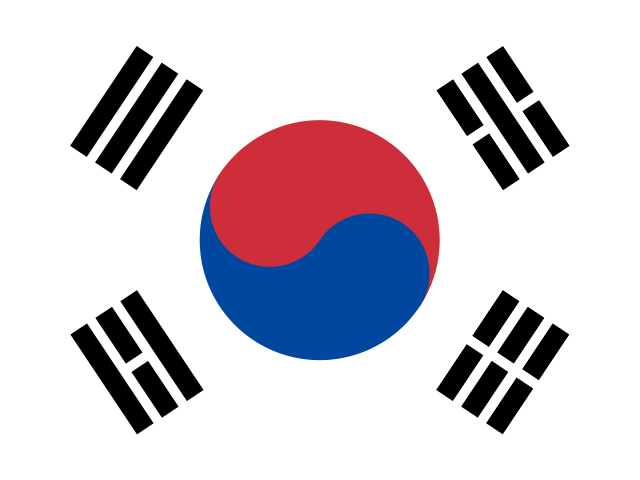
Flag of South Korea
Travel guide

Learn South Korea before you go

Royal palaces, mountain temples, kimchi and bright modern cities, on the southern half of the Korean Peninsula.
Take the full trip
CapitalSeoul
CurrencySouth Korean won (₩)
Official languageKorean; Korean Sign Language is also official by law since 2016
Drives on theRight
Calling code+82

10 phrases to learn

In Korean. Capital letters show the stressed part. Tap the heart to practise a phrase later.

Annyeonghaseyo (안녕하세요)
ahn-nyung-HAH-seh-yo
Hello
Greeting anyone, at any time of day
Gamsahamnida (감사합니다)
KAHM-sah-hahm-nee-dah
Thank you
Thanking anyone politely
Mannaseo bangapseumnida (만나서 반갑습니다)
mahn-nah-suh bahn-GAHP-sum-nee-dah
Nice to meet you
Meeting someone for the first time
Annyeonghi gaseyo (안녕히 가세요)
ahn-NYUNG-hee KAH-seh-yo
Goodbye (go in peace)
Saying goodbye to someone who is leaving
Annyeonghi gyeseyo (안녕히 계세요)
ahn-NYUNG-hee KYEH-seh-yo
Goodbye (stay in peace)
Saying goodbye when you are the one leaving
Joesonghamnida (죄송합니다)
chweh-SONG-hahm-nee-dah
I am sorry
Apologising politely
Jeogiyo (저기요)
CHUH-gee-yo
Excuse me
Calling a waiter or getting someone's attention
Gwaenchanayo (괜찮아요)
kwen-CHAH-nah-yo
It is fine, I am okay
Saying no problem, or no thank you
Eolmayeyo? (얼마예요?)
UHL-mah-yeh-yo
How much is it?
Shopping in a market
Igeo juseyo (이거 주세요)
ee-GUH JOO-seh-yo
This one, please
Pointing at something in a shop or on a menu

At the table

  • Wait for the oldest person at the table to start eating before you begin.
  • Rice and soup are eaten with a spoon, and side dishes with chopsticks. Chopsticks and spoons are usually made of metal.
  • Leave your rice bowl on the table instead of lifting it to your mouth.
  • Never stand your chopsticks upright in a bowl of rice: it looks like a ritual for the dead.
  • When someone older pours you a drink, hold your glass with both hands, and when you pour for them, use both hands too.
  • Side dishes are shared and usually refilled for free, so it is fine to ask for more.

Local tips

Get a T-money card

A rechargeable T-money card works on subways, city buses and many taxis across the country, and each ride is a little cheaper than with a paper ticket. Buy and top it up at convenience stores and subway stations; topping up usually needs cash.

Use Korean map apps

Naver Map and KakaoMap usually give much better walking and public transport directions in South Korea than Google Maps. Naver Map has a full English version, and KakaoMap has English menus.

Do not tip

Tipping is not customary in restaurants, taxis or hotels. The price you see is the price you pay.

Remember the emergency numbers

Call 112 for the police and 119 for an ambulance or the fire service. The tourist helpline 1330 answers questions in English and other languages.

Take your shoes off

Take off your shoes when you enter a home, a temple hall and many traditional restaurants where people sit on the floor. Wear socks without holes, and shoes that slip on and off easily.

Leave priority seats free

Priority seats on subways and buses are kept for older people, disabled people and pregnant women. Leave them free if you do not need one.

Plan around the big holidays

At Seollal (Lunar New Year) and Chuseok (the autumn harvest festival) millions travel home, trains sell out and many shops close. In 2027 Seollal falls on 6 to 9 February and Chuseok on 14 to 16 September.

Bring the right plug

South Korea uses 220 volts and round two-pin European plugs (types C and F). Visitors from Britain, the USA and elsewhere need an adapter.

Dishes to try

  • Kimchi (김치): Vegetables, most often napa cabbage or radish, salted and fermented with chilli, garlic, ginger and spring onion. It is served with almost every meal, and older, sourer kimchi is used for cooking stews and pancakes.
  • Bibimbap (비빔밥): A bowl of warm rice topped with seasoned vegetables, meat, an egg and a spoonful of gochujang, all mixed together just before eating. The name means 'mixed rice'.
  • Bulgogi (불고기): Thin slices of beef marinated in soy sauce, sugar, sesame oil, garlic and grated pear, then grilled or pan-fried. The name means 'fire meat'.
  • Samgyeopsal (삼겹살): Thick slices of pork belly that diners grill themselves on a hot plate in the middle of the table, then wrap in lettuce leaves with garlic and a dab of ssamjang, a spicy bean paste.
  • Kimchi stew (김치찌개): A bubbling, spicy stew of well-fermented kimchi, pork and tofu, one of the most common home dishes in Korea. It is served boiling hot in the middle of the table with rice.
  • Japchae (잡채): Glass noodles made from sweet potato starch, stir-fried with vegetables, mushrooms and beef and seasoned with soy sauce and sesame oil. It is a favourite dish for birthdays, weddings and holidays.
  • Seafood and spring onion pancake (해물파전): A large, crisp pancake of batter packed with whole spring onions and seafood such as squid, prawns and clams, cut into pieces and dipped in soy sauce with vinegar.
  • Tteokbokki (떡볶이): Chewy rice cakes shaped like thick fingers, simmered in a sweet and fiery gochujang sauce with fish cakes and spring onions. It is the classic street food of Korea.

Cities to see

  • Seoul (capital): Gyeongbokgung and Changdeokgung palaces, The Han River parks, Markets such as Gwangjang and Namdaemun.
  • Busan: Haeundae Beach, Jagalchi fish market, Gamcheon Culture Village.
  • Incheon: Incheon International Airport, Korea's only official Chinatown, The Incheon landing of 1950.
  • Daegu: Apples, Seomun Market, Yangnyeongsi herbal medicine market.
  • Daejeon: Daedeok Innopolis research town, KAIST university, Expo '93.
  • Suwon: Hwaseong Fortress, Suwon galbi (beef ribs), Samsung Electronics.

Landmarks and the city map are on the South Korea trip