World Stroll
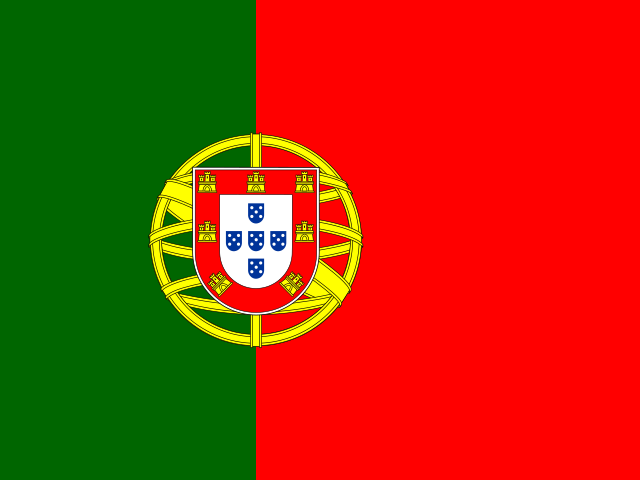
Flag of Portugal
Travel guide

Learn Portugal before you go

Seafaring explorers, custard tarts and fado, on the sunny Atlantic edge of Europe.
Take the full trip
CapitalLisbon
CurrencyEuro (€), since 2002 (before that, the escudo)
Official languagePortuguese (Mirandese is also recognised in the far northeast)
Drives on theRight
Calling code+351

10 phrases to learn

In Portuguese (as spoken in Portugal). Capital letters show the stressed part. Tap the heart to practise a phrase later.

Bom dia
bohn DEE-ah
Good morning
Greeting someone before noon
Boa tarde
BOH-ah TARD
Good afternoon
Greeting someone from noon until about 7 pm
Boa noite
BOH-ah NOYT
Good evening, good night
Greeting someone in the evening, or saying goodnight
Olá, tudo bem?
oh-LAH, TOO-doo BAYNG
Hi, how are you doing?
A friendly greeting
Muito obrigado / Muito obrigada
MWEEN-too oh-bree-GAH-doo / -dah
Thank you very much (said by a man / by a woman)
Thanking someone warmly
De nada
d' NAH-dah
You're welcome
Answering when someone thanks you
Desculpe
dish-KOOLP
Sorry, excuse me
Apologising, or getting a stranger's attention politely
Com licença
kohn lee-SEN-sah
Excuse me, may I get past?
Asking to get past someone in a crowd or on a bus
Fala inglês?
FAH-lah een-GLAYSH
Do you speak English?
Before asking for help
Não percebo
nowng per-SAY-boo
I don't understand
When you cannot follow what someone says

At the table

  • Lunch is usually between noon and about 2:30 pm, and dinner between about 7:30 and 10:30 pm.
  • Bread, olives, cheese or other starters (the 'couvert') are often put on the table without being ordered. You pay for them only if you eat them, so send them back if you do not want them.
  • Restaurants must offer free tap water to their customers.
  • Say 'Bom apetite' to wish people a good meal before eating.
  • A meal usually ends with a small, strong coffee. Ask for 'um café' and you get an espresso.

Local tips

Know the couvert

Bread, butter, olives or cheese are often brought to the table before you order. They are not free, but you pay only if you eat them. If you do not want them, ask the waiter to take them away.

Tap water is free

Restaurants must offer free tap water, in clean reusable glasses, to customers who are eating or drinking there.

Tipping

Service is included in restaurant bills, but it is customary to leave about 5 to 10 percent for good service. In taxis, people tip about 5 to 10 percent or round up to the nearest euro.

Wear shoes with good grip

Lisbon and Porto are very hilly, and the beautiful pavements of small polished stones, the 'calçada', can be slippery, especially when wet.

Meal times

Restaurants usually serve lunch from noon to about 2:30 or 3 pm and dinner from about 7:30 to 10:30 pm. Shops traditionally open from 9 or 10 am to 7 pm on weekdays, and shopping centres stay open until late every day.

Portuguese, not Spanish

Portuguese is a different language from Spanish, and people appreciate it when visitors try a few words of Portuguese. Many Portuguese speak good English.

Coffee like a local

'Um café' gets you a small, strong espresso, drunk standing at the counter. In Lisbon it is often called a 'bica'.

Emergencies and pharmacies

The emergency number is 112. Pharmacies are marked with a green cross and usually open on weekdays from 9 am to 7 pm, and on Saturday mornings.

Dishes to try

  • Bacalhau à Brás: Shredded salt cod, onions and very thin fried potato sticks, bound together with softly scrambled egg and finished with black olives and parsley.
  • Caldo verde: 'Green broth': a potato soup filled with very finely shredded Portuguese cabbage or kale, served with a slice of chouriço sausage and a drizzle of olive oil.
  • Pastel de nata (Pastéis de nata (plural)): A small tart of crisp, flaky pastry filled with egg custard, baked in a very hot oven until the top is blistered and dark in spots. Often dusted with cinnamon and eaten with a coffee.
  • Grilled sardines (Sardinhas assadas): Whole fresh sardines sprinkled with coarse salt and grilled over charcoal, eaten with boiled potatoes, a salad of peppers, or simply on a slice of bread.
  • Arroz doce: A creamy rice pudding flavoured with lemon peel and enriched with egg yolks, served cold with patterns of ground cinnamon drawn on top.
  • Francesinha: A towering sandwich of bread, steak, ham and sausage, covered in melted cheese and a hot tomato and beer sauce, usually with chips on the side.
  • Tripas à moda do Porto: A hearty stew of tripe with white beans, sausage and carrots, served with rice.
  • Bifana: Thin slices of pork simmered with garlic and white wine, served hot in a soft bread roll, often with mustard. A cheap, quick lunch at a café counter.

Cities to see

  • Lisbon (capital): Alfama, the oldest quarter, Yellow trams on steep hills, Belém and its pastries.
  • Porto: Port wine lodges across the river in Vila Nova de Gaia, The Ribeira riverside quarter, São Bento station and its blue tiles.
  • Braga: The sanctuary of Bom Jesus do Monte, Its old cathedral, The Roman ruins of Bracara Augusta.
  • Guimarães: Its medieval castle, A UNESCO-listed historic centre, European Capital of Culture in 2012.
  • Aveiro: Moliceiro boats, Ovos moles, a sweet of egg yolk and sugar, Striped beach houses at nearby Costa Nova.
  • Coimbra: The University of Coimbra, Coimbra fado, sung by students in black capes, The tomb of the first king in the Santa Cruz Monastery.

Landmarks and the city map are on the Portugal trip