World Stroll
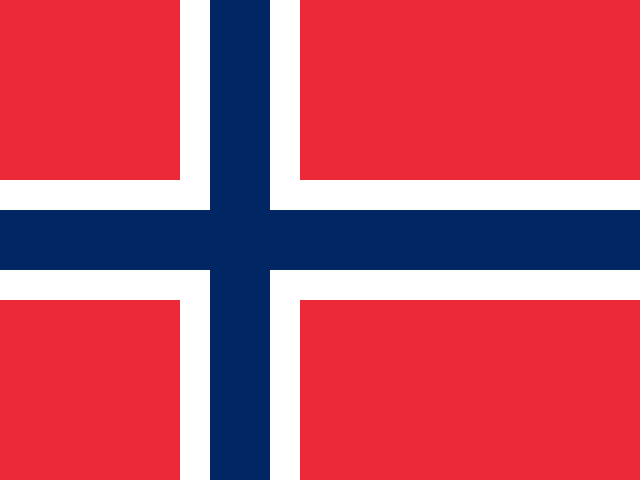
Flag of Norway
Travel guide

Learn Norway before you go

Deep fjords, the midnight sun, northern lights and a long, proud coast at the top of Europe.
Take the full trip
CapitalOslo
CurrencyNorwegian krone (NOK), in use since 1875
Official languageNorwegian, written in two official standards, Bokmål (used by most people) and Nynorsk, and the Sámi languages, spoken by the Indigenous Sámi people, mainly in the north
Drives on theRight
Calling code+47

10 phrases to learn

In Norwegian (Bokmål). Capital letters show the stressed part. Tap the heart to practise a phrase later.

Hei
HAY
Hi, hello
Greeting anyone, at any time of day
God morgen
goo MOR-en
Good morning
Greeting someone in the morning
Hvordan har du det?
VOOR-dahn har doo deh
How are you?
Asking after someone
Bare bra, takk
BAH-reh BRAH, tahk
Just fine, thanks
Answering 'How are you?'
Tusen takk
TOO-sen tahk
Thank you very much (literally 'a thousand thanks')
Thanking someone warmly
Vær så snill
vair saw SNILL
Please
Asking politely for something
Unnskyld
UN-shill
Excuse me, sorry
Getting someone's attention or apologising
Snakker du engelsk?
SNAHK-er doo ENG-elsk
Do you speak English?
Before asking for help
Jeg forstår ikke
yai for-STOR IK-keh
I don't understand
When you have not understood
Hvor er toalettet?
voor air too-ah-LET-teh
Where is the toilet?
Looking for the toilet

At the table

  • After a meal, thank the host with 'Takk for maten' (tahk for MAH-ten), 'thanks for the food'. The host may answer 'Vel bekomme', 'you are welcome'.
  • The hot main meal, 'middag', is eaten early, often between 4 and 7 in the evening, so plan dinner invitations accordingly.
  • Many Norwegians take a packed lunch, a 'matpakke' of simple open sandwiches, to work or school, rather than eating out.
  • When raising a glass, say 'Skål!' (SKOAL).
  • Tipping is not expected. If you are happy with the service in a restaurant, rounding up or leaving 5 to 15 percent is a kind extra, but it is entirely up to you.

Local tips

Headlights on, always

Norway drives on the right, and dipped headlights must be on at all times, even on a bright summer day. Speed limits are low, usually 80 km/h outside towns and at most 110 km/h, the drink-driving limit is very strict (0.2 per mille) and fines are high.

Tolls and ferries

Most road tolls are collected automatically by camera. If you rent a car, ask how tolls are paid. Many roads along the fjords include short car ferries, paid with the AutoPASS or FerryPay systems, and some routes are free.

Cards almost everywhere

Debit and credit cards, and phone payments, are accepted almost everywhere. Carry a little cash in Norwegian kroner for small places in the countryside. Tipping is not expected.

Buying wine and beer

You must be 18 to buy beer and wine and 20 to buy spirits. Supermarkets sell beer only until 8 pm on weekdays and 6 pm on Saturdays. Apart from airport tax-free shops, wine, spirits and stronger beer are sold only in the state shops called Vinmonopolet.

When to see the light

For the midnight sun, travel north of the Arctic Circle between about late May and late July (a shorter time just north of the circle, such as in Bodø). For the northern lights, go to the north between September and March and look up on dark, clear nights, often late in the evening.

Respect nature

The right to roam lets you walk and camp on open land, but campfires in the countryside are banned from 15 April to 15 September, except in safe places such as by the sea or at approved fire sites, and you should take all your rubbish with you. The weather in the mountains changes fast, so bring warm, waterproof layers even in summer.

Plugs

Norway uses 230 volt electricity and the round two-pin plugs common in continental Europe. Visitors from the United Kingdom and North America need an adapter.

Emergencies

The emergency numbers are 112 for police, 113 for an ambulance and 110 for fire.

Dishes to try

  • Fårikål: Mutton or lamb on the bone layered with cabbage and whole black peppercorns, then slowly simmered for hours and served with boiled potatoes. The name means 'mutton in cabbage'.
  • Kjøttkaker: Flattened, oval meat patties, larger than meatballs, simmered in a brown gravy and served with boiled potatoes, creamed cabbage and lingonberry jam. A classic everyday dinner.
  • Raspeball (Also komle, klubb, kumle or potetball): Large, soft dumplings of grated raw potato and flour, boiled and served with salted or boiled pork or lamb, sausages, melted butter and mashed rutabaga.
  • Gravlaks: Raw salmon cured for a day or more in salt, sugar and dill, then sliced thin and served with a sweet mustard and dill sauce on bread or with potatoes. The name means 'buried salmon', from the old way of burying salted fish.
  • Kanelboller and skillingsboller (Kanelboller, skillingsboller): Soft yeast buns rolled up with butter, sugar and cinnamon, eaten with coffee at any time of day. In Bergen they are called skillingsboller.
  • Brunost (Brunost (brown cheese)): A sweet, caramel-coloured 'cheese' made by boiling whey, milk and cream until the milk sugars turn brown. It is sliced thin with a cheese slicer and eaten on bread, crispbread or warm waffles. The most popular kind, Gudbrandsdalsost, mixes cow's and goat's milk.
  • Lutefisk: Dried whitefish, usually cod, soaked for days in water, then in lye, then in water again until it turns soft and jelly-like. It is served with boiled potatoes, mashed peas, bacon and melted butter. Lye is strongly caustic, and the fish is not edible until the lye has been fully soaked out, so buy lutefisk ready to cook rather than making it at home.
  • Pinnekjøtt: Salted and dried lamb ribs, soaked to remove the salt, then steamed for hours over a layer of birch sticks. It is served at Christmas with mashed rutabaga, potatoes and sausages.

Cities to see

  • Oslo (capital): The Royal Palace, The Opera House, with a roof you can walk on, Vigeland's sculptures in Frogner Park.
  • Bergen: The old wharf of Bryggen, Nickname 'the city of seven mountains', Rain on about 200 days a year.
  • Trondheim: Nidaros Cathedral, The old wooden houses of Bakklandet, The Trampe bicycle lift.
  • Stavanger: Stavanger Cathedral, The white wooden houses of Old Stavanger, The Norwegian Petroleum Museum.
  • Kristiansand: Kristiansand Zoo and Amusement Park, Beaches such as Bystranda, The Kvadraturen grid.
  • Ålesund: Art Nouveau (Jugendstil) buildings, The Art Nouveau Centre (Jugendstilsenteret), Hurtigruten coastal ships.

Landmarks and the city map are on the Norway trip