World Stroll
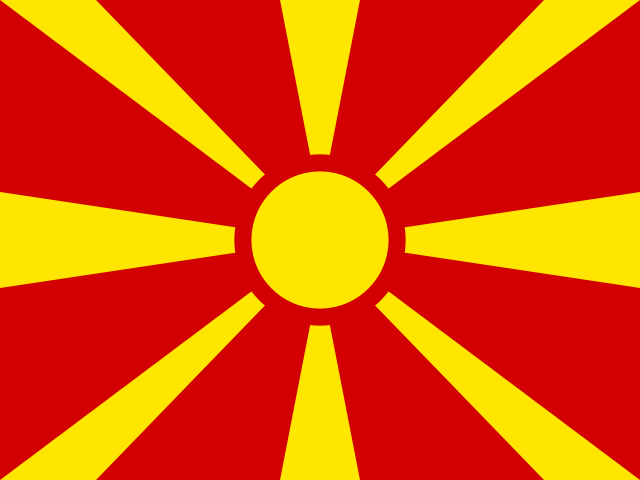
Flag of North Macedonia
Travel guide

Learn North Macedonia before you go

A small, mountainous Balkan country of deep ancient lakes, frescoed Byzantine churches, Ottoman bazaars and beans baked slowly in clay dishes.
Take the full trip
CapitalSkopje
CurrencyMacedonian denar (MKD)
Official languageMacedonian. Since 2019 Albanian is also official at state level
Drives on theRight
Calling code+389

10 phrases to learn

In Macedonian. Capital letters show the stressed part. Tap the heart to practise a phrase later.

Dobro utro (Добро утро)
DOH-broh OO-troh
Good morning
Greeting someone in the morning
Dobar den (Добар ден)
doh-bahr DEHN
Good day, hello
The polite greeting for most of the day, in shops and with strangers
Dobrovečer (Добровечер)
doh-BROH-veh-chehr
Good evening
Greeting someone in the evening
Dobra noḱ (Добра ноќ)
DOH-brah NOHTCH
Good night
Saying goodbye late at night or before bed
Do viduvanje (До видување)
doh vee-DOO-vah-nyeh
Goodbye
Leaving a shop, a restaurant or people you don't know well
Prijatno (Пријатно)
PREE-yaht-noh
Goodbye (literally "pleasant")
A friendly goodbye, often heard in shops
Kako ste? (Како сте?)
KAH-koh steh
How are you? (polite)
Asking an older person or a stranger how they are
Mnogu dobro, blagodaram (Многу добро, благодарам)
MNOH-goo DOH-broh, blah-GOH-dah-rahm
Very well, thank you
Answering "How are you?"
Ve molam (Ве молам)
veh MOH-lahm
Please
Asking politely for something
Izvinete (Извинете)
eez-VEE-neh-teh
Excuse me, or sorry
Getting someone's attention, or apologising

At the table

  • When glasses are raised, people say "Na zdravje!", which means "to your health".
  • A meal often begins with a salad such as šopska and a small glass of rakija.
  • At grill houses (skara), side dishes such as salad, bread and potatoes are usually ordered separately.
  • Coffee culture is strong: Turkish-style coffee is traditional, and the macchiato is the most common order in modern cafés.
  • Meals are unhurried, and service can be slow, so relax and enjoy the conversation.
  • The best-known local wines are reds from the Vranec grape, and the Tikveš region around Kavadarci and Negotino is the centre of wine making.

Local tips

Denars, cards and a little cash

The currency is the Macedonian denar. Cards and contactless payment are widely accepted, and many places also take euros, but carry some denars for markets, taxis and small cafés. As of 2026, many ATMs charge their own fee of about 200 to 300 denars on top of your bank's, so check before you withdraw.

Your hotel registers you

Visitors must be registered with the police within 48 hours of arrival. Hotels do this automatically when you check in; if you stay privately, make sure your host does it.

Check your passport dates

As of September 2026, UK government advice says your passport must be valid for at least 90 days after the date you arrive. Other nationalities should check their own government's advice before travelling.

Emergency numbers

The European emergency number 112 works in North Macedonia. The police can also be reached on 192 and the ambulance on 194. For roadside help, call 196.

Headlights on, day and night

Traffic drives on the right. Dipped headlights must be on in daytime as well as at night, and the alcohol limit is 0.05%, lower for new and professional drivers. Mountain roads can be narrow and winding, so allow extra time.

Learn a few Cyrillic letters

Macedonian is written in Cyrillic. Road signs also show town names in Latin letters, but menus, shop signs and bus tickets in smaller towns are often in Cyrillic only, so knowing a few letters helps a lot.

No photos of military sites

It is illegal to photograph military installations and sites of government or strategic importance. If in doubt, put the camera away.

Tread gently with politics

In everyday speech many people still call their country simply Makedonija, Macedonia. Relations with neighbouring countries and between communities are sensitive topics, so it is wiser to ask questions than to offer opinions.

Dishes to try

  • Tavče gravče (тавче гравче): White beans cooked with onion and dried red pepper, then baked in a shallow earthenware dish until thick and slightly crusty on top. Sausage or smoked meat is often added.
  • Ajvar (ајвар): A thick relish of red peppers, roasted whole, peeled and slowly cooked with oil, sometimes with aubergine. It can be sweet or hot and is eaten on bread or next to grilled meat.
  • Šopska salad (шопска салата): Diced tomatoes, cucumbers, peppers and onion, lightly dressed with oil and covered with a thick layer of grated white brined cheese.
  • Pastrmajlija (пастрмајлија): An oval, open bread pie topped with small cubes of salted, dried meat, sometimes with an egg baked on top.
  • Ohrid trout (охридска пастрмка): A trout found only in Lake Ohrid and the rivers around it, long a speciality of the lakeside towns. Its taste is often compared to a cross between a brown trout and a salmon.
  • Turli tava (турли тава): A mixed vegetable bake of potatoes, aubergine, okra, green beans, peppers and tomatoes, with or without meat, slowly cooked in a clay dish called a tava.
  • Stuffed peppers (полнети пиперки): Peppers filled with rice, or with rice and minced meat, and baked in a light tomato sauce.
  • Pindžur (пинџур): A summer and autumn relish of roasted red peppers, tomatoes and garlic, often with aubergine. It is chunkier and fresher than ajvar.

Cities to see

  • Skopje (capital): The Stone Bridge and the Old Bazaar, Matka Canyon nearby, The birthplace of Mother Teresa.
  • Kumanovo: Its jazz festival, The Kokino archaeological site nearby, Tobacco and metal industries.
  • Tetovo: The Painted Mosque (Šarena Džamija), The Arabati Baba Teḱe, Two universities.
  • Veles: The Vardar river through the town, Pastrmajlija, The road to ancient Stobi.
  • Štip: The Isar fortress above the town, Its pastrmajlija festival, Textiles and fashion.
  • Strumica: Prehistoric sites nearby, The Carevi Kuli hill above the town, A mild, warm climate.

Landmarks and the city map are on the North Macedonia trip