World Stroll
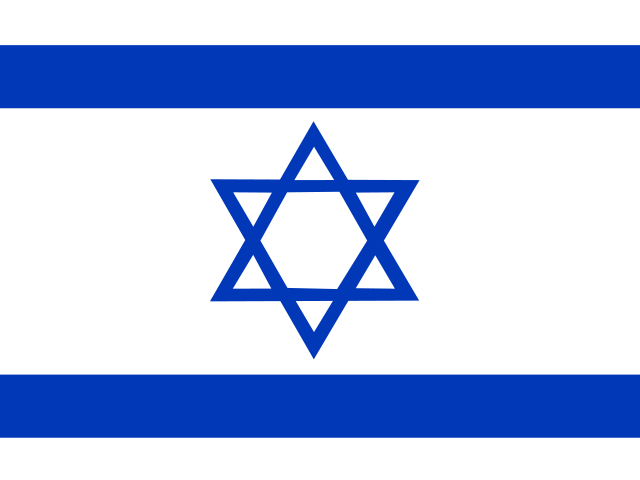
Flag of Israel
Travel guide

Learn Israel before you go

Mediterranean beaches, desert mountains and cities sacred to three faiths, in a country about the size of Wales.
Take the full trip
CapitalJerusalem
CurrencyIsraeli new shekel (₪)
Official languageHebrew. Arabic has a special status under a 2018 law, and English is widely understood
Drives on theRight
Calling code+972

10 phrases to learn

In Hebrew (Ivrit). Capital letters show the stressed part. Tap the heart to practise a phrase later.

Shalom
shah-LOHM
Hello, goodbye (literally: peace)
Greeting anyone at any time of day
Boker tov
BOH-ker TOHV
Good morning
Greeting someone in the morning
Erev tov
EH-rev TOHV
Good evening
Greeting someone in the evening
Laila tov
LIE-lah TOHV
Good night
Saying goodbye late in the evening
Ma nishma?
mah nish-MAH
How are you? What's new?
A friendly, informal greeting
Todah rabah
toh-DAH rah-BAH
Thank you very much
Thanking someone warmly
Bevakasha
beh-vah-kah-SHAH
Please; you're welcome
Asking for something, or answering a thank you
Slicha
slee-KHAH
Excuse me, sorry
Getting someone's attention or apologising
Ani lo mevin / mevina
ah-NEE loh meh-VEEN / meh-vee-NAH
I don't understand (said by a man / by a woman)
When you cannot follow what someone says
Ata medaber anglit? / At medaberet anglit?
ah-TAH meh-dah-BER ahng-LEET / aht meh-dah-BEH-ret ahng-LEET
Do you speak English? (to a man / to a woman)
Asking for help in English

At the table

  • Many restaurants in Jewish areas are kosher: they never serve meat and milk products in the same meal, so there is no cheese on a burger and often no milk for coffee after a meat meal.
  • Many kosher restaurants close from Friday afternoon until Saturday evening for Shabbat. Restaurants in Arab towns and many places in Tel Aviv stay open.
  • At a Friday evening dinner, wait for the host to say the blessing over the wine and the challah before you start eating.
  • Salads and dips come to the table first and are shared by everyone. Tear off a piece of pita and use it to scoop up hummus.
  • In Arab and Druze homes, guests are usually offered coffee or tea and something sweet. Accepting at least a little is polite.
  • If you are invited to a home, a small gift such as flowers, sweets or a bottle of wine is welcome. In a kosher home, choose something with a kosher label.

Local tips

Plan around Shabbat

In most cities, buses and trains stop on Friday afternoon and start again on Saturday evening, and many shops and kosher restaurants close. Taxis and some shared minibuses (sherut) still run. Book transport and shopping for Friday morning.

Sunday is a working day

The working week runs from Sunday to Thursday. Offices, banks and museums may have short hours on Friday and be closed on Saturday, so check opening times before you go.

Dress for holy places

At synagogues, churches and mosques, cover your shoulders and knees. Some sites lend wraps at the entrance, and men may be asked to cover their heads at the Western Wall.

Know the emergency numbers

Police 100, ambulance (Magen David Adom) 101, fire and rescue 102.

Bring the right plug

Israel uses 230 volts and its own three-pin Type H socket. Most modern sockets also take the two-pin European Type C plug.

Respect the desert heat

In the Negev and at the Dead Sea, carry plenty of water, wear a hat and start walks early in the morning. Summer temperatures often pass 40 °C.

Expect security checks

Bags are checked at the entrances of shopping centres, bus and train stations. At Ben Gurion Airport, allow extra time for questions before departure.

Check travel advice

As of September 2026, conditions in the region can change quickly. Before you travel, read your own government's current travel advice and follow the instructions of local authorities.

Dishes to try

  • Hummus (חומוס): A smooth purée of cooked chickpeas, tahini (sesame paste), lemon and garlic, spread on a plate with olive oil on top and scooped up with warm pita.
  • Falafel (פלאפל): Crisp deep-fried balls of ground chickpeas, herbs and spices. In Israel they are stuffed into a pita with salad, tahini sauce and pickles.
  • Sabich (סביח): A pita filled with fried aubergine slices, hard-boiled egg, chopped salad, hummus, tahini and amba, a tangy mango pickle.
  • Shakshouka (שקשוקה): Eggs gently cooked in a spicy sauce of tomatoes, peppers, onion and cumin, served in the pan with bread to dip. Israelis eat it for breakfast or a light supper.
  • Israeli salad (סלט ישראלי): Tomatoes and cucumbers cut into very small cubes, dressed with olive oil, lemon juice and salt. It is served with almost every meal, even breakfast.
  • Jachnun (ג'חנון): Thin layers of buttery dough rolled into logs and baked very slowly overnight until golden brown. It is eaten on Saturday morning with grated tomato, a hard-boiled egg and spicy zhug sauce.
  • Bourekas (בורקס): Flaky pastries filled with salty cheese, potato, spinach or mushrooms, often topped with sesame seeds. The shape often tells you the filling.
  • Challah (חלה): A soft, slightly sweet braided bread made with eggs. Two loaves are placed on the table for the Friday evening meal and on holidays.

Cities to see

  • Jerusalem (capital): The Old City, The Israel Museum, The Mahane Yehuda market.
  • Tel Aviv: The White City, Beaches and the seafront promenade, Old Jaffa.
  • Haifa: The Bahá'í Gardens, Mount Carmel, The port.
  • Acre: The Old City of Acre, Crusader halls, The fishing harbour.
  • Nazareth: The Basilica of the Annunciation, The old market, Arab sweets and coffee.
  • Tiberias: The Sea of Galilee, Hot springs, Fish from the lake.

Landmarks and the city map are on the Israel trip