World Stroll
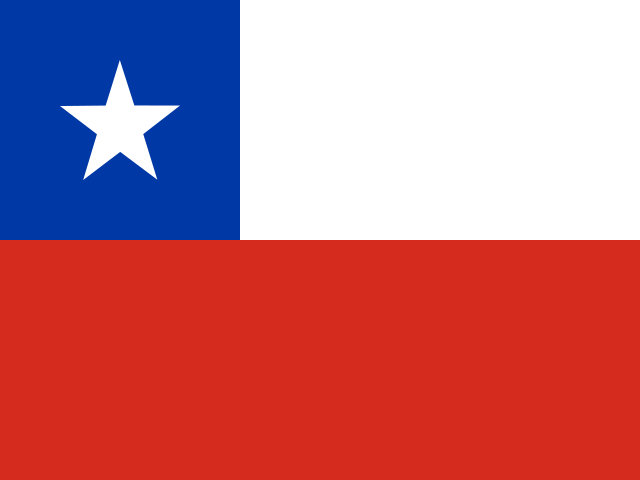
Flag of Chile
Travel guide

Learn Chile before you go

A ribbon of land more than 4,300 km long, from the driest desert on Earth to the glaciers of Patagonia, with the moai of Easter Island far out in the Pacific.
Take the full trip
CapitalSantiago
CurrencyChilean peso (CLP)
Official languageSpanish in practice: no law names an official language, but the constitution and all official documents are written in Spanish. Indigenous languages such as Mapudungun, Aymara and Rapa Nui are recognised in the areas where they are spoken
Drives on theRight
Calling code+56

10 phrases to learn

In Spanish. Capital letters show the stressed part. Tap the heart to practise a phrase later.

Buenos días
BWEH-nohs DEE-ahs
Good morning, hello
Greeting someone in the morning, until about noon
Buenas tardes
BWEH-nahs TAR-dehs
Good afternoon
Greeting someone from about noon until it gets dark
Buenas noches
BWEH-nahs NOH-chehs
Good evening, good night
Greeting someone after dark, or saying goodnight
Mucho gusto
MOO-choh GOOS-toh
Nice to meet you
When you are introduced to someone
Por favor
POHR fah-BOHR
Please
Asking for anything
Gracias
GRAH-syahs
Thank you
Any time someone helps you
De nada
DEH NAH-dah
You're welcome
Answering 'gracias'
Sí, por favor
SEE, POHR fah-BOHR
Yes, please
Accepting an offer. A bare 'sí' can sound rude
No, gracias
NOH, GRAH-syahs
No, thank you
Politely saying no to an offer
Con permiso
kohn pehr-MEE-soh
Excuse me, with your permission
Getting past someone, or leaving the table

At the table

  • If someone offers you something, say 'Sí, por favor' or 'No, gracias'. A bare 'sí' or 'no' sounds rude.
  • When you arrive at or leave a gathering, greet every person there. Men shake hands; with women, a light touch of the right cheeks is usual.
  • When you leave the table at a formal meal, it is polite to say 'Con permiso' (excuse me).
  • A tip of about 10 percent is customary in restaurants when the service is good, and some restaurants add it to the bill. Leaving no tip at all is seen as rude unless the service was very bad.
  • Burping at the table is considered very rude.

Local tips

Remember the seasons are reversed

Chile is in the Southern Hemisphere, so summer is from December to March and winter from June to August. Chilean families take their holidays from December to early March. Ski resorts in the Andes open from about June to October.

Protect yourself from the sun

Ultraviolet light in Chile is very strong, especially at midday from September to March. Use sunscreen and wear a hat, sunglasses and long sleeves, above all in the desert and the mountains.

Take the altitude seriously

San Pedro de Atacama is at about 2,400 m, and the El Tatio geysers are at 4,320 m. Altitude sickness is a risk: go slowly, drink plenty of water and ask your doctor for advice before you travel, especially if you have heart or lung problems.

Know what to do in an earthquake

All of Chile lies on the Pacific Ring of Fire and is prone to earthquakes and tsunamis. Modern buildings follow earthquake codes, and hotels give safety instructions: read them when you arrive.

Keep the emergency numbers

The emergency numbers in Chile are 131 for an ambulance, 132 for the fire brigade and 133 for the police (Carabineros). Do not expect the operator to speak English.

Watch your bag in busy places

Pickpockets work in central Santiago, Valparaíso, bus stations, airports and viewpoints. At Santiago airport, take a taxi only from the official booths inside the terminal.

Stay away from protests

Demonstrations in Santiago and other cities can turn violent, even when they start peacefully. Keep clear of them, especially around 11 September, the anniversary of the 1973 coup. Under Chilean law, foreigners who take part in or promote violent acts can be deported.

Tip about 10 percent

In restaurants a tip of about 10 percent is expected when the service is good. Sometimes it is already added to the bill, so check before you pay. At supermarkets it is usual to give a few hundred pesos to the person who packs your bags.

Dishes to try

  • Empanada de pino: Chile's best-loved pastry: a large baked turnover filled with pino, a mixture of minced beef and onion, with a piece of hard-boiled egg, a black olive and a few raisins. There are also fried empanadas filled with cheese.
  • Pastel de choclo: A summer corn pie. A layer of pino, the beef and onion filling, with chicken, olives, raisins and slices of hard-boiled egg is covered with a thick topping of fresh sweetcorn blended with basil and baked until golden.
  • Cazuela: A generous soup of beef or chicken with a big piece of potato, a slice of squash, a piece of corn on the cob, green beans and rice, sprinkled with coriander or parsley. Each diner gets one of every ingredient in a deep plate.
  • Curanto: A feast cooked in a pit in the ground. Stones are heated red hot in a fire, then covered with layers of clams, mussels and giant barnacles, meat, sausages, potatoes and potato dumplings called milcao and chapaleles, and sealed with large nalca leaves and turf.
  • Porotos granados: A thick summer stew of fresh cranberry beans, sweetcorn and squash, with onion and basil. It is often made without meat.
  • Humitas: Fresh sweetcorn ground to a paste with onion, basil and butter, wrapped in corn husks, tied with string and boiled or baked. Chileans eat them with a little sugar or with a fresh tomato salad.
  • Charquicán: A hearty home-style stew of potatoes, pumpkin, corn and onion mashed together with beef, usually topped with a fried egg. It was first made with dried meat called charqui.
  • Completo: The Chilean hot dog, much bigger and more loaded than the American one. The favourite version, the completo italiano, is topped with chopped tomato, mashed avocado and mayonnaise.

Cities to see

  • Santiago (capital): La Moneda Palace and the Plaza de Armas, San Cristóbal Hill and its statue of the Virgin Mary, The foothills of the Andes on its eastern edge.
  • Arica: The Morro de Arica headland, Chinchorro mummies, A summer beach destination for Chileans.
  • Iquique: A free trade zone for shopping, The ghost saltpetre towns of Humberstone and Santa Laura, Summer beach holidays.
  • San Pedro de Atacama: Its whitewashed adobe church, Stargazing in very clear, dry air, The Gustavo Le Paige archaeological museum.
  • Valparaíso: A historic quarter listed by UNESCO, The ascensores that climb the hills, One of Pablo Neruda's three houses.
  • Concepción: The University of Concepción, Industry and a busy student life, Its people are called penquistas.

Landmarks and the city map are on the Chile trip