World Stroll
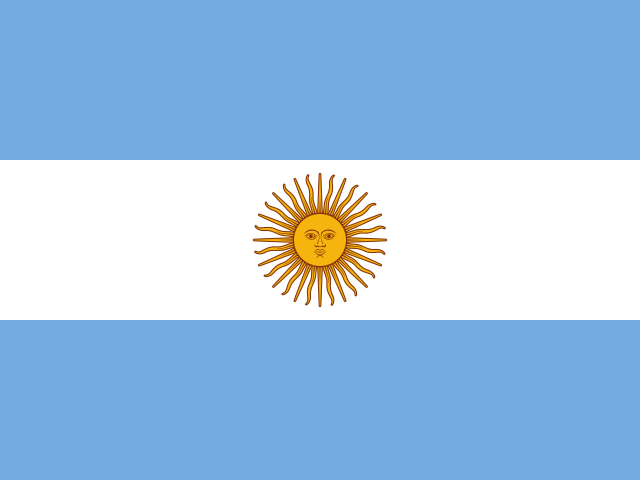
Flag of Argentina
Travel guide

Learn Argentina before you go

Tango and football, glaciers and giant waterfalls, the highest mountain in the Americas and a grill that never seems to go cold.
Take the full trip
CapitalBuenos Aires
CurrencyArgentine peso (ARS)
Official languageSpanish in practice: the national constitution does not name an official language. Guaraní is also official in the province of Corrientes, and Qom, Moqoit and Wichí in Chaco
Drives on theRight
Calling code+54

10 phrases to learn

In Spanish (Argentine, Rioplatense). Capital letters show the stressed part. Tap the heart to practise a phrase later.

Buenos días
BWEH-nohs DEE-ahs
Good morning, hello
Greeting someone in the morning, until about noon
Buenas tardes
BWEH-nahs TAR-dehs
Good afternoon
Greeting someone from about noon until it gets dark
Buenas noches
BWEH-nahs NOH-chehs
Good evening, good night
Greeting someone after dark, or saying goodnight
¿Cómo andás?
KOH-moh ahn-DAHS
How are you doing?
A friendly, everyday greeting. Argentines say 'vos' for 'you', so the verb ends in -ás
Mucho gusto
MOO-choh GOOS-toh
Nice to meet you
When you are introduced to someone
Me llamo...
meh SHAH-moh
My name is...
Introducing yourself. In Buenos Aires the 'll' sounds like 'sh'
¿Hablás inglés?
ah-BLAHS een-GLEHS
Do you speak English?
Before asking for help
No entiendo
noh ehn-TYEHN-doh
I don't understand
When someone speaks too fast
¿Me podés ayudar?
meh poh-DEHS ah-shoo-DAR
Can you help me?
Asking a stranger for help
¿Cuánto cuesta?
KWAHN-toh KWEHS-tah
How much is it?
Asking the price in a shop or market

At the table

  • Dinner is late. In Buenos Aires many restaurants serve dinner from about 8 in the evening, and the busiest time is from about half past nine.
  • At an asado, the asador is the star. It is polite to thank and praise the cook before the meal is over.
  • If you are offered mate, drink the whole gourd through the straw and hand it back to the person serving. Do not stir the straw, and only say 'gracias' when you have had enough: it means 'no more for me'.
  • Waiters do not bring the bill until you ask. Say 'La cuenta, por favor'.
  • The 'cubierto' on the bill is a cover charge for bread and table service. It is not a tip.
  • A tip of about 10 percent is usual for good service. Leave it in cash if you can, because card machines often have no space for a tip.

Local tips

Remember the seasons are reversed

Argentina is in the Southern Hemisphere, so summer is December to February and winter is June to August. Patagonia is best visited from about October to April; the north is pleasant in winter. Pack for wind in Patagonia at any time of year.

Fly across the big distances

Argentina is huge: Buenos Aires to Ushuaia is more than 2,000 km as the crow flies. Domestic flights save days of travel, but they can be delayed or cancelled, so check before you go to the airport and leave spare time between connections.

Watch your bag in Buenos Aires

Pickpockets work on public transport, at bus and train stations and in busy areas such as San Telmo, Florida Street and around the Obelisk. In La Boca, stay in the Caminito tourist area. If a stranger sprays something on you and offers to clean it, politely refuse help and walk away: it is a known trick to steal bags.

Use radio taxis or book ahead

Book taxis in advance, or ask your hotel to call one. If you take a taxi in the street, use a 'radio taxi' with the company's logo on the doors.

Take it slowly at altitude

Parts of the northwest are very high: the railway of the Train to the Clouds climbs to more than 4,200 m, and altitude sickness is a risk there. Rest on your first day, drink water and go easy on alcohol. If you have heart or breathing problems, ask your doctor before you go.

Carry some cash for tips

A tip of about 10 percent is usual in restaurants for good service. Card machines often have no space for a tip, so keep some pesos in small notes. The 'cubierto' on the bill is a cover charge, not a tip. Prices and exchange rules change often: check the latest advice before you travel.

Bring your passport to Iguazú

The Iguazú Falls can be seen from both Argentina and Brazil. Crossing to the Brazilian side means passing through border control, so take your passport and check whether you need a visa for Brazil.

Get good travel insurance

Make sure your insurance covers medical treatment and evacuation. For mountain trips, including Aconcagua, check that it covers helicopter rescue: visitors usually have to pay for it.

Dishes to try

  • Asado: The Argentine barbecue, and a social event as much as a meal. Beef ribs, steaks, chorizo sausages, black pudding (morcilla) and other cuts are cooked slowly over wood embers on a grill called a parrilla. The person in charge of the fire is the asador, and the meal can last all afternoon.
  • Chimichurri: An uncooked green sauce of finely chopped parsley, garlic, oregano, chilli, oil and vinegar, spooned over grilled meat.
  • Empanadas: Half-moon pastries with a savoury filling, baked or fried and eaten with your hands. In Salta they are small, juicy and spicy, with potato; in Tucumán they are often made with beef cut by knife; in La Rioja the filling can include egg, olives and raisins. Each filling has its own pattern of folds on the edge, the repulgue.
  • Choripán: A grilled chorizo sausage of beef and pork, split open and served in a crusty roll, usually with chimichurri. It is often the first thing to come off the grill at an asado.
  • Provoleta: A thick round slice of provolone-style cheese, grilled until it is crisp outside and soft inside, then sprinkled with oregano and chilli. It is a favourite starter at an asado.
  • Milanesa: A thin slice of beef or chicken, dipped in egg and breadcrumbs and fried or baked. It is one of the most common home meals in Argentina, served with chips, mashed potatoes or salad, or in a sandwich.
  • Locro: A thick, warming stew of white corn, beans, squash and meat, simmered for hours. Its name comes from the Quechua word ruqru.
  • Humita: Fresh sweetcorn, grated to a cream and cooked with onion, squash, spices and sometimes cheese. It is eaten from a pot (humita a la olla) or wrapped and steamed in corn husks (humita en chala).

Cities to see

  • Buenos Aires (capital): Tango, born in its working-class neighbourhoods, The Plaza de Mayo and the pink Casa Rosada, Cafés, bookshops and the Teatro Colón opera house.
  • Córdoba: The Jesuit Block, a UNESCO World Heritage Site, A lively student life, Weekend trips to the Sierras de Córdoba.
  • Rosario: The National Flag Memorial, Riverside parks and beaches on the Paraná, Art Nouveau and Art Deco buildings.
  • Mendoza: Malbec wine and vineyard visits, Views of the snowy Andes, San Martín's army set out from here in 1817.
  • San Miguel de Tucumán: The House of Tucumán, where independence was declared, Empanadas, Green hills and sugar cane fields.
  • Salta: Colonial buildings around the 9 de Julio square, Small, spicy empanadas salteñas, The Train to the Clouds, reached by bus from the city.

Landmarks and the city map are on the Argentina trip